AArchTune — Quality-Gated GGUF Optimization for Native Arm64
Challenge track: Cloud AI
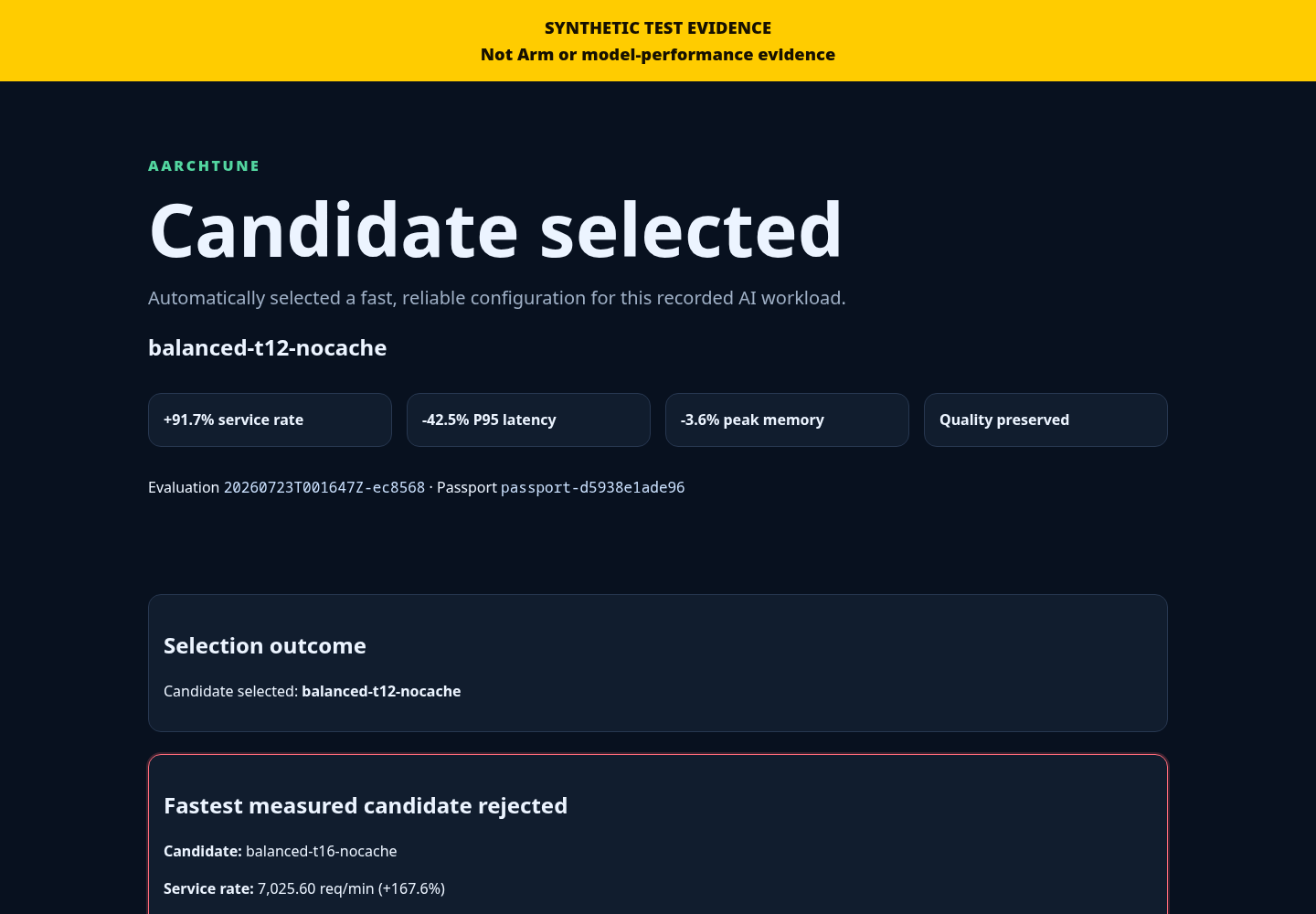
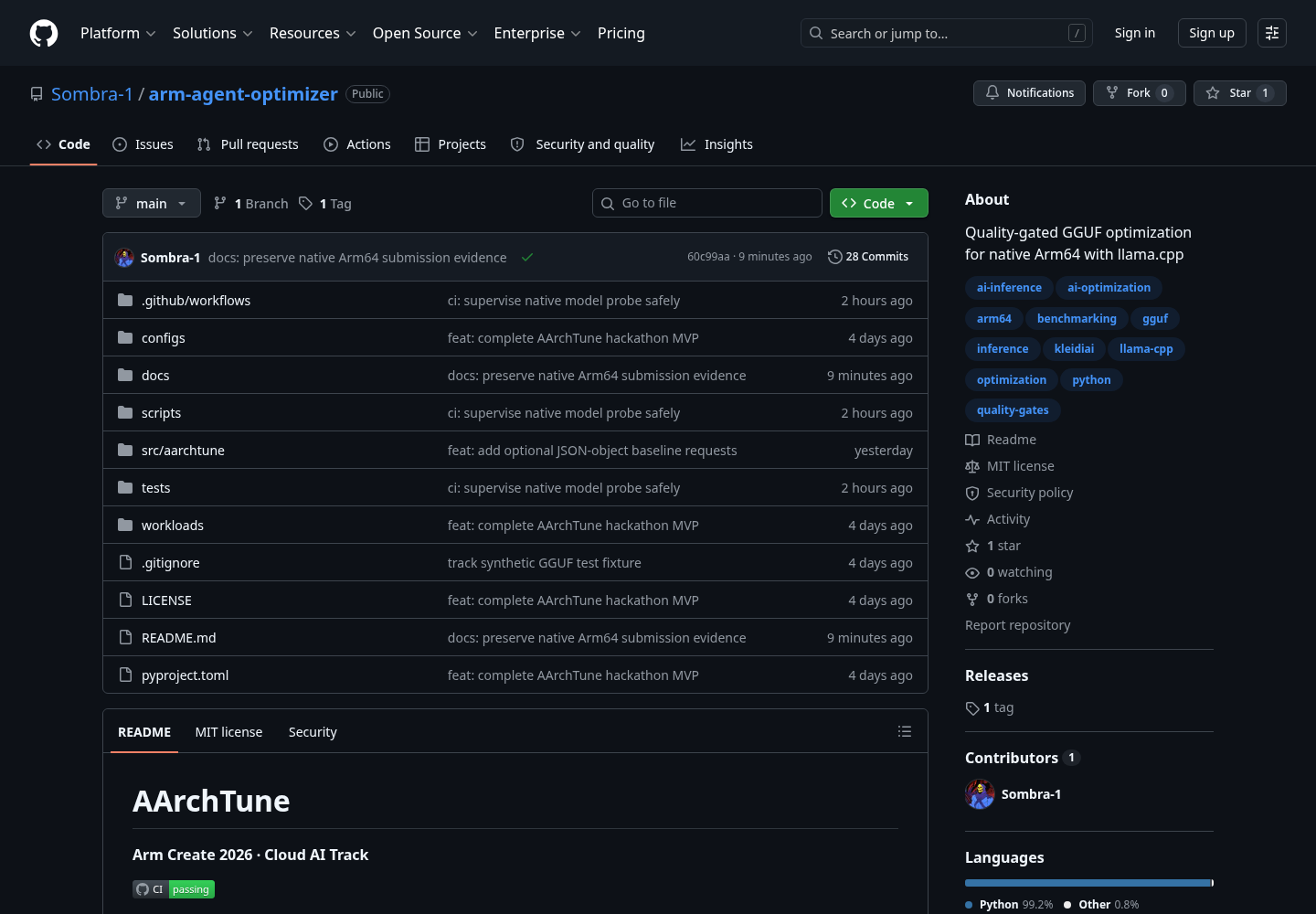
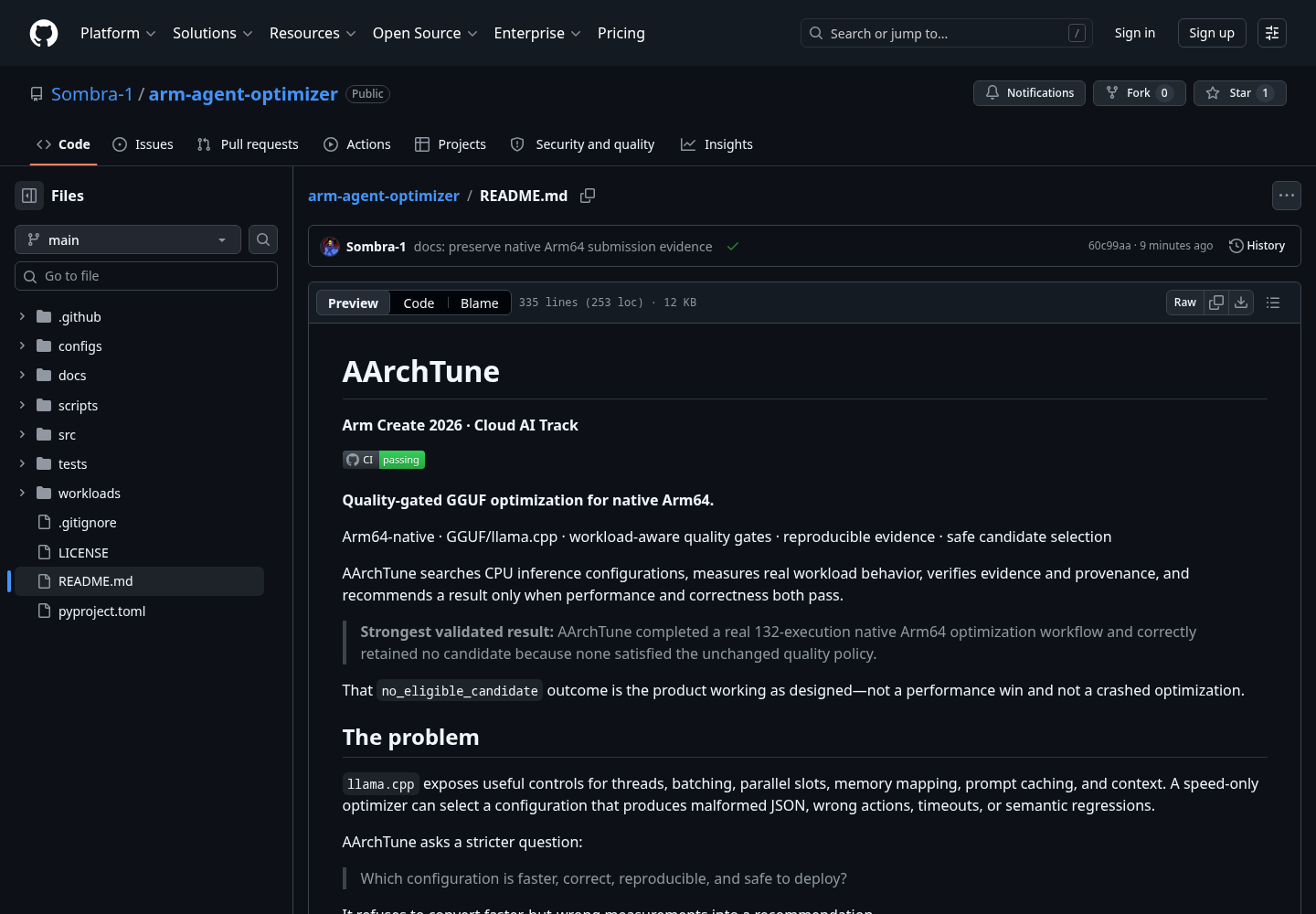
One-line description: AArchTune searches native Arm64 inference configurations and recommends a result only when performance, correctness, provenance, and repeatability all pass.
Inspiration
Most inference optimizers ask which configuration is fastest. That is not enough for an agent or structured-output workload: a faster server can still return malformed JSON, choose the wrong action, time out, or violate a safety constraint.
AArchTune began with a stricter question:
Which configuration is faster, correct, reproducible, and safe to deploy?
What it does
AArchTune is an open-source, local-first optimizer for GGUF inference with
llama.cpp on Linux Arm64. It:
- detects hardware, topology, memory, and runtime capabilities;
- measures a fixed real-workload baseline;
- creates a deterministic bounded candidate plan;
- screens duplicate low-level signatures;
- evaluates advanced profiles against the real workload;
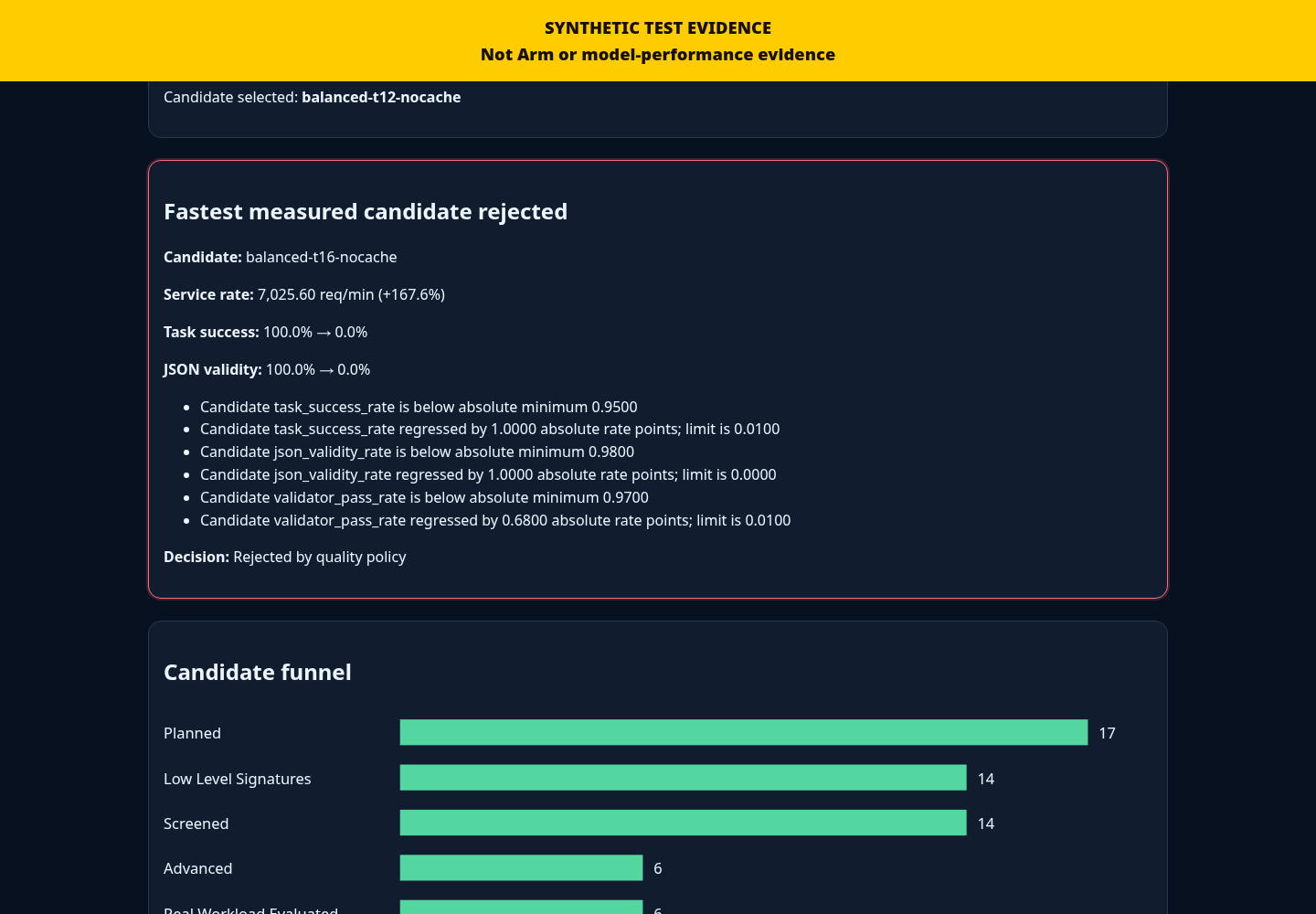
- applies absolute and baseline-relative quality gates;
- validates temporal drift;
- selects an eligible candidate or records why no candidate is safe; and
- creates a verifiable Optimization Passport, report, and deployment bundle.
It tunes runtime configuration. It does not train or modify the model.
How it works
The pipeline is:
hardware detection → runtime discovery → baseline → candidate plan
→ screening → native measurement → workload validators → eligibility gate
→ drift validation → selection or baseline retention → Passport
Performance ranking happens only after evidence completeness and workload quality pass. Failed candidates keep diagnostic evidence but cannot enter final ranking.
What was optimized and measured
The baseline workflow AArchTune replaces is manual, speed-first configuration testing: benchmark several llama.cpp settings, keep the fastest number, and document the environment afterward. That approach repeats equivalent low-level configurations and can promote output that is fast but wrong.
AArchTune changes that workflow in four concrete ways:
- hardware facts constrain a deterministic candidate plan;
- low-level signatures are deduplicated before expensive workload evaluation;
- quality and drift gates run before performance ranking; and
- every decision is bound to reusable provenance and validation artifacts.
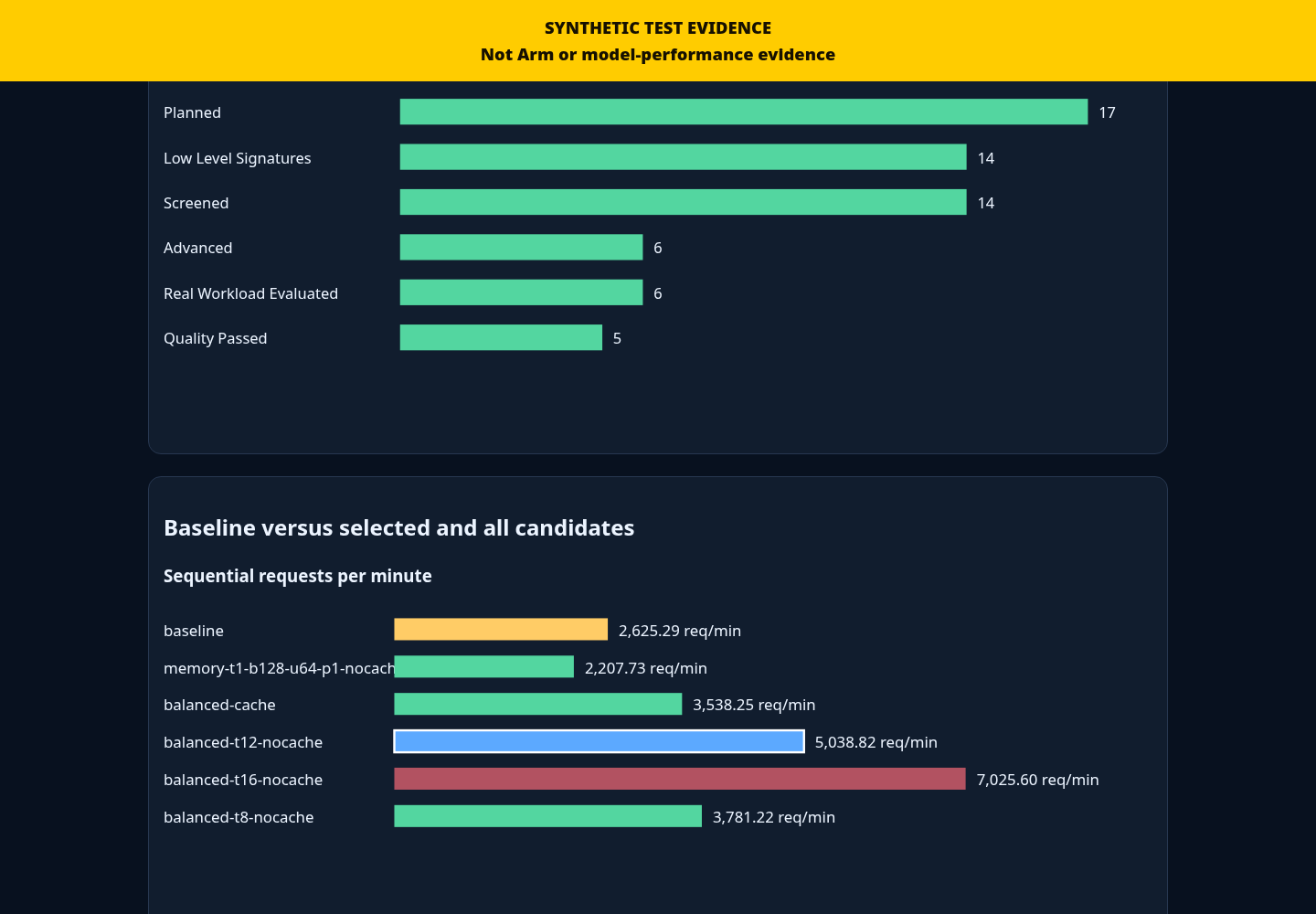
The completed native run measured the resulting optimization funnel: 132
screening executions completed, producing 11 distinct low-level signatures, and
only four profiles advanced to expensive real-workload evaluation. None passed
the unchanged quality policy, so the system correctly emitted
no_eligible_candidate.
This is measurable developer-workflow and decision-quality evidence, not an end-to-end inference speedup claim. It shows which repetitive work was automated, which candidates reached the expensive stage, and why an unsafe recommendation was avoided.
How Arm technology is used
Real optimization requires native Linux AArch64. AArchTune records Arm CPU features, physical/logical core topology, NUMA layout, available memory, and runtime-supported flags. Candidate generation uses those facts rather than assuming that maximum threads, larger batches, mmap changes, caching, or parallel requests are always beneficial.
Native validation ran on GitHub-hosted ubuntu-24.04-arm with four Arm
Neoverse-N2 cores and CPU-only llama.cpp. The workflow pinned llama.cpp release
b10106 to immutable commit
1425386fd996511e1f3295e7366c38289a92a271.
KleidiAI was compiled into the pinned llama.cpp build. During the Qwen2.5-1.5B Q4_K_M native smoke, llama.cpp reported that q4_K tensors had no KleidiAI kernel and were not accelerated; available kernels were reported for Q4_0 and Q8_0. No end-to-end KleidiAI runtime speedup is claimed for this tested model, and no general conclusion is made about other tensor formats or hardware.
Quality and reliability
The default policy requires at least:
- 0.98 request success;
- 0.95 task success;
- 0.98 JSON validity;
- 0.97 validator pass rate; and
- 0.98 completed evidence.
It also limits timeouts, baseline-relative regression, critical-validator failures, and start/end baseline drift. A fast configuration that fails these checks is ineligible.
The strongest native result demonstrates this safety behavior. AArchTune
completed all 132 configured candidate executions, deduplicated them into 11
signatures, advanced four profiles to real-workload evaluation, and returned
no_eligible_candidate because every evaluated profile failed the unchanged
quality policy.
That is not a successful performance optimization. It is a successful refusal to deploy a faster-but-incorrect configuration.
Technical architecture
AArchTune uses typed Pydantic artifacts, deterministic stage boundaries, SHA-256 provenance, isolated process groups, bounded output/timeouts, loopback server binding, network-disabled JSON Schema resolution, time-isolated declarative validators, and resumable orchestration that trusts only revalidated completed stages.
The final bundle includes:
- a canonical Optimization Passport;
- stage and bundle hashes;
- quality decisions and rejection reasons;
- drift evidence;
- a self-contained report with no network dependencies;
- a selected configuration only when eligible; and
- safe reproduction/deployment files or an explicit unavailable result.
Raw responses, server logs, model weights, caches, environment dumps, and credentials are excluded from reviewed public evidence.
Challenges
The main challenge was separating three kinds of truth:
- low-level performance evidence;
- application-quality evidence; and
- evidence completeness and provenance.
The native smoke completed but found no quality-eligible candidate. Later Qwen quality prechecks improved aggregate quality over the 1.5B model but still failed policy. Two final Mistral attempts lost the shared hosted runner during CPU loading before inference, so Mistral quality remains unknown. The project records that as incomplete evidence rather than inventing an OOM or quality conclusion.
Accomplishments
- Completed a real 132-execution optimization workflow on native Arm64.
- Correctly returned
no_eligible_candidateunder the unchanged quality policy. - Verified immutable runtime, model, source-model, license, workload, and policy provenance.
- Implemented baseline-relative quality gating, drift checks, deterministic planning, safe process ownership, and candidate eligibility controls.
- Built validated final bundles and canonical Optimization Passports.
- Kept native evidence visibly separate from synthetic product-behavior tests.
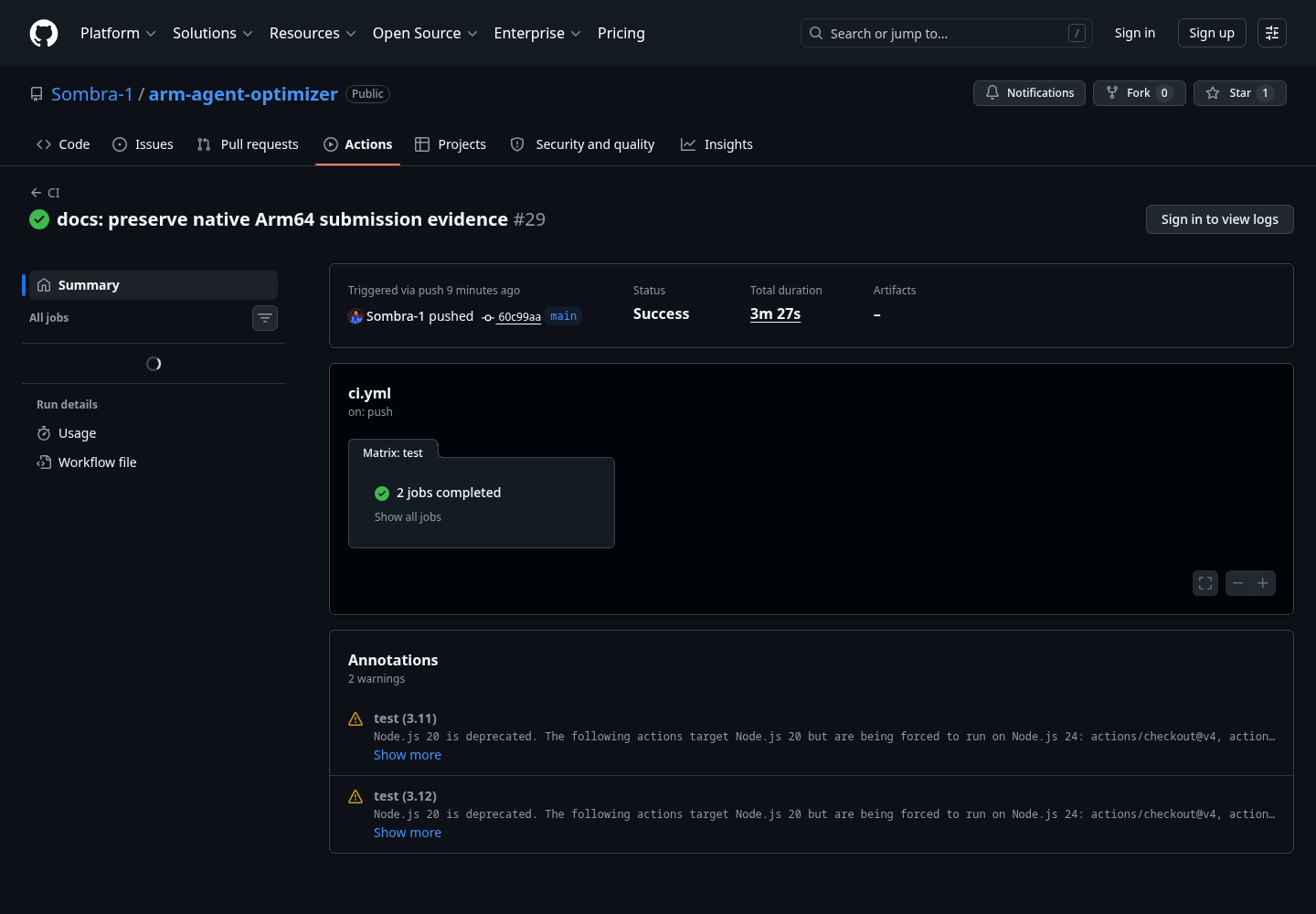
- Passed 518 automated tests with 90% aggregate coverage, strict MyPy, Ruff, and Python 3.11/3.12 CI.
What we learned
- Request success does not imply application correctness.
- Scaling the tested Qwen model from 7B to 14B did not change this workload's aggregate quality result.
- Plain JSON-object mode did not change the tested Qwen 7B aggregate result.
no_eligible_candidateis an important production safety state, not an error to hide.- Missing evidence must stay missing: hosted-runner shutdown does not prove model failure, Arm incompatibility, or OOM.
- Reproducibility requires hashes, provenance, stage validation, and drift evidence—not just a benchmark screenshot.
Limitations
- Native results come from an ephemeral shared runner.
- One full native optimization smoke is not repeatability proof.
- Tested Qwen configurations did not satisfy the workload quality policy.
- Mistral quality was not measured because the hosted runner was lost before baseline inference.
- KleidiAI build integration is proven; the tested Q4_K tensors had no KleidiAI kernel, and no end-to-end runtime speedup is claimed.
- Sequential service rate is not concurrent-client throughput.
- No candidate is claimed as production-optimal.
- No performance speedup is claimed.
What is next
The project and final demo video are published. Native performance experimentation remains frozen for this submission.
Future work after submission may add repeated measurements on dedicated Arm hardware, broader Arm server families, more representative workloads, concurrent-client testing, and stronger runtime-level acceleration evidence. Those would be new validation campaigns, not retroactive claims about the current runs.
Built with
- Python 3.11/3.12
- Typer
- Pydantic
llama.cpp- GGUF models
- Linux AArch64
- GitHub-hosted Arm runners
- KleidiAI build integration
- pytest, Ruff, MyPy, JSON Schema, and Rich
- GitHub Actions
Repository and evidence
- Repository: https://github.com/Sombra-1/arm-agent-optimizer
- License: MIT
- Final validation report: https://github.com/Sombra-1/arm-agent-optimizer/blob/main/docs/FINAL_VALIDATION_REPORT.md
- Demo script: https://github.com/Sombra-1/arm-agent-optimizer/blob/main/docs/DEMO_SCRIPT.md
- Submission checklist: https://github.com/Sombra-1/arm-agent-optimizer/blob/main/docs/SUBMISSION_CHECKLIST.md
- Permanent native evidence: https://github.com/Sombra-1/arm-agent-optimizer/blob/main/docs/evidence/README.md


Log in or sign up for Devpost to join the conversation.