Inspiration
AI agents are becoming a big part of modern applications, but as they become more complex, managing their performance, security, and efficiency becomes harder. We wanted to build a system that could sit between an application and AI models and help make every request more efficient. This idea led us to AAPO — AI Agent Performance Optimizer.
What it does
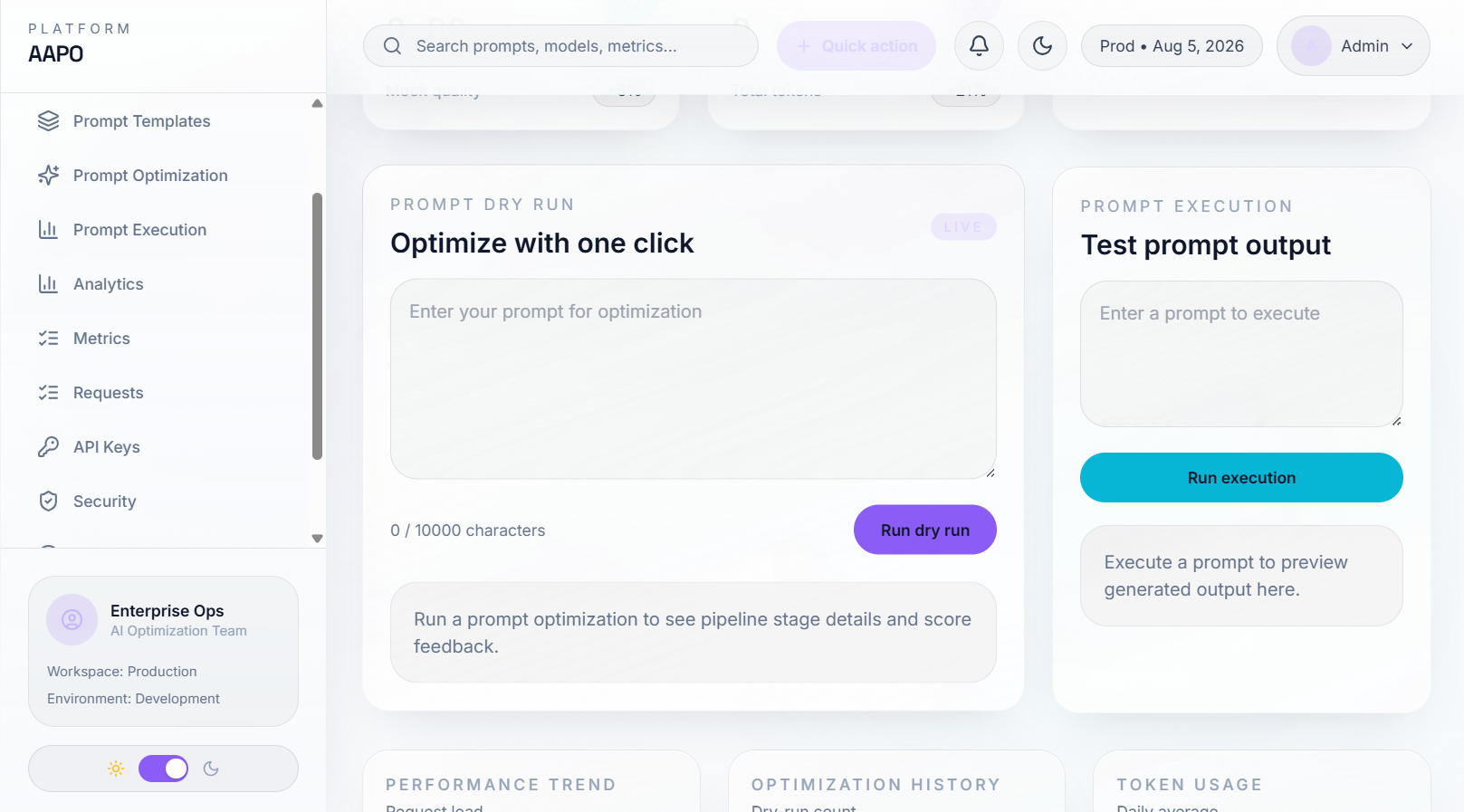
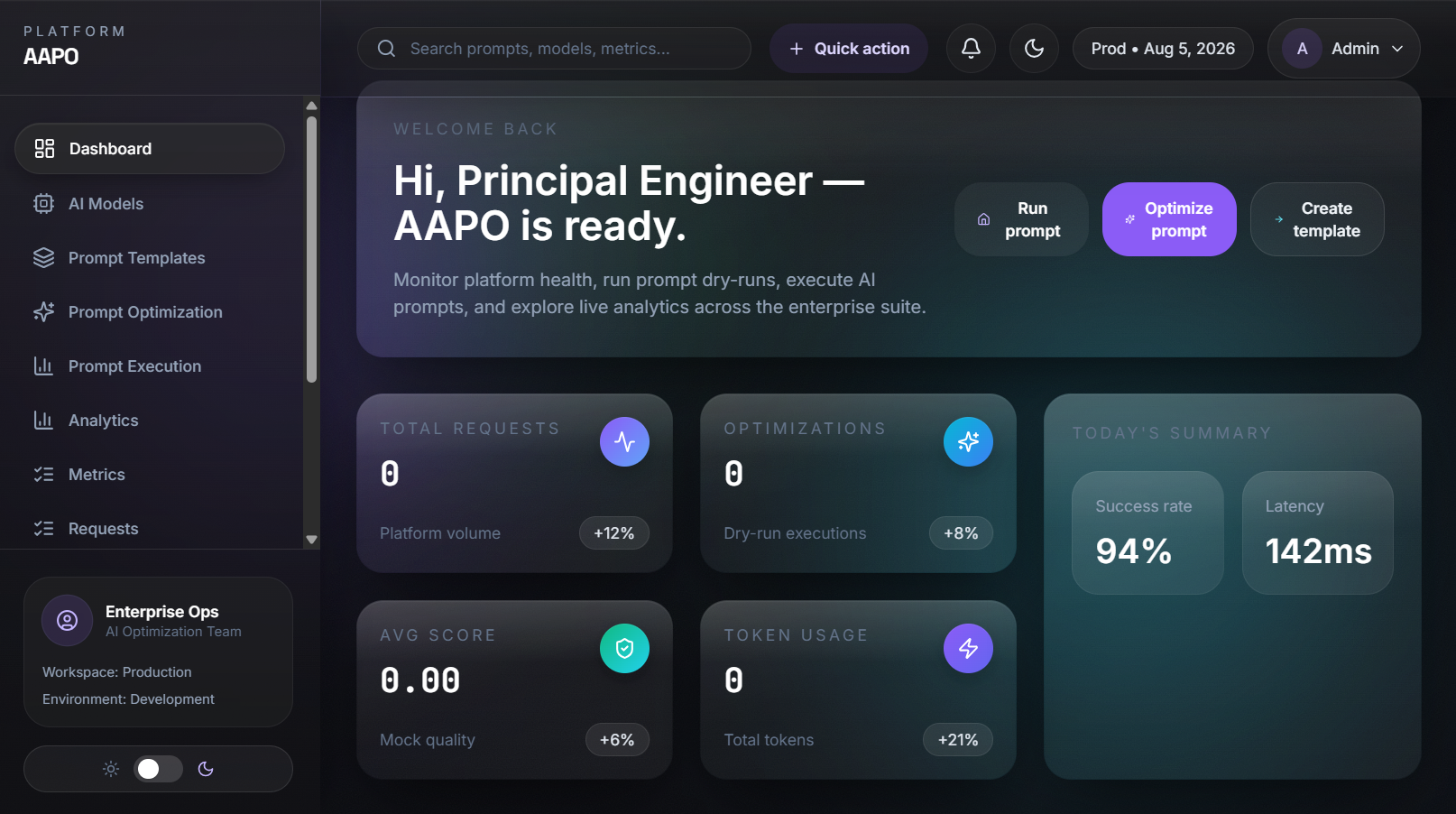
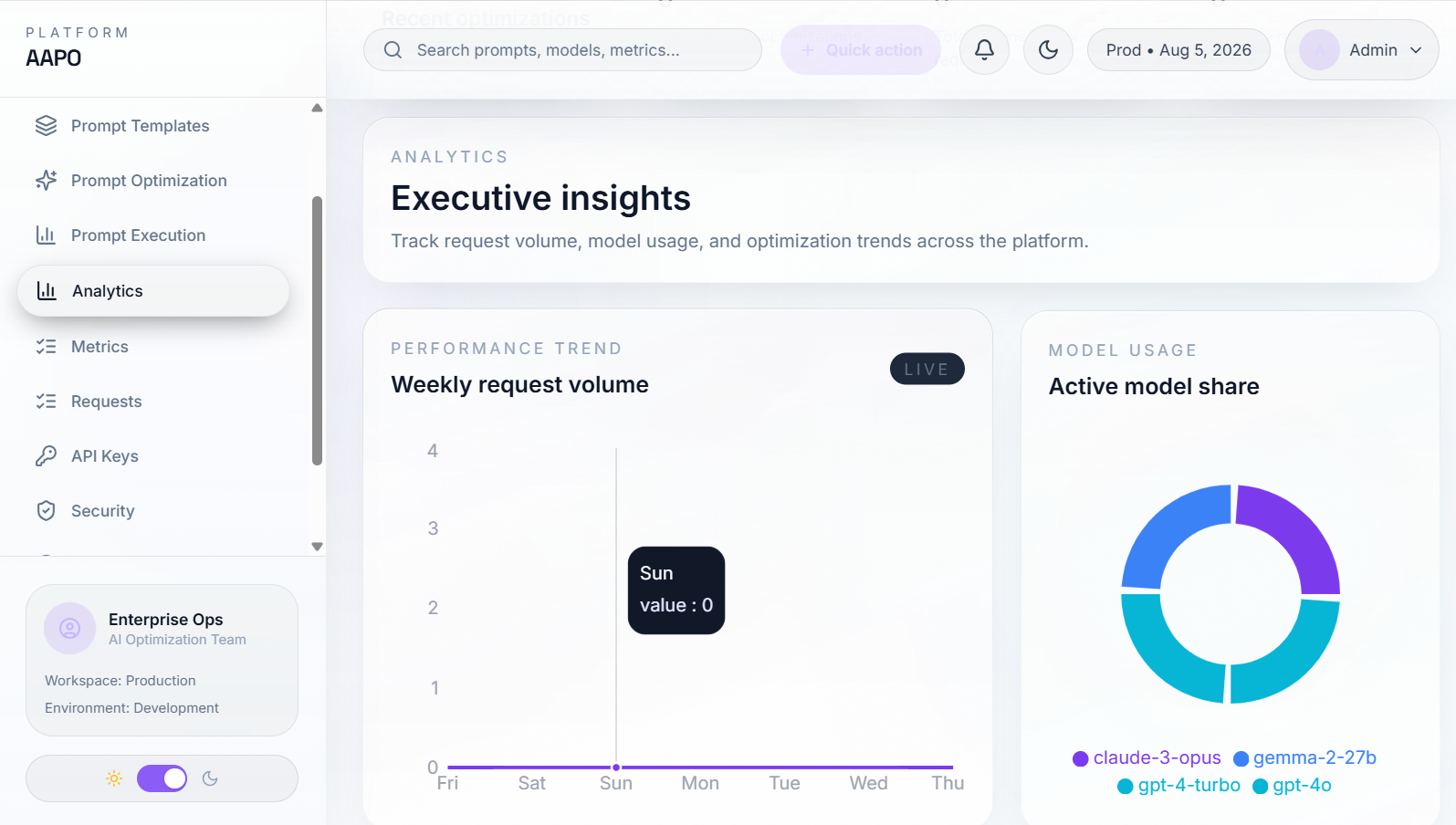
AAPO works as a middleware layer for AI applications. It provides secure API access, API-key management, request tracking, security checks, and performance monitoring.
The platform also includes an optimization pipeline that can be extended with real AI models. The current version uses a dry-run optimization flow as a foundation for future AI-powered optimization.
How we built it
We built the backend using Python and FastAPI, with PostgreSQL for persistent data and Redis for caching and fast-access data. The frontend is built with React, TypeScript, Vite, and Tailwind CSS.
We designed the system in separate layers for APIs, services, repositories, security, database models, metrics, and the optimization pipeline. We also used Docker and Docker Compose to simplify development and deployment.
Challenges we ran into
One of our biggest challenges was designing the architecture so that we could add new AI capabilities later without rebuilding the entire system.
We also had to bring together authentication, API keys, security checks, request tracking, performance metrics, and the optimization pipeline while keeping the code organized and maintainable.
Another challenge was avoiding tight dependency on a single AI model. We designed the optimization pipeline to be flexible so that real LLM integrations can be added as the project grows.
Accomplishments that we're proud of
We are proud that AAPO is more than just an AI demo. We built a strong foundation for an AI-agent optimization platform, including authentication, API-key management, security checks, request tracking, performance metrics, database models, a frontend, and an optimization pipeline.
We also focused on making the architecture modular and scalable, so new AI models and optimization techniques can be added without changing the core system.
What we learned
This project taught us that building reliable AI systems is about much more than connecting an application to an LLM. Security, monitoring, performance, scalability, and architecture are equally important.
We also gained practical experience with FastAPI, React, PostgreSQL, Redis, Docker, API design, authentication, database modeling, and performance monitoring.
What's next for AAPO — AI Agent Performance Optimizer
AAPO is still at an early stage, and there is a lot more we want to build. Our next steps are to integrate real LLMs and add prompt optimization, context compression, intelligent model routing, vector search, tool routing, and continuous learning.
Our long-term vision is for AAPO to automatically analyze each AI request and determine the most efficient way to process it while balancing performance, quality, security, and cost.
Built With
- alembic
- compose
- css
- docker
- fastapi
- postgresql
- pytest
- python
- react
- redis
- rest
- sqlalchemy
- tailwind
- typescript
- vite

Log in or sign up for Devpost to join the conversation.