Inspiration
Every year, billions of dollars in food, shelter, and healthcare benefits go unclaimed, not because people don't need them, but because the system is too fragmented and overwhelming to navigate during a crisis. We watched someone spend three hours on hold trying to find a food bank after losing their job. Aanya exists so that never happens again.
What it does
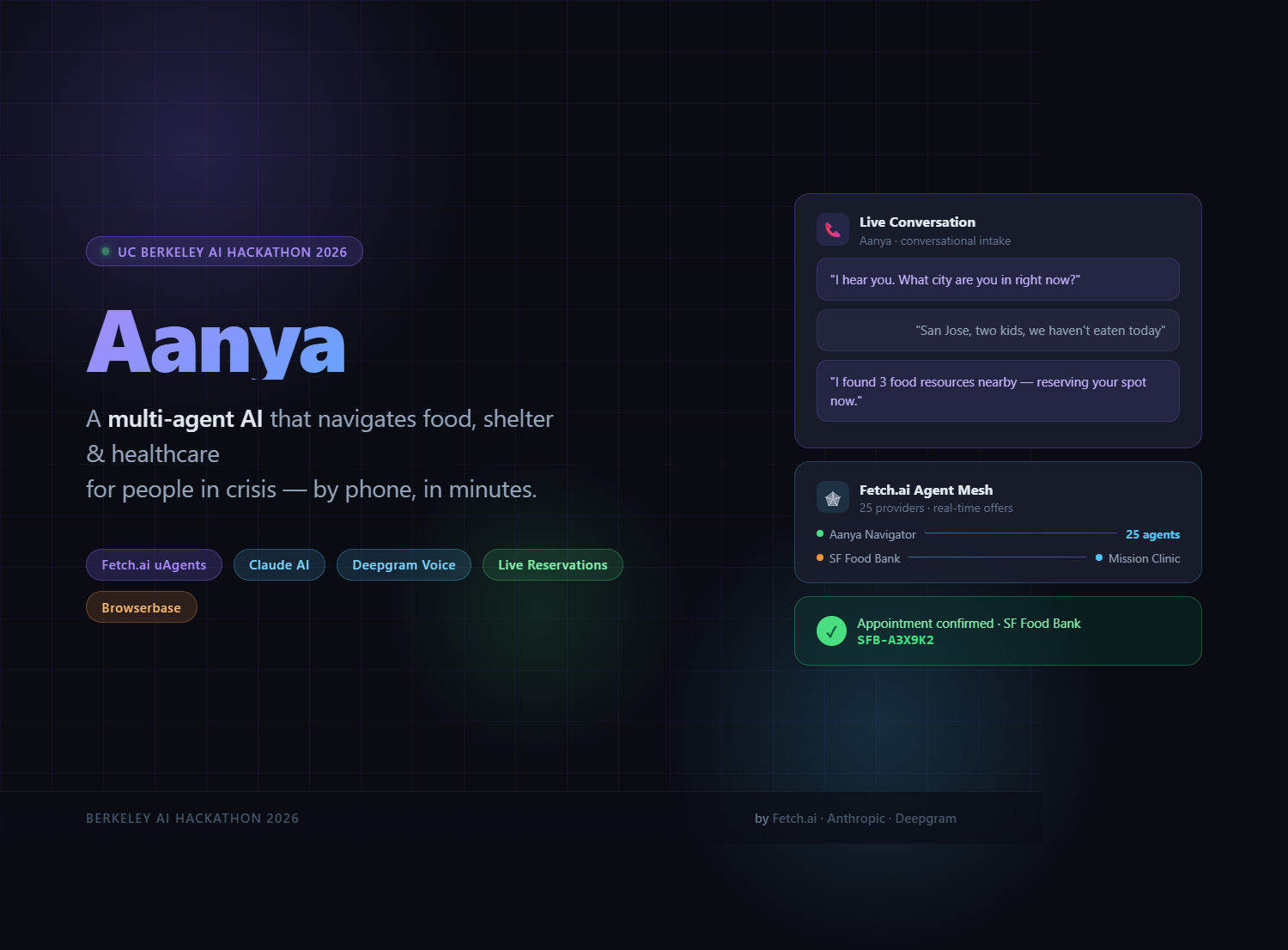
Aanya is a voice-first AI resource navigator that acts like a knowledgeable friend who happens to know every food bank, shelter, and clinic near you. You call in, describe your situation in plain language, and Aanya has a real conversation to understand your needs and then dispatches a network of AI provider agents to find available resources, presents you with matched options, and reserves your spot instantly. No forms, no hold music, no wrong transfers. By the time the call ends, your appointment is booked and the paperwork is being auto-filled in the background.
How we built it
We built a multi-agent mesh using Fetch.ai uAgents, Aanya is the central navigator agent, and each service provider (food banks, shelters, clinics) runs its own agent that registers on the mesh, responds to resource requests, and confirms reservations in real time. Claude powers two things: a multi-turn conversational intake that asks warm, targeted questions before searching, and empathetic spoken responses throughout the call. Deepgram Aura handles all voice synthesis. The caller experience is a phone-call-style UI where the user can speak or type, choose from offer cards with a click or their voice, and receive a confirmation card with a reference code. Browserbase auto-fills program intake forms in the background once a reservation is confirmed.
Challenges we ran into
Getting a multi-agent system to behave correctly across process boundaries was the hardest part, coordinating Fetch.ai's Bureau, a FastAPI dashboard, and a browser UI with no shared memory required a file-based IPC layer that each component polls independently. We also had to stop Claude from over-inferring needs from vague inputs ("hi, I need help" was matching food banks immediately) which was solved by replacing single-shot intake with a multi-turn conversation that waits until it has location and at least one explicit need before searching. We also faced difficulties in getting the Browserbase setup as the government forms were getting killed by the website's automatic bot detectors.
Accomplishments that we're proud of
The full end-to-end spine works: a person can call in with nothing but a vague description, have a real conversation with Aanya, choose from live provider offers by speaking or tapping, and receive a confirmed reservation with a reference code, all in under two minutes. The multi-agent mesh genuinely runs: provider agents register, respond to broadcasts, and send confirmations through Fetch.ai's messaging layer, not mocks.
What we learned
Conversational AI for crisis situations requires a very different design discipline than chatbots: latency matters, warmth matters, and never making someone repeat themselves matters. We also learned that multi-agent architectures are most powerful when each agent has a narrow, well-defined contract; the complexity lives in the orchestration, not in any single agent.
What's next for Aanya Real provider onboarding with a live slot-count dashboard, work with real-time data, SMS confirmation, multilingual support (Spanish intake is one voice model swap away), and a mobile app so callers don't need a browser. Long-term: letting providers push real-time availability into the mesh so Aanya always knows what's actually open before she promises a spot.
Built With
- browserbase
- deepgram
- fastapi
- fetch.ai
- javascript
- python
- redis

Log in or sign up for Devpost to join the conversation.