-
-
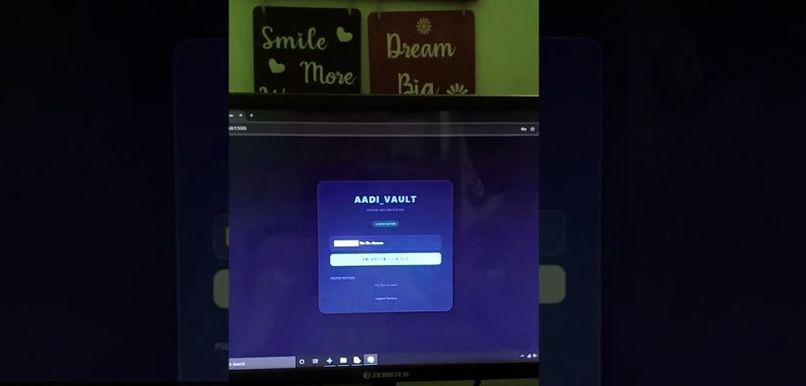
Normal imageplaced on Google
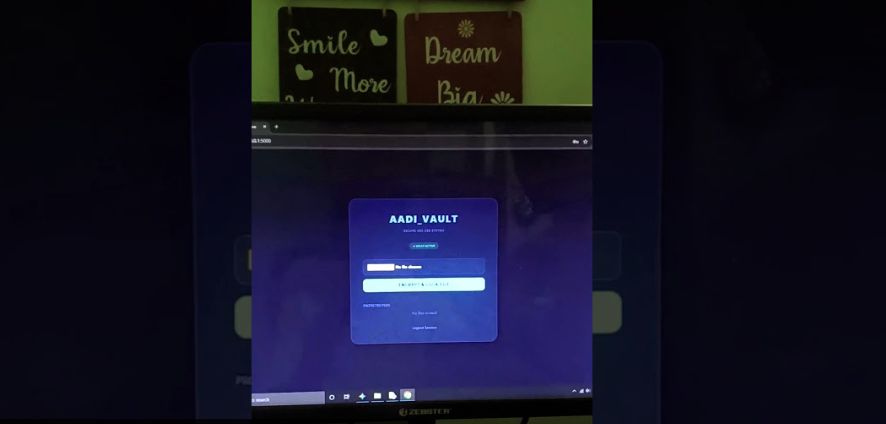
🚀 Aadi-Vault: AI-Powered Local Security Station
Inspiration
The inspiration comes from a growing concern over data privacy in the age of Cloud-AI. Most AI tools today require users to upload sensitive information to remote servers, creating a "security vs. utility" trade-off. I wanted to build a solution where the user remains the absolute master of their data. Inspired by the "Digital Conservation Theorem," I envisioned a world where intelligence and security coexist locally—right in the browser.
What it does
Aadi-Vault is an AI-powered local security station. It acts as a private sanctuary for developers and students to store encrypted code, notes, and sensitive files. Unlike traditional vaults, it integrates a Serverless Neural Engine that allows users to analyze, debug, and query their data using AI—without a single byte ever leaving their device. It turns your browser into a self-sustained, secure computing environment.
How we built it
The core engine is built using Transformers.js to run LLMs (like Qwen and Phi-3) directly in the browser via WebAssembly and WebGPU.
- Frontend: Crafted with a high-end "Cyber-Dark" UI using HTML5, CSS3, and modern Glassmorphism.
- Storage: We used IndexedDB for the local database to handle large neural model weights.
- Optimization: Implemented a custom Caching Layer and Web Workers to ensure the AI boots up instantly after the first load without freezing the UI.
Challenges we ran into
The biggest hurdle was the "50% Loading Stall." Large neural models often freeze the browser or stop midway due to memory constraints on mobile devices. I had to deep-dive into memory management, eventually solving it by switching to Quantized 4-bit models and implementing a fallback system that shifts from Qwen to Phi-3 depending on the hardware's capability.
Accomplishments that we're proud of
I am proud of achieving Zero-Server Dependency. Successfully running a 500M+ parameter model on a standard mobile browser with smooth "Typing Effects" was a huge win. Also, establishing the "Aadi-Gemini Law of Binary Convergence" as the logical foundation for the vault's state transformation is something I’m personally very excited about.
What we learned
Building Aadi-Vault taught me that the future of AI isn't just in the cloud; it's on the Edge. I learned the intricacies of browser-side storage, the limitations of mobile WebGPU, and most importantly, how to simplify complex "State Transformation" logic into a user-friendly interface.
What's next for Aadi-Vault: AI-Powered Local Security Station
The next phase is "The .aadi Protocol"—a proprietary file extension that will store data in a state of "Digital Superposition," where the file only reveals its true form when the correct Master Key is applied via the Aadi-Vault engine. I also plan to add voice-command security and multi-model switching for specialized coding tasks.


Log in or sign up for Devpost to join the conversation.