-
Logo
-
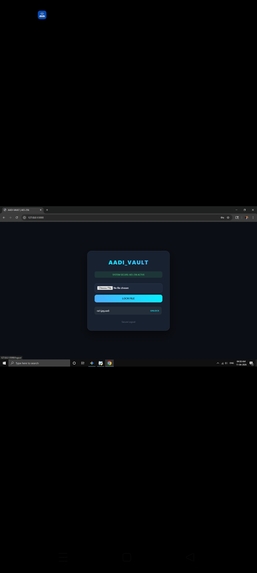
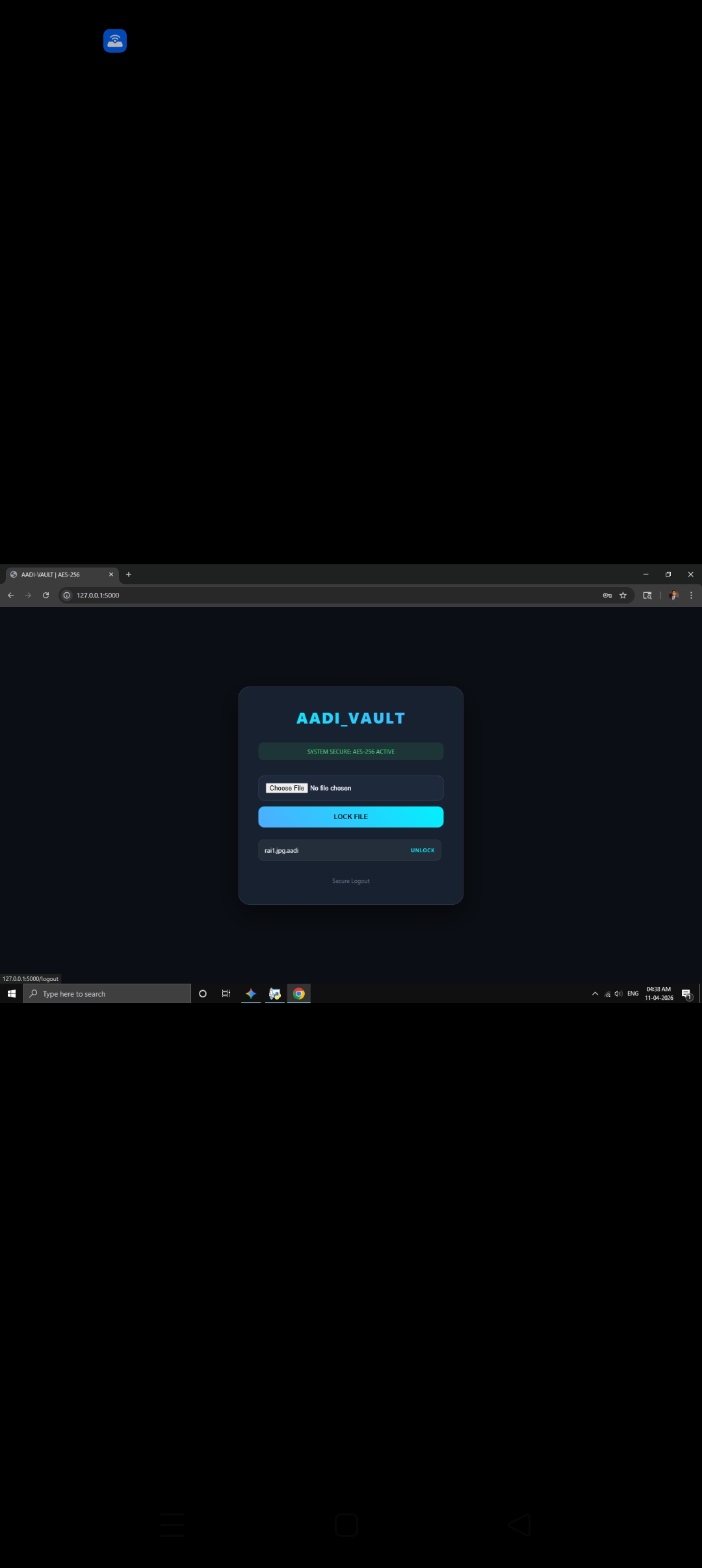
Basic interface v1.0.0.0
🛡️ Aadi-Vault: Theoretical Data Conservation System
Next-Gen AI Security Station for Event Privacy
🌌 The Inspiration
In the modern digital era, data isn't just "stored"; it's a state of energy. Current encryption methods are static, but threats are dynamic. I wanted to build a system that treats data like a physical law—The Aadi-Rai Law of Binary Convergence.
🧠 The Core Philosophy (Theorem)
Unlike standard vaults, Aadi-Vault calculates a real-time Vulnerability Index ($A$). We treat information as a conserved state in a digital superposition.
$$A = \frac{D \times T}{E^s}$$
- $D$: Data Density (Importance of files)
- $T$: Threat Vector (External attempts)
- $E^s$: Entropy of the Security Key (Encryption strength)
🚀 What It Does
Aadi-Vault acts as a Local AI Security Node. It provides:
- Proactive Threat Analysis: Uses Google Gemini AI to predict potential leaks.
- Zero-Network Leakage: Keeps sensitive event data (guest lists, payments) on a secure local server.
- Digital Superposition: Files are "invisible" ($V(d) = \infty$) unless the Master Key is applied ($K^s = 1$).
🛠️ Technical Stack
- Backend: Python 3.12 (The Engine)
- Framework: Flask (Local Web Server)
- AI Brain: Google Gemini 1.5 Flash (Through Vertex AI API)
- Security Protocol: Custom AES-based "Aadi-Logic"
📈 Future Scalability
Aadi-Vault is designed to handle massive datasets for large-scale events. By implementing Ghost Packet Protocols, we can scale this to secure entire smart cities or corporate headquarters.
"Information is never locked; it only changes its state of visibility." > — Aditya Rai (Lead Developer)


Log in or sign up for Devpost to join the conversation.