I chose this track because it was the best opportunity to play around with statistical methods that I have been studying in courses, but not yet had a chance to apply.
Detection
Leaks and worn pumps start small enough to hide in the sensor noise for a while. I started with a CUSUM on each sensor and then fit the shape of each problem across all the sensors it affects. A worn pump is a slow ramp, a leak is a step followed by a ramp:
$$z_c(t) = a_c\,[t \ge \tau] + b_c\,(t - \tau)_+$$
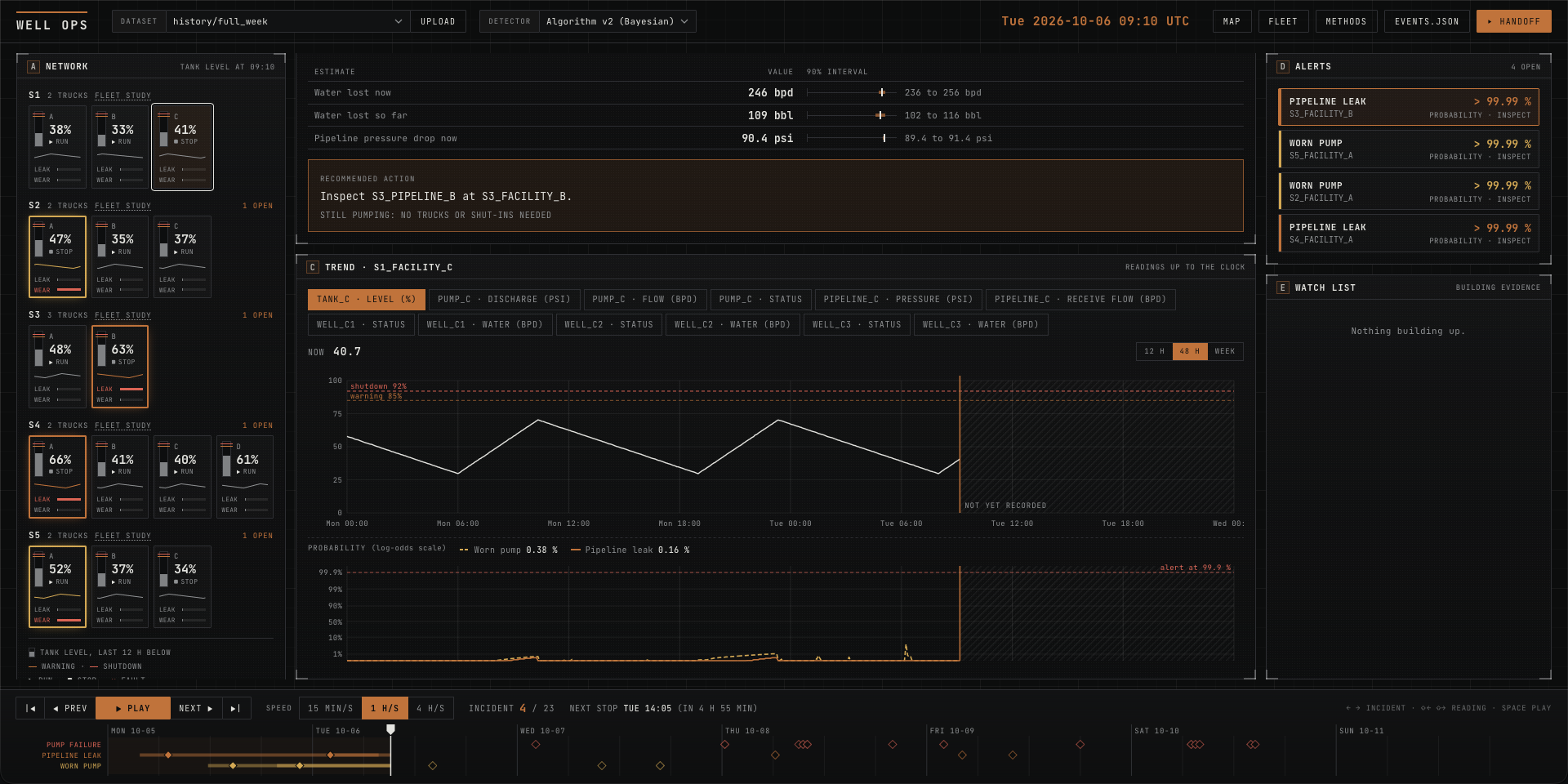
The final version uses a Bayesian approach, putting half-normal priors on the step and slope and integrates them out in closed form, so every reading gets a probability that something is wrong and every alert gets a credible interval for when the problem started.
Not overfitting
There was only one labelled week, so I fixed the constants up front and wrote a generator for 12 more weeks on new networks. Across 167 leaks and worn pumps it found every one with no false alerts, with a median time to alert of 5 minutes for leaks.
Planning
For pump failures, the planner finds the cheapest mix of trucks and early well shut-ins, with trucks shared across failures in the same system. Its plans came within 1% of the answer key's cost.
All of it runs in a console where you drag the operator's clock through the week and see only what was known at that moment.
