Inspiration
Our project began with a paradox. Smartwatches measure every visible metric of human performance—steps, pace, calories, elevation—yet remain completely blind to the earliest signals of mental overload. For Aysha our team member, who was diagnosed with panic disorder last year, this gap was painfully real. Her therapist taught her grounding exercises, controlled breathing, and the 5-4-3-2-1 method. But the real challenge was timing: in moments of rising panic, the mind freezes and the body becomes the last available channel. Her therapist suggested using a wristband as a reminder to breathe. But Aysha didn’t want reminders; she wanted intelligence. She needed something that could detect the micro-movements, heart-rate shifts, and HRV drops that her body sensed long before she did. The Huawei Watch 5 is designed for movement—cadence, running form, activity cycles. We realized: for people like Aysha, the most meaningful movements are smaller. The tremor before panic. The shallow breath. The subtle desynchronization of heart and motion. What if a watch built for athletic movement could understand emotional movement? What if it could intervene before the spiral formed? This idea became NeuroPace: a nervous-system interface on the wrist.
What is it
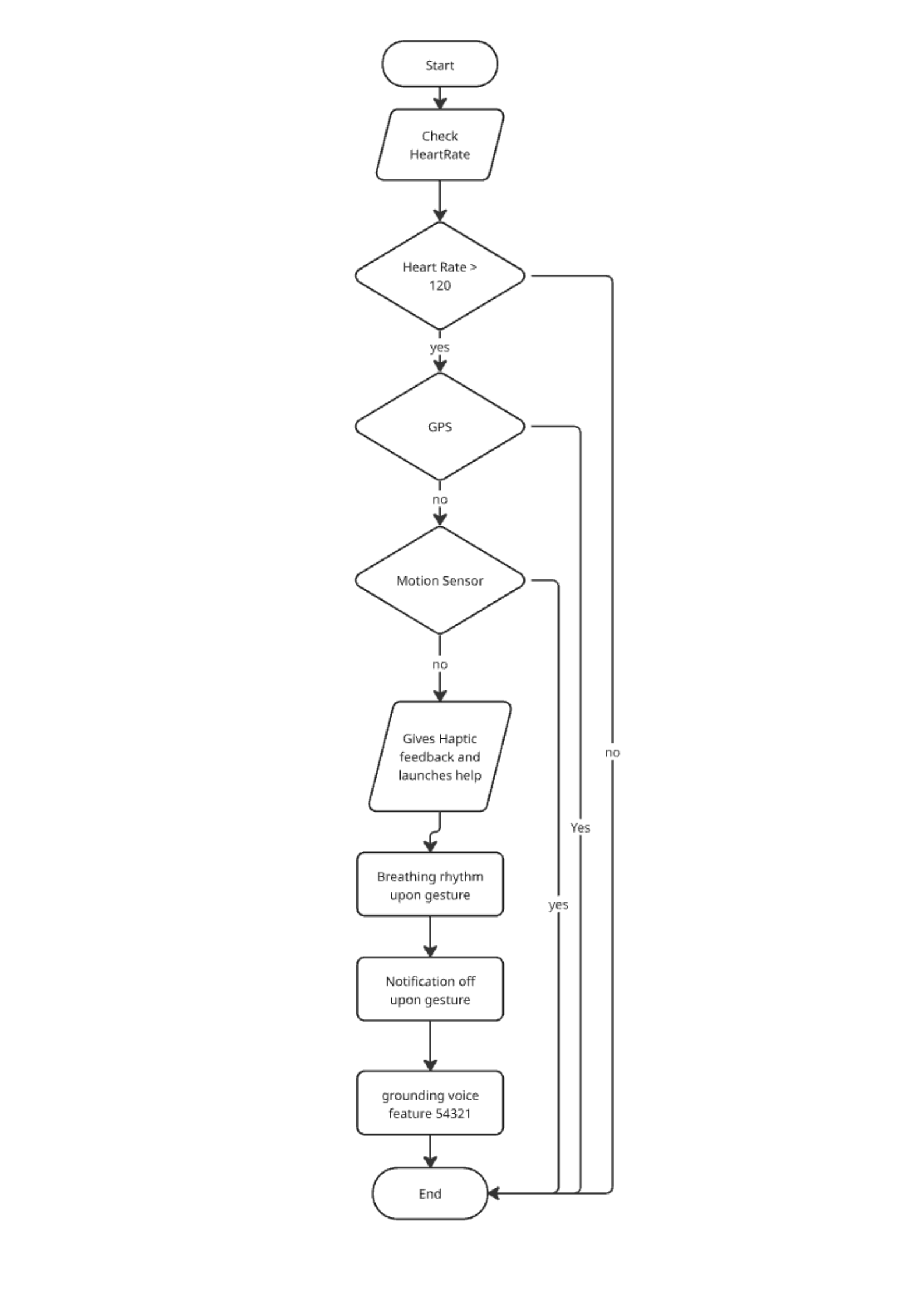
AI NeuroPace is a real-time grounding companion that uses the body’s own micro-movements as early signals of mental overload. When the watch detects rising tension through shifts in heart rhythm and subtle wrist jitter, it transitions into a grounding state.
The display begins to breathe with you — expanding and softening in a rhythmic glow — while gentle vibrations sync with this visual breath. Together, they act as a calming intervention delivered through the wrist, restoring a sense of rhythm and control.
NeuroPace does not notify. It entrains. It gives the nervous system a pattern to follow when the mind loses its own.
How we built it
We combined heart rate changes, HRV fluctuations, and accelerometer micro-movements into a dynamic stress indicator. When this indicator rises past a threshold, the system activates visual entrainment: a smooth breathing glow tuned to calm the autonomic system. We paired this with subtle haptic pulses that match the breathing pace, turning the watch into a multi-sensory grounding tool.
All of this runs on-device using ArkTS, following the watch’s natural design for continuous motion sensing.
Challenges we ran into
Calibrating haptics to be grounding rather than intrusive Building without an wearable emulator Balancing scientific grounding with simplicity and elegance
Accomplishments that we're proud of
We turned a sports-focused device into a nervous system stabilizer We built a breathing UI that feels organic and soothing Our dual-sensory grounding experience genuinely calmed real users The system responds before conscious stress awareness — something Aysha always wished for Most meaningfully: Aysha said, “This feels like the watch understands my body.”
What we learned
Designing for the nervous system requires rhythm, not information A wrist device can be more than a tracker — it can be a point of regulation
What's next for A3B
personalized stress baselines panic-episode early warnings gesture-triggered grounding adaptive breathing rhythms on-device micro-coaching long-term emotional stability insights
Built With
- arkts
- arkui
- devecostudio
- harmonyos
- ohosmulimediamedia
- ohossensorapi
- ohosvibratior
- openharmony

Log in or sign up for Devpost to join the conversation.