-
-
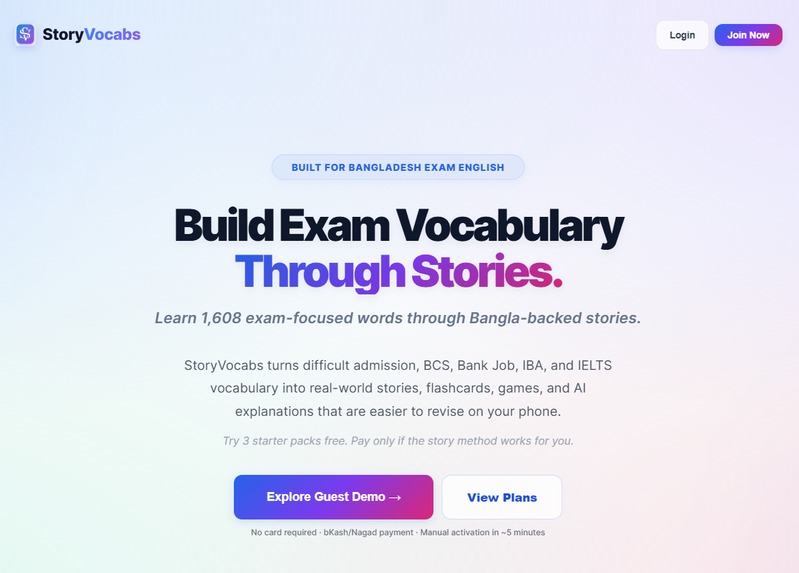
Home- Guest Log in
-
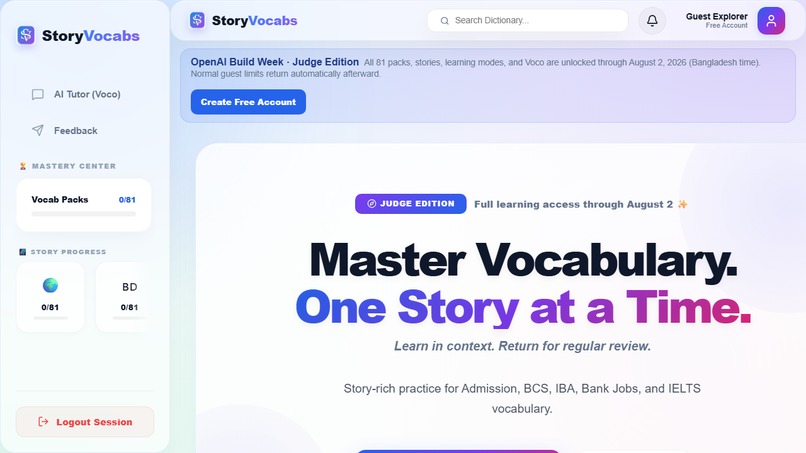
Dashboard
-
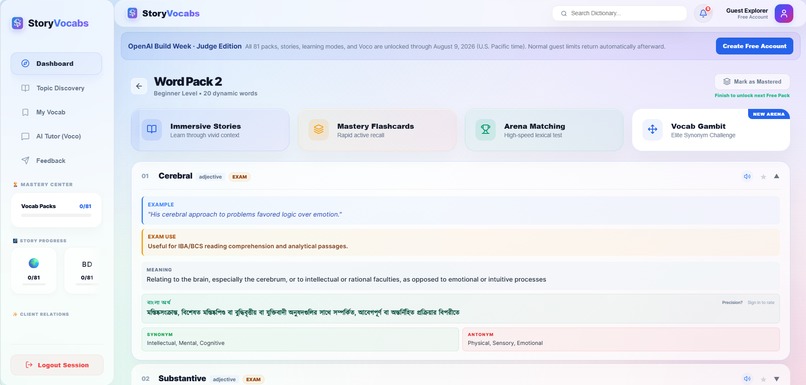
bilingual-word-details
-
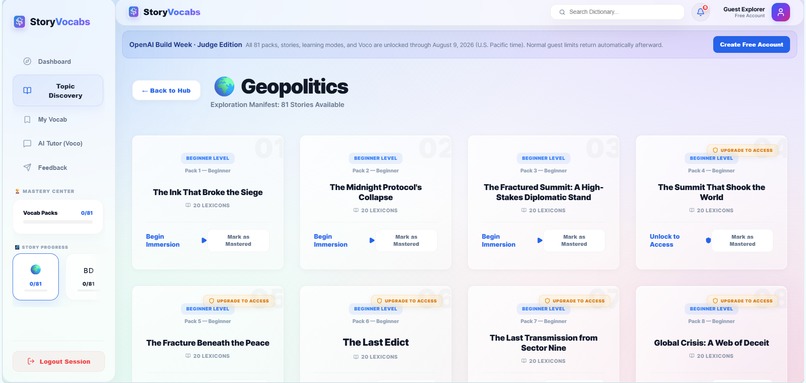
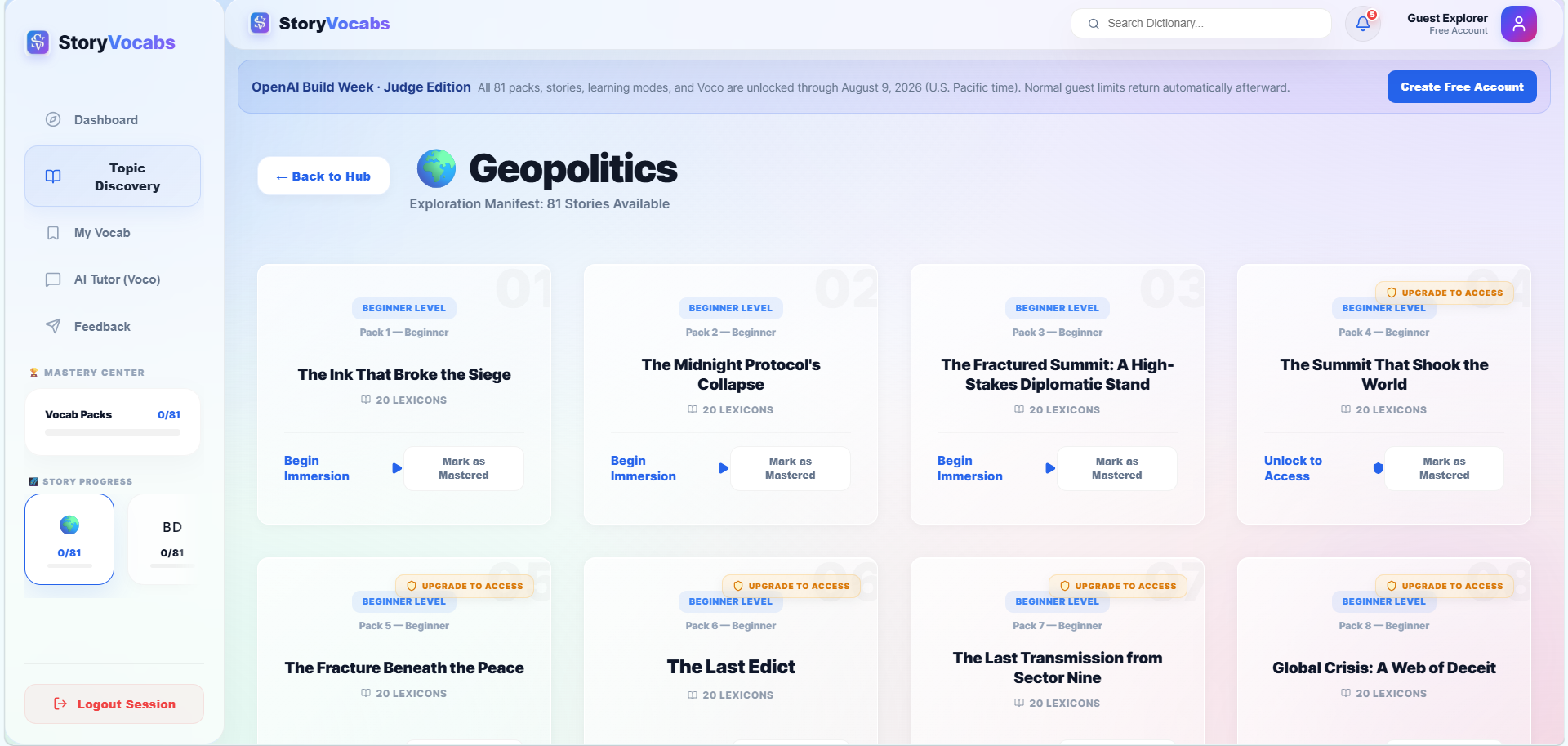
Stories with difficult words in a particular Genre of topic
-
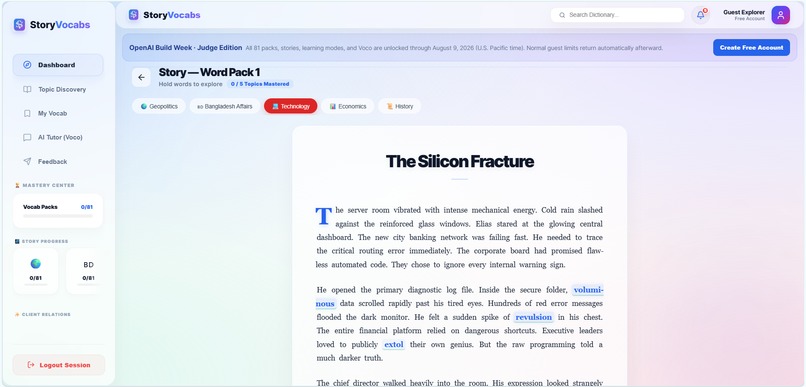
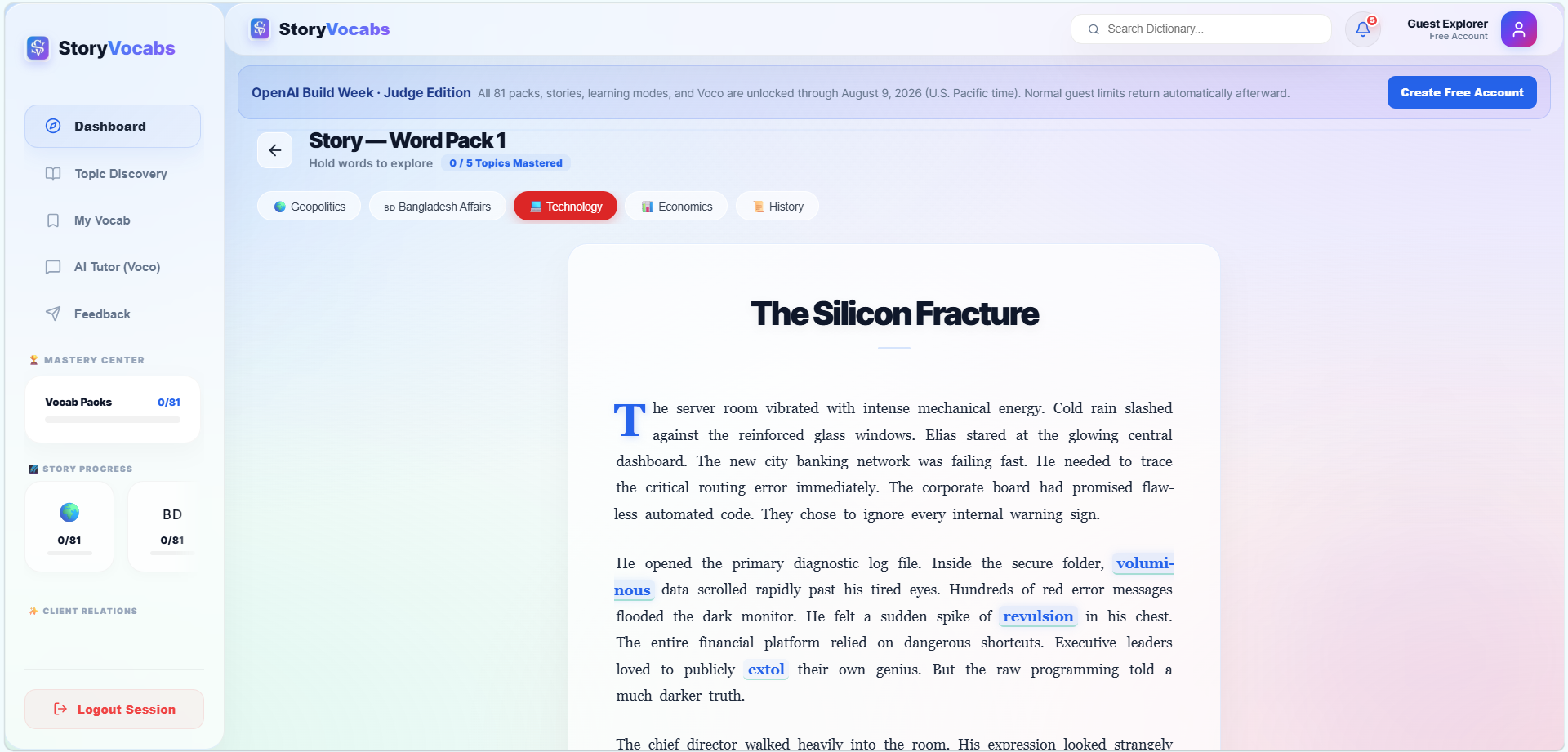
story-context
-
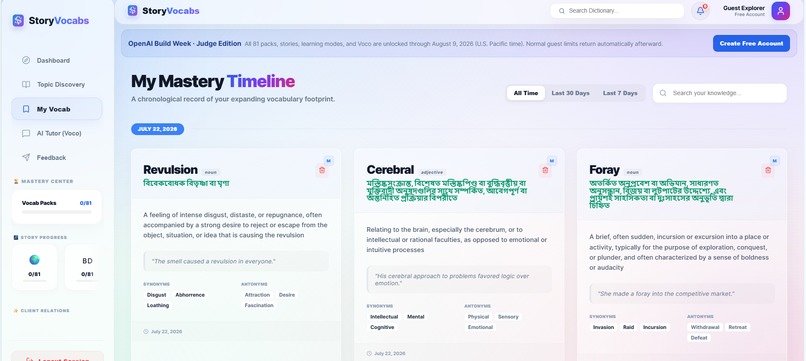
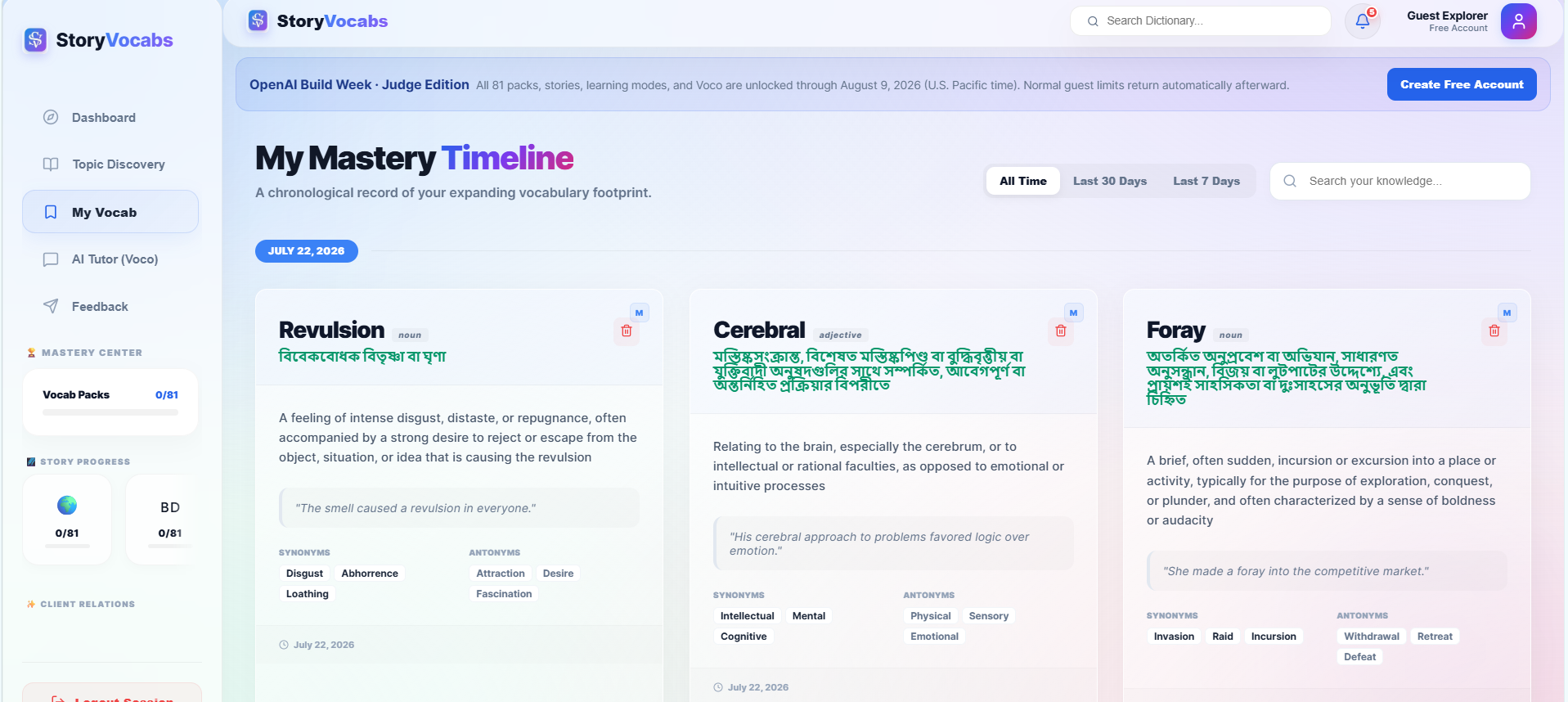
Vocab bookmark ( filter feature feature)
-
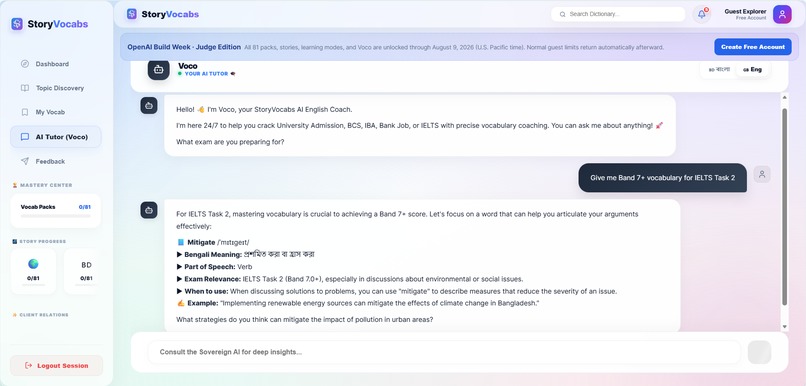
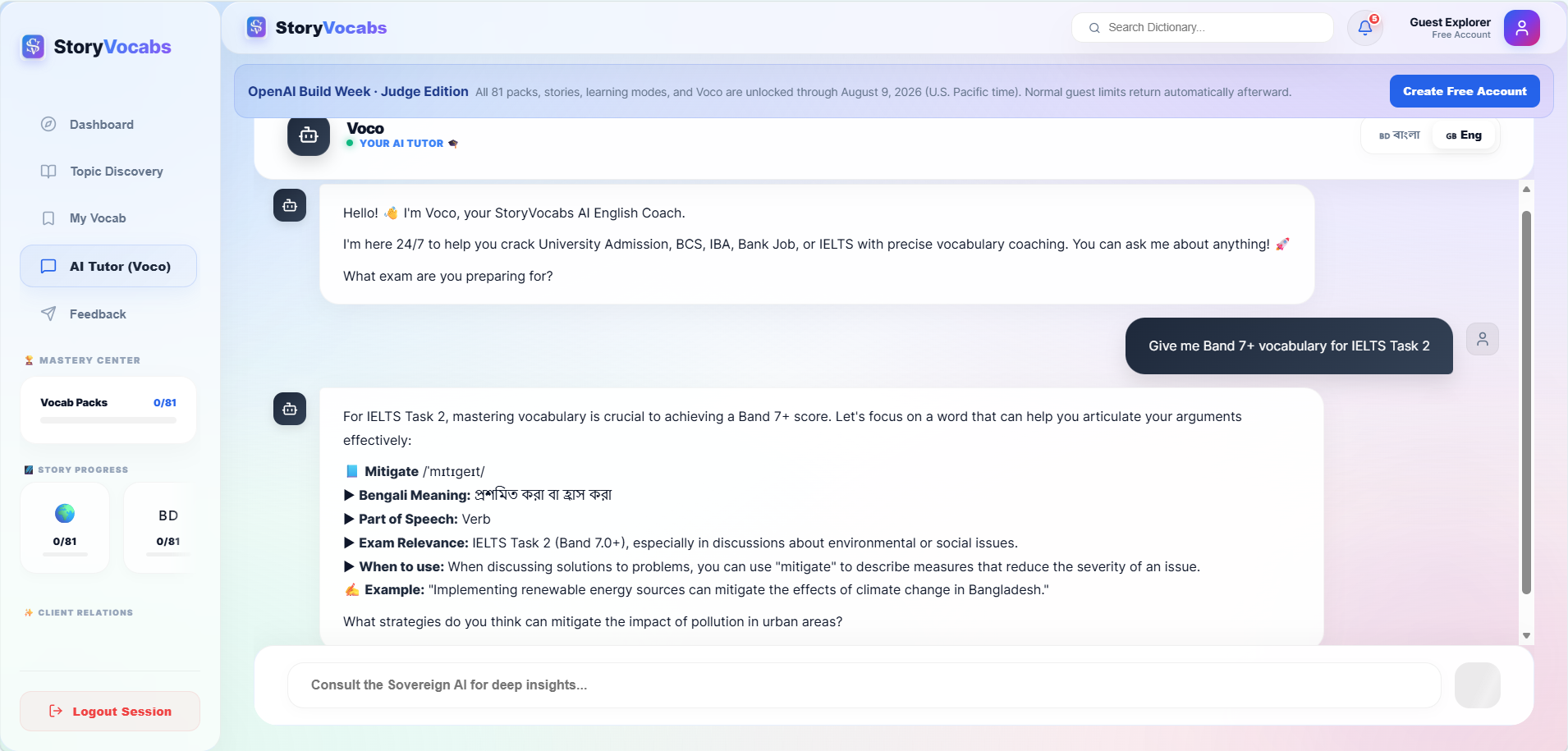
AI- tutor (VOCO)
-
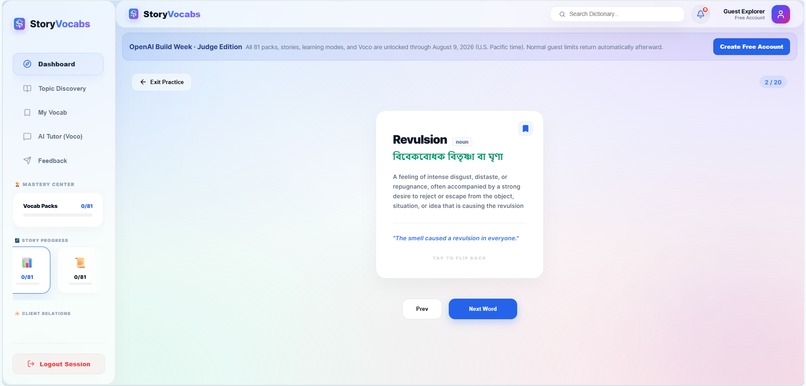
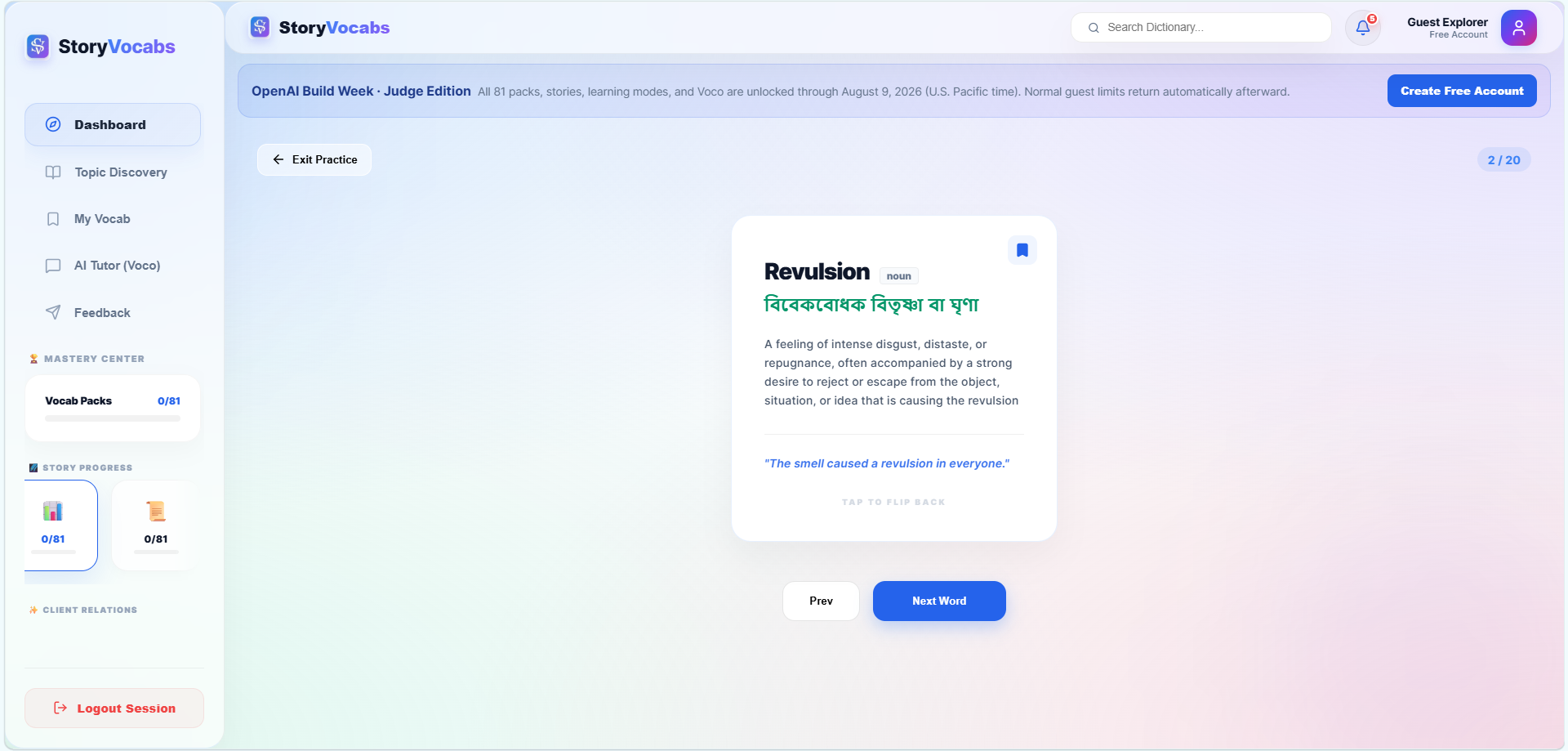
Dynamic Flashcard feature
-
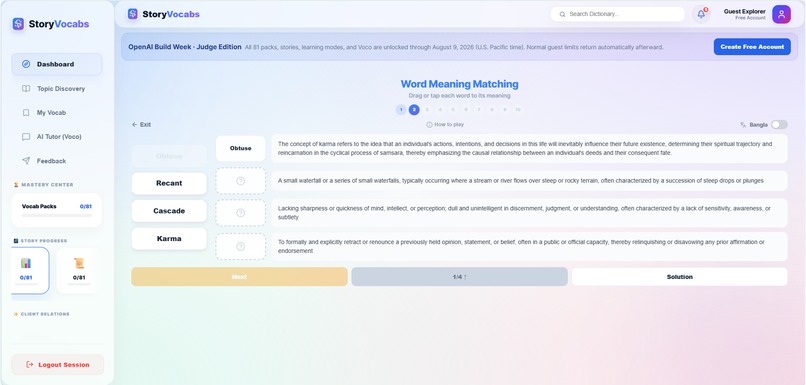
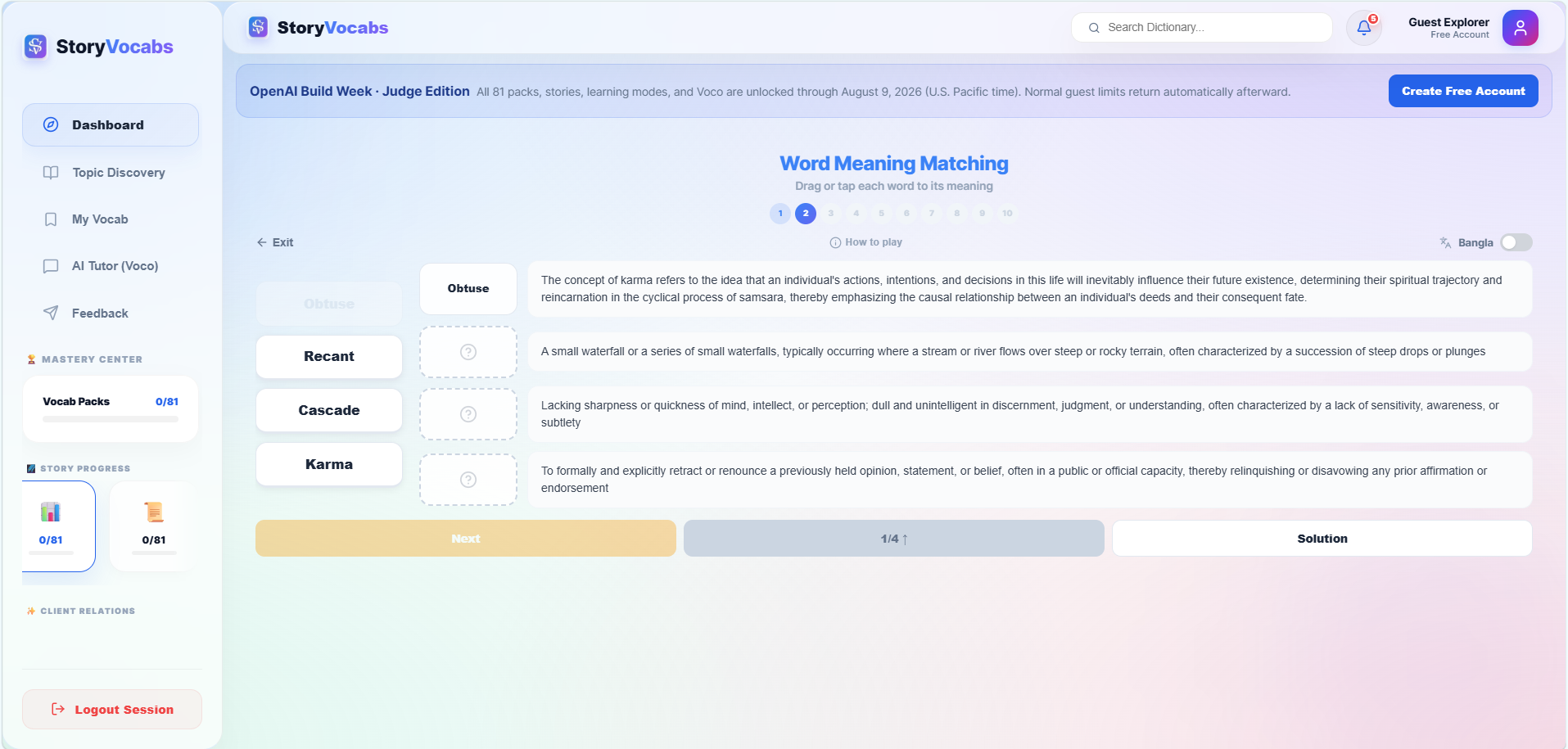
Word matching game
-
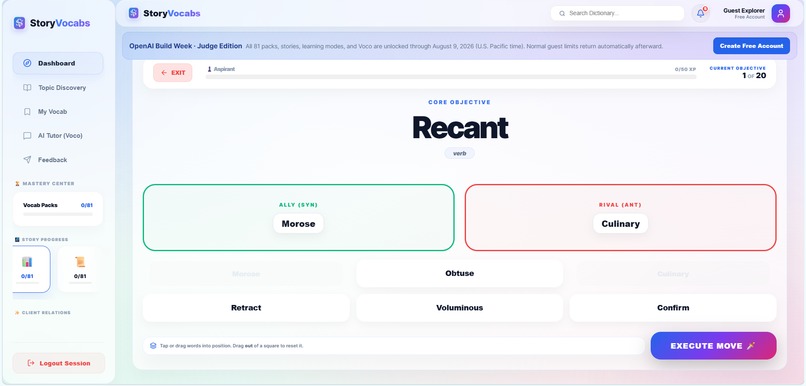
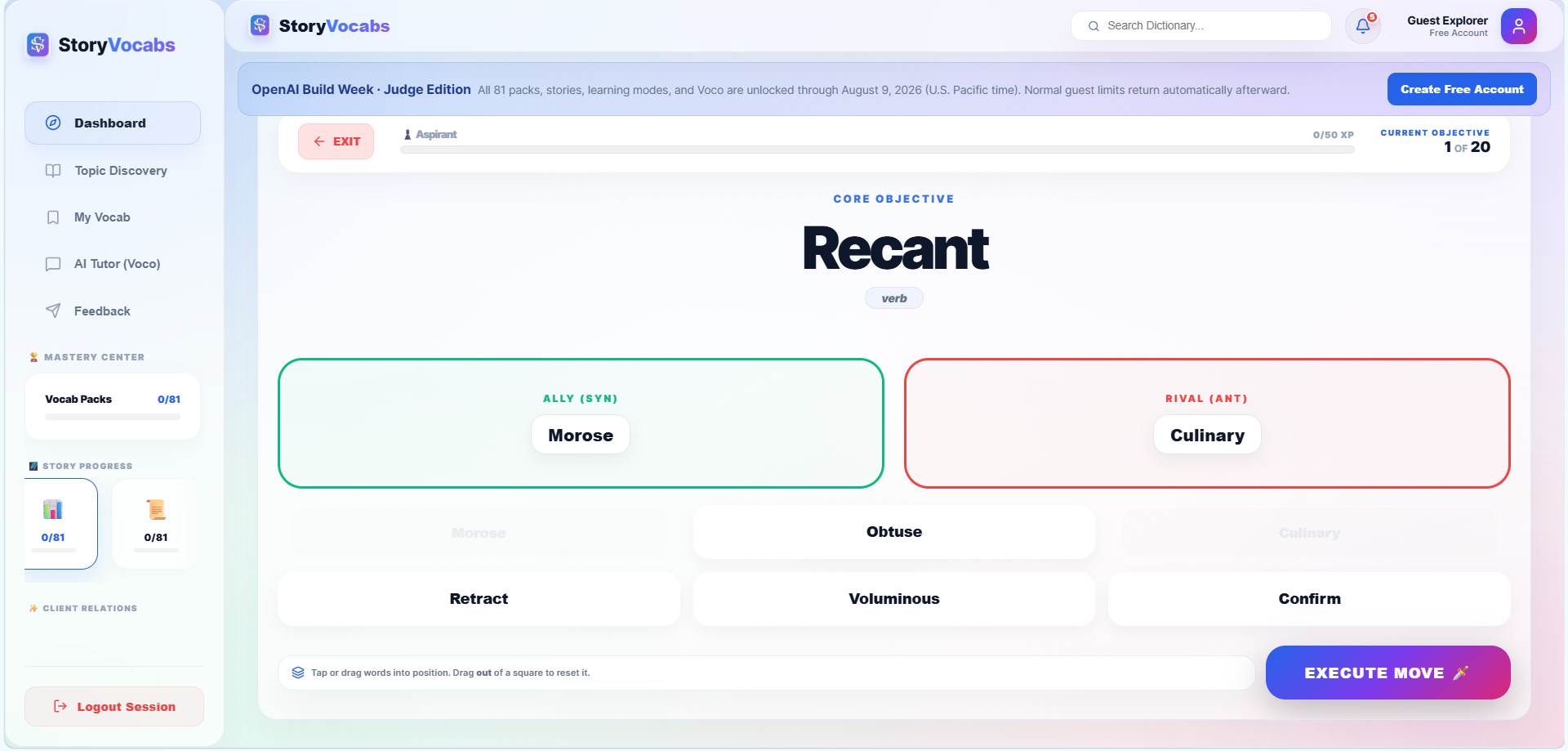
Learning synonym and Antonym through a game
Inspiration
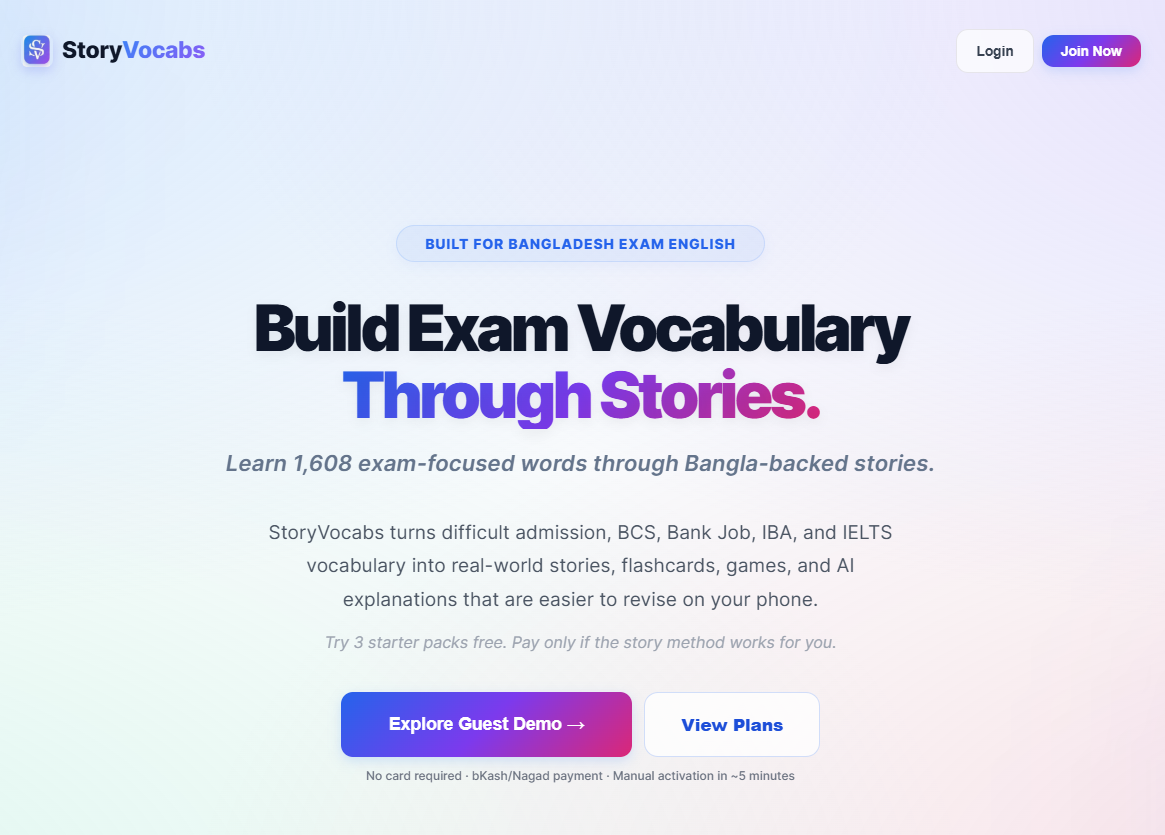
I started StoryVocabs because memorizing vocabulary from disconnected word lists never felt effective. Students preparing for university admission, BCS, IBA, bank-job, and IELTS exams may recognize a word while studying but fail to remember it when they actually need it.
This problem is especially noticeable for Bangladeshi learners. A dictionary can explain a word, but it rarely connects the English meaning, Bangla meaning, pronunciation, exam usage, practice, and revision in one place.
I wanted to build something I would genuinely use: a mobile-friendly learning platform where a student can understand a difficult word, see it inside a memorable story, practise it, and return to review it later. That idea became StoryVocabs.
What it does
StoryVocabs is a bilingual vocabulary-learning platform built for Bangladeshi students and competitive-exam candidates.
It currently contains 81 vocabulary packs with 1,620 vocabulary records, 1,608 unique words, and 405 contextual stories. The stories cover topics such as Bangladesh affairs, geopolitics, economics, technology, and history.
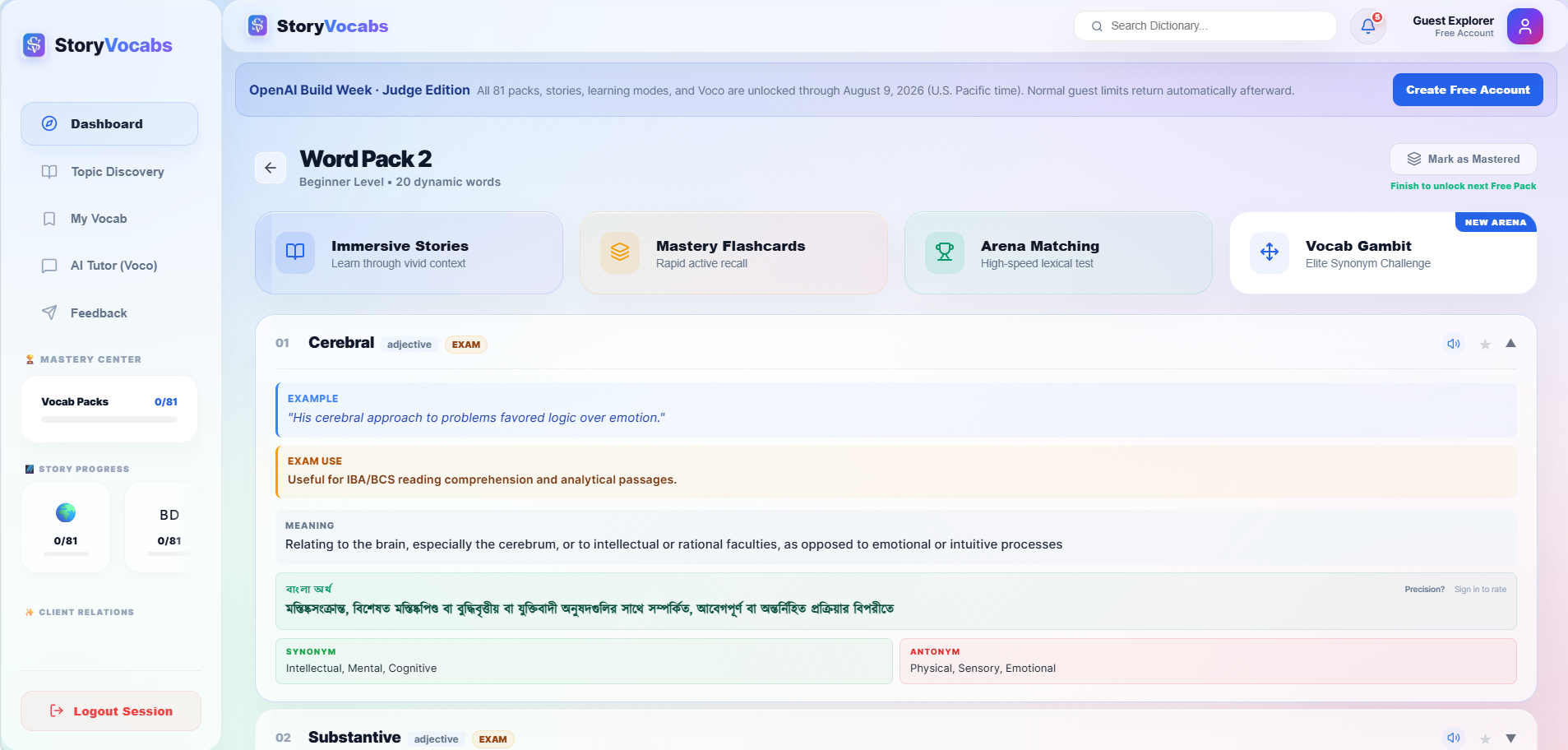
For each word, learners can explore:
- English definitions
- Bengali meanings
- Example sentences
- Pronunciation
- Synonyms and antonyms
- Exam-focused usage guidance
The same vocabulary appears throughout the learning experience. After studying a word, learners can find it again inside an interactive story, practise it with Mastery Flashcards, play Arena Matching or Vocab Gambit, bookmark difficult words, and return through the review and progress features.
StoryVocabs also includes Voco, a bilingual vocabulary assistant that can explain words and answer questions in English or Bangla.
The application works as a Progressive Web App, so learners can install it on a phone and use it with an app-like interface.
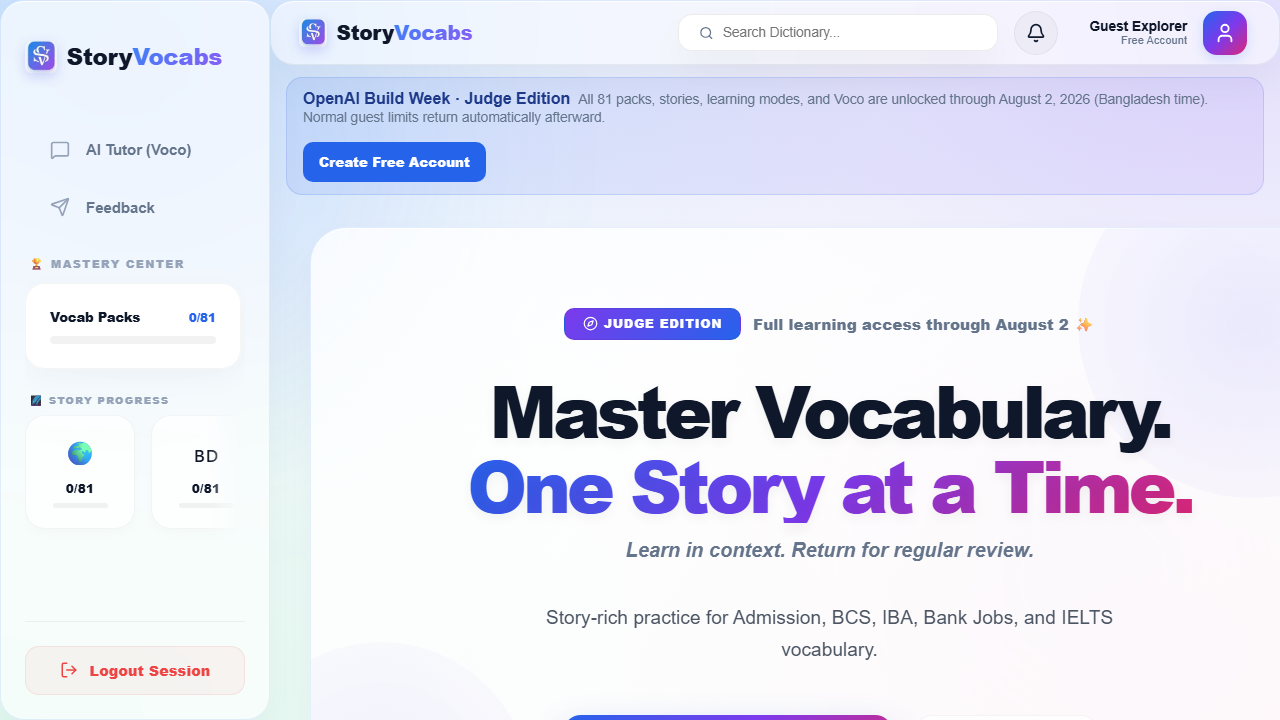
For OpenAI Build Week judging, I created a credential-free Guest Demo. Judges can explore all 81 packs, stories, learning modes, and Voco without creating an account or making a payment. Guest access remains available until August 9, 2026 at 5:00 PM Pacific Time.
How I built it
StoryVocabs is built with React 19, JavaScript, and Vite. It is deployed on Vercel as a responsive Progressive Web App.
The main vocabulary and story catalog is stored as structured static data, which keeps the core learning experience fast. Supabase provides authentication, PostgreSQL storage, and per-user learning state. The browser's Web Speech API provides pronunciation, while server-side functions protect Voco provider credentials, quotas, and other sensitive operations.
Voco uses Groq at runtime, with OpenRouter available as a fallback.
StoryVocabs existed before OpenAI Build Week, so I separated the existing product from the work completed during the event. Before Build Week, the core vocabulary catalog, bilingual meanings, stories, games, bookmarks, progress tracking, Voco foundation, and PWA foundation already existed.
During Build Week, I used Codex with GPT-5.6 as my engineering and release collaborator. It helped me:
- Map the React, Supabase, and server-function architecture
- Review the product scope and identify release risks
- Audit 1,620 vocabulary records and 405 stories
- Strengthen authentication, payment, entitlement, and AI quota boundaries
- Find mobile-layout and authentication-timing problems
- Add automated content checks and tests
- Enforce zero-warning linting and repeatable production builds
- Diagnose differences between the local and deployed application
- Verify the required Supabase migrations
- Build a reliable Guest Demo for judges
- Prepare the README, Build Week changelog, testing guide, and submission materials
GPT-5.6 does not power Voco at runtime. I used GPT-5.6 through Codex during Build Week to understand, extend, test, secure, document, and prepare the project for release. I documented this distinction because I wanted the role of each AI system to be clear.
Challenges I ran into
The hardest challenge was keeping the local application, deployed frontend, database schema, guest-access rules, and documentation consistent.
At one point, my local build and the deployed application were not showing the same version. I also encountered a failed deployment, a production database that was behind the expected migration history, mobile header overlap, and authentication timing problems.
Some operations also needed stronger boundaries. Payment approval, entitlement changes, pricing, and Voco quotas could not depend only on browser-side checks. I moved important decisions into protected server-side paths and added tests for those boundaries.
Another challenge was deciding what not to build. With a limited amount of time, adding more features would have made the project less reliable. I stopped expanding the scope and focused on the judge experience, deployment stability, content validation, security, and documentation.
The Guest Demo also needed an automatic cutoff that matched the official end of judging across different time zones. I implemented the cutoff using an exact UTC timestamp corresponding to August 9 at 5:00 PM Pacific Time.
Accomplishments that I am proud of
I am most proud that StoryVocabs now feels like one connected learning process instead of a collection of unrelated vocabulary tools.
A learner can understand a word, read it inside a story, practise it, bookmark it, and return to review it. Every part reinforces the same vocabulary.
Other accomplishments include:
- 81 complete vocabulary packs
- 1,608 unique English words
- 405 contextual stories
- English and Bengali learning support
- Multiple active-recall learning modes
- A responsive and installable PWA
- A credential-free judging experience
- Automated checks for vocabulary and story coverage
- Twelve passing automated tests
- Zero-warning ESLint
- A verified production build and PWA cache policy
- Clear documentation of the work completed during Build Week
I am also proud that judges do not need to create an account, enter payment information, or follow a complicated setup process to understand the project.
What I learned
The biggest lesson I learned was that reliability matters more than adding another feature. A smaller experience that works consistently is more useful than a larger one with broken paths.
I also learned how many small details affect trust in an education product. Bengali text must be readable, pronunciation must be easy to access, navigation must work on mobile devices,
Built With
- codex
- css3
- eslint
- githubactions
- gpt-5.6
- groq
- html5
- javascript
- node.js
- openrouter
- postgresql
- pwa
- react
- supabase
- vercel
- vite
- webspeechapi

Log in or sign up for Devpost to join the conversation.