SolTerra
SolTerra allows you to save the world by buying territory on a digital planet.
Inspiration
Donations are invisible by design, so we built planets where they aren't. Every tile of land on our digital world represents an environmental cause that we support. As funding comes in, the land visibly changes, and giving finally has something to look at.
Solana's speed and low fees made it possible to imagine thousands of small, real transactions (buying a tile, donating a few cents, ad-revenue microtransactions) without the friction or gas costs that would kill the idea on most other chains. And because it isn't tied to any single currency, anyone anywhere in the world can take part without worrying about exchange rates or banking access.
What it does
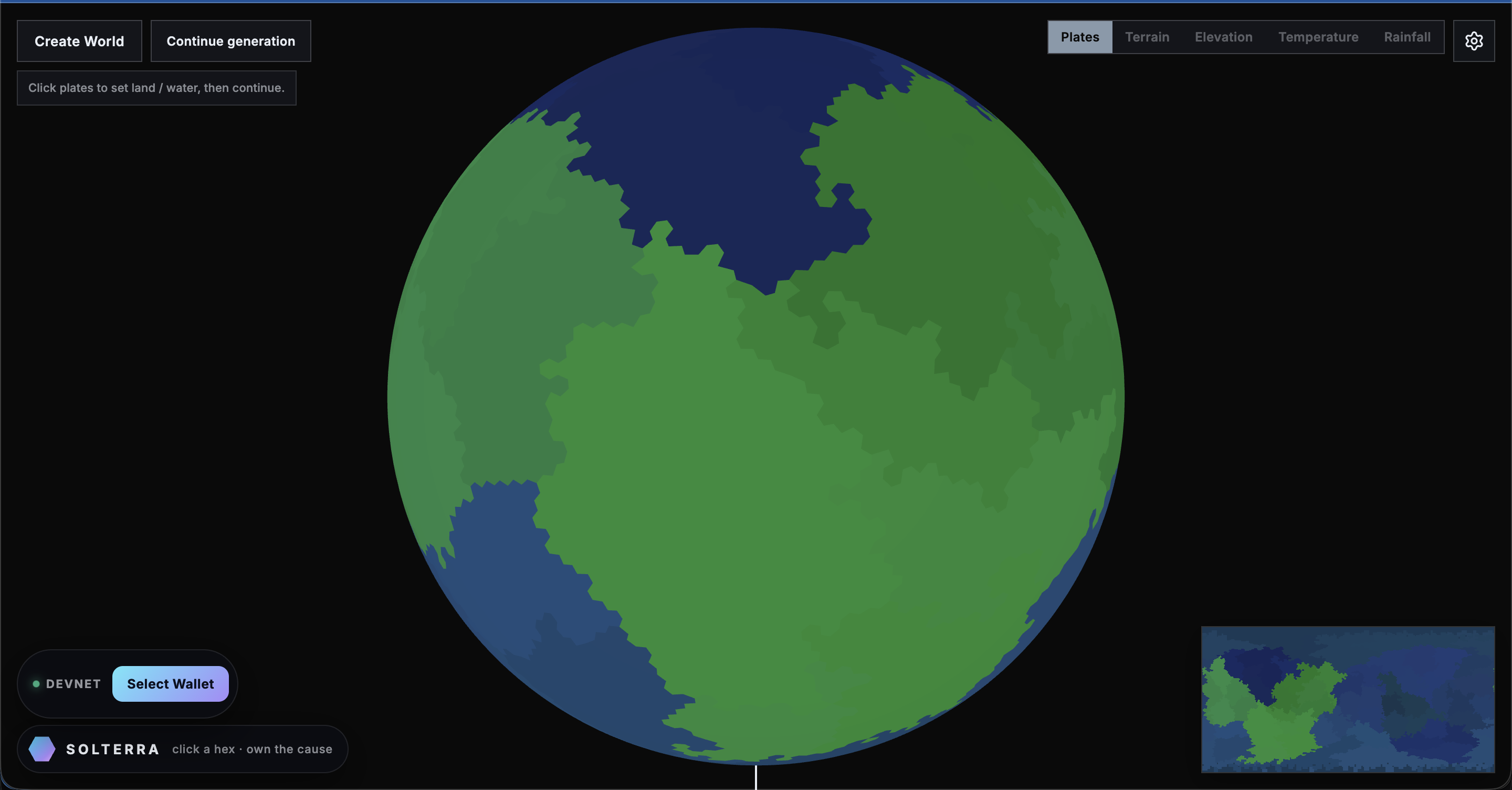
SolTerra allows you to generate a custom planet made up of pentagonal and hexagonal tiles, each rendered on an interactive 3D globe. Each tile represents a specific environmental issue.
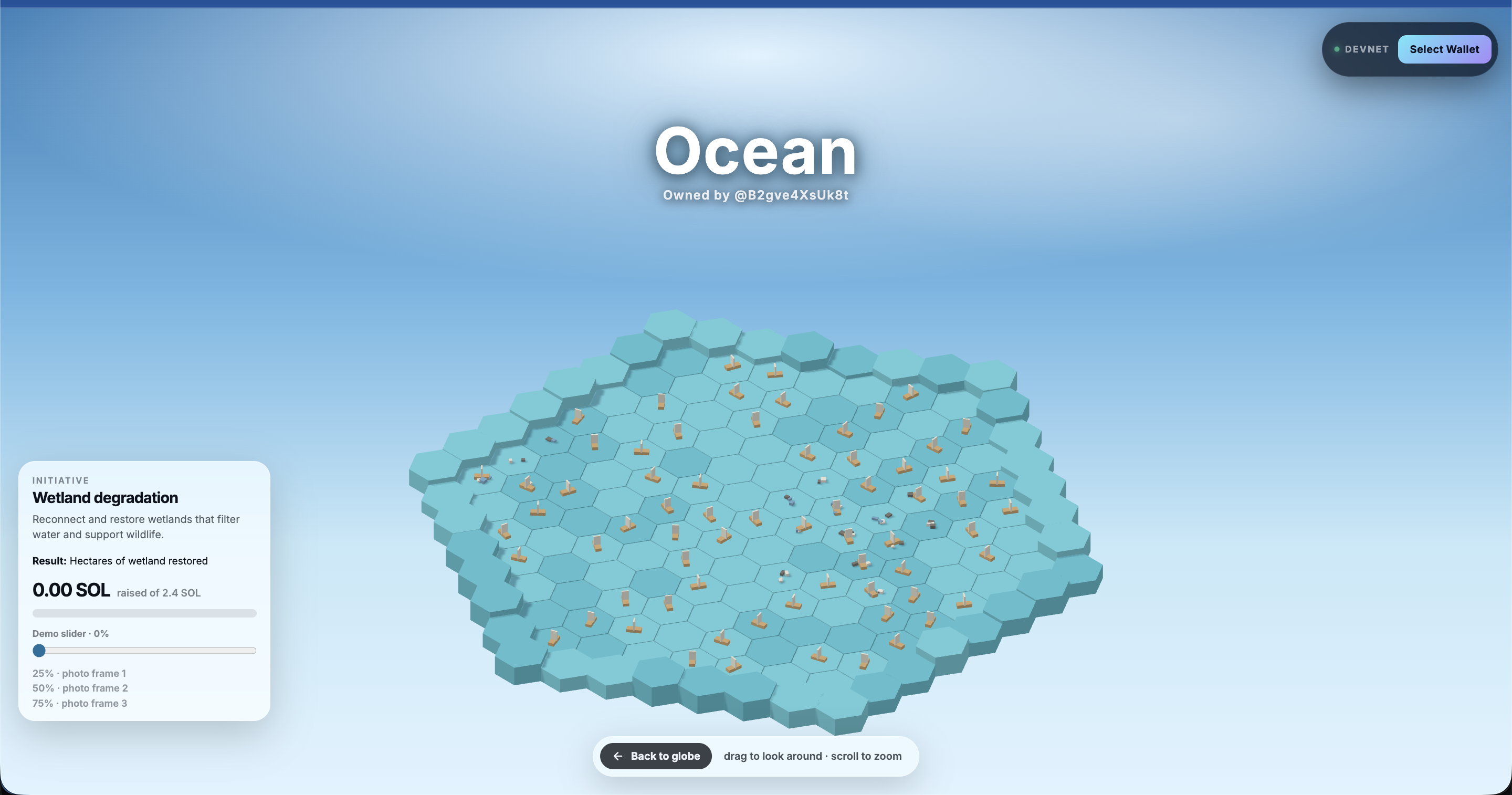
SolTerra turns the globe into a living map of real environmental causes. Each of its thousands of tiles represents a specific issue: barren land that needs reforestation, polluted oceans, or forests still recovering from wildfires. SolTerra connects a sponsor with an organization capable of doing the work, then creates a transparent impact contract between them. Funding is tied to measurable milestones, results are verified, and the land visibly evolves as real progress is made. Every tile belongs to one of twelve biomes (ice cap, tundra, plains, savannah, temperate forest, boreal forest, rainforest, warm desert, cool desert, highlands, cool mountain, warm mountain), and their issues are specifically tailored to their biome.
Each tile can be purchased with SOL. Once owned, it comes with a fundraiser goal tied to its cause, and anyone can donate SOL toward that goal, not just the owner. As the fundraiser fills up, the owner unlocks more ways to physically restore the land. Full funding brings the tile to life on its own. At that point, the owner also unlocks an ad billboard that allows you to make your tile your own.
Because it all runs on Solana, every donation and purchase can be a real, tiny transation that settles in sections for a fraction of a cent. That means the loop still works at five cents at a time, and it works the same for someone anywhere in the world, no matter their currency or access to a bank.
How we built it • Globe & tiles: a 3D globe rendered with [deck.gl / Three.js — confirm], with the hex grid generated using H3, and biome/terrain shape faked as tectonic plates via Voronoi-partitioned regions plus seeded Perlin noise, rather than real geologic simulation. • Tile environments: each biome has a procedurally generated 3D scene (seeded by tile ID, so the same tile always looks the same) with instanced trees, rocks, and buildings scattered per biome. • Transition screen: a consistent "lock-in" screen between clicking a tile and entering its environment, showing biome name, lock status if unowned, or
How we built it
3D world generation
Creating entirely new planets consists of creating a polygon mesh, creating tectonic plates, generating elevation and climate data, and finally generating terrain and biomes.
Building the polygon mesh involves evenly scattering thousands of points on a sphere, building a spherical hull of polygons centered on those points, reducing heptagons towards hexagons, and stretching small edges to create the finished mesh.
Creating tectonic plates involves generating 10–20 seeds that will become the tectonic plates, expanding them using flood fill and jitter to create the large plates, and repeating the process with 50–100 smaller plates, which are subsections of the large plates.
The user specifies which plates are land and which are ocean, and then the generation is continued. Creating elevation involves setting a speed and height for every tectonic platea and sub-plate, and creating mountains, trenches, and ocean ridges. Noise is added to create a realistic elevation map.
Temperature data is created using a sea-level mean from latitude as a base, cooling with height, adjust for continentality, wind and ocean influence, and a bit of noise. Seasonal values are calculated from the annual mean. Calculating rainfall data involves a base from latitude belts, moisture carry inland along wind, and an orographic boost with rain shadows.
Finally, terrain and biomes are generated by calculating which biome a cell belongs to from its data. It's then turned into a colour that is unique to that cell. The maps are rendered using an equirectangular map and Three.js for the globe.
Solana integration
Solana is SolTerra’s identity, payment, and accountability layer. Wallets act as user logins, while each project receives a unique on-chain account. Contributions create public receipts showing who paid, how much, and where the funding went.
Organizations store large evidence files off-chain while recording their fingerprints on Solana. Trusted reviewers approve milestones using their wallets, creating a permanent verification history. Sponsors also receive stewardship NFTs that upgrade as results are verified. Solana’s low fees and parallel processing allow many territories to receive funding simultaneously. Future smart-contract milestones will release funds only after evidence is submitted and approved.
Challenges we ran into
Accomplishments that we're proud of
What we learned
We learned that blockchain cannot prove real-world work by itself, it works best as a transparent record of funding, evidence, and human decisions. We also learned that separating each territory into its own Solana accounts allows independent projects to operate in parallel.



Log in or sign up for Devpost to join the conversation.