-
-
Race Engineer Setup
LapSynk: The AI-Powered Race Engineer Dashboard
Inspiration
In Formula 1, milliseconds define victory or defeat. While drivers battle on the track, race engineers fight their own race behind the screens, analyzing telemetry, interpreting driver feedback, and deciding what to communicate next, all under immense time pressure.
This project is designed from the perspective of Carlos Sainz’s race engineer, focusing on how AI can help manage communication, timing, and strategy during the chaos of a live Grand Prix.
We asked ourselves: “What if an AI could help engineers not just decide what to say, but when to say it?”
That question led to LapSynk, an intelligent race-engineering dashboard that understands context, monitors driver workload, and optimizes communication timing. The result is a system that helps engineers deliver the right message at the right moment, keeping drivers focused when it matters most.
What It Does
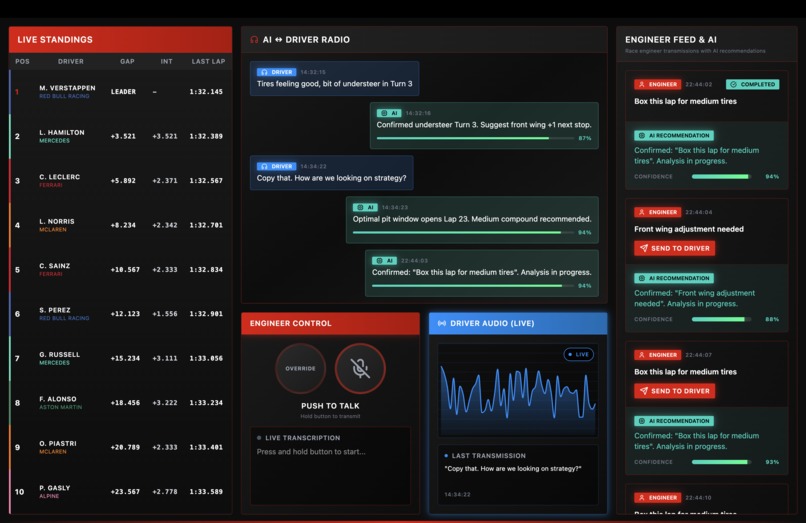
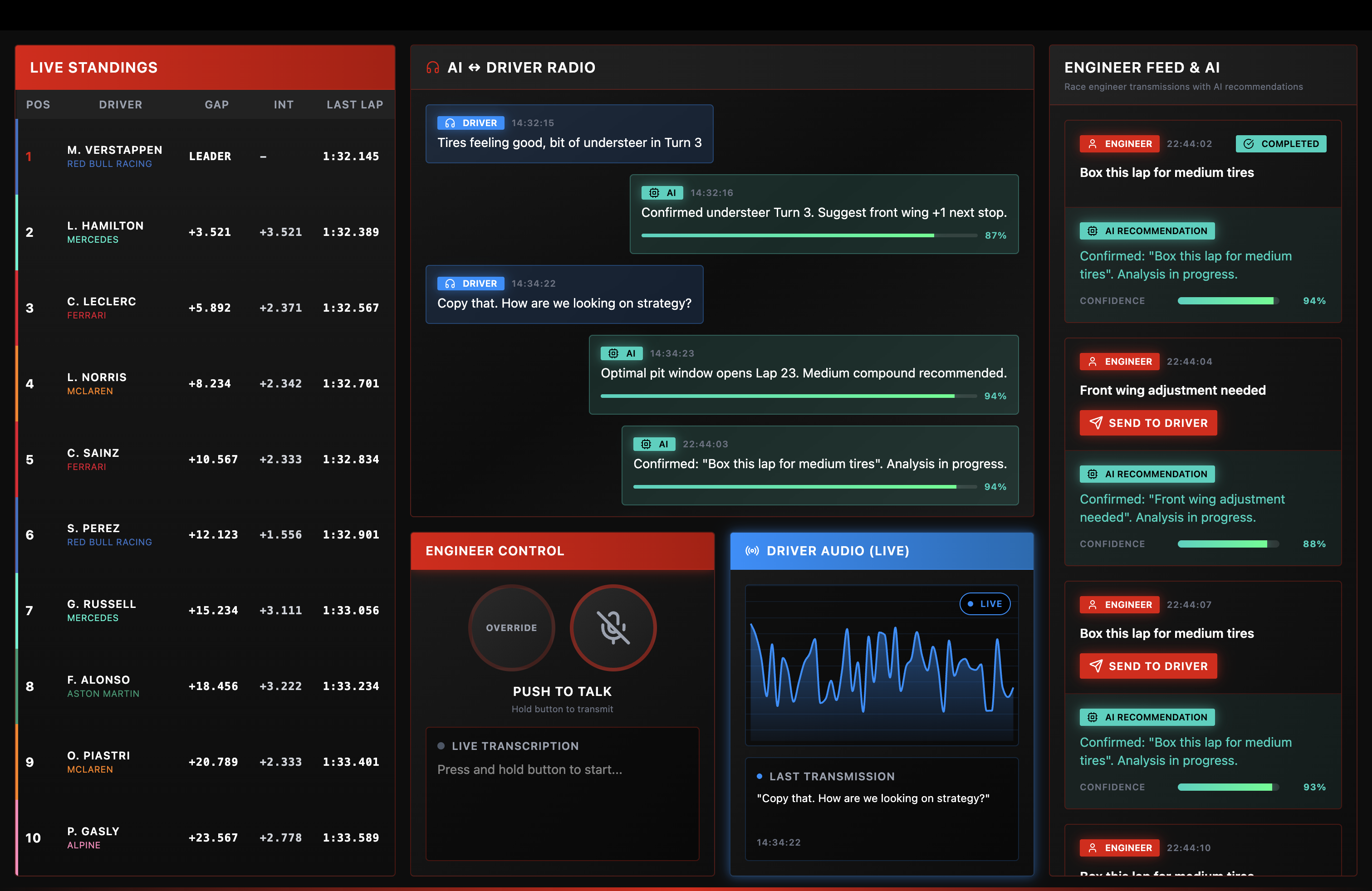
LapSynk is an AI-powered dashboard that gives race engineers real-time awareness of driver communication, telemetry, and AI reasoning. It is designed specifically to support Carlos Sainz’s race engineer in managing when and how to communicate with the driver under pressure.
Analyzes Telemetry to Time Communication: LapSynk continuously monitors telemetry signals such as lap traffic density, cornering load, braking force, and extreme weather conditions. Using this data, the AI determines when the driver is under high workload and advises the engineer to delay communication until conditions stabilize.
To ensure clarity and safety, LapSynk currently operates on a rule-based message severity system:
- High-severity messages are transmitted immediately within 1 millisecond.
- Medium-severity messages are sent after 3 seconds, allowing the driver to clear minor workloads.
- Low-severity messages are delayed for 5 seconds, minimizing distractions during focus-intensive laps.
This timing model will later evolve into an adaptive algorithm that analyzes real telemetry, driver workload, and situational context to dynamically calculate when a message should be relayed.
Displays Live Standings: The dashboard updates driver placements, lap times, and gaps dynamically, reflecting the race as it unfolds.
Facilitates AI ↔ Driver Communication: Every driver transmission is captured through ElevenLabs Speech-to-Text, interpreted by Gemini 2.5 Flash, and responded to with context-aware insights. These responses are voiced back using ElevenLabs Text-to-Speech, simulating natural two-way radio communication.
Supports Engineer Feed and Recommendations: When the engineer uses Push-to-Talk, their message is transcribed and analyzed by Gemini. The system provides a recommendation with confidence level, timestamp, and a live status indicator that switches from In Progress to Completed once relayed.
Processes Driver Feedback in Real Time: LapSynk interprets keywords from the driver such as “understeer” or “traction issues” and suggests actionable insights like tire compound changes or pit window adjustments.
Presents Telemetry Data Visually: For deeper analysis, engineers can view detailed graphs that track Fuel Consumption, Throttle and Brake Pressure, Tire Temperature, and Brake Temperature. These visuals help engineers identify performance trends, manage resources, and make data-driven strategy calls throughout the race.
Ensures Human Control: The engineer always remains in command. An Override control allows them to bypass AI timing advice in critical moments or emergencies.
For demo purposes, the Driver Audio panel is displayed on the same dashboard. In a real-world setup, it would be part of a dedicated driver console, ensuring separation of roles between cockpit and pit wall.
How We Built It
LapSynk was built with modern web technologies and edge AI infrastructure to simulate the precision and pace of a Formula 1 environment.
Frontend: Developed with Vite 5 and React, delivering a modular, high-performance interface that updates in milliseconds. Styled with TailwindCSS 3.4, the dashboard provides an intuitive and realistic race control experience. For testing, race telemetry is simulated through a local JSON feed, streaming lap times, weather conditions, and traffic data.
Backend: Powered by Cloudflare Workers, which handle AI orchestration, audio processing, and context management at the network edge. This architecture ensures ultra-low latency for live voice and data processing.
AI and Voice Pipeline: The system uses Gemini 2.5 Flash to analyze speech, driver workload metrics, and telemetry data to determine optimal communication timing and generate strategic recommendations. ElevenLabs manages both speech-to-text and text-to-speech conversion, ensuring natural, human-like communication between driver and engineer.
Data Layer: Race data is stored locally for this prototype but is designed to integrate with official F1 telemetry APIs and WebSocket-based live updates for future real-world use.
A Note for the Judges: Our Alignment with Your Tracks
We were very intentional in designing LapSynk to align across multiple HackTX and MLH sponsor challenges.
For the [MLH] Best AI Application Built with Cloudflare: LapSynk uses Cloudflare Workers to manage AI timing analysis and voice data orchestration at the edge, allowing for near-instant response cycles even under simulated race loads.
For the [MLH] Best Use of Gemini API: Gemini 2.5 Flash performs real-time reasoning, analyzing both natural language and telemetry data to decide when and how the engineer should relay critical messages. It acts as a real-time strategist that understands pressure, pace, and driver context.
For the [MLH] Best Use of ElevenLabs: ElevenLabs drives the continuous voice loop that powers LapSynk, transforming raw audio from both engineer and driver into instant, natural responses. It ensures clarity even in the chaos of a live race.
For the [MLH] Best .Tech Domain Name: The project lives at lapsynk.tech, symbolizing synchronization between human decision-making, AI precision, and machine telemetry.
For the Best Novice Hack and Best NorthMark Hack: LapSynk represents an ambitious first-time integration of real-time AI reasoning, voice interfaces, and context-sensitive automation, a cross-disciplinary solution built for high-performance environments.
Challenges We Ran Into
Our main challenge was building a timing-aware AI pipeline capable of recognizing driver workload from telemetry in real time. Determining when not to talk to the driver required correlating multiple data streams such as lap traffic density, G-force load, and braking behavior, and interpreting them through Gemini’s reasoning engine.
We also had to ensure synchronization between transcription, reasoning, and speech synthesis. Even a one-second delay could disrupt the natural pacing of radio communication. Cloudflare Workers provided the scalability and responsiveness needed to manage overlapping voice and telemetry streams.
Finally, we worked to design a UI that reflects the reality of a Formula 1 pit wall, functional, minimal, and responsive, while ensuring that AI recommendations enhance, not replace, human judgment.
Accomplishments That We’re Proud Of
We are proud that LapSynk doesn’t just automate communication, it improves judgment. By helping engineers determine the right moment to speak, LapSynk reduces driver frustration, prevents unnecessary distractions, and maintains focus during critical racing moments.
We successfully integrated Gemini, ElevenLabs, and Cloudflare into a continuous loop of transcription, reasoning, and speech synthesis. The dashboard achieves a level of realism that mirrors professional race operations, showing how AI can augment human awareness under extreme pressure.
What We Learned
We learned that the most important part of real-time AI systems isn’t what the AI says, it’s when it says it. In high-stakes domains like motorsport, cognitive timing and situational awareness are as critical as accuracy.
We also learned that designing for professionals requires empathy and precision. Engineers don’t need more data, they need clarity and confidence on when to act. LapSynk taught us how to combine human expertise and AI guidance without crossing the line into automation overload.
What’s Next for LapSynk
The next evolution of LapSynk will focus on contextual awareness and message prioritization. Our goal is to replace the current rule-based timing model with a fully adaptive algorithm that analyzes telemetry, driver workload, and race context in real time. This system will assess message urgency and driver state, factoring in traffic density, braking patterns, and weather severity to automatically calculate when communication should occur.
In future iterations, the system will ensure that engineer audio only transmits when the driver isn’t under heavy workload, such as during straight-line sections rather than corners, and will automatically delay messages if the driver is actively defending, overtaking, or facing adverse track conditions.
We also plan to introduce dual UIs tailored for each role:
- A Race Engineer Console, equipped with telemetry overlays, timing predictions, and AI reasoning metrics.
- A Driver Console, optimized for concise audio feedback and real-time message prioritization.
Additionally, we’ll integrate official telemetry APIs, predictive fatigue modeling, and adaptive voice controls for hands-free operation.
Our long-term vision is to make LapSynk a fully deployable, intelligent pit-wall companion that merges AI timing, human expertise, and situational intelligence to redefine how race communication happens.
Demo
Our short demo video showcases LapSynk in action from the perspective of Carlos Sainz’s race engineer, featuring live standings, AI-timed radio communication, engineer feed recommendations, and real-time audio transcription, all unified in a single intelligent race-engineering dashboard.
Built With
- autoprefixer
- cloudflare
- gemini
- postcss
- tailwind
- typescript
- vite
- websockets


Log in or sign up for Devpost to join the conversation.