1. The problem our project solves
Both citizens and policy makers are faced with tremendous challenges in developing strategies during and after the Corona crisis. There is often a disconnection between citizens and the policy process in developing these strategies. This has a negative impact on the quality of the policies, their legitimacy and the involvement of citizens.
Existing solutions to bridge the gap either focus on policy makers consulting citizens (as in opinion polls) or on having groups of citizens develop their own micro-projects (‘do-democracy’). While this has its value, in order to develop policies, different stakeholders have to sit at the table and be involved in the design of policy. At the same time, those sitting at the table should be connected to those they represent, especially in times of crisis when citizens feel stressed and isolated.
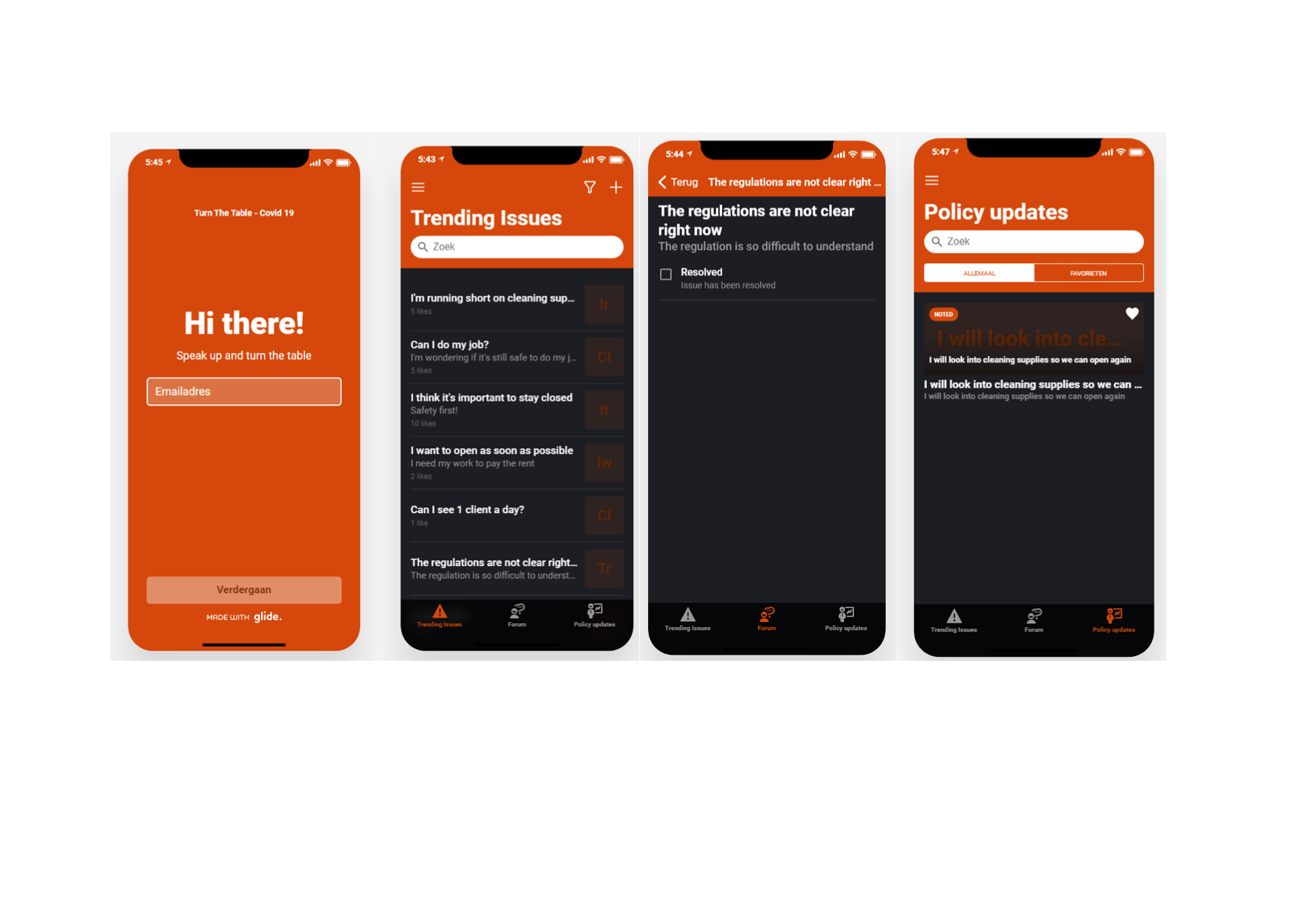
Our platform will provide a step-by-step connection between citizens and policy makers, through a combination of an app streamlining the input from citizens and a virtual table where representatives from different groups of citizens can meet and work out an advice on policy problems. e.g. the re-opening of bars and restaurants or the financial support of cultural institutions.
On the one hand citizen’s voices are not being heard at the table where policies are being made and on the other hand, especially in times of crisis, the decision makers cannot prioritize interacting with the citizens. Our platform solves that problem by providing the decision makers with valuable advice from the community they represent.
The Corona crisis intensifies a trend which has long been visible - the demand for digital democracy solutions. These solutions will be essential in rebuilding the society after the current crisis and our platform offers a unique approach by creating a table of representatives of different stakeholder groups which combines the top-down with the bottom-up approach where both, the decision makers as well as ordinary citizens give valuable input to the political discourse.
2. The solution we bring to the table
Target group
- Local citizens
- Local politicians, parties, experts, unions, identity-based groups etc.
Two-sided flow
- Top-down approach: proposed policies are introduced to possible affected citizens/stakeholders (Check constituency, avoid ineffective policy alienation).
- Bottom-up approach: citizens express their problems (or topics) and channel it through the Citizen’s Assembly (Table) to politicians and urge them to act. This process can be track-and-traced. Process - How it works
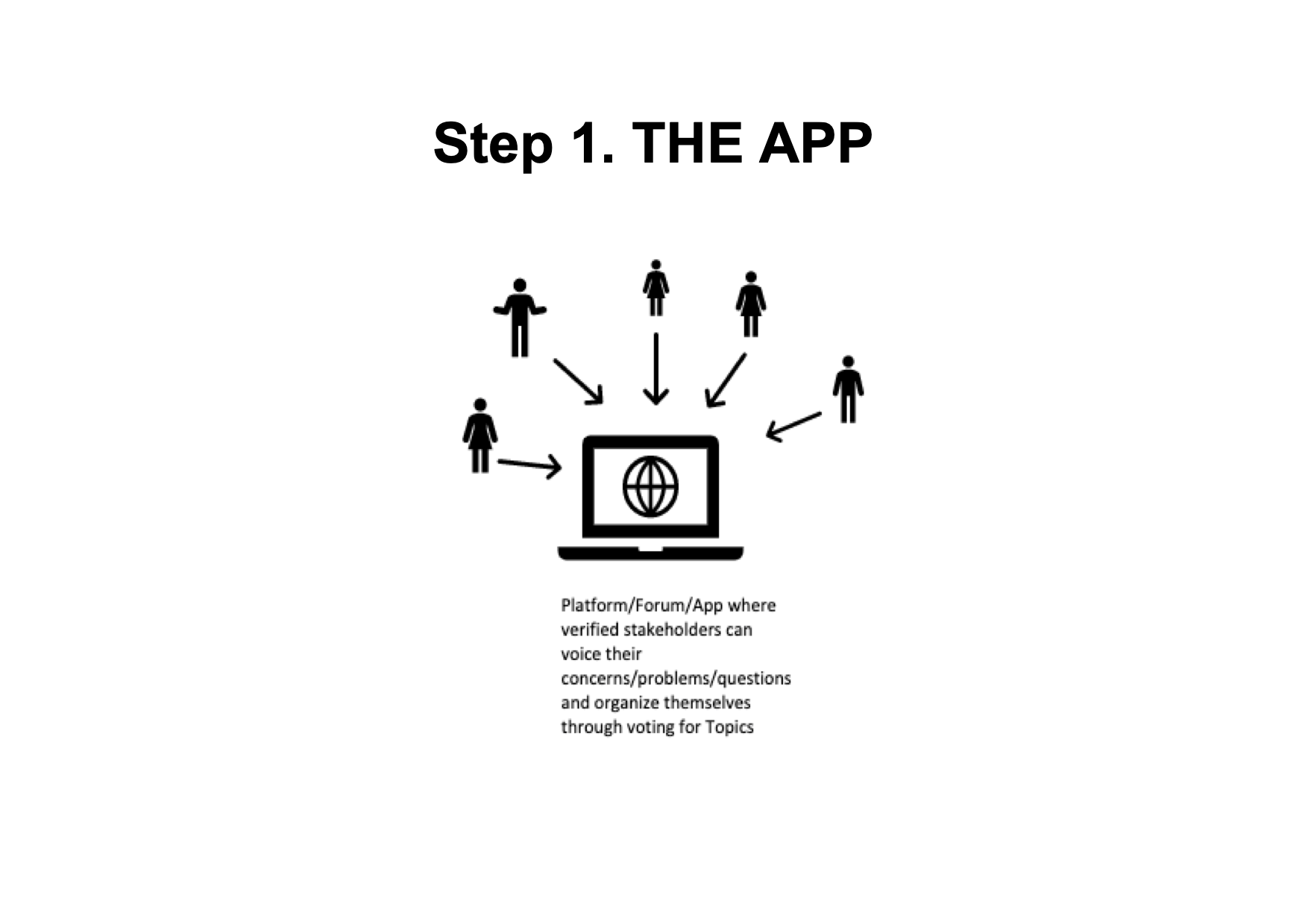
Step 1. THE APP
Participants can register on the platform: a. All inhabitants and companies within the municipality’s jurisdiction can register on the platform by entering a code they get via letter/e-mail; b. Registration code would be connected with the postal code (that would be the only mandatory information linked to your profile, additional information like age, profession etc. is optional).
How the agenda for table discussion will be set: a. If agenda/point gets certain number of upvotes (number to be determined by municipality, based on amount of app-participants) it becomes part of the table discussion agenda; b. If a topic doesn’t meet formal criteria (e.g. jurisdiction) it will be excluded from the agenda (regardless of the number of received upvotes); c. Municipality can add issues/proposals directly to the agenda; d. Table representatives can add issues directly to the agenda.
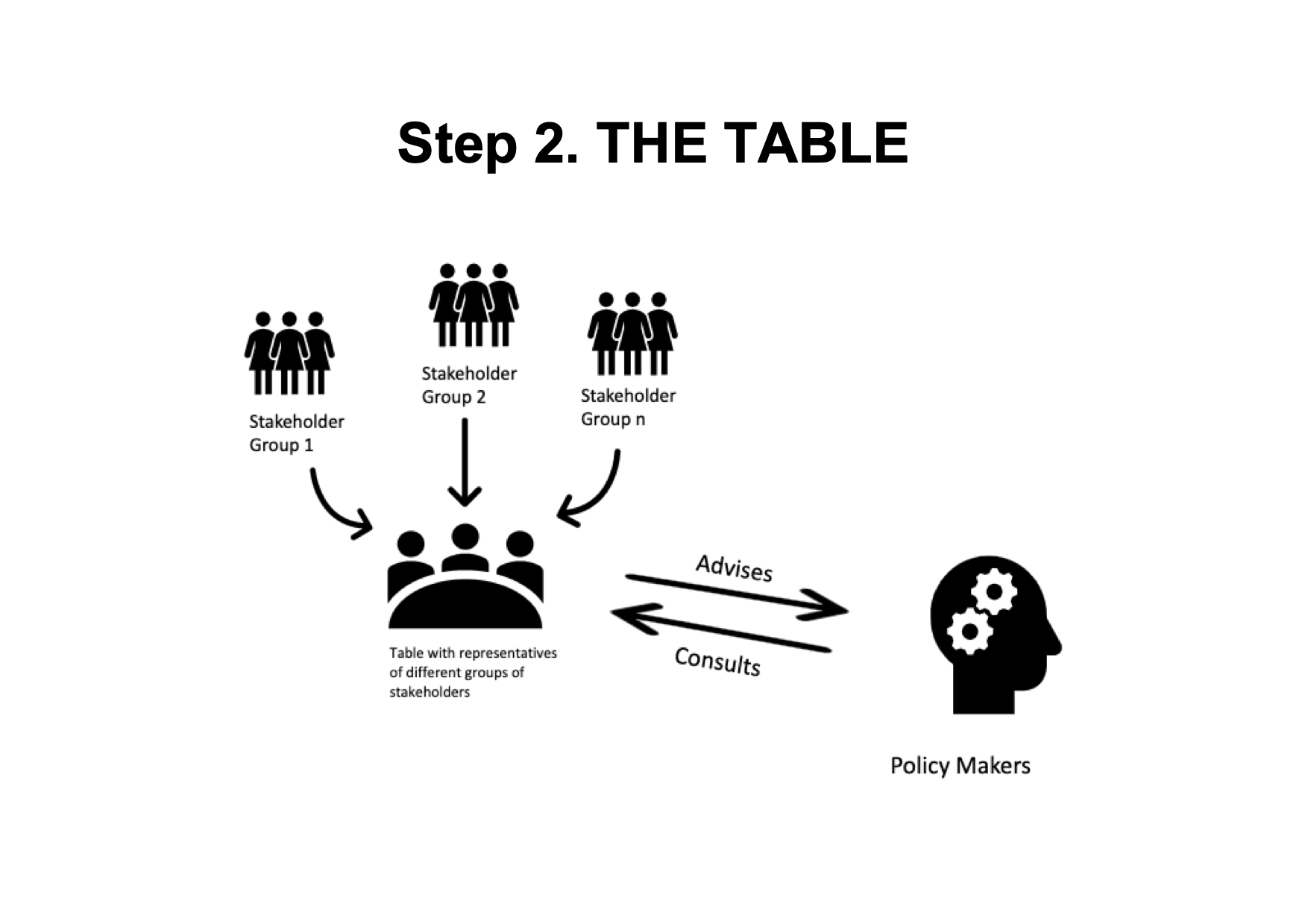
Step 2. THE TABLE
- Table representatives a. Are appointed for a certain period of time, during that time they are allowed to have a say in every table discussion happening. b. Analog to the G1000 initiative, certain citizens will randomly be invited to join the table. c. Every representative that takes part gets a discussion forum, on which all citizens can provide input; or topical platforms (business, health, environment etc.) an independent chairperson or intermediate will curate the table discussion. d. Procedures geared towards consensus, rather than ton majority voting. e. Table provides advice to city government and city council.
Unique selling points
Competitors/inspiration:
- Decidim: a community where citizens can create and present policy proposals (bottom-up approach);
- G1000: trending topics/questions are voted/ discussed by randomly selected citizens;
- Locali: app for citizens participation. The app connects citizens and local politicians with a bottom-up approach.
How are we different?
- Linking citizens and policy makers both ways, top-down communication & bottom-up;
- No harassment/trolling a. Positive Environment → only inhabitants of municipality’s jurisdiction (connected through postal code). b. Anonymity of citizens who vote for topics;
- Social Solidarity a. Community Forums;
- Transparency a. Social Contract → Politicians who join community forums pledge to keep the citizens informed (accountability) b. Direct link between Topic-voters and Table-Talk representatives.
Marketing
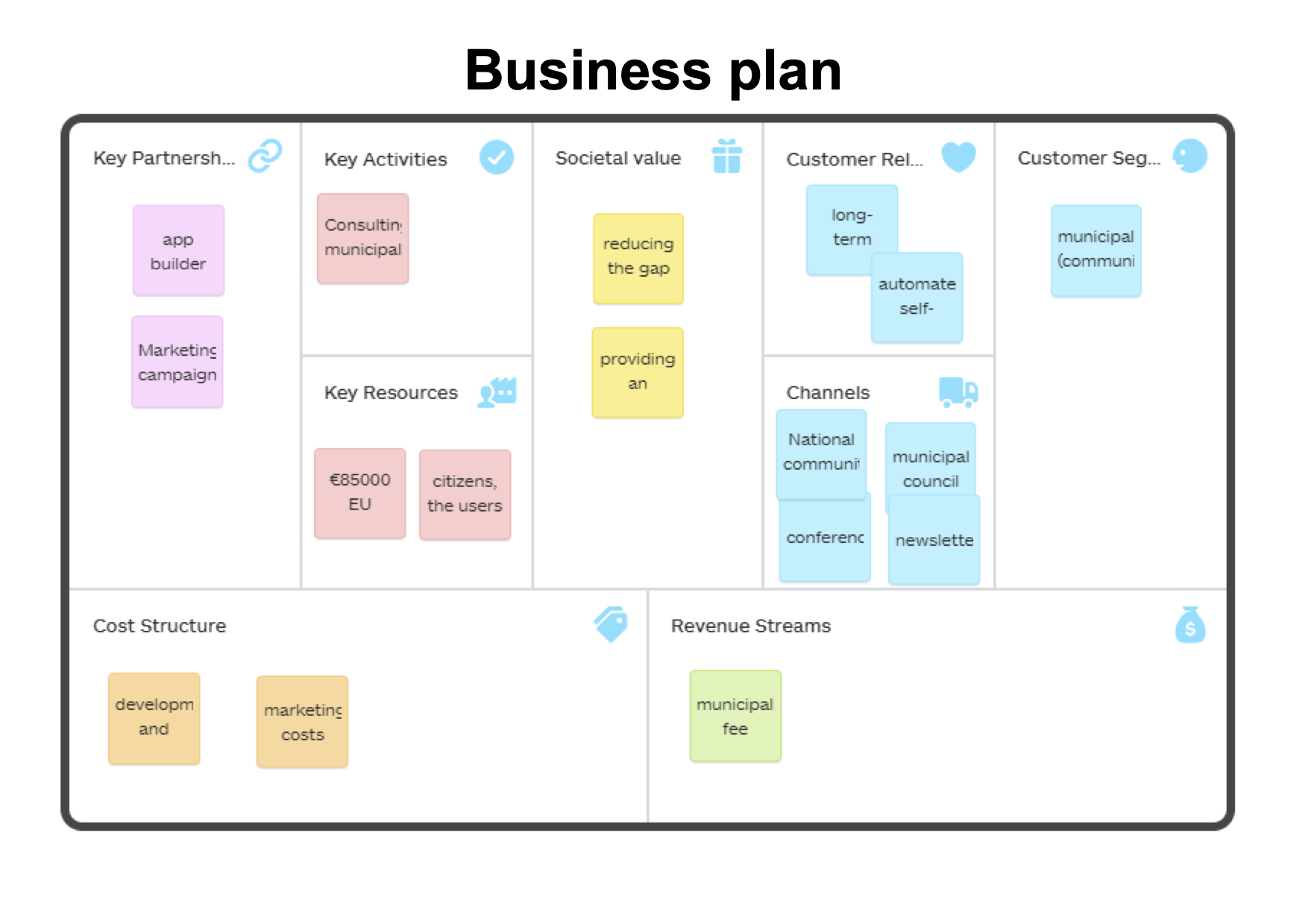
- pilot cities
- promotion from municipalities
- content marketing
- online and print newspaper
- social media ads
Dealing with privacy issues
- Separation between identifier and discussion chair to protect the identity a. Identity verification by the identifier b. Discussion chair responsible within the forum
- Anonymity for the app users
- Individual data cannot be stored
- Two-step identification (use of identifier)
- App user & app builder: No data about location, age, gender
3. What we have done during the weekend
We are a team consisting of students and professors from the Faculty of Social Science of the Vrije Universiteit Amsterdam. Our different expertise in political science, organizational science and sociology enabled us to create a solution for the posed challenge within 48 hours. In line with the educational vision of the Vrije Universiteit Amsterdam, this endeavor encouraged students in our team to, as a part of their professional development, engage with real societal challenges (see: https://www.vu.nl/en/about-vu-amsterdam/mission-and-profile/strategy/index.aspx).
We began by defining what local democracy is and how the Corona crisis currently endangers it and subsequently divided ourselves into two groups, one working on a solution for direct democracy and the other one for representative democracy. By Saturday night we were able to merge our ideas and finalized the hybrid product and the details on Sunday.
4. The solution’s impact to the crisis
One of the biggest challenges of the Corona crisis is to find ways to deal with it in a way that includes all citizens and that is experienced as legitimate. If we fail to do that, it might undermine the effectiveness of the measures in the short run, and undermine democracy as a whole in the long run. Our platform will help to link local policy makers, civil society and ordinary citizens in the process of developing policies, and through that prevent this health crisis from developing into a serious democratic crisis.
5. The necessities in order to continue the project
In order to further develop the platform, we need to work on two issues.
- We need to team up with technological experts, who can help us to translate our ambitions to usable tools.
- Furthermore, we have to continue talks with politicians, representatives of civil society and ordinary citizens, to find out what are the exact features they are looking for in order to make the next step in digital democracy (agile).
6. The value of our solution(s) after the crisis
The gap between policy makers and citizens, and the invisibility of network tables is not new. Yet, it is even more explicit during the current crisis. This offers an excellent opportunity to pilot new solutions. If we use this crisis as an opportunity to test this kind of modernization of democracy, it will be highly beneficial for today's society and future generations. Our platform will offer an excellent learning environment for the upcoming digital world.
Our E-Citizen app can easily be adjusted to larger municipalities. It is actually even designed to organize discussions between thousands of citizens while involving everybody.


Log in or sign up for Devpost to join the conversation.