-
-
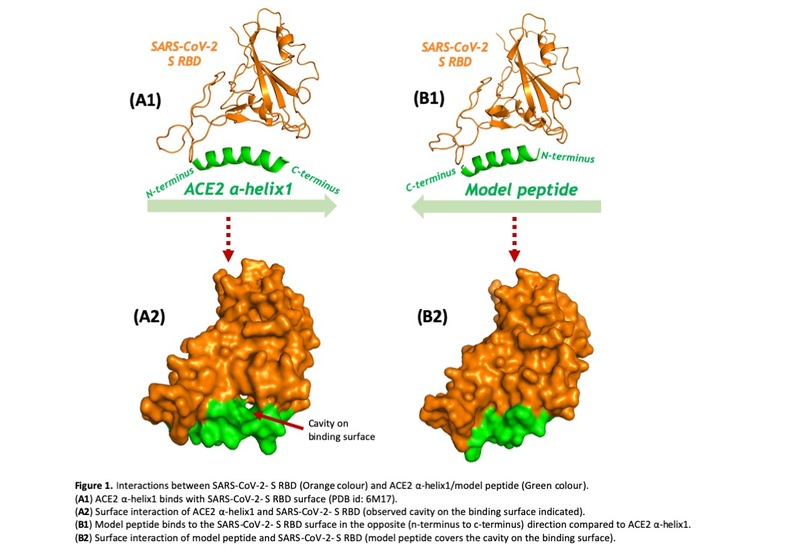
Interactions between SARS-CoV-2- S RBD (Orange colour) and ACE2 α-helix1/model peptide (Green colour).
Inspiration
As of 14th of April 2020, almost half of the world has gone into lockdown due to COVID-19 pandemic, creating an immense economic burden on the affected nations that may take a generation to recover.
What it does
Peptides with high affinity to SARS-COV-2 S protein RBD can be delivered by inhalation (nebulizer) or spray to the upper respiratory tract where the virus load can be high. These peptides can also be used as intravenous prophylactics for treating COVID- 19 patients with severe symptoms. High-affinity peptides can also serve as a key tool for antigen testing of SARS-COV-2 during the early days of infection.
How we built it
We designed peptides with very high affinity to SARS-CoV-2 S protein by introducing smart mutations in ACE2 α-helix1, based on the biochemical and structural study of RBD-ACE2 binding of SARS-CoV and SARS-CoV-2 followed by computational deep learning of the structural data. These peptides are being analysed by computational modelling and docking with PEP-FOLD and HADDOCK servers.
Challenges we ran into
- Working online with team members living in different time zones was very challenging during this lockdown
- It was difficult to find suitable peptide modelling servers
- Finding a suitable wet lab for in-vitro studies was difficult
Accomplishments that we're proud of
We have been working on designing peptide drugs for the prevention and treatment of COVID-19 for the last 4 weeks. Using our combined experience of 25 years in infectious diseases and drug development, we have designed and validated 5 such peptides (between 6-19 amino acids) using computational modelling and docking using PEP-FOLD and HADDOCK Server. Our smart peptides are the fusion of deep mining of biochemistry, proteomics and structural biology data published since 2003 on SARS-CoV S protein, SARS-CoV-2 S protein, MERS-CoV S protein and human ACE2 receptor. The binding affinity demonstrated by these peptides toward SARS CoV-2 receptor-binding domain (RBD) gives us the confidence that we can make something a lot better than we were hoping for when we started.
What we learned
We have learned that there are no effective drugs for treating COVID-19 infection and it will take at least two more years for the first drug to roll out in the market. It is possible to design peptides with very high binding affinity to SARS-CoV-2 S protein-based on the biochemical and structural study of RBD-ACE2 binding to SARS-CoV and SARS-CoV-2. Developing a smart peptide drug against SARS-CoV-2 will give us preparedness for the prevention and treatment of any such emerging coronavirus with significant mutations and higher virulence. We have also learned that using nanoparticles, the challenges of targeted peptide delivery can be mitigated.
What's next for A smart peptide solve the COVID-19 (SARS-CoV-2) pandemic
We will carry out in-vitro experiments with peptide drugs under development. The peptides that demonstrate efficient in-vitro binding with SARS-CoV-2 RBD will undergo further mutations for enhancing the binding affinity further. The synthesis process of these peptides with potential will be optimized for improved performance. These peptides will then undergo modifications for improved in-vivo stability. Then these peptides will be modified according to the planned delivery mechanisms. The delivery efficiency, in-vivo stability and binding performance of these peptides will be tested in animal models. We hope to shortlist 3 peptide molecules for pre-clinical and clinical trials by the end of 2020. We intend to exploit nanoparticles for delivering our peptides to intended target cells and devising diagnostic tools for early diagnosis of SARS CoV-2 infection.
Built With
- computer-modelling
- drug-discovery-knowledge
- literature-review
- proteomics
- virology





Log in or sign up for Devpost to join the conversation.