-
-
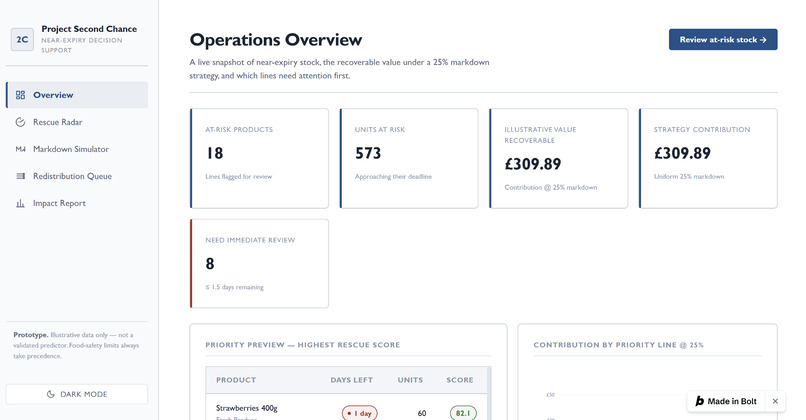
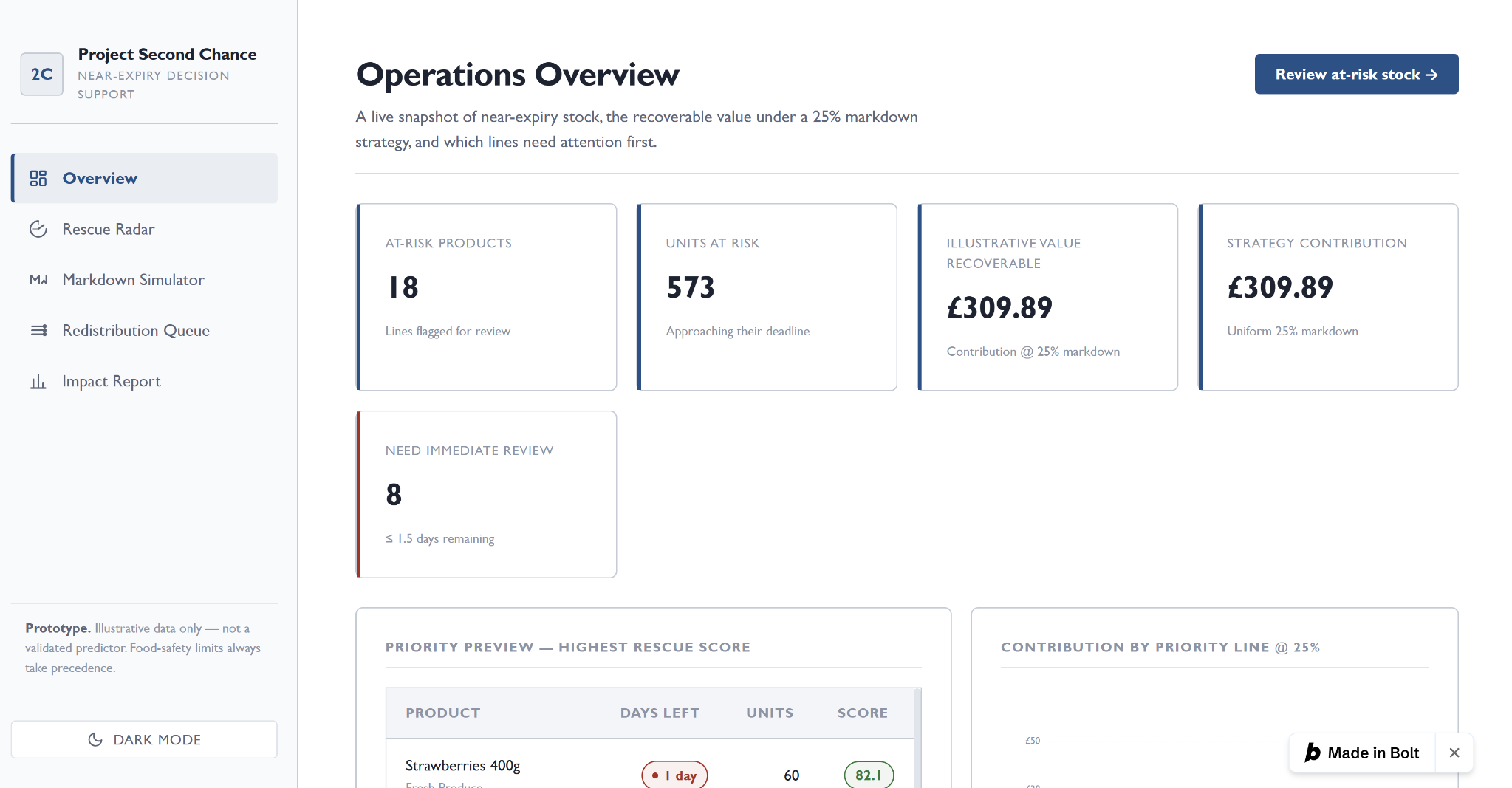
Operations Overview
-
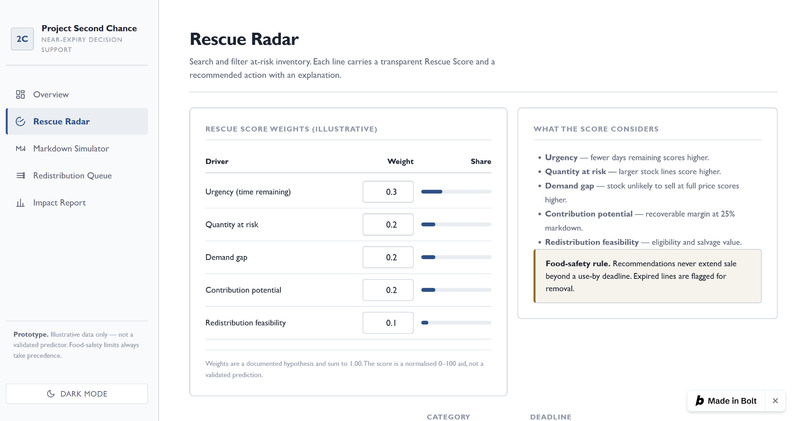
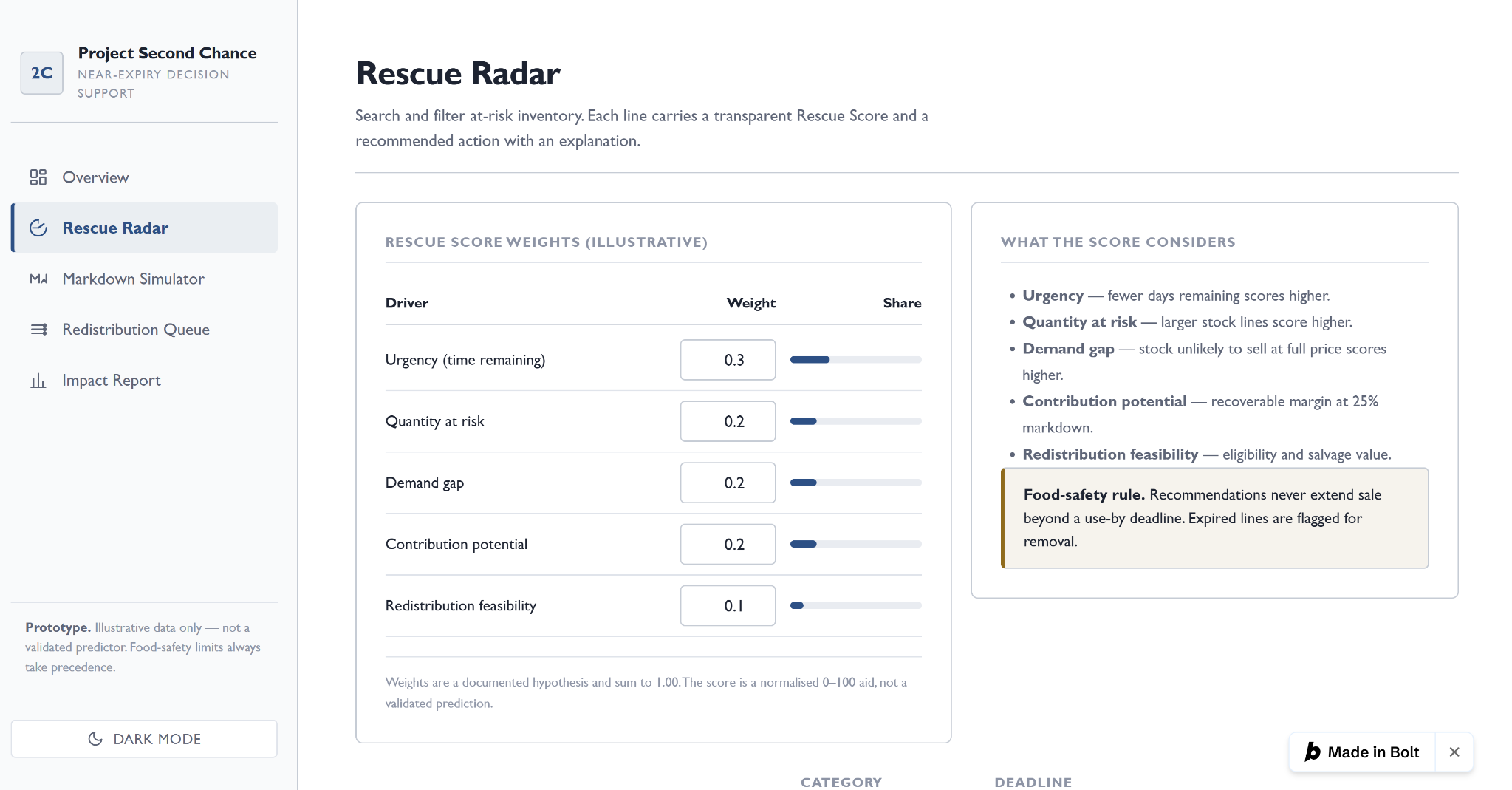
Rescue Radar #1
-
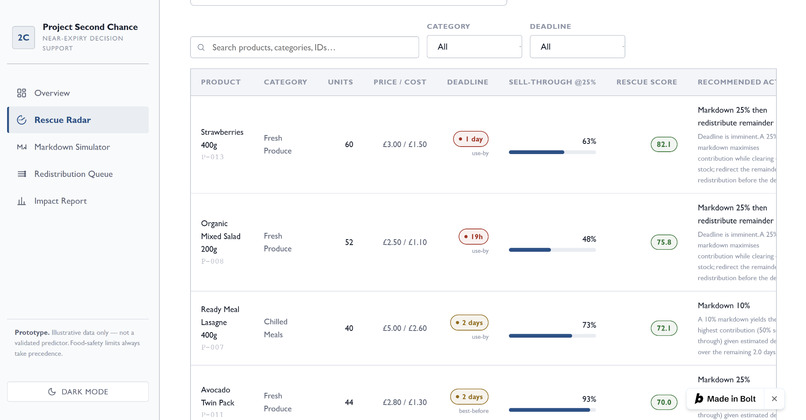
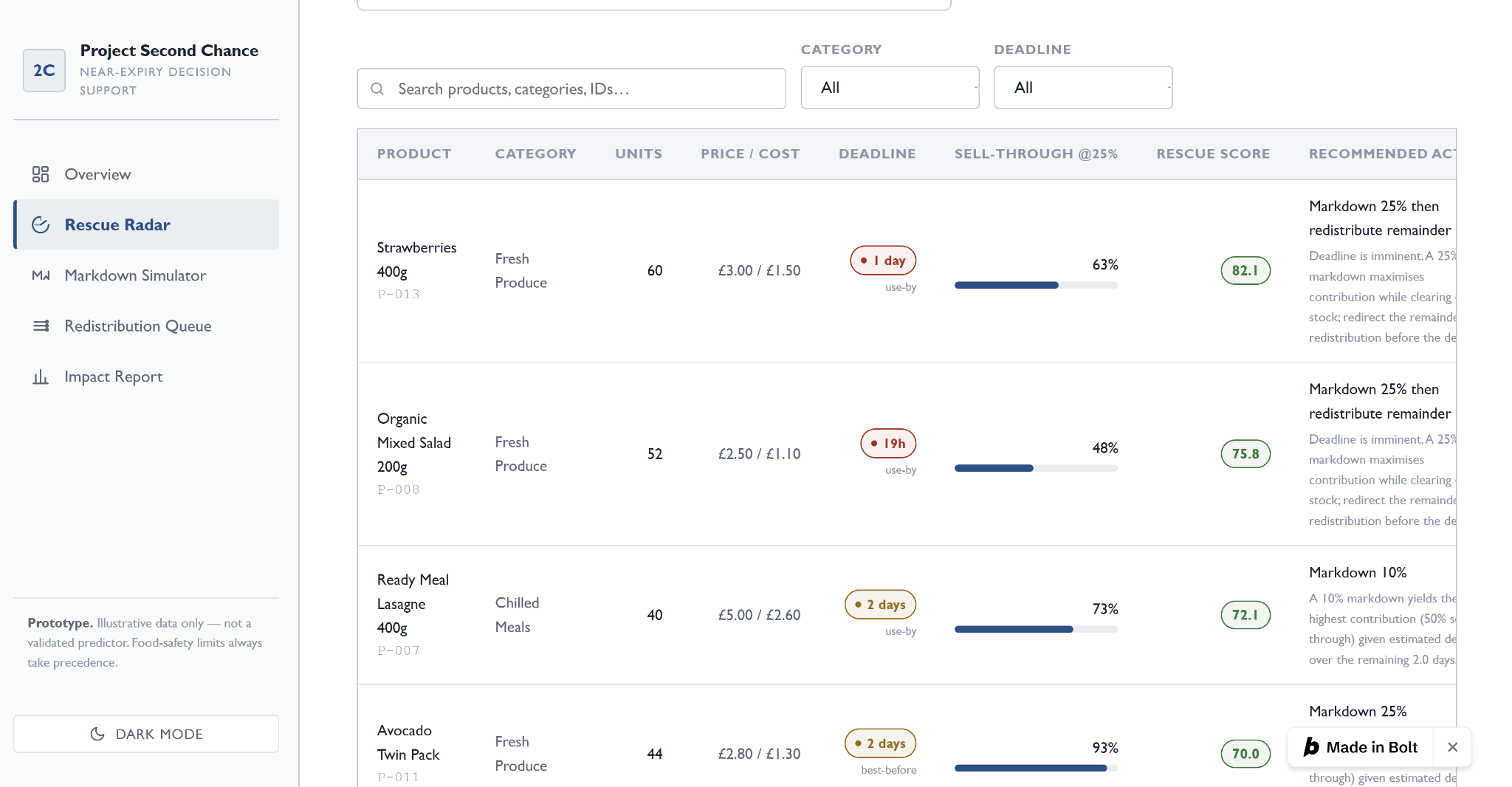
Rescue Radar #2
-
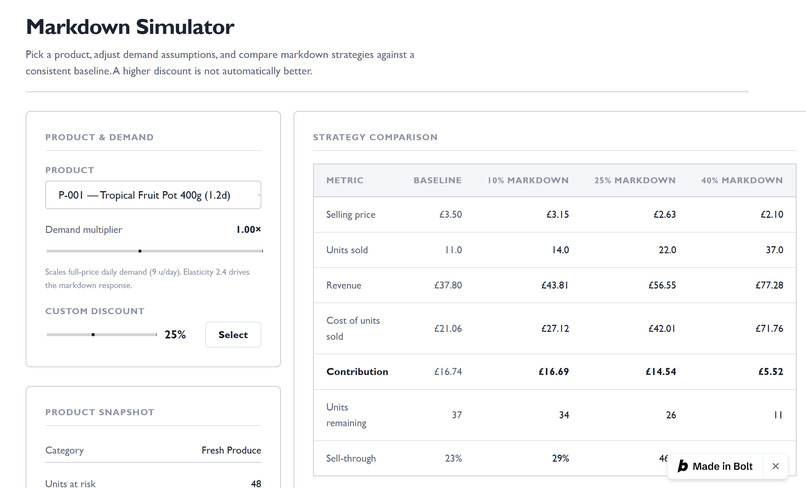
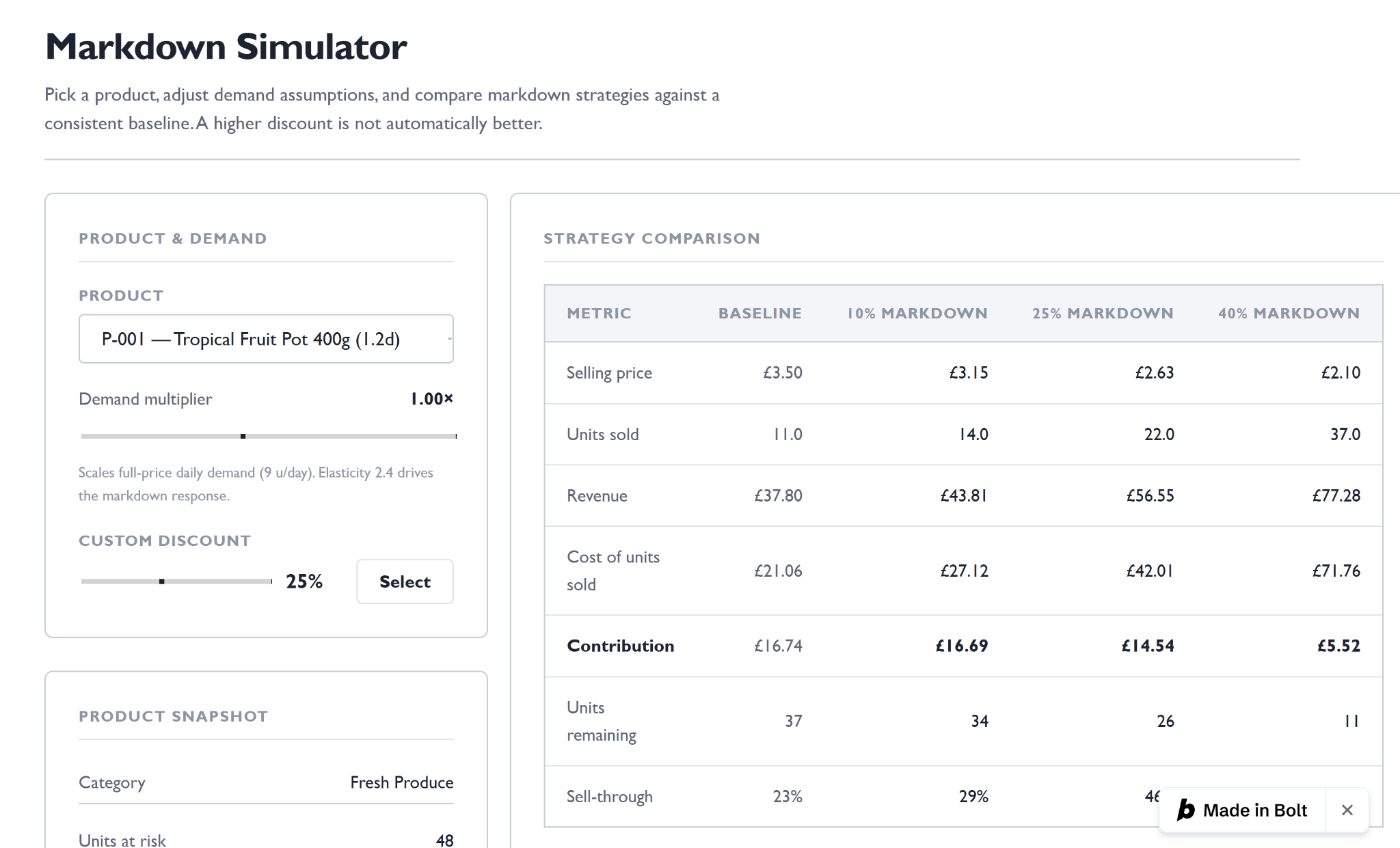
Markdown Simulator
Inspiration
Food waste is one of the challenges facing the global grocery industry. Every day, supermarkets have to make decisions about products approaching their use-by dates. Should they apply a markdown? How large should it be? Could the remaining stock be redirected for redistribution instead?
What caught our attention was that these decisions are not as straightforward as they might seem. A product with very little time remaining does not necessarily need the biggest discount, and maximising sales does not always mean maximising contribution.
We wanted to explore whether a transparent, data-driven decision-support tool could help grocery store teams make these decisions more intelligently.
That idea became Project Second Chance.
What it does
Project Second Chance is a grocery inventory decision-support prototype designed to help store teams manage near-expiry products.
It brings together five key features:
- Overview: Provides a snapshot of at-risk inventory, quantities requiring attention and illustrative financial indicators.
- Rescue Radar: Prioritises products using a transparent Rescue Score based on urgency, quantity at risk, demand gap, contribution potential and redistribution feasibility.
- Markdown Simulator: Compares different pricing strategies, including 10%, 25% and 40% discounts, to illustrate their effects on projected sales, revenue, contribution and remaining inventory.
- Redistribution Queue: Helps organise the next steps for eligible unsold products that may be suitable for redistribution.
- Impact Report: Compares the projected outcomes of different strategies and makes their financial trade-offs visible.
Our central idea is simple: the goal isn't to discount everything harder. It's to make better-informed decisions about what to sell, when to reduce the price and what to redirect.
How we built it
We approached Project Second Chance as a practical software prototype rather than just a conceptual solution.
We used AI-assisted development through Bolt to build a browser-based application with an interactive dashboard, product inventory views, markdown simulations and an impact reporting interface.
We structured the application around five interconnected sections, ensuring that the user could move from identifying an at-risk product to evaluating possible actions.
An important part of the development process was designing the decision logic behind the interface. We introduced a weighted Rescue Score to make product prioritisation more transparent and built financial calculations to compare different markdown scenarios.
We also incorporated sample grocery inventory data to demonstrate how the system could work in a realistic store environment.
All sample inventory, demand estimates, scores and financial projections are illustrative. They are not actual Tesco operational data or verified real-world outcomes.
Challenges we ran into
One of our biggest challenges was balancing multiple competing factors within a single decision-making process.
A deeper discount might increase the number of units sold, but it could also reduce contribution. Similarly, prioritising the most urgent product without considering demand or redistribution options could lead to an incomplete decision.
Getting the financial logic right was another challenge. We had to distinguish revenue from contribution, account for the cost of units sold and ensure that inventory quantities and projected sales remained consistent.
We also had to think carefully about food safety. Commercial optimisation should never override product-specific safety requirements or permitted sale deadlines.
Finally, translating these ideas into a clear and accessible interface required careful consideration. We wanted the application to feel like a practical tool that store teams could understand, rather than an overwhelming analytics platform.
Accomplishments that we're proud of
We're proud to have turned an initial idea into an interactive prototype with a complete decision-support workflow.
Some of our key accomplishments include:
- Building an integrated dashboard for near-expiry inventory management.
- Developing an explainable, weighted Rescue Score rather than relying on an unexplained recommendation.
- Creating an interactive markdown simulator that demonstrates the trade-off between sales volume and contribution.
- Incorporating a redistribution workflow alongside pricing decisions.
- Bringing financial comparisons and operational recommendations together in one interface.
Most importantly, we're proud of the central approach behind the project: treating near-expiry inventory as a decision-making challenge rather than simply a discounting problem.
What we learned
Building Project Second Chance taught us that solving a real-world problem requires more than building an application that looks good.
We learned how important it is to understand the decisions people actually make, identify the variables influencing those decisions and translate them into understandable software.
We also learned that financial metrics need to be handled carefully. Revenue, contribution, waste avoided and recovered value are different measures, and confusing them can make an otherwise promising solution misleading.
Another important lesson was the value of explainability. A recommendation becomes much more useful when the person receiving it can understand why it was made.
Finally, we learned how AI-assisted development can accelerate the process of turning an idea into a working prototype, while still requiring human judgement to verify calculations, assumptions and the overall quality of the solution.
What's next for Project Second Chance
Our next objective is to move beyond an illustrative prototype and towards real-world validation.
We would like to:
- Validate the decision model: Work with grocery professionals to refine the Rescue Score factors and their respective weights.
- Introduce real operational data: Integrate actual inventory, sales, pricing and product deadline information, subject to retailer permissions.
- Conduct user testing: Compare decisions made by store teams with and without Project Second Chance.
- Run a small-scale pilot: Evaluate whether the tool can improve decision-making, sell-through and contribution while respecting food-safety requirements.
- Explore commercial deployment: Investigate a business-to-business subscription model that could make the platform accessible to grocery retailers of different sizes.
We see Project Second Chance as an opportunity to make grocery inventory decisions more transparent, informed and responsible.
Rescue More. Waste Less. Decide Smarter.
Built With
- ai-assisted
- bolt.new
- css
- javascript
- lucide
- react
- tailwind
- typescript
- vite

Log in or sign up for Devpost to join the conversation.