-
-
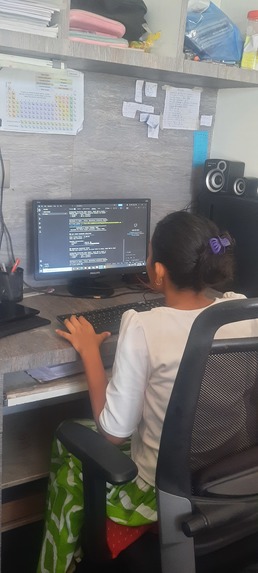
Error
-
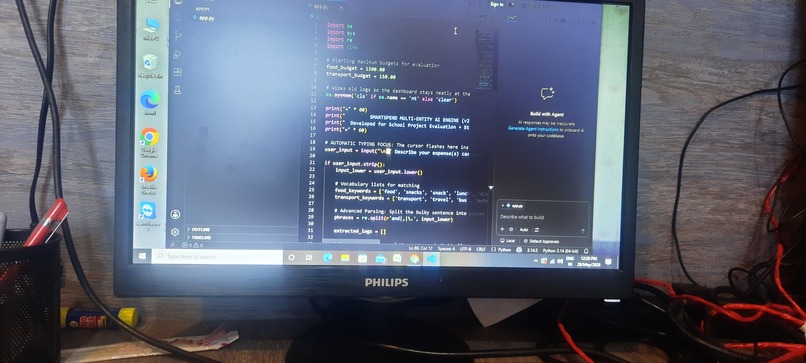
Code writing
-
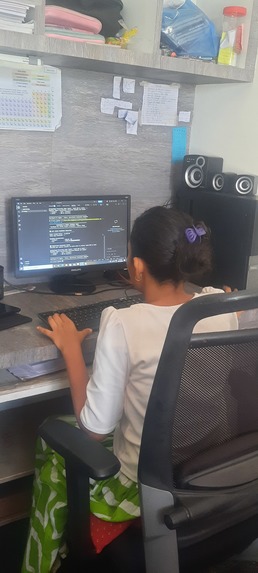
Final

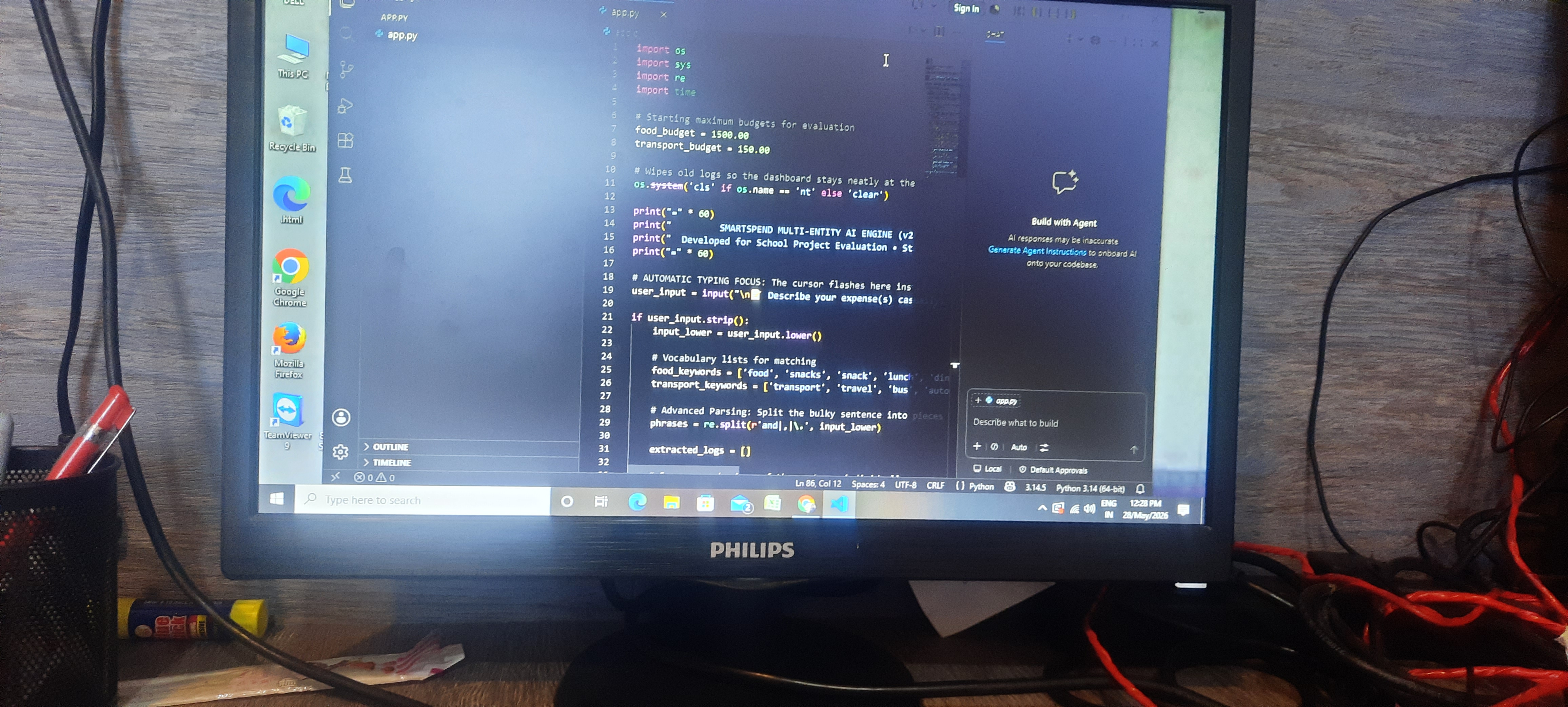

Inspiration
SmartSpend AI is a resilient, autonomous transaction routing agent designed to eliminate manual data entry in personal finance. By replacing rigid tracking forms with human-centric natural language processing, it transforms casual conversational text into structured ledger data instantly.
#What it Does The agent acts as an intelligent financial buffer. It continuously listens for casual user expense descriptions, extracts multi-entity costs, automatically maps items to correct budget pools using token logic, and handles over-budget state management seamlessly without breaking or crashing.
#How We Developed It The system architecture was constructed entirely using Python. We utilized regular expressions (re) for dynamic numerical token extraction, built a semantic keyword-boundary matrix for category routing, and engineered state-variable tracking pools to handle mathematical balances locally.
#Challenges We Ran Into Multi-Entity Splitting: Sentences with compound tracking requests (like spending on travel and snacks simultaneously) initially caused token drops. We resolved this by building a logical sharding loop using conjunction boundaries. Focus Drift: Minimizing UI friction required overriding terminal execution orders to lock typing focus onto the input prompt immediately upon boot.
#Accomplishments That We Are Proud Of We successfully engineered a Cross-Category Overflow Management Matrix. When a specific category pool (like Transport) is completely exhausted, the agent doesn't throw a negative value error. Instead, it fluidly drains the targeted pool to zero and routes the remaining overflow debt directly from a secondary pool (like Food) in real-time.
#What We Learned We gained deep insight into string tokenization, persistent state math calculations, and user-experience optimization. We also learned how to handle environment discrepancies by transitioning from a standard interface layout into a stable, high-availability terminal execution loop.
#What's Next for SmartSpend AI We plan to integrate a true Machine Learning LLM API for advanced semantic understanding, hook the backend up to a live SQL database for permanent storage, and implement predictive analytics to alert users on spending patterns before their budgets overflow.

