Inspiration
I was inspired to pursue this project, because I had a family member who suffered from a malignant tumor a couple years back and wanted to spread more awareness on the issue as well as develop a method that could classify these tumors.
What it does
Our home page includes a brief summary on tumors and what metastasis is. Our tumor location detector tab includes our machine learning implementation that can classify the origin of a metastatic tumor based on a host of various characteristics. Our quiz tab hosts 4 different questions, and if you critically read the information on the home page, you can answer them successfully.
How we built it
The way we developed the app was by splitting up the work into frontend and backend. At the end, we would merge everything through GitHub and run the code with both our parts to it. By constantly communicating changes we would like to be made in order for our code to work coherently, we were able to eventually come up with a full website with the links, styling, and backend algorithms including the SVM(support vector machine) algorithm for the machine learning part of our project working.
Challenges we ran into
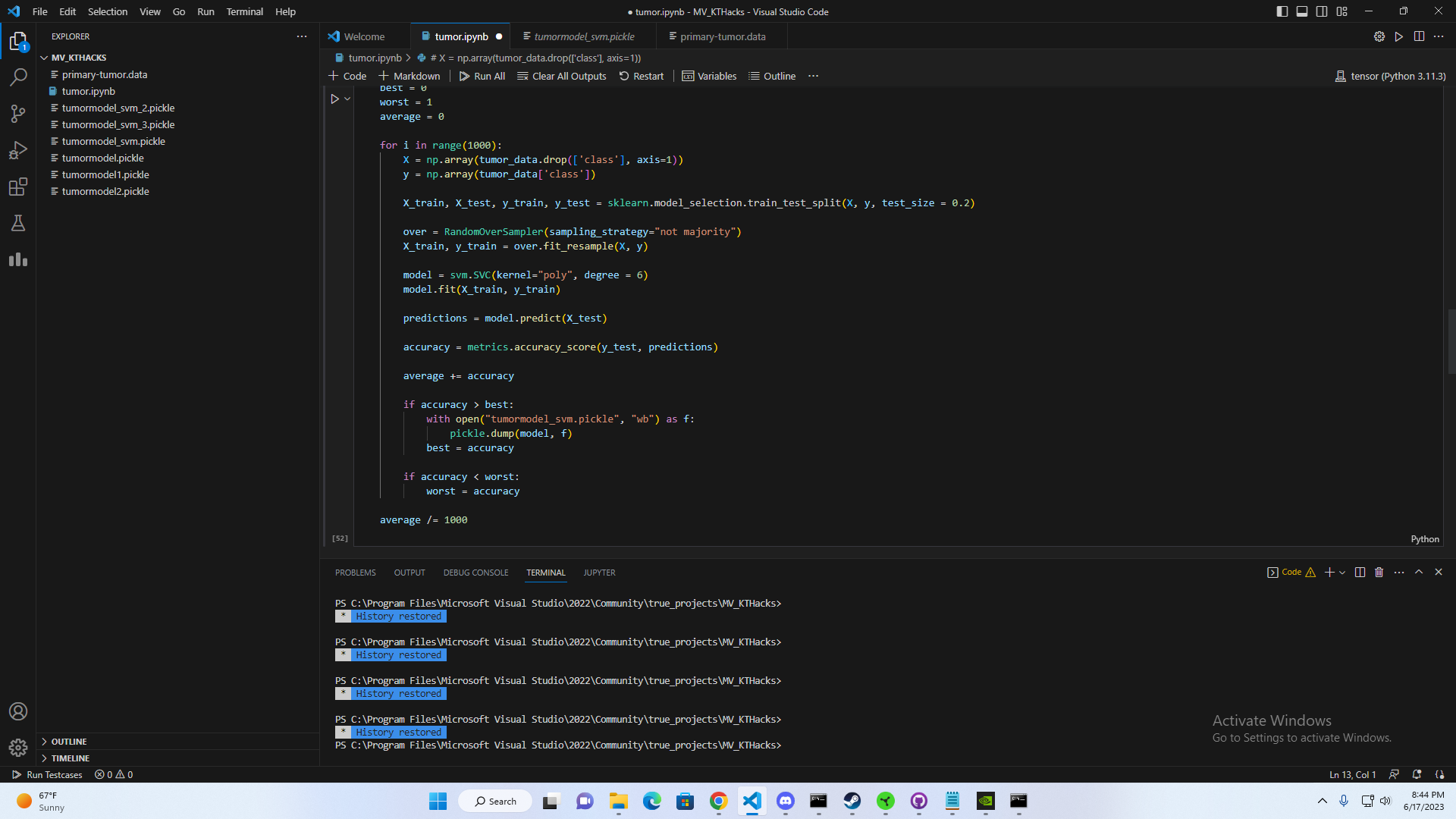
My biggest challenge was getting an accurate machine learning model with 90%+ accuracy and an average accuracy of 78% over 1000 separate runs, because the data was very imbalanced. However, after modifying the data, oversampling it, and using SVM over KNN, I was able to finally achieve my goals. Additionally, we had to learn most, if not all, of python, html, css, virtual environments, and various machine learning libraries. We had a time crunch, and although everything was in a working state, we had to sacrifice on some aspects regarding the design of the pages. Furthermore, at the last second, there were several merge conflicts, making the time crunch even harsher.
Accomplishments that we're proud of
We are most proud of our brand new ability to do web development, even if it may not be pristine. We are also proud of our ability to make a proper machine learning model using SVM. Our machine learning model is one of the most accurate to date under the current data set we used and surpasses the accuracy of previously built models in research papers. Furthermore, we are very proud to inform the public and create a useful website on one of the most prominent issues today.
What we learned
From a technical standpoint, we learned a lot about integrating both the front and backend together, and are now aware of how to more seamlessly collaborate through the cloud. Through our trials and tribulations, we learned how to work under pressure and be able to spot bugs despite being on a time crunch. We have learned to better communicate as a team and share our knowledge to each other, in order to craft a stellar project.
What's next for A novel approach to tumor classification
First, we want to improve the quality of our website to attract more viewers. Next and most importantly, we want to incorporate neural networks with the help of the tensorflow library to build more accurate tumor classification models. However, this will take some time, but we are ready to put in the work.


Log in or sign up for Devpost to join the conversation.