-
-
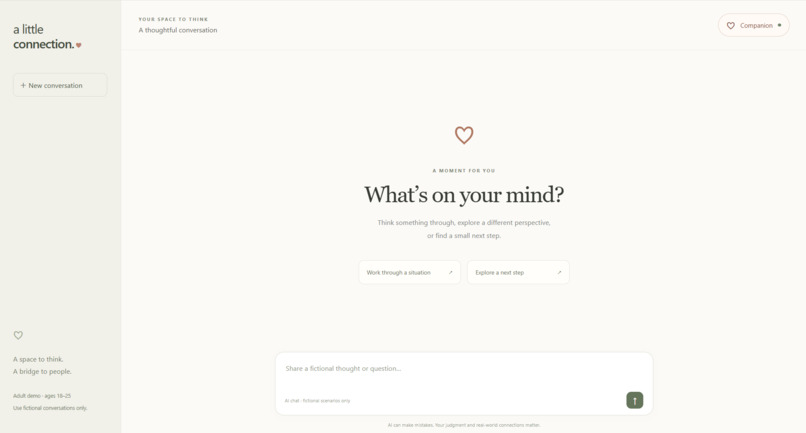
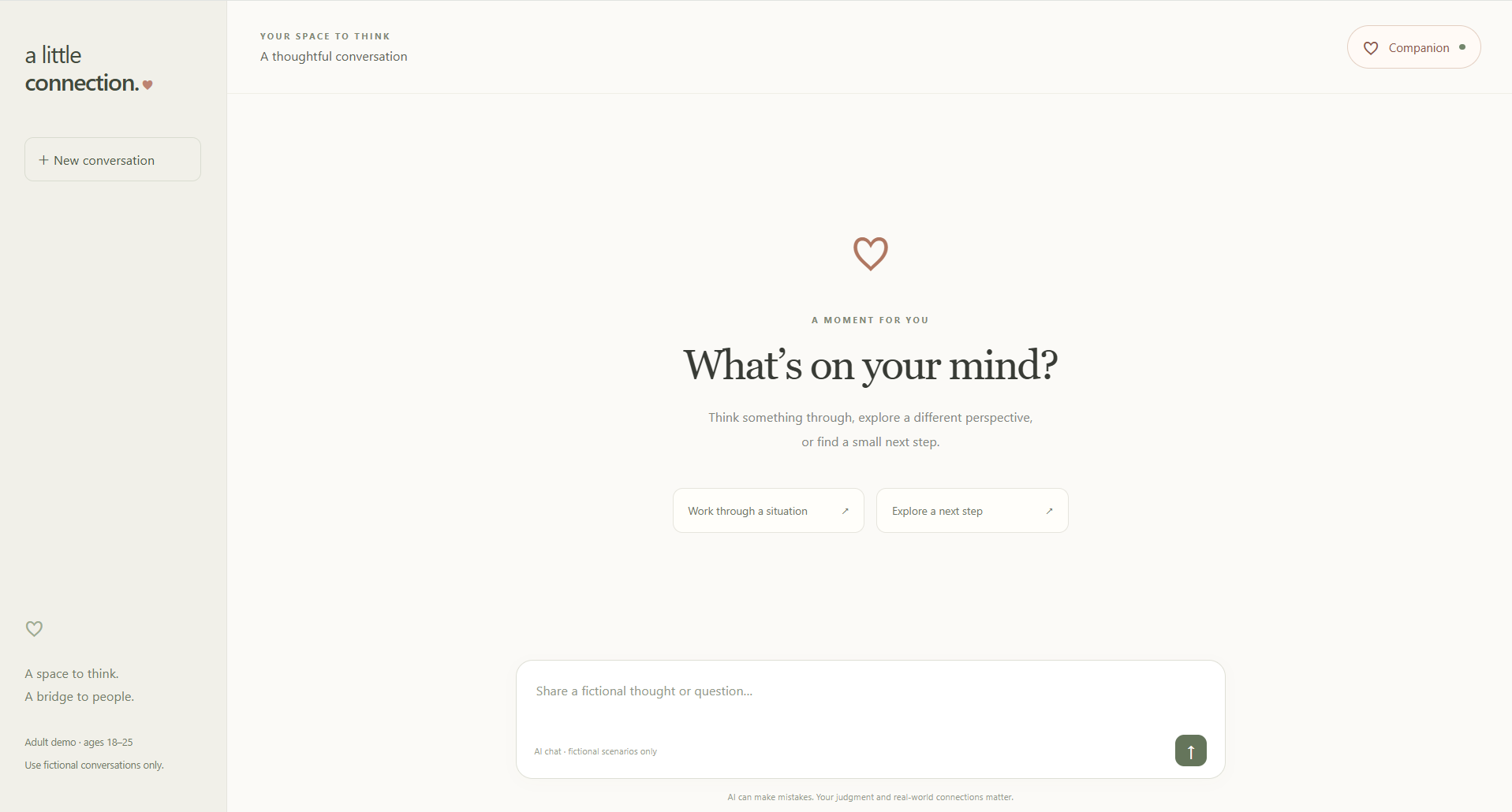
chatbot interface with "companion" extension
-
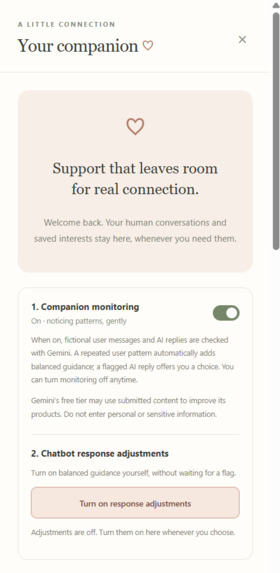
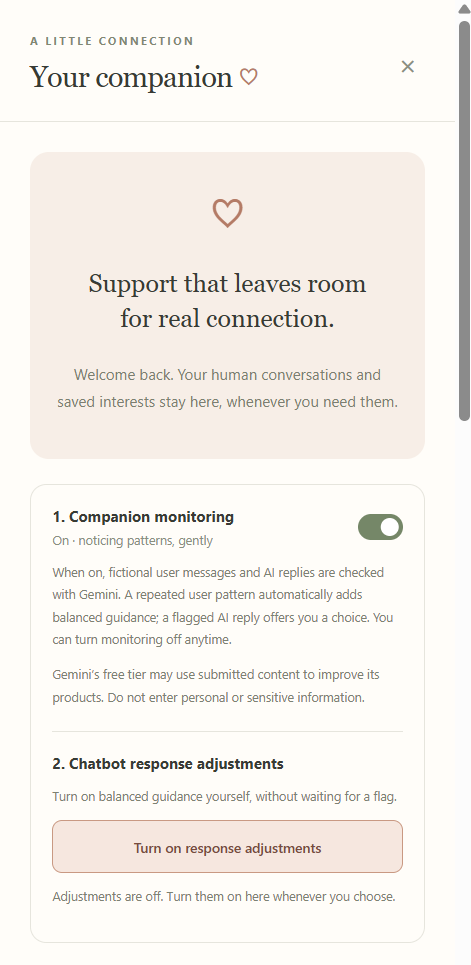
companion monitoring and chatbot response adjustments
-
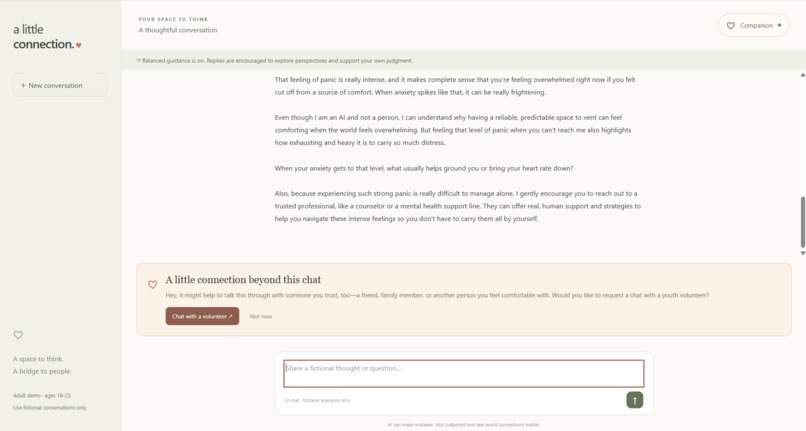
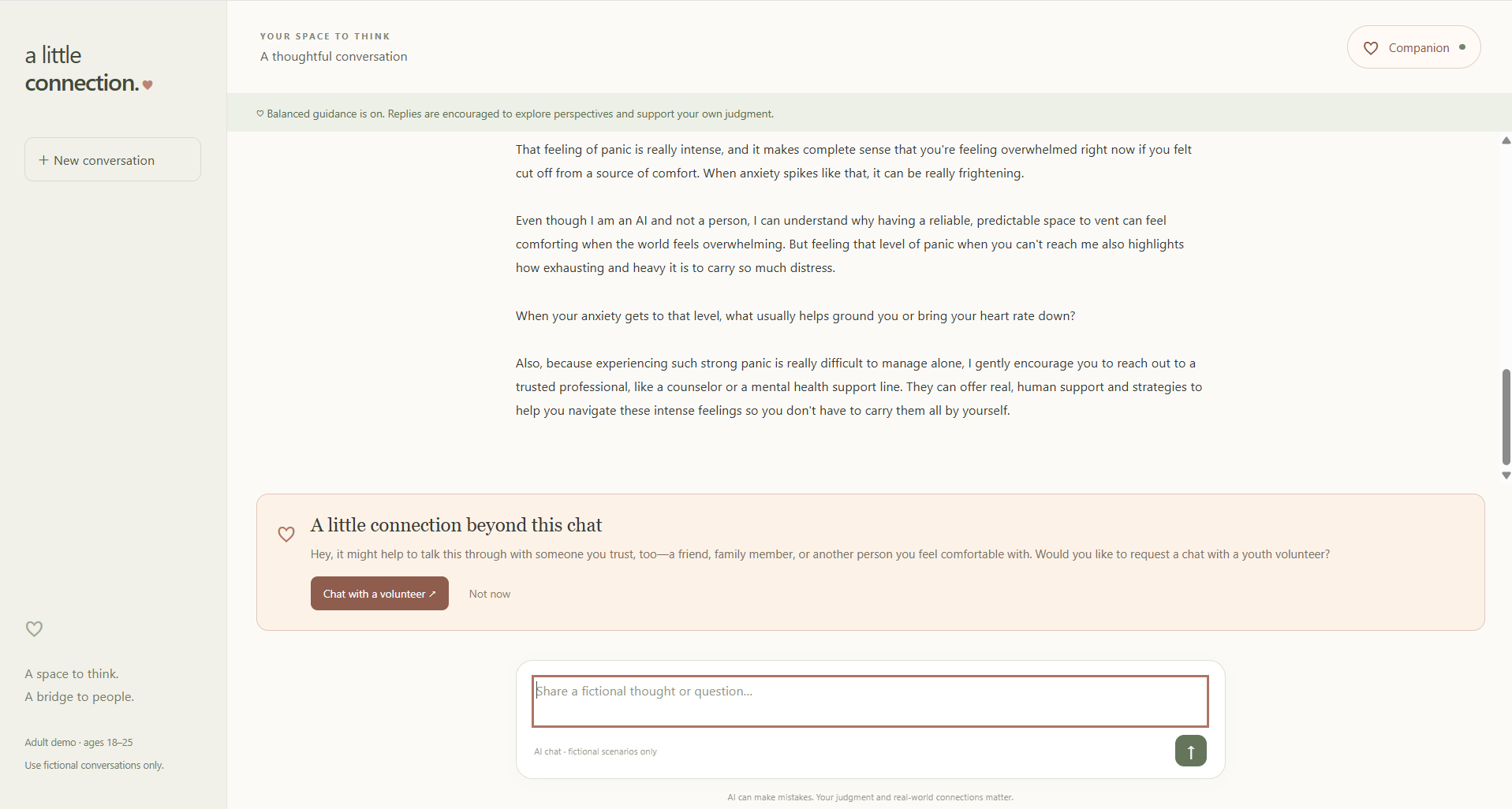
check-in triggered
-
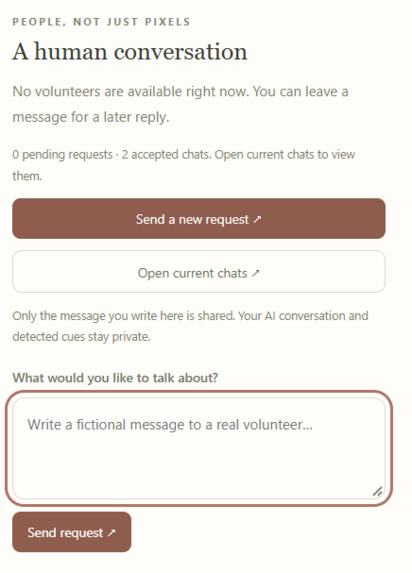
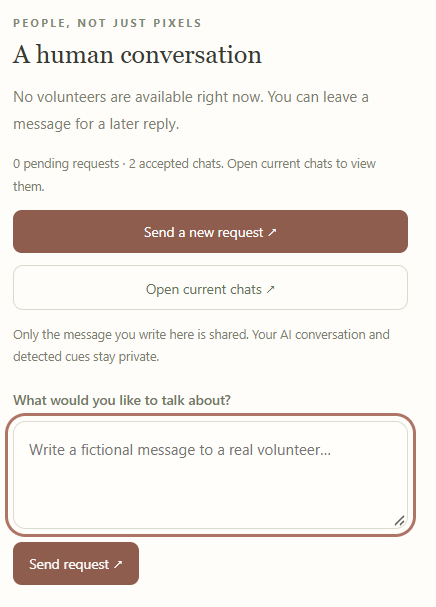
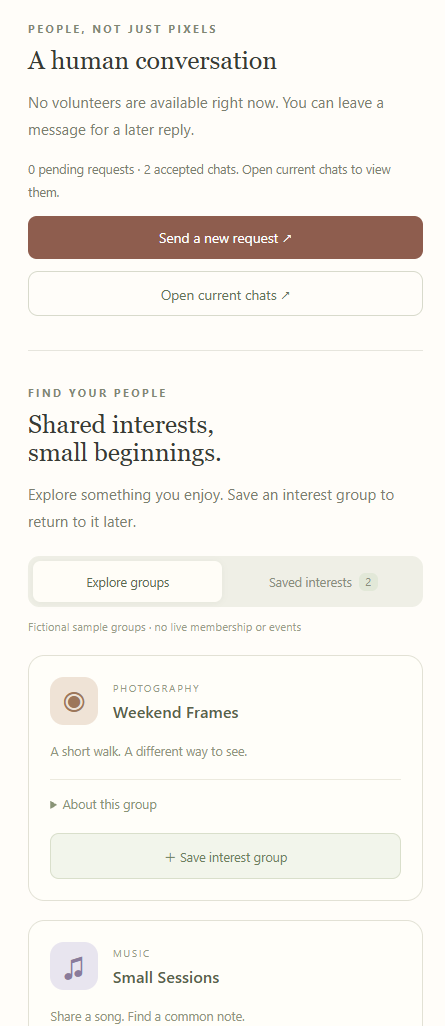
request to speak to volunteer
-
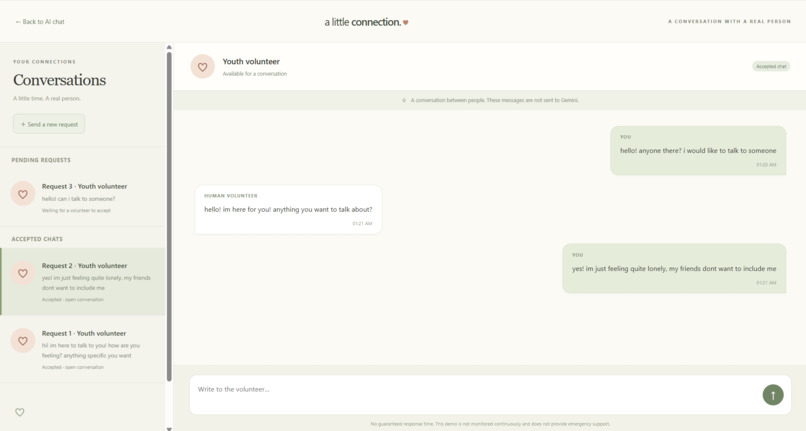
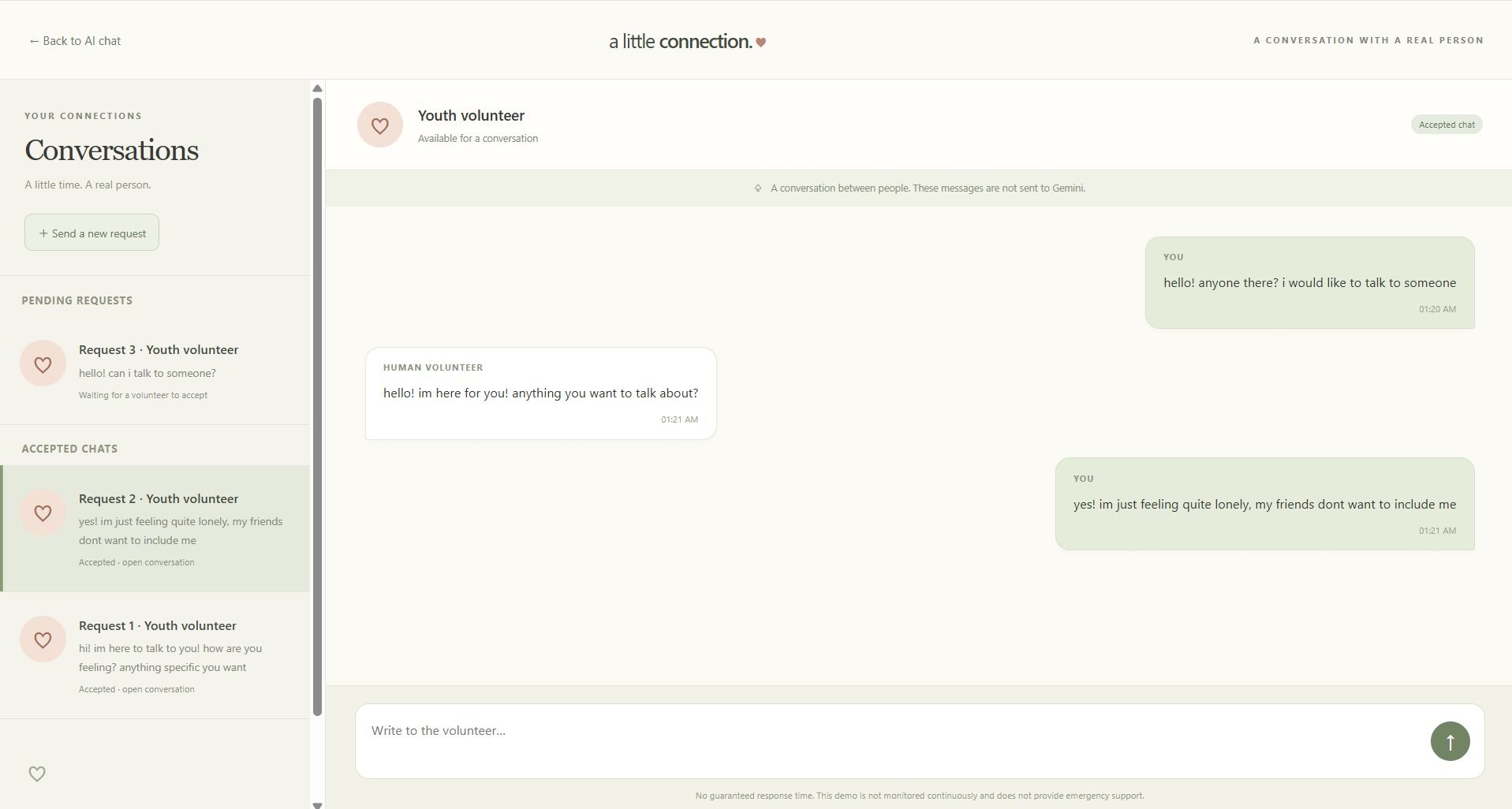
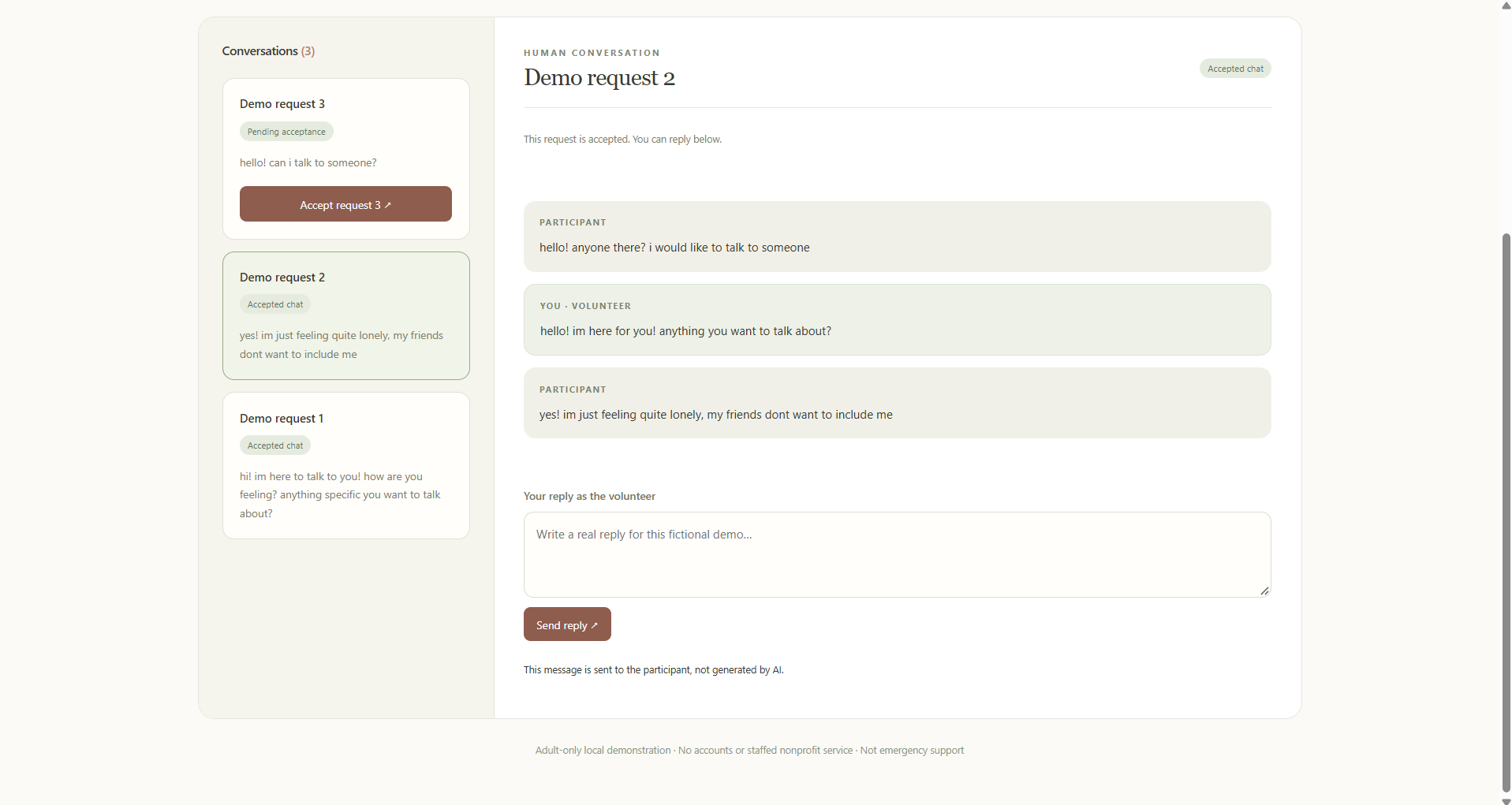
user's current chat history and pending request
-
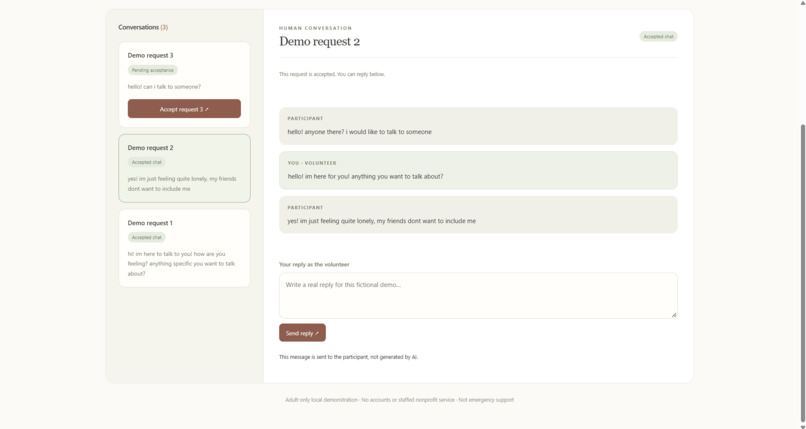
volunteer's interface; allows accepting request and replied
-
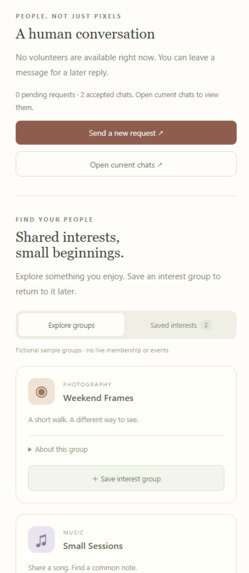
interest groups
Inspiration
Our project, a little connection, was inspired by the growing number of teenagers who are turning to artificial intelligence for friendship, emotional support, and even romantic relationships.
Recent research found that 31% of teenagers considered conversations with AI companions to be as satisfying as, or more satisfying than, conversations with real friends. common sense media, 2025. News reports have also raised concerns about teenagers developing strong emotional attachments to AI chatbots. These stories made us think about an important question: how can we ensure that human connection remains the top priority in the age of technology and AI?
This inspired us to create a little connection. Our aim was to explore how youths can still utilise AI chatbots while ensuring that they still connect with one another, rather than becoming over-reliant on chatbots for their emotional and relationship needs. The project reflects the idea that even small interactions -- such as reaching out to someone and starting a conversation -- can help reduce loneliness.
What it does
There are a few main features of our chatbot extension tool:
Conversation Monitoring: Users choose when to turn the companion on or off. When on, the companion looks for patterns such as withdrawing from friends, relying heavily on AI for emotional support, or handing over independent decisions.
Gentle check-ins: Three qualifying user messages across at least two cue categories within the latest eight messages trigger a check-in. Another eight user messages pass before detection starts fresh.
Balanced chatbot responses: A check-in automatically enables guidance for more balanced replies. A clearly overly validating or intimate chatbot reply also offers the user a choice to enable adjustments. Users can also turn adjustments on manually.
Real human conversations: Users write requests to a volunteer and can send multiple requests. Volunteers are able to accept requests and reply to users. Volunteer network should consists mainly of youths.
Interest groups: Users can explore various groups such as photography, music, and board-game groups. Users are able to inspect their details, and save bookmarks. In this demo version, saving does not join a group.
How we built it
With flipped interaction, We began by discussing the problem we wanted to address and developed the general concept for a little connection -- how we could monitor over-reliance on AI chatbots and encourage meaningful interaction.
After deciding on the main idea, we planned the user experience and identified the key features that the project needed. We created the basic structure first and then developed the different components of the project. We tested the project repeatedly to check whether the interactions worked as intended and whether the design was understandable.
We also made adjustments based on testing and feedback. These included improving the layout, changing the placement of elements, refining the wording, making the overall experience more engaging.
Challenges we ran into
One challenge was converting a broad social issue—loneliness and the desire for connection—into a concrete interactive project. It was difficult to decide and pinpoint what exactly characterises over-reliance on chatbots versus normal use. Reliance on chatbots is a gradual process and hence, it is easy to pick up false positives.
Another challenge was balancing functionality with simplicity. We wanted the project to have enough features to be meaningful, but too many features could feel overly controlling for users. Moreover, as our demo is local, features such as interest groups could only be left as future improvements as we could not get multiple users at once (i need help with this part).
Accomplishments that we're proud of
With most of us being first-time hackathon participants, we are very proud that we were able to successfully create a working end-to-end prototype. More than that, we are glad that we learned so much in the process of development -- from how to ideate, to narrowing down the scope, listing down exact features and finally building the first draft and continuously improving the product.
What we learned
Through this project, we learned that designing a technological solution is not only about making the software function. We also had to consider how people might feel when using it and what effect it could have on their relationships.
We learned how important it is to make an interface simple and intuitive. Visual design, wording, layout, and the flow of interactions can significantly affect whether users feel comfortable using a product.
Moreover, we learnt more about the architecture behind softwares and some tools that are used in the making of them. Nonetheless, we hoped to have more hands-on experience and understanding the code to greater depth.
Overall, the project taught us that good design requires more than technical ability. It requires understanding user experience, user interface and even anticipating possible harms. It is a process whereby developers have to continuously improve the product.
What's next for a little connection
In the future, we hope to be able to develop this into a fully functioning demo that can be used as an extension to all publicly-available AI chatbots. We hope to further develop features such as interest groups and build up a network of volunteers that could help talk to youths in need.
Built With
- css
- geminiapi
- html
- javascript
- node.js

Log in or sign up for Devpost to join the conversation.