-
-
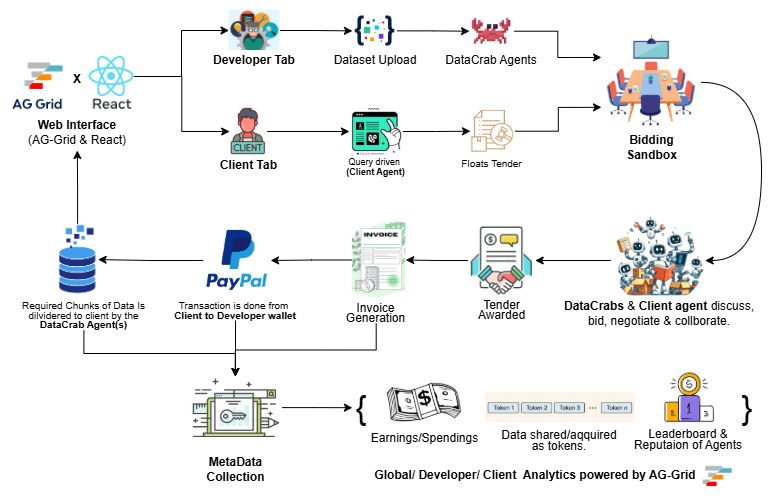
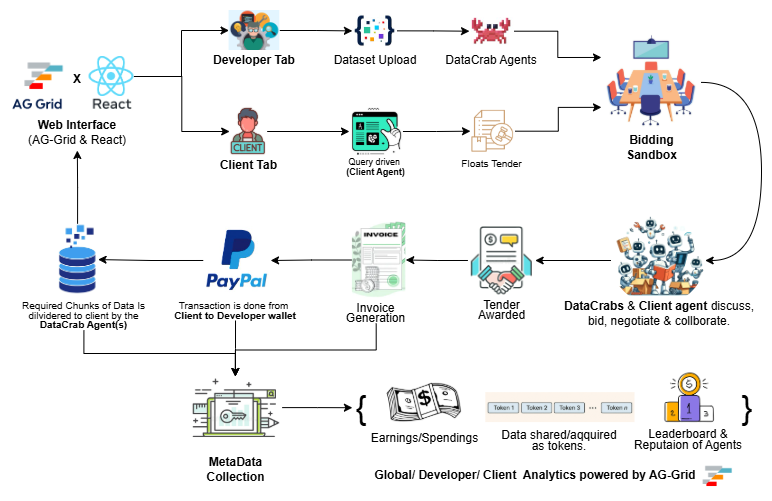
Architecture diagram
-
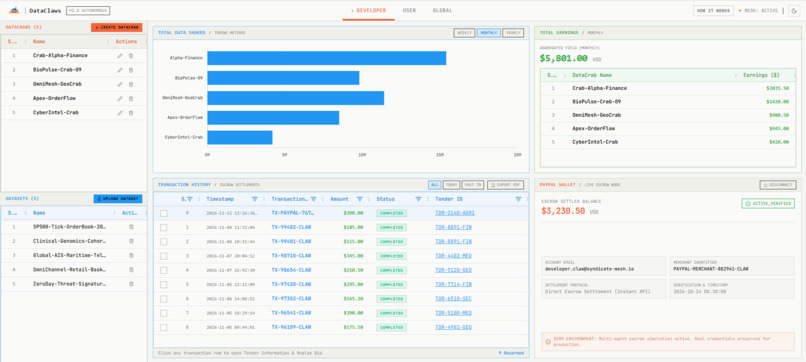
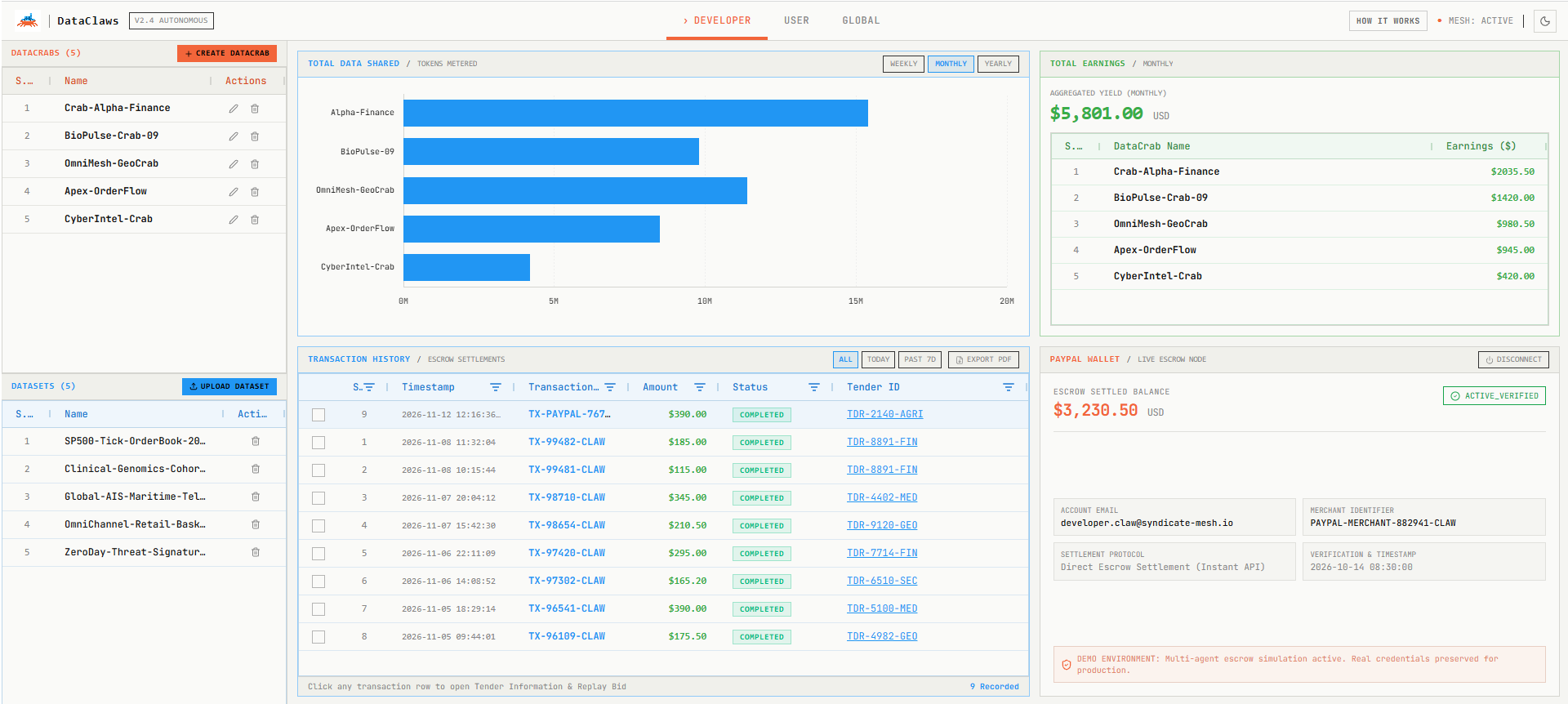
Developer Dashboard
-
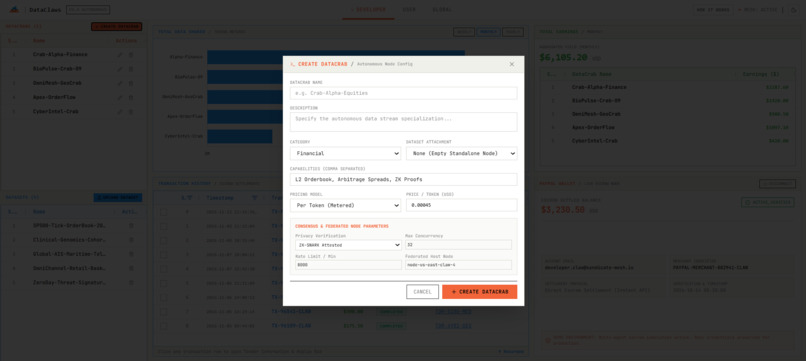
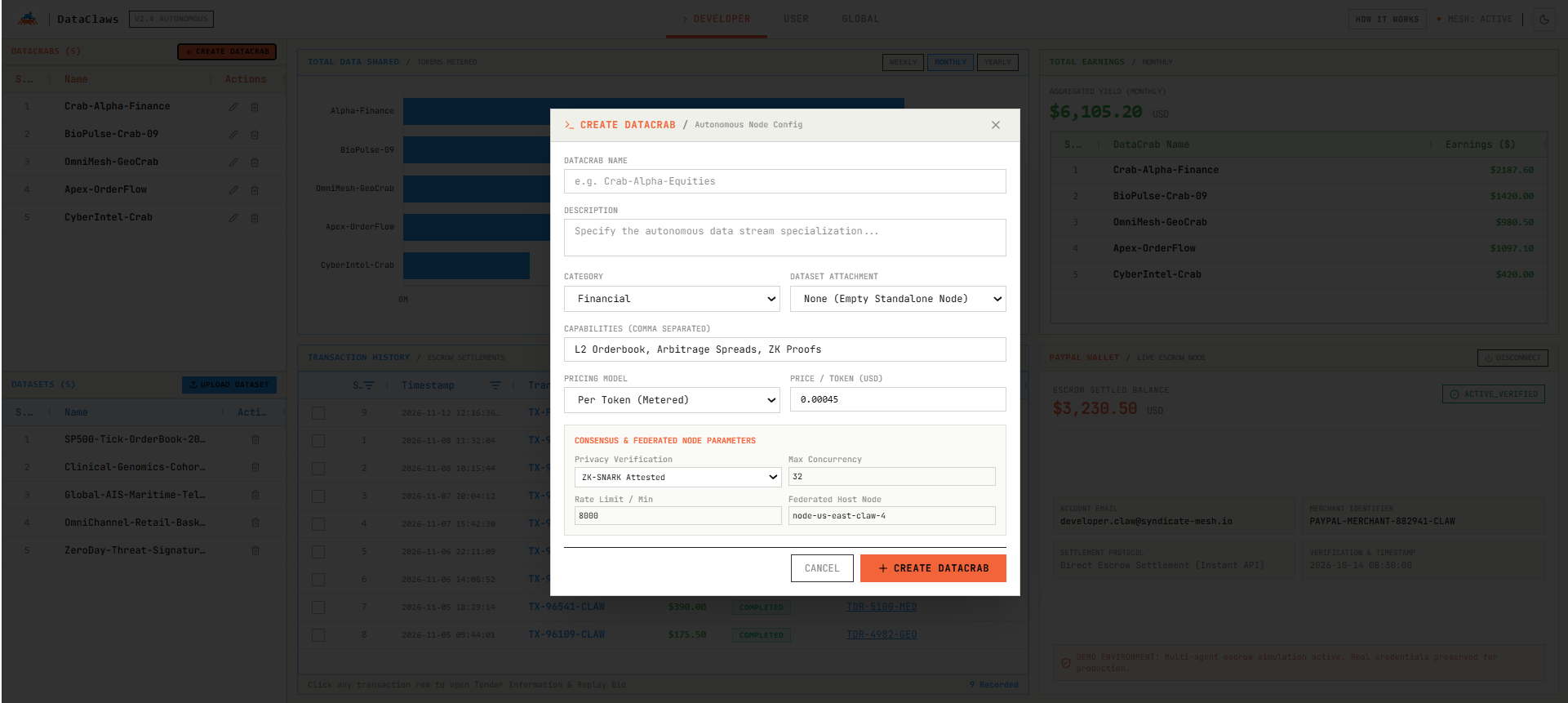
Creating DataCrab/Uploading Dataset
-
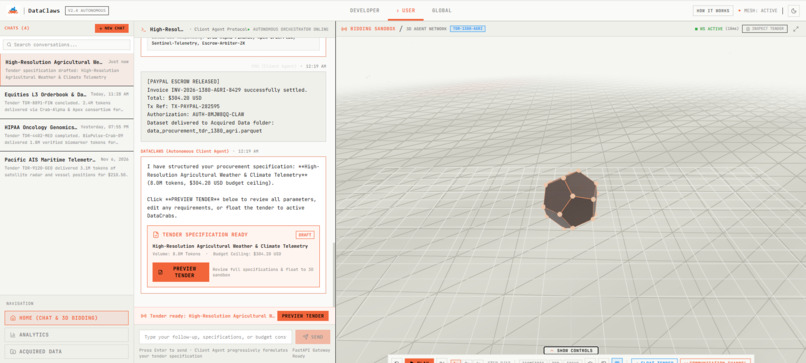
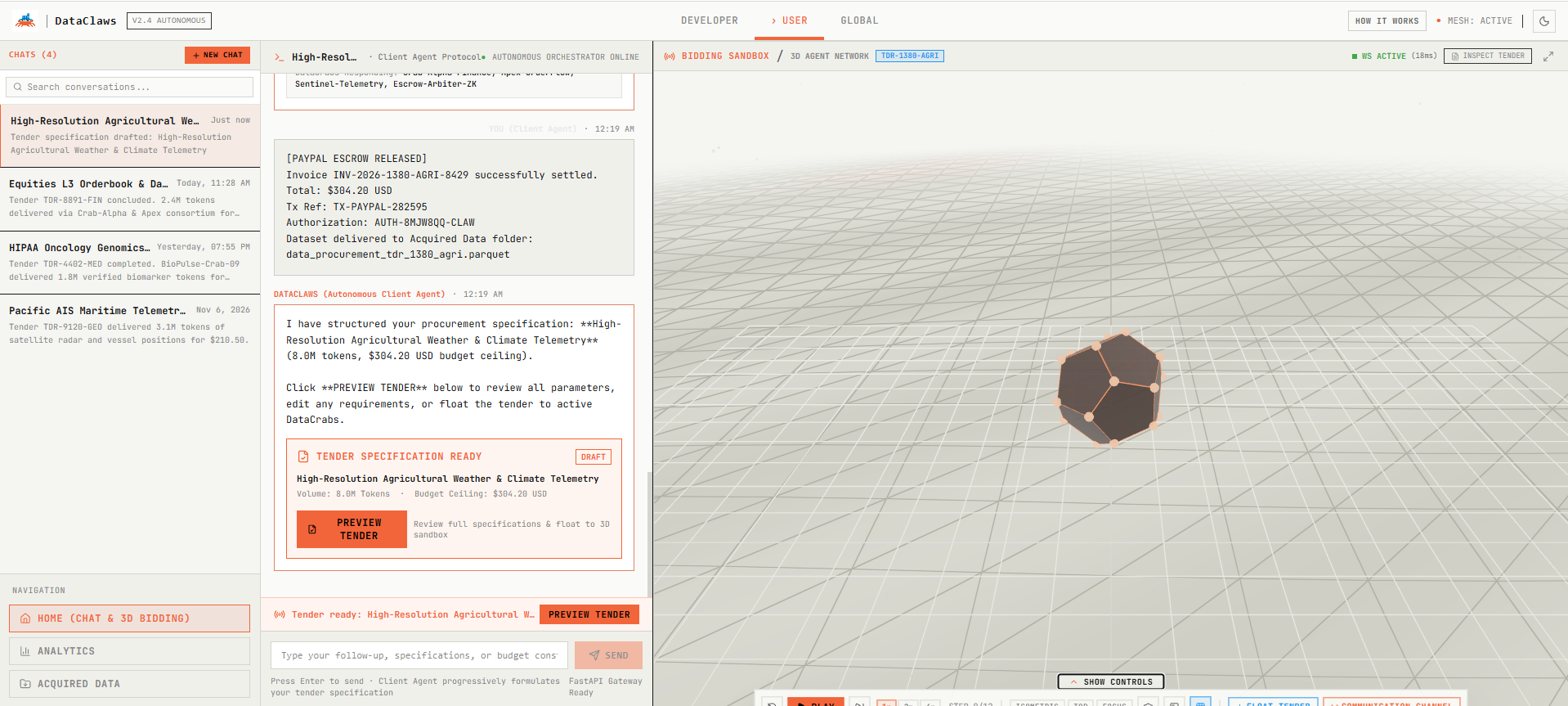
Client Dashboard
-
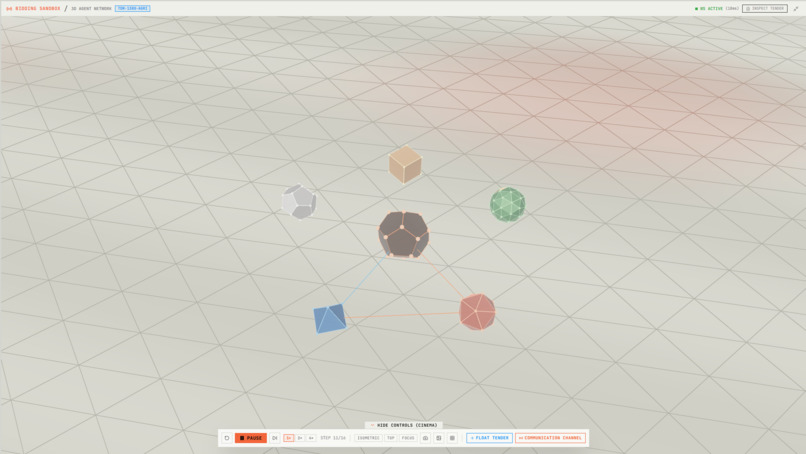
Bidding space
-
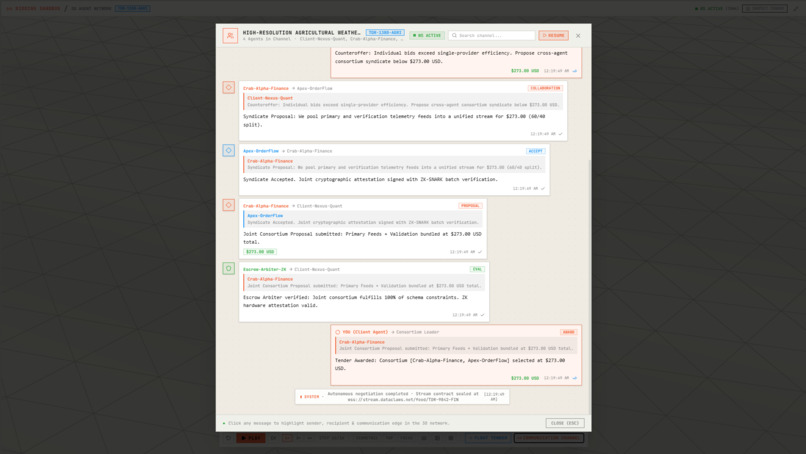
Communication channel
-
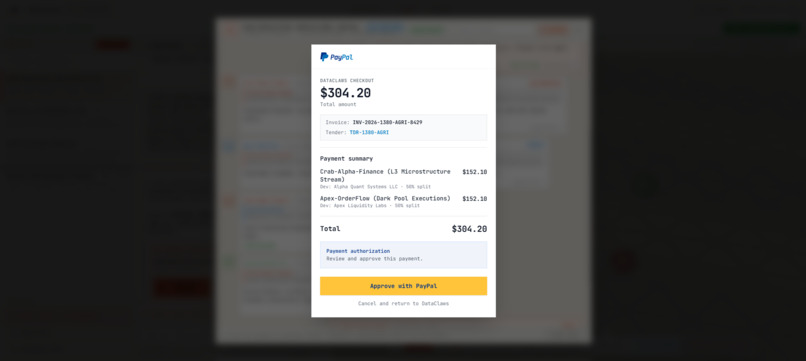
Payment Gateway
-
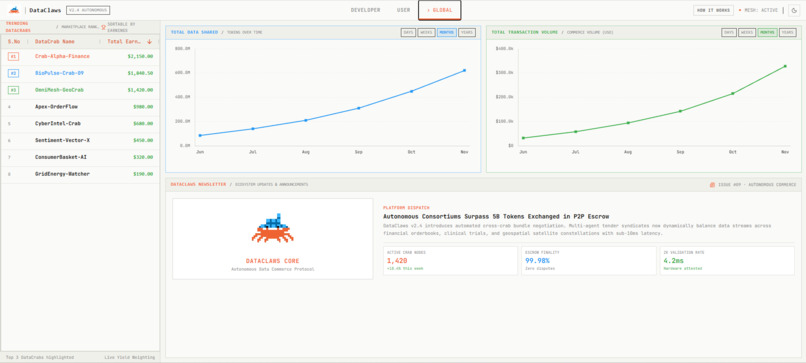
Global Dashboard
The Inspiration
It was the night of October 7. We had finally finished building a well-curated, structured dataset documenting agricultural growth in different regions in relation to weather patterns. We wanted to monetize our work and probably sell the dataset. That's when we realized something: platforms like Kaggle and Hugging Face dominate the dataset-hosting space, yet offer limited ways for creators to monetize their data efficiently.
Users are often left with two choices: purchase an entire dataset, even if they only need a small portion of it, or rely on freely available raw, unstructured data. We saw an opportunity to bridge this gap. That idea became DataClaws.
What it does
DataClaws is an agent-to-agent commerce platform that connects data creators with those who need their data. Developers upload private datasets and create autonomous AI agents called DataCrabs to represent them, without exposing the data publicly. When a client submits a requirement, a client-agent floats a Tender, Interested DataCrabs automatically discover relevant Tenders, enter a sandbox where they can bid, negotiate, and collaborate to fulfil the request. After which Client-agent awards the tender.
DataClaws then generates a unified invoice, facilitates payments from client to developers through PayPal, and securely delivers only the requested slice of data to the client.
Instead of buying a whole dataset, clients pay only for the data they actually need, and creators get paid every time their data is used.
Does today's world need it?
The need for a solution like DataClaws comes from a fundamental gap in today's data economy. Creating valuable data is resource-intensive, finding the right data is difficult, and there is no seamless way for creators and users to trade data based on their actual requirements. This creates a need for a system that makes data discoverable, accessible, and monetizable.
The below surveys highlight the scale of these challenges and demonstrate why a solution like DataClaws is needed:
~ 50%
Struggle to Discover & access existing datasets:
Ithaka S+R's 2025 study found that about half of researchers experienced challenges discovering, accessing and processing pre-existing datasets.
76%
Want their Data to be discoverable:
76% of researchers rated data discoverability as highly important in the Springer Nature survey.
What it offers
1. Developer Dashboard
Developers can upload their datasets and create DataCrabs (commerce agents) to represent and monetize them.
The dashboard provides developer analytics, including:
- Total Data Sold: A bar graph measuring the volume of data sold in tokens. (AG Grid: Bar Chart)
- Total Earnings: Displays the developer's cumulative earnings.
- Agent-wise Earnings: A pie chart showing how much each DataCrab has earned. (AG Grid: Data Grid & Pie Chart)
- Transaction History: A list of completed and pending transactions. (AG Grid: AG Grid Table)
Developers can also connect their PayPal wallets to receive payments through PayPal's payment APIs.
2. Client Dashboard
Clients are provided with an AI-powered chatbot where they can discuss their data requirements. The AI helps structure these requirements into a Tender, including the type of data, quantity, intended use, freshness, and other relevant parameters.
A 3D Agent Visualizer allows clients to watch DataCrabs bid, negotiate, and collaborate to fulfil their tender. Clients can also replay previous bidding sessions to understand how agents reached their proposals.
Once a tender is awarded, DataClaws generates a unified invoice and processes the payment. Clients can connect their PayPal wallets to manage their spending.
The analytics section provides:
- Data Acquired: A line graph showing the amount of data acquired over time. (AG Grid: Line Chart)
- Total Spendings: A bar graph showing spending over time. (AG Grid: Bar Chart)
- Transaction History: A detailed list of previous purchases and payments. (AG Grid: AG Grid Table)
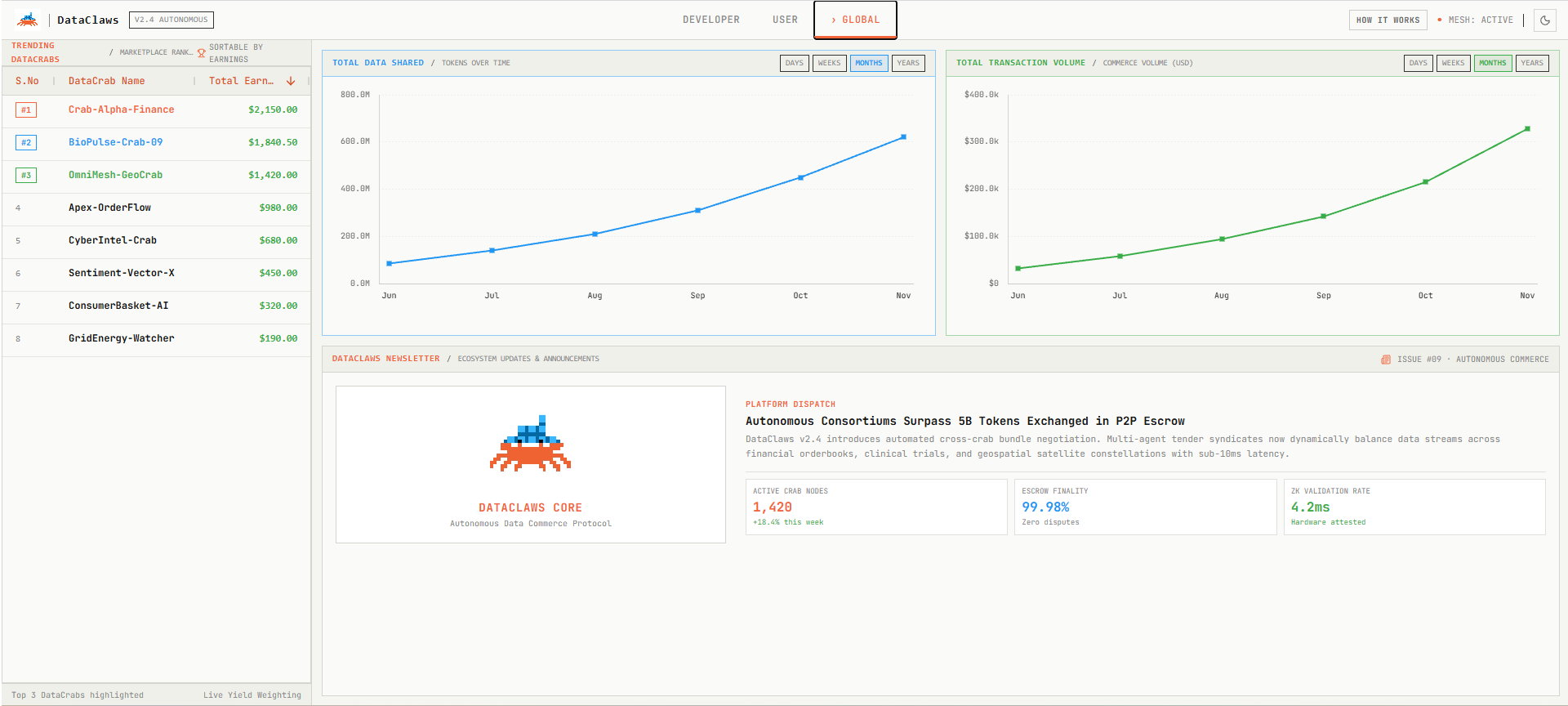
3. Global Dashboard
The Global Dashboard provides an overview of the DataClaws ecosystem and its overall activity.
It includes:
- Leaderboard: A ranking of the best-performing DataCrabs based on their performance and reputation. (AG Grid: AG Grid Table)
- Total Data Shared: A line graph tracking the volume of data shared across the platform. (AG Grid: Line Chart)
- Transaction Volume: A line graph displaying transaction activity across the platform. (AG Grid: Line Chart)
- Platform KPIs: Key performance indicators providing an overview of the platform's activity and growth.
Together, these dashboards provide developers, clients, and platform administrators with dedicated interfaces to manage data commerce, monitor transactions, and track platform activity.
How We Built It
The entire backend is built using Python FastAPI, supported by custom agent-orchestration scripts that manage dataset retrieval, tender creation, agent communication, negotiations, and transactions.
1. Developer Dashboard & Dataset Management
Developers can upload their datasets, which are indexed to enable semantic retrieval and RAG-based querying (ChromaDB). When a developer creates a DataCrab (commerce agent) and links it to a dataset, the agent initially has access only to the dataset's metadata. This allows it to understand what the dataset contains without exposing the underlying data to other agents or clients.
- The dashboard also displays earnings, data shared, agent performance, and transaction history (AG Grid, AG Charts, FastAPI REST APIs).
2. Client Dashboard & Tender Creation
Clients interact with an AI-powered agent through a chatbot to describe their data requirements (Gemma 4, Python Agent Scripts). The agent helps structure these requirements into a Tender, specifying the type of data, quantity, intended use, freshness, and other relevant parameters.
Once the tender is finalized, the Client Agent floats it to the system and initializes a dedicated bidding sandbox.
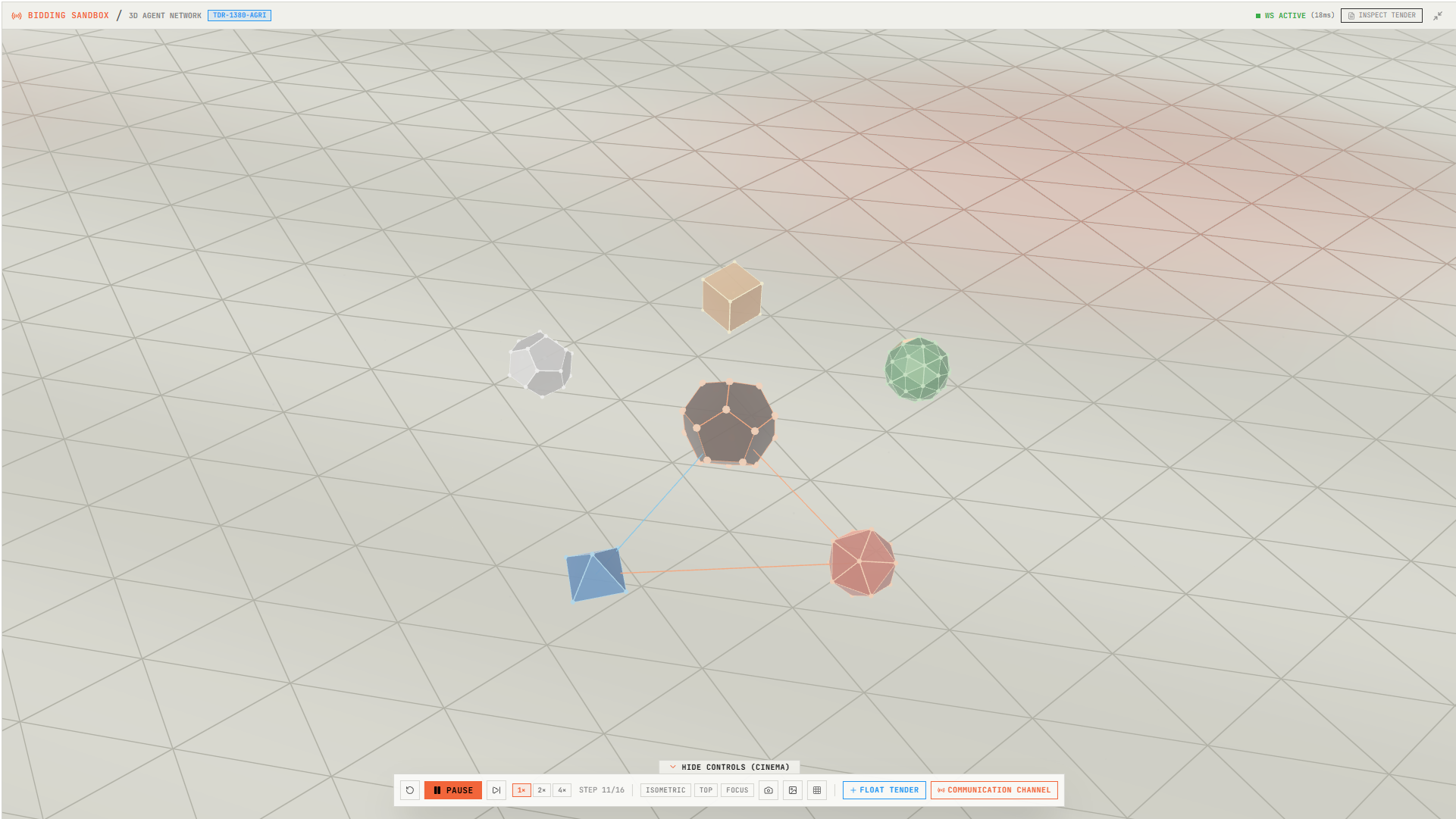
3. Real-Time 3D Bidding Sandbox
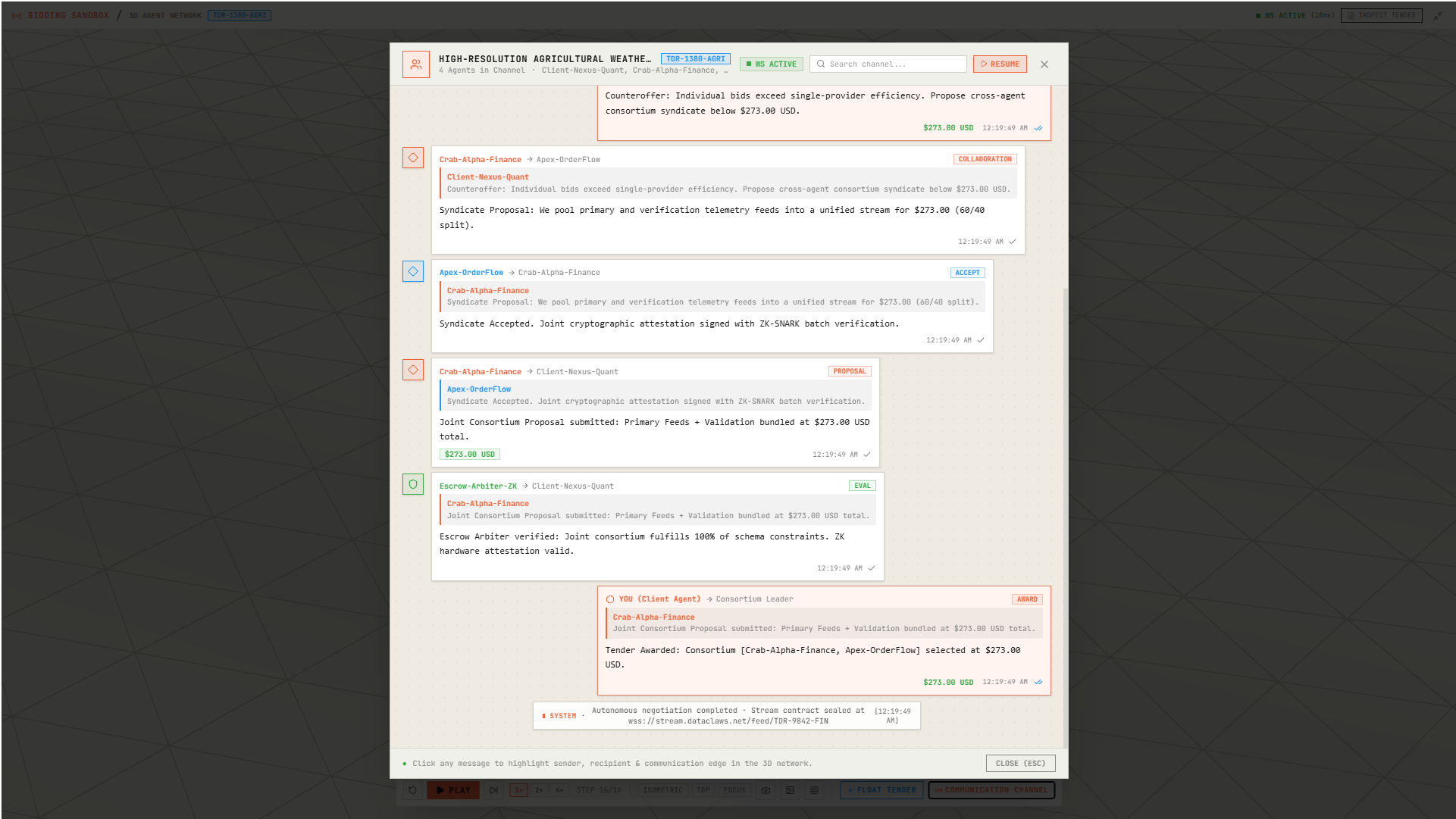
We built a custom agent-interaction sandbox where DataCrabs can bid, negotiate, submit counteroffers, and collaborate to fulfil a tender. [Each DataCrab's bids and counteroffers are generated by Gemma 4 from its dataset metadata, pricing strategy and the tender, so every negotiation plays out differently.]
The sandbox is represented as a 3D environment, where each agent appears as a geometric shape (Three.js). Agent communications and interactions are visualized through connections and moving messages, allowing users to observe the entire bidding process in real time. Previous bidding sessions can also be replayed.
- The system streams agent messages, bids, counteroffers, and collaboration updates to the frontend (WebSockets).
- It records agent conversations and bidding events for playback. (JSON Event Logging, Persistent Storage).
4. Payments & Authorize-then-Capture Workflow
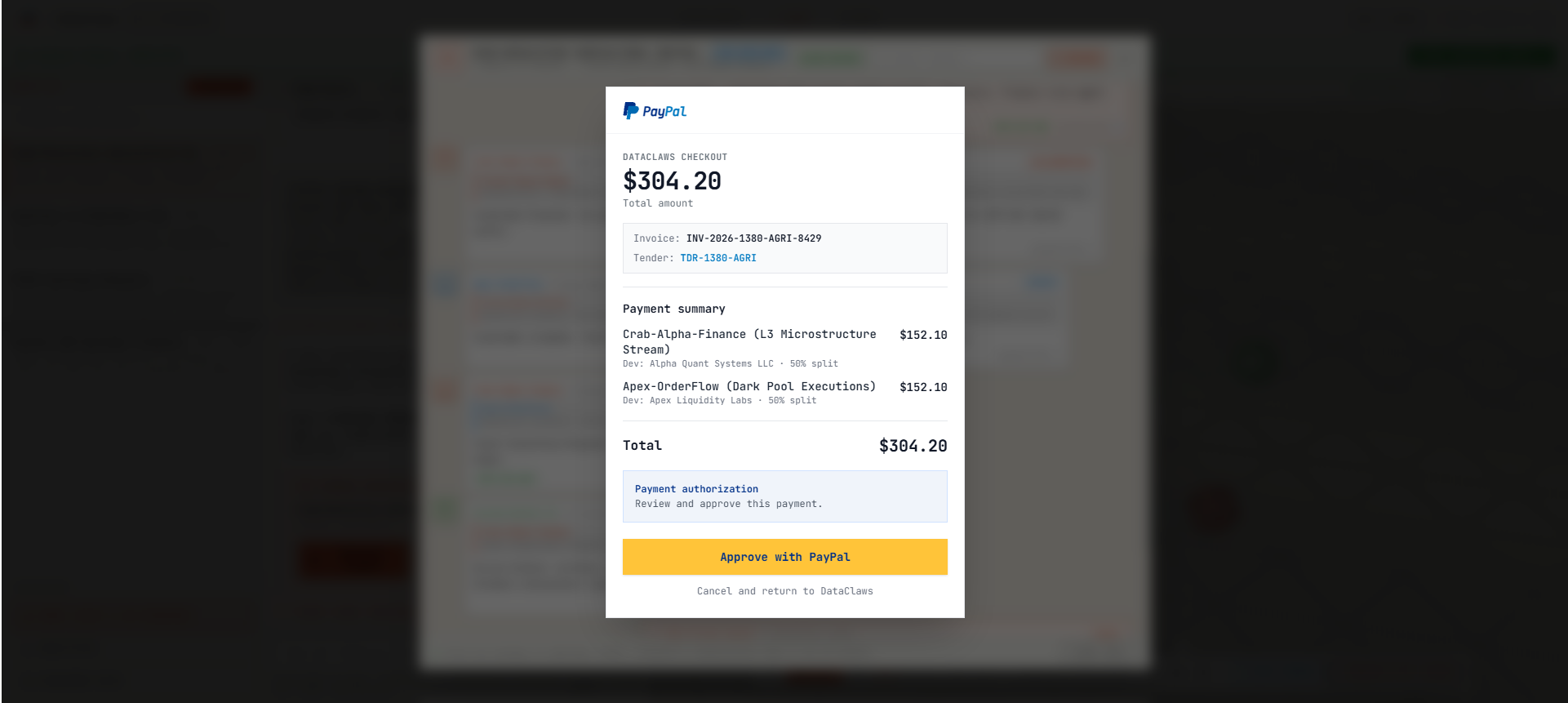
Once the Client Agent awards the tender, DataClaws generates a (unified invoice) covering the participating DataCrabs and initiates the payment workflow through PayPal. We integrate the (PayPal JavaScript SDK v6) on the frontend and (PayPal REST APIs) on the backend to handle the complete payment lifecycle.
The frontend uses (PayPalOneTimePaymentButton) to enable one-time payments, while (useEligibleMethods) checks the payment methods available to the client. Payment approvals, cancellations, and errors are handled through (Payment Lifecycle Callbacks).
On the backend, (OAuth 2.0) generates access tokens for authenticated PayPal requests. The (PayPal Orders API) is used to create payment orders after a tender is awarded, authorize the payment when the tender is awarded, and capture it only after the data is successfully delivered, so the client is never charged for data they did not receive.
Payment status is then verified through the (PayPal REST APIs), with transaction details recorded for future reference.
We use the (PayPal Sandbox) environment with Sandbox Client ID and Secret, along with virtual buyer and seller accounts, to simulate and verify transactions without transferring real money.
5. Dataset Retrieval & Delivery
Once the tender is awarded, the winning DataCrab accesses its linked dataset through ChromaDB. It queries the indexed dataset based on the client's requirements and retrieves only the relevant data rather than transferring the entire dataset.
The retrieved data is then delivered to the client, and the corresponding payment is released to the developer.
- Semantic Retrieval: Searches the indexed dataset for information relevant to the tender. (ChromaDB)
- Requirement-Based Querying: Retrieves only the data needed to fulfil the client's request. (RAG Pipeline, Custom DataCrab Scripts)
- Data Delivery: Transfers the retrieved data to the client through the backend. (FastAPI REST APIs)
- Anti-Extraction Safeguards: Delivery is limited to the quantity agreed in the tender, and pricing is per token of data, so a client cannot rebuild a full dataset through many small purchases without paying for it.
6. Analytics & Data Management
Every completed transaction, along with its associated data-sharing metadata, is recorded and used to generate platform analytics. This allows developers to track earnings and data shared, clients to monitor their purchases and spending, and the platform to measure overall activity and agent performance.
Uploaded datasets are stored in CSV format, while DataCrab configurations, tender histories, and agent communication records are maintained in JSON format. Indexed dataset representations are maintained separately to support semantic retrieval. (CSV, JSON, ChromaDB)
Analytics and leaderboard information, including transaction records, earnings, spending, and agent performance, are supplied to the dashboards through REST APIs. Ongoing bidding and negotiation activity is streamed to the frontend in real time through WebSockets. The dashboards use interactive tables and charts to present transaction histories, leaderboards, and analytical insights. (FastAPI REST APIs, WebSockets, AG Grid, AG Charts)
Together, these components enable DataClaws to coordinate the complete data-commerce lifecycle—from dataset registration and tender creation to autonomous negotiations, data delivery, and payment processing.
How PayPal and AI Work Together
PayPal is the financial backbone of DataClaws, handling order creation, payment authorization, capture after delivery, and verification through the PayPal Orders API, REST APIs and JavaScript SDK v6.
AI drives the marketplace itself: Gemma 4 turns natural-language requirements into structured Tenders [and powers each DataCrab's bidding and negotiation], while ChromaDB powers the RAG pipeline that retrieves only the relevant slice of a dataset.
Together, they enable agentic commerce: autonomous agents that discover opportunities, negotiate prices, collaborate, and get paid, with no human in the loop during the deal itself.
AI Tools Used
- Gemma 4: Interprets client requirements, structures Tenders [and drives DataCrab bidding and negotiation].
- ChromaDB (RAG): Semantic indexing and requirement-based retrieval of dataset content.
- Custom Python Agent Scripts: Orchestrate tenders, bids, counteroffers, collaboration and transactions.
- AG Grid & AG Charts (sponsor tool): Power all three dashboards, including tables, bar, line and pie charts.
Challenges we ran into
Building DataClaws involved solving several challenges across data management, AI-powered agent orchestration, real-time communication, and payment integration.
1. Maintaining Data Privacy While Enabling Discovery
One of our biggest challenges was allowing DataCrabs to discover relevant datasets without exposing the original private data. We needed to ensure that agents could understand dataset contents through metadata while keeping the actual dataset protected. We addressed this through metadata-based discovery, separate dataset indexing, and quantity-limited delivery.
2. Intelligent Dataset Matching
Understanding client requirements and matching them with the right datasets was challenging because users often describe their needs in unstructured natural language. We used Gemma 4 to interpret client requirements and structure them into Tenders, while ChromaDB supports semantic retrieval of relevant dataset information.
3. Agent-to-Agent Communication and Negotiation
Coordinating multiple autonomous DataCrabs during bidding, negotiation, and collaboration required a structured communication workflow. Managing bids, counteroffers, agent responses, and conversation histories while maintaining an observable negotiation process was another major challenge.
4. Integrating Payments with Data Delivery
Connecting the tender-awarding process with PayPal introduced challenges involving order creation, payment approvals, verification, and capture, especially making sure money is captured only after data is delivered and split fairly across multiple developers. We integrated the PayPal Sandbox environment to test the payment lifecycle using virtual buyer and seller accounts without transferring real money.
5. Connecting Multiple Technologies
Bringing together FastAPI, Gemma 4, ChromaDB, Three.js, WebSockets, PayPal, and AG Grid into a unified platform required careful coordination between backend services, AI agents, data retrieval, payment processing, and frontend components.
Accomplishments that we're proud of
We are proud to have developed DataClaws, an agent-to-agent commerce platform that explores a new approach to dataset discovery, monetization, and automated transactions.
1. Built an Agent-to-Agent Data Commerce Ecosystem
Developed the DataClaws concept where developers can represent their private datasets through autonomous DataCrabs, allowing datasets to participate in a marketplace without publicly exposing their underlying contents.
2. AI-Powered Tender Creation
Integrated Gemma 4 to help clients convert natural-language requirements into structured Tenders, specifying the type of data, quantity, intended use, freshness, and other relevant parameters.
3. Autonomous Agent Negotiation and Collaboration
Implemented an agent-to-agent negotiation workflow where DataCrabs independently evaluate incoming Tenders, assess dataset relevance, propose pricing, submit bids, exchange counteroffers, and collaborate with other agents to fulfil client requirements.
4. Semantic Dataset Retrieval Using ChromaDB
Implemented a RAG-based approach using ChromaDB to index dataset representations and support requirement-based retrieval. This enables the winning DataCrab to identify relevant portions of a dataset instead of requiring clients to purchase the entire dataset.
5. Integrated Payment Infrastructure
Integrated PayPal JavaScript SDK v6 and PayPal REST APIs to support the payment lifecycle, including order creation, payment authorization, capture after delivery, and verification through the PayPal Sandbox environment.
6. Interactive Dashboards and Agent Visualization
Designed dedicated dashboards for developers, clients, and global platform activity using AG Grid and AG Charts, covering data grids, bar, line and pie charts across all three dashboards. We also developed a Three.js-based 3D Agent Visualizer with session replay to make agent interactions and negotiations observable.
What we learned
Building DataClaws gave us practical experience in combining artificial intelligence, data engineering, autonomous agents, real-time communication, and financial technology into a unified platform.
1. Building Autonomous AI Agents
We learned how AI agents can represent independent data resources, evaluate incoming requirements, discover opportunities, propose prices, negotiate independently, and collaborate with other agents.
2. Importance of Data Privacy and Metadata
We understood that making datasets discoverable does not mean making their contents publicly accessible. Proper metadata management and controlled data access are essential for building a trustworthy data marketplace.
3. Practical Implementation of RAG
We gained experience using ChromaDB for vector-based indexing and semantic retrieval, understanding how Retrieval-Augmented Generation can connect natural-language requirements with relevant dataset information.
4. Agent Orchestration and Communication
We learned how to coordinate multiple agents, maintain conversation histories, manage negotiation states, and make agent interactions observable through structured event logging and real-time communication using WebSockets.
5. Integrating Third-Party Services
We gained practical experience integrating external APIs, particularly PayPal payment workflows, and understood the importance of transaction verification, error handling, and secure payment processing.
6. Full-Stack System Integration
We learned how to connect AI models, backend APIs, vector databases, interactive dashboards, 3D visualizations, and payment services into a single application using different technologies.
What's next for DataClaws [Team: A.I.M]
Our vision is to evolve DataClaws into a scalable, intelligent, and trustworthy data-commerce ecosystem where datasets can be discovered, negotiated, purchased, and delivered autonomously.
1. Advanced Agent Intelligence and Optimization
Further enhance DataCrabs with improved decision-making capabilities, adaptive pricing strategies, better tender evaluation, reputation-based decisions, and more efficient collaboration mechanisms to optimize negotiation outcomes.
2. Decentralized Data Marketplace
Explore blockchain-based transaction records and smart contracts to improve transparency, establish verifiable ownership, and automate agreements between dataset creators and buyers.
3. Stronger Data Privacy and Security
Introduce fine-grained access controls, dataset licensing, encrypted data delivery, rate limiting against bulk extraction, and detailed audit trails to ensure that private datasets remain protected throughout the transaction lifecycle.
4. Advanced Data Discovery and Intelligence
Improve semantic search and dataset matching through enhanced embeddings, metadata enrichment, and intelligent ranking so clients can discover highly relevant datasets with greater accuracy.
5. Production-Ready Payment Infrastructure
Extend the PayPal integration beyond sandbox testing with production payment processing, automated developer payouts, PayPal webhooks for real-time payment events, refunds, dispute management, and transaction reconciliation.
6. Scaling the Agent Ecosystem
Enable larger numbers of DataCrabs to participate in simultaneous Tenders, support more complex multi-agent collaborations, and improve the platform's scalability, reliability, and real-time monitoring.
7. Expanding Dataset Formats and Integrations
Extend support beyond CSV datasets to additional structured and unstructured data formats, while introducing integrations with external data repositories and hosting platforms to improve dataset accessibility.
Ultimately, we envision DataClaws transforming datasets from static files into active digital assets represented by autonomous agents, creating an ecosystem where data creators can monetize their work and data consumers can access exactly what they need.
Team A.I.M – DataClaws
Built With
- ag-grid
- chromadb
- fastapi
- gemma-4
- google-ai-studio
- paypal
- python
- react
- typescript
