Inspiration
A.I.D.E. (Adaptive Intelligent Department Efficiency) was inspired by real-world frustration. My teammate and I both experienced firsthand the limitations of customer-facing roles during our time working at Georgia State University's Recreation Center. Every time a patron asked us a question, we found ourselves hurriedly sifting through stacks of manuals and documents, struggling to quickly pinpoint accurate information. We knew there had to be a better, tech-driven solution.
What it does
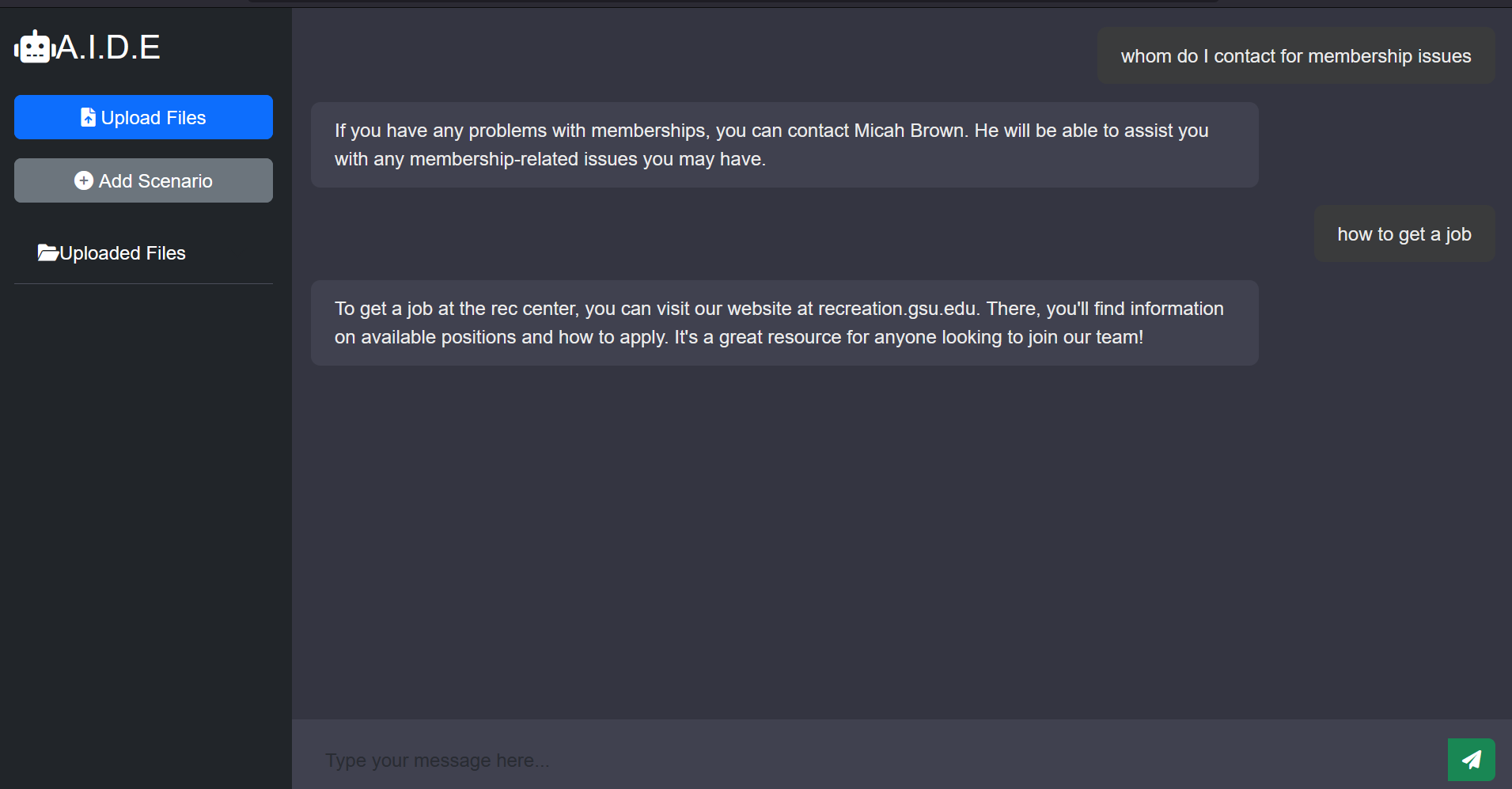
A.I.D.E. empowers front desk employees by providing rapid and accurate responses to customer inquiries. It utilizes Retrieval-Augmented Generation (RAG) to quickly search through uploaded departmental documents and deliver precise answers within seconds. This dramatically enhances response accuracy and reduces wait times, improving the overall customer experience.
A unique feature of A.I.D.E. is its "Add Scenario" button, allowing users to instantly incorporate new queries into the system, continually improving its accuracy and adaptability.
How we built it
How we built it
We developed A.I.D.E. using:
Flask: For creating the web application framework.
OpenAI API: For advanced natural language processing and understanding.
Retrieval-Augmented Generation (RAG): To efficiently search and retrieve relevant information from documents. Our solution supports multiple file formats including PDFs, DOCX, and plain text, ensuring versatility and ease of integration in various departments.
Challenges we ran into
One major challenge was effectively integrating RAG with diverse document formats. Handling the variety and complexity of real-world departmental documents required us to use different modules like Py2PDF etc.
Accomplishments that we're proud of
We're particularly proud of:
Successfully implementing the innovative "Add Scenario" feature, making the tool increasingly adaptive.
Achieving swift and accurate information retrieval, significantly cutting down response times.
Creating a user-friendly interface that can be easily adopted by non-technical users.
What we learned
Throughout the project, we gained valuable insights into:
Advanced natural language processing techniques.
Handling and indexing large, varied datasets effectively.
Developing user-centric features and interfaces tailored to real-world needs.
What's next for A.I.D.E.
Future plans include:
1.) Expanding support to additional file types and multimedia formats.
2.) Enabling encryption to enhance data security.
3.) Developing A.I.D.E. as a fully web-hosted application for broader accessibility.
4.) Strengthening resilience against prompt injection attacks.
5.) Deploying A.I.D.E. in real-world environments to gather user feedback for continuous improvement.
Through A.I.D.E., we aim to continuously empower front desk staff to deliver exceptional customer service efficiently and effectively.


Log in or sign up for Devpost to join the conversation.