-
-
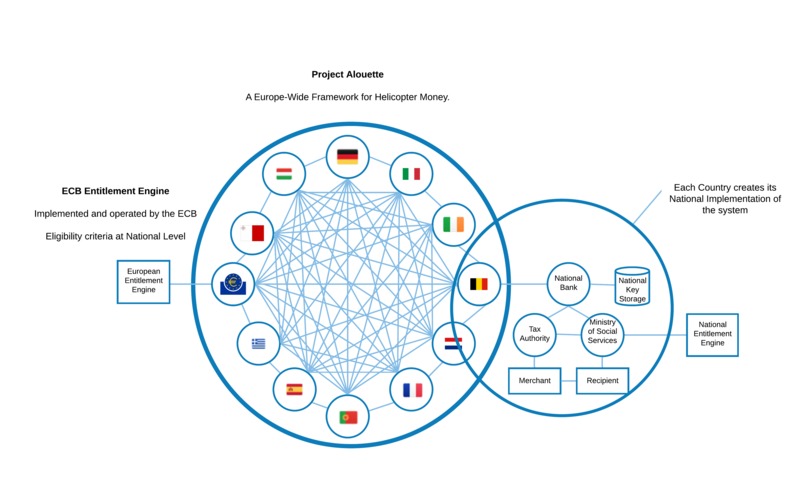
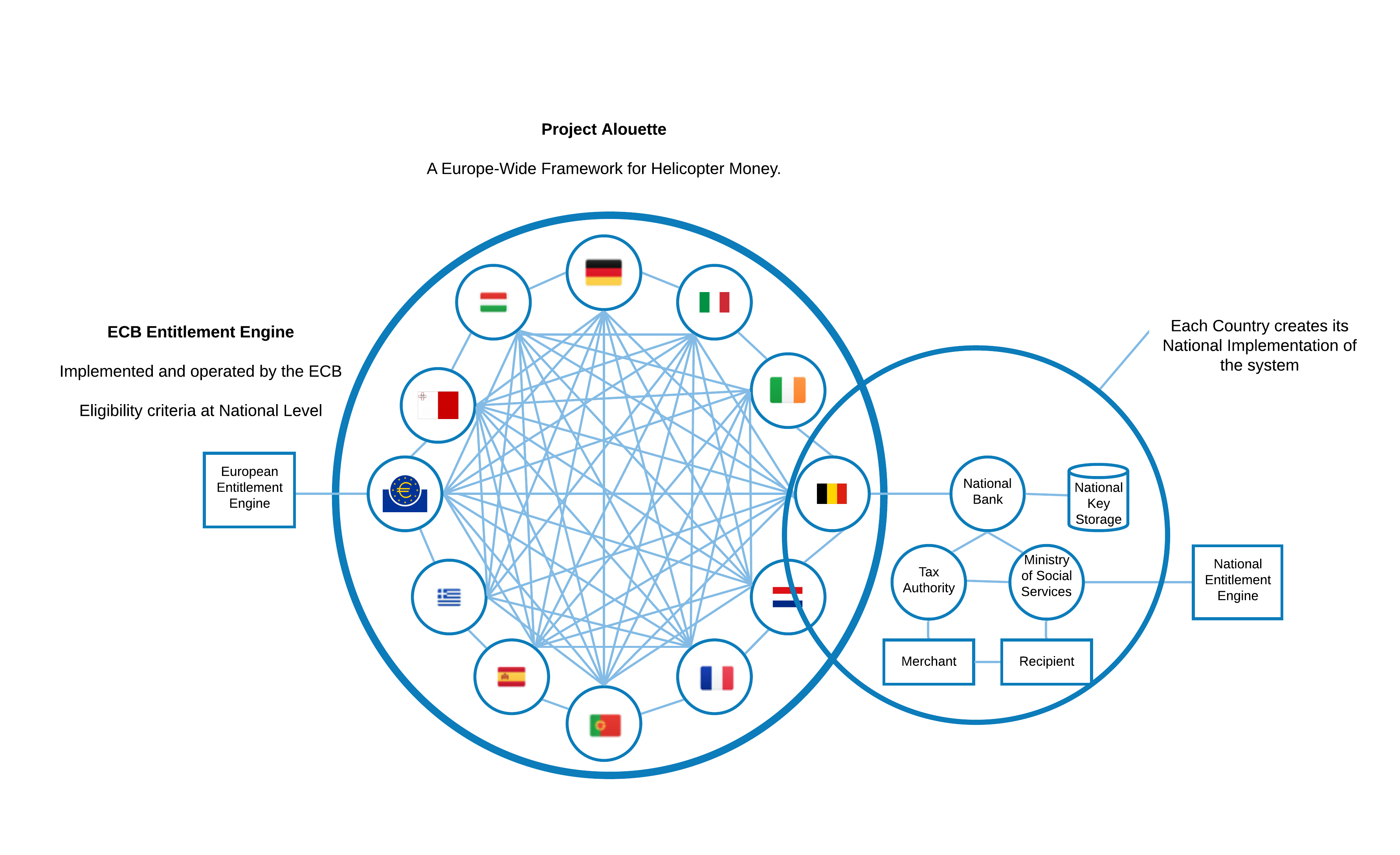
Alouette operating model
-
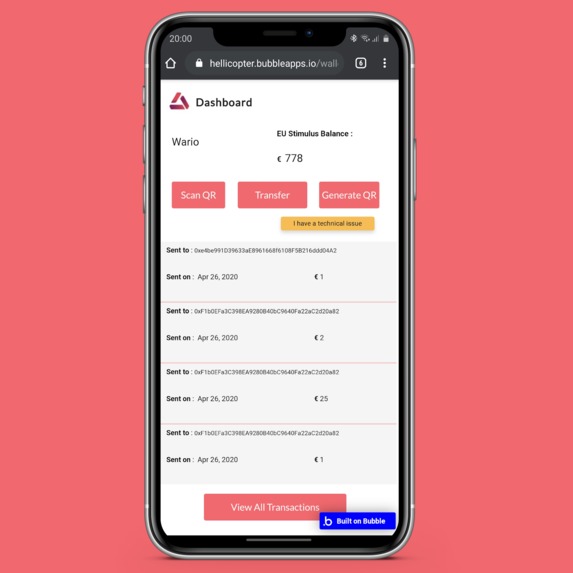
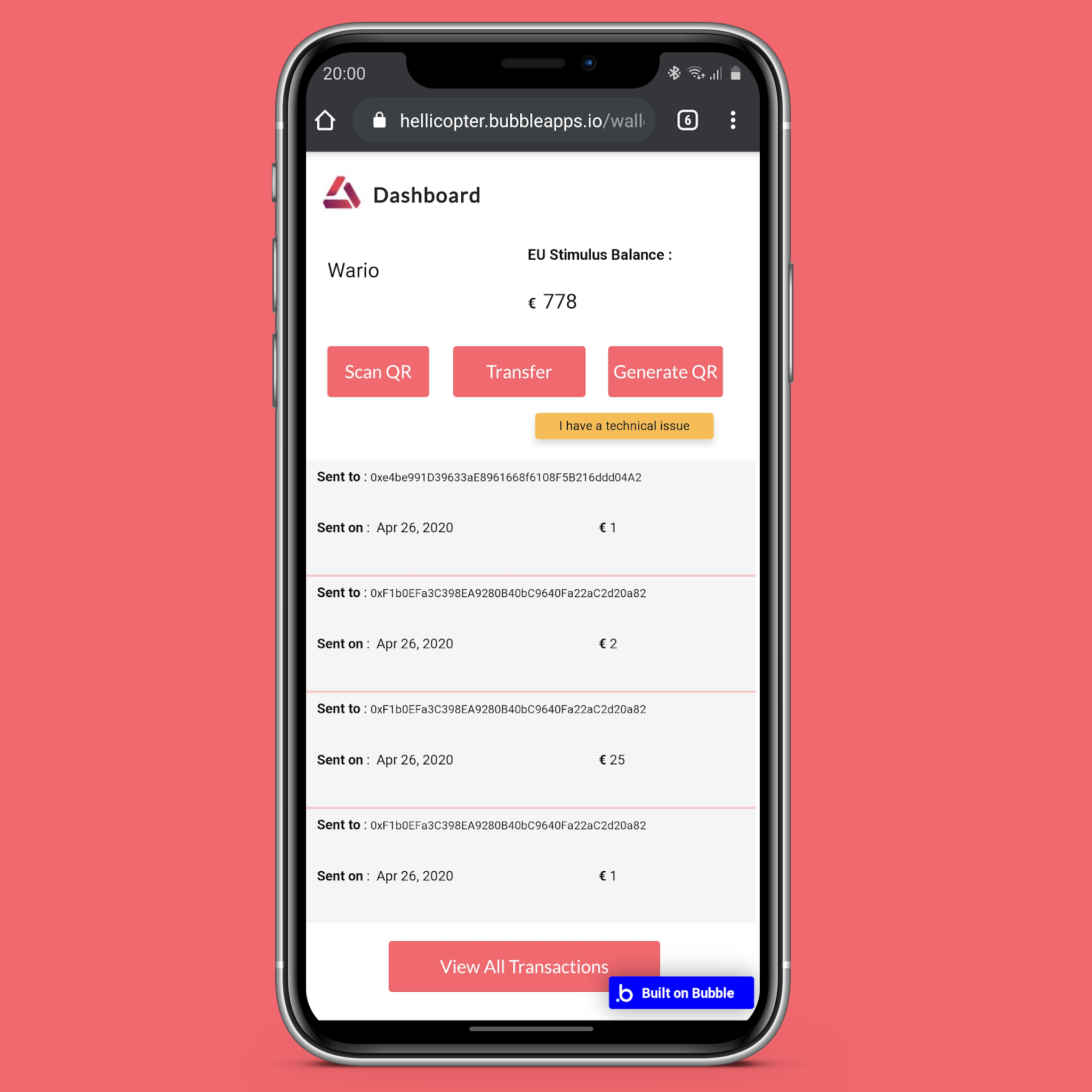
Printscreen app
-
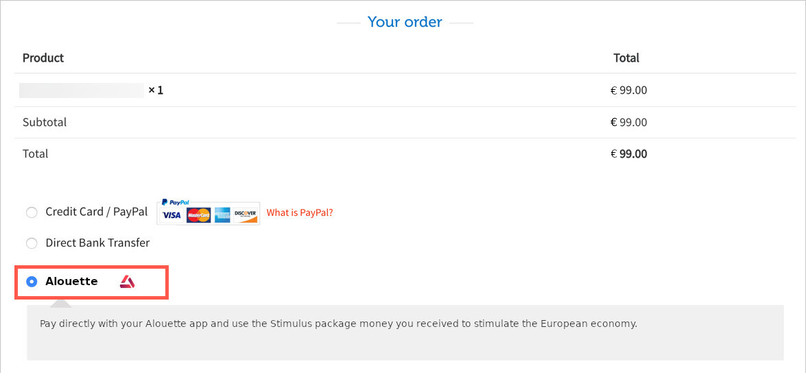
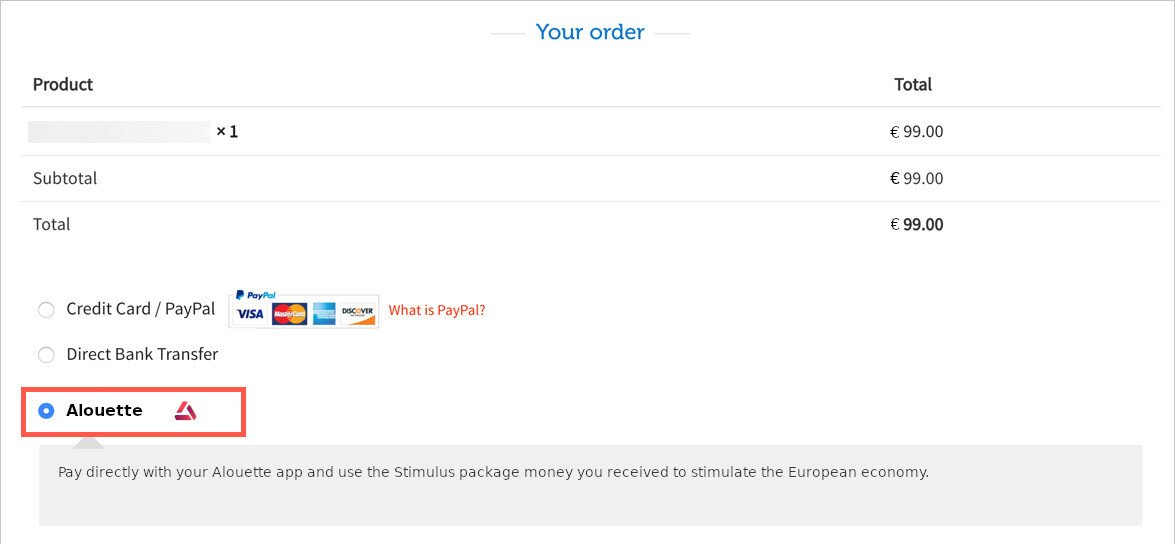
e-commerce integration
-
Alouette logo
Inspiration
Quantitative easing (QE) has led to near zero interest rates leaving little room to continue using this policy tool for fiscal stimulus during the current financial crisis.
Helicopter money has been proposed as a viable alternative to QE but has never been a policy tool of choice in the European Union. Milton Friedman conceived the theory in 1969 as part of a thought experiment where a helicopter 'drops' money directly to citizens.
The need for alternative tools to provide immediate economic stimulus have never been more acute.
Problem
Implementing Helicopter Money as a policy tool from the ECB to Europe’s 360 million adult population is a monumental task that will require coordination on a technical, governance and policy level. Key challenges include:
- Allocation: determination of national and individual citizen entitlements (ECB does not have complete records to determine impactful entitlement at the citizen level)
- Distribution: distributing funds to recipients (ECB does not have complete records necessary for this)
- Economic impact: no guarantee that funds distributed will be spent rather than hoarded (empirically, just 25%-30% is spent)
Solution
Alouette uses distributed ledger technology to tokenise and distribute Helicopter Money to adult EU citizens directly and efficiently. From the governance approach to the infrastructure and technology required to move Helicopter Money from a theoretical model to an active policy tool in Europe.
Key benefits include:
Impact on crisis
Total stimulus committed to the crisis (as of April 26th) is €3.4tn. If 10% of this is distributed as helicopter money, each adult citizen would receive ~€900. Research shows that with traditional distribution methods, this would have an impact of between €85bn-€100bn equating to 0.5-0.6% boost of GDP.
Alouette’s model would have an impact of €390bn equating to a 2.3% boost to European GDP. This is 4-5 times greater impact on GDP than deployment by any other means. This is due to (i) 'token economics' using depreciation to incentivise spending; (ii) possibility to direct funds to citizens with a higher propensity to spend and to businesses that will yield a higher economic boost.
How it works
Alouette creates a circular system introducing stimulus directly to citizens, spending and finally automated removal of the stimulus measure from the economy.
Alouette partners with ECB, EU member states (national banks, social security and tax authorities) to implement the required governance, infrastructure and distribution mechanisms.
Tokens are issued which are pegged one to one to the Euro by the ECB to the National Bank of each member state.
Ministry responsible for Social Security in each country determines each citizens’ entitlement and creates citizens wallets, funding them with allocated money.
Ministry of Finance and Tax Authority identifies registered businesses and creates wallets.
Citizens receive tokens and can only spend in eligible wallets (shop, marketplace or online retailer in the EU). Eligibility can be changed to maximise economic impact.
Citizens can spend tokens by: (i) citizen app to merchant app QR code scanning; (ii) citizen app to merchant QR code (printed version); or (iii) citizen QR code (printed version) to merchant app scanning.
Tokens received by merchants are then used as credits towards future tax obligations (VAT or corporate tax). To ramp up impact as needed via a multiplier effect, this restriction could be lifted in subsequent distributions.
To incentivise utilisation of the token, Alouette includes a mechanism to decrease the value of tokens by 25% per month; essentially ‘use it or lose it'.
What we accomplished in a weekend?
We have built an end-to-end prototype for stimulus distribution and a solid underlying business model. There were challenges, however, the team pitched in immediately to support and prioritise in an efficient and pragmatic way. We learned a lot in the process and the result provides a strong basis to lead Europe out of the current financial crisis as quickly as possible.
We have defined a complete operating model for the system, a governance model for implementation, identified key stakeholders and already started our outreach to them.
On the tech side, we have:
- Deployed a working infrastructure that is fully EBSI compatible
- Developed the end-to-end flow of the smart contracts in an MVP format
- Launched a prototype wallet system for all stakeholders
- Built an easy to use app for citizens and merchants
- Had great fun along the way!
Check it out here: https://youtu.be/BNF1fHBCGi0
How we built it
Having identified the challenges that surround Helicopter money, we tried to understand how best to approach these challenges at a European level. We developed High and Low level architectures and defined how parameters could be translated into Smart Contract Code.
To set up the Blockchain Infrastructure, we used the SettleMint BPaaS solution and were able to deploy a full consortium network using HyperLedger Besu that can scale up to more nodes easily as implementation begins and government departments are onboarded. With the integrated developer environment of the solution for smart contract writing, the first version of the smart contracts were written and deployed in a little over an hour.
In parallel, we worked with our UX team to ensure that, in the end, the user would have a super intuitive experience.
The technologies used include:
What's next for Alouette
- Roll-out: 4 Weeks to Integrate, Scale and Impact
- Pre rollout: Onboard ECB and stakeholders (governments, national banks, social security, tax authority) through physical or online meetings
- Integrate with citizen ID and company ID registries
- Support Ministry of Social Security with smart contract modifications
- Maintain network
- Product roadmap:
- Donate option to transfer funds to a charity
- Transfer funds to head of household so only one family member has to venture out to spend
- Fiat conversion off ramp for merchants
- Merchant to merchant transfers (pay my suppliers)
- Possible business model extensions:
- Subsequent helicopter drops outside Europe
- Universal basic income trials or roll-out
- "Normal" times subsidy distribution system
Resources required for first country implementation
- Implementation Manager/Architect (SettleMint in-house)
- Smart Contract Engineers (SettleMint in-house)
- Front-end developers (SettleMint in-house)
- Country coordinators (Outsourced, native language proficiency in pilot country)
- SettleMint Blockchain Platform as a Service (H2020 SME Phase 2 Grant agreement ID: 849969 https://cordis.europa.eu/project/id/849969)
- Hosting infrastructure (hosted by SettleMint or on-premise)
for the "Try it out" please use your mobile device for best experience. Enjoy!
Built With
- api
- bubble.io
- javascript
- restful
- settlemintbpaas
- solidity
- swagger
- truffle
- typescript
- web3







Log in or sign up for Devpost to join the conversation.