-
-
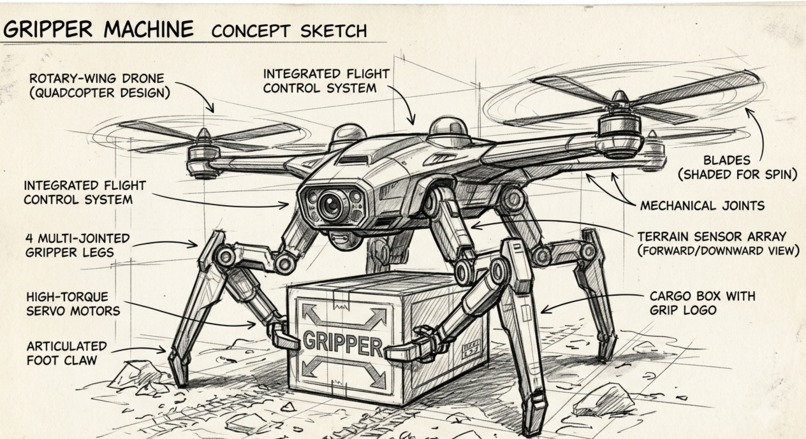
A GRIPPER MACHINE SKETCH
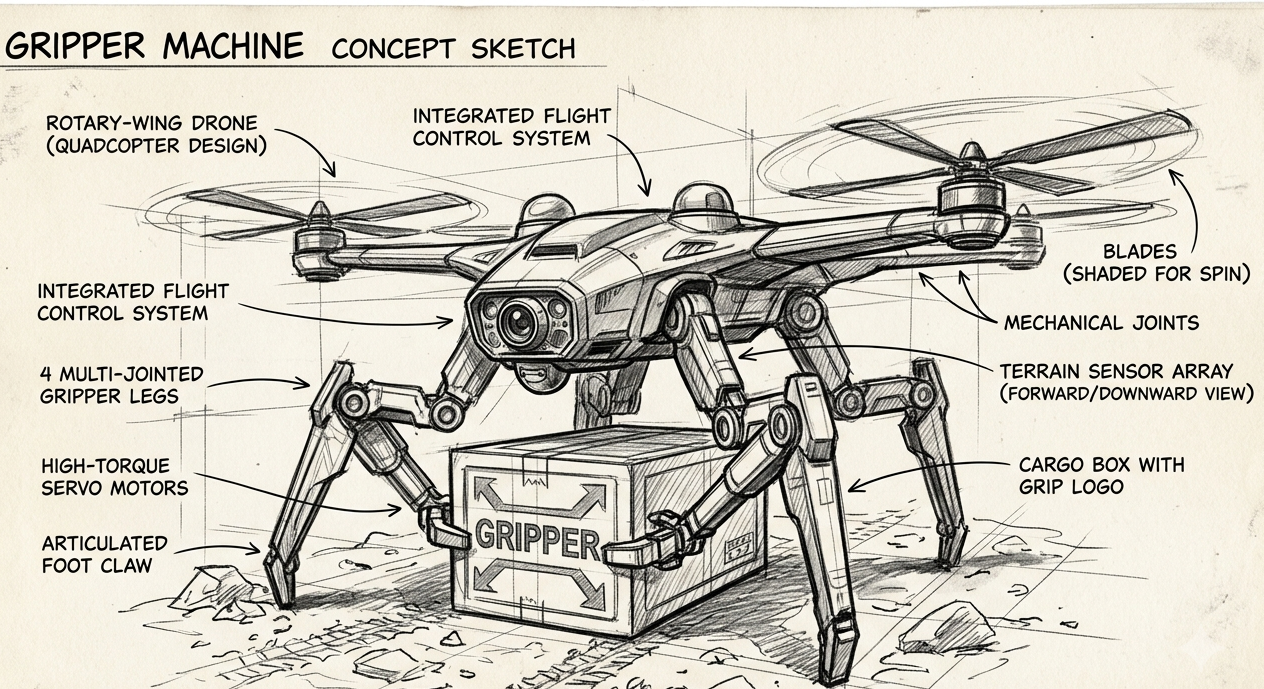
INSPIRATION: The inspiration for A GRIPPER MACHINE came from combining heavy-duty industrial robotics with the immersive feel of modern mobile gaming. Traditional cargo drones rely on bulky, intimidating remote controllers with steep learning curves. We wanted to flip the script: what if controlling a powerful, real-world delivery drone felt exactly like playing a high-stakes mobile flight simulator? By merging a quad-legged robotic claw with an intuitive, tilt-to-fly smartphone app, we set out to make aerial cargo transportation accessible, interactive, and fun.
WHAT IT DOES: A GRIPPER MACHINE is an advanced delivery drone system designed to autonomously grip, lift, and transport physical objects while giving the operator a true "cockpit" experience. The Grip & Flip Action: The drone lands using four articulating robotic legs. Once positioned over an object, the legs contract inward to securely clamp it. A dual-axis camera automatically rotates $180^ downward so the user can watch the grip happen in real-time, before tilting back up as the drone ascends. Immersive App Control: Instead of joysticks, the pilot uses a mobile app. Tilting the smartphone controls the drone's pitch and roll. A live, low-latency video feed streams in the background of the app, complete with a real-time navigation mini-map in the top-left corner. Long-Range Safety & Turbo Boost: The machine can climb to an altitude of 1,000 meters and cruise at 30 km/h (1 km every 2 minutes). It actively scans 2 km ahead for hazards using predictive sensors. If danger is detected, the pilot can hit a "Nitro" button on the app, forcing a sudden burst of speed to safely escape and return to base.
HOW WE BUILT IT: Building this project required a mix of hardware engineering, robotics, and mobile application development. The Hardware: We used a high-payload carbon fiber quadcopter frame equipped with powerful brushless motors and Electronic Speed Controllers (ESCs). The four legs were custom-designed and driven by high-torque digital servo motors connected to an onboard microcontroller. The Software & App: The mobile application was built using a mobile game engine to handle the fluid rendering of the video feed and the UI overlays. We utilized the smartphone’s internal gyroscope and accelerometer to translate physical phone tilts into flight commands. The Communication Link: To handle live video streaming and control signals simultaneously over long distances, we implemented a high-bandwidth 4G/5G cellular data link, keeping control latency below 50 milliseconds.
CHALLENGES WE RAN INTO: Our biggest hurdle was managing the sudden physics and power shifts during flight. When the drone clamps onto a heavy object, its center of gravity changes instantly. We had to program the flight controller to dynamically adjust individual motor speeds to keep the drone perfectly level during takeoff .Another massive challenge was the math behind the Nitro Boost. Activating the boost demands an immense amount of thrust ($T$), which forces a massive current draw from the lithium-polymer ( L I P O ) battery. The total required thrust to accelerate away from danger while carrying cargo is calculated using:$$T = (m_{drone} + m_{cargo})(g + a)$$(where $g$ is acceleration due to gravity and $a$ is the emergency acceleration)During testing, this spike in current caused the battery voltage to drop significantly, nearly crashing the drone. We solved this by implementing a software "fuse" that caps the Nitro boost to a maximum of 5 seconds, protecting the electronics while providing just enough time to clear an obstacle.
ACCOMPLISMENTS THAT WE'RE PROUD OF: Successfully syncing the phone's physical tilt mechanics with the drone's flight controller, achieving a control scheme that feels exactly like a mobile racing game. Designing a structural leg mechanism that perfectly doubles as both stable landing gear and a high-strength gripping claw. Establishing a reliable, low-latency video stream that displays live navigation data directly over the camera feed without lagging the controls.
WHAT WE LEARNED: We walked away with a deep understanding of sensor fusion—how to combine data from GPS, gyroscopes, and long-range sensors so they work together seamlessly. We also learned the realities of battery power management, realizing that software limits are just as important as hardware limits when it comes to keeping an aircraft safe.
WHAT NEXT FOR A GRIPPER MACHINE: The next step for the project is transitioning from manual control to supervised autonomy. We want to implement computer vision into the downward-facing camera. This will allow A GRIPPER MACHINE to automatically recognize target objects, align itself, and execute the grip sequence perfectly without the pilot needing to manually guide the claws.
Built With
- robticengineeringmachineandgemniai


Log in or sign up for Devpost to join the conversation.