Inspiration
There's a trend on social media right now: people asking AI to evaluate them based on their chat history. "Rate me based on our conversation." It goes viral every time, because it touches something real — we want to be seen, and we want to understand ourselves.
But here's the thing. The richest data about who we actually are isn't in a questionnaire or a mood tracker. It's already sitting in our chat apps. Every conversation we've had with the people closest to us — the late-night messages, the inside jokes, the way a friendship slowly shifts from formal to completely unfiltered — that's a modern diary. It's just never been treated like one.
Zymix started from a simple question: what if the conversations you're already having could become a way of understanding yourself?
We're building a fully AI-enabled social app that takes the two richest sources of personal data — your chats and your daily photos — and turns them into something genuinely useful: a record of who you are, how you feel, and how your relationships evolve over time.
What It Does
Zymix has two core features, both powered by generative AI.
Feature 1: AI-Enhanced Messaging
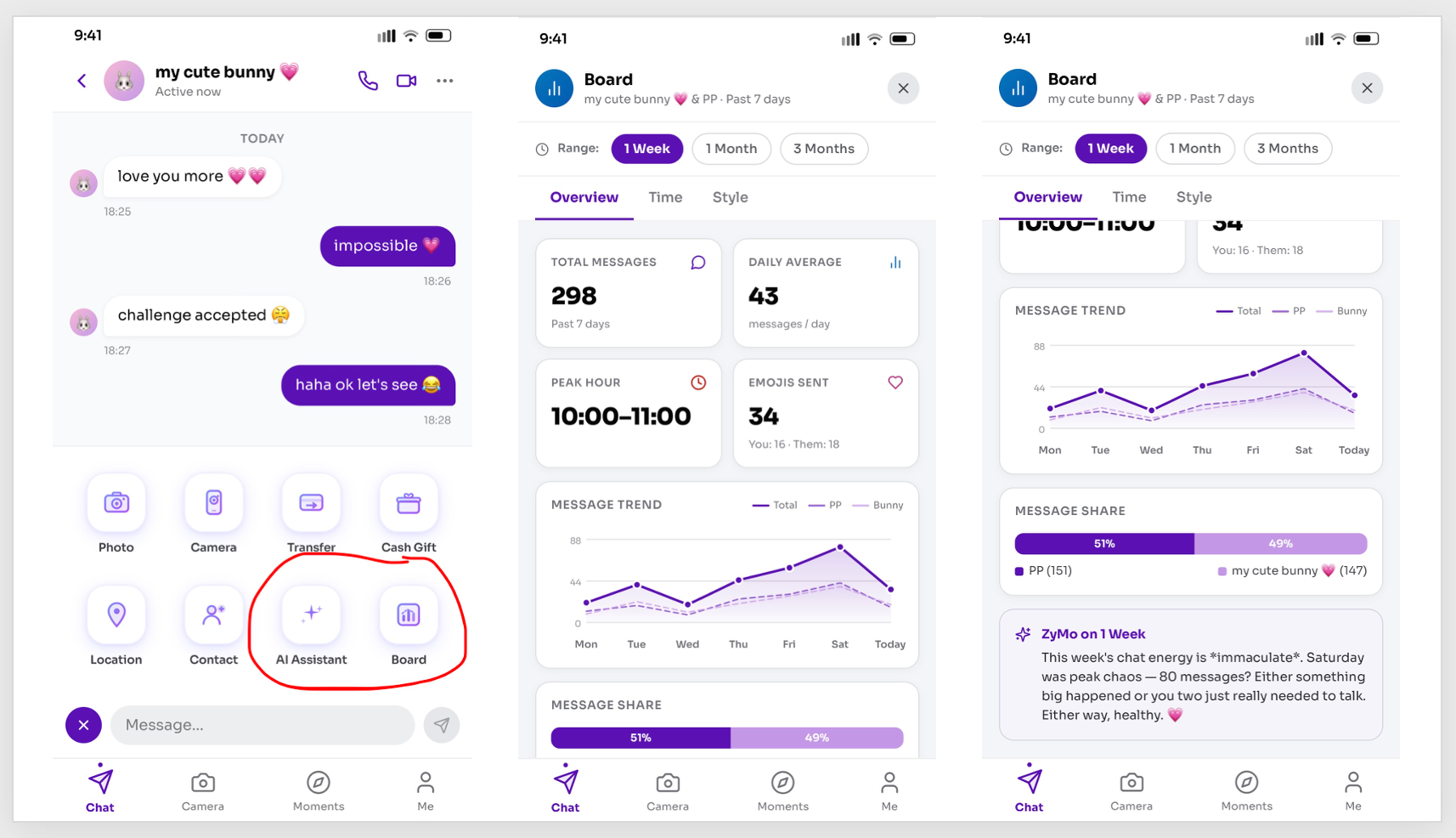
When you open a conversation in Zymix, the standard chat interface has two additions that no other messaging app offers.
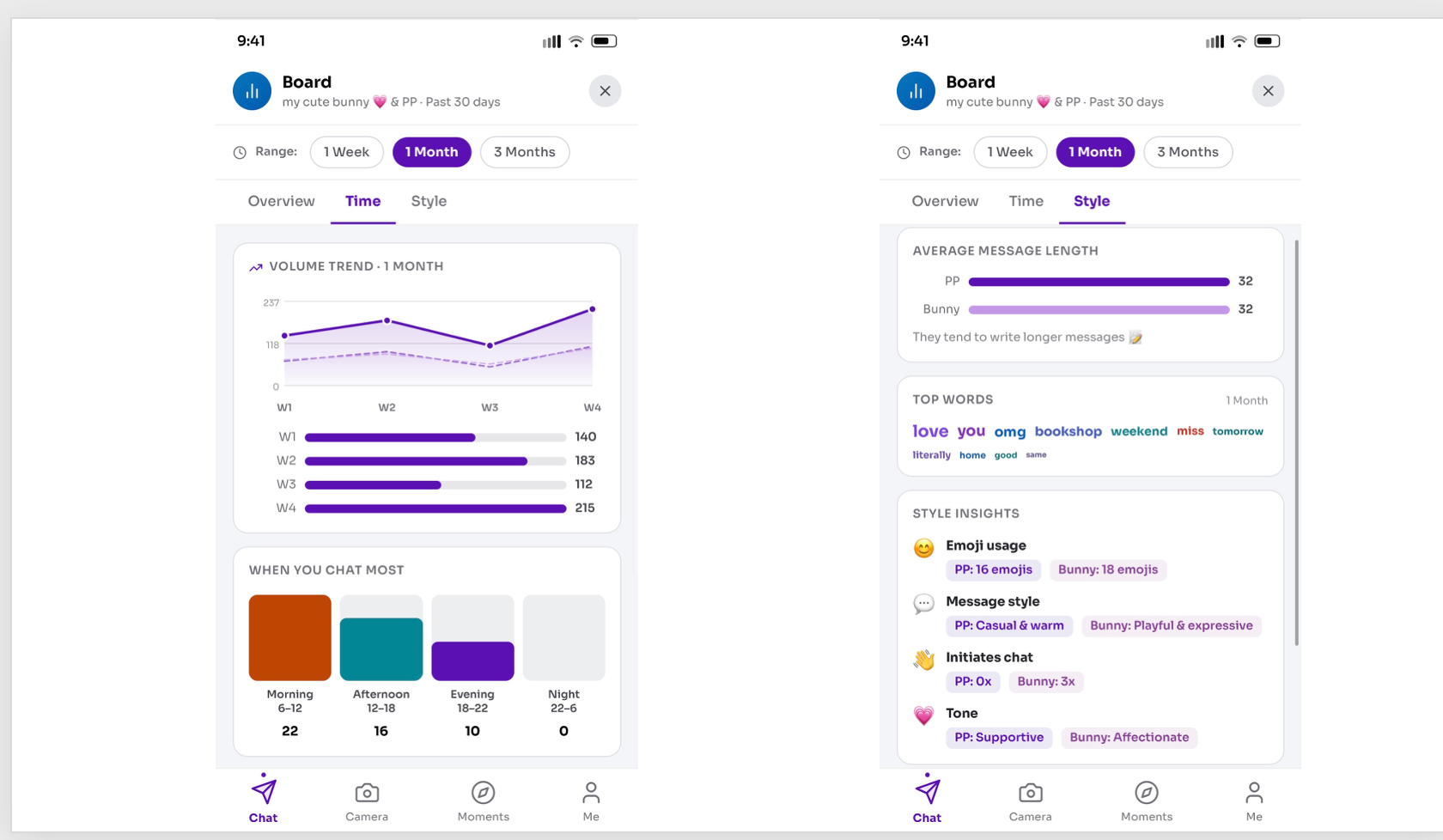
The first is Board — a visual analytics dashboard that surfaces the hidden patterns in your conversation history. It shows message volume over time, interaction frequency, peak hours, chat style, language patterns, and even recurring phrases. These data points tell a story: the arc from strangers to close friends, the warmth of a relationship building, the quiet periods and the sudden bursts of energy. Board makes that story visible.
The second is AI Assistant (ZyMo) — a generative AI integrated directly into the chat interface. ZyMo isn't just a chatbot you talk to alone; it's a presence inside your conversations with other people. We've designed a set of suggested prompts that make two-person chats more playful and interesting — things neither person would have thought to ask on their own. In future updates, we'll develop ZyMo's personality further: more opinionated, more sarcastic, more distinctly its own thing — the kind of AI character people talk about the way they talk about Duolingo's owl.
Feature 2: Visual Diary with AI Analysis
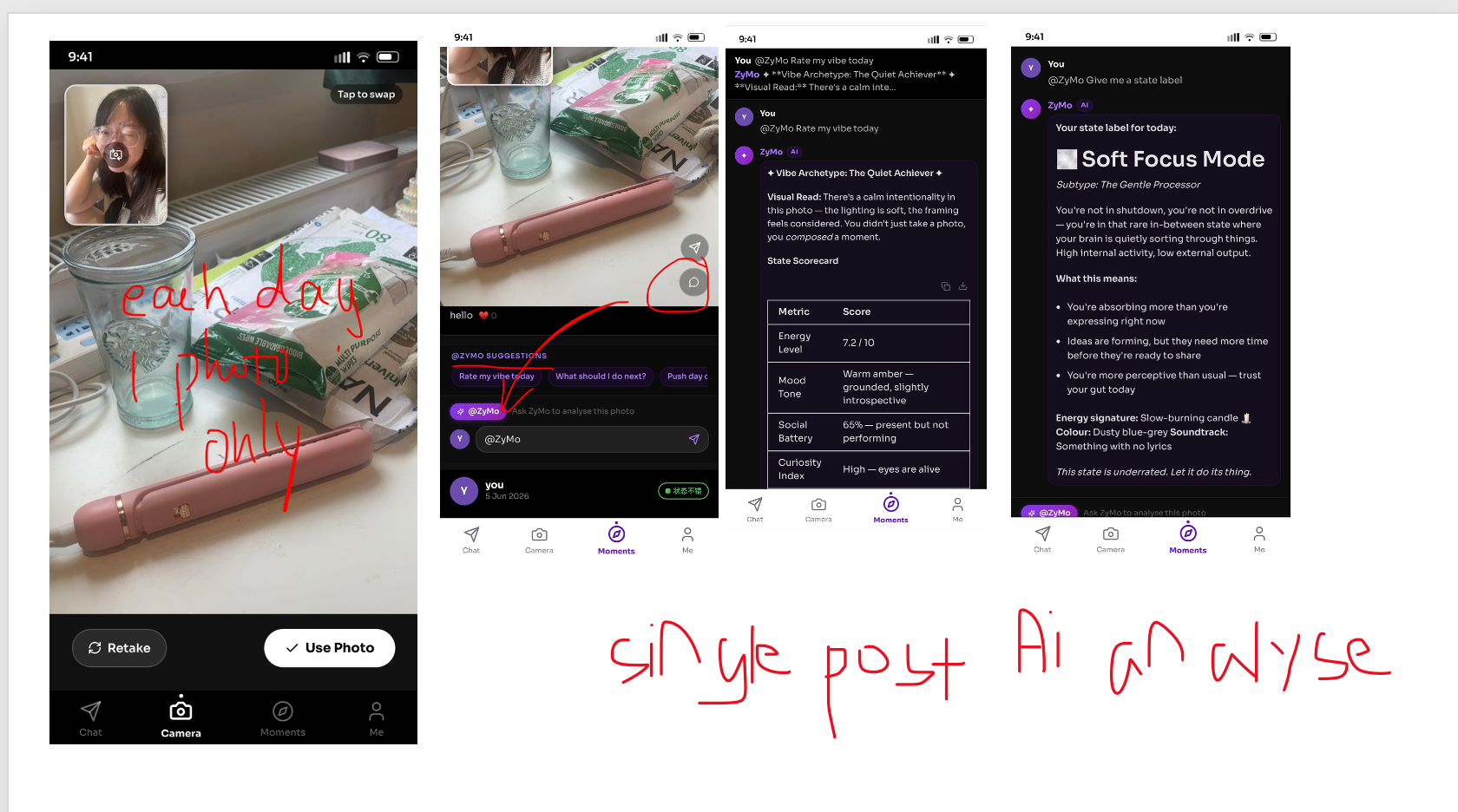
Once a day, Zymix lets you take one photo. Not a curated, filtered, heavily edited post — just a real, unposed snapshot of your day. On mobile, the front and rear cameras capture simultaneously: your face and your surroundings in a single frame. The result is honest in a way that most social media isn't.
These photos live in Moments, which has two views:
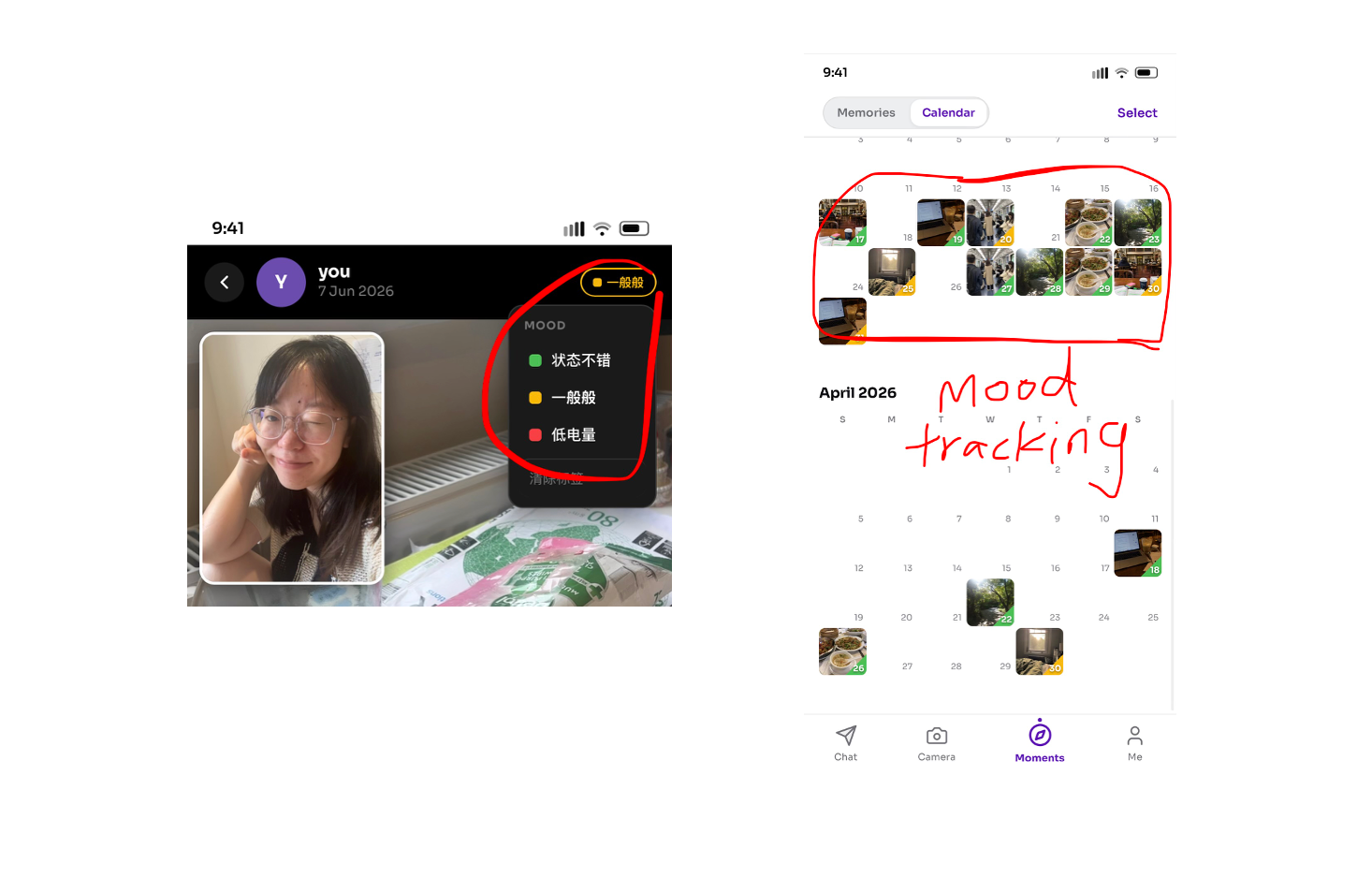
Memories is a feed of your daily posts. Each one can be tagged with a mood (green / yellow / red), and when you open a post, you can @ZyMo in the comments for a quick AI read of your photo — suggested prompts include things like "rate my vibe today," "what should I do next," and "push day or survival mode?" This turns a social post into a moment of self-reflection.
Calendar maps your mood tags across the month as a colour grid. Watching the colours shift over weeks is surprisingly powerful — it's the kind of pattern you can't see when you're living inside it.
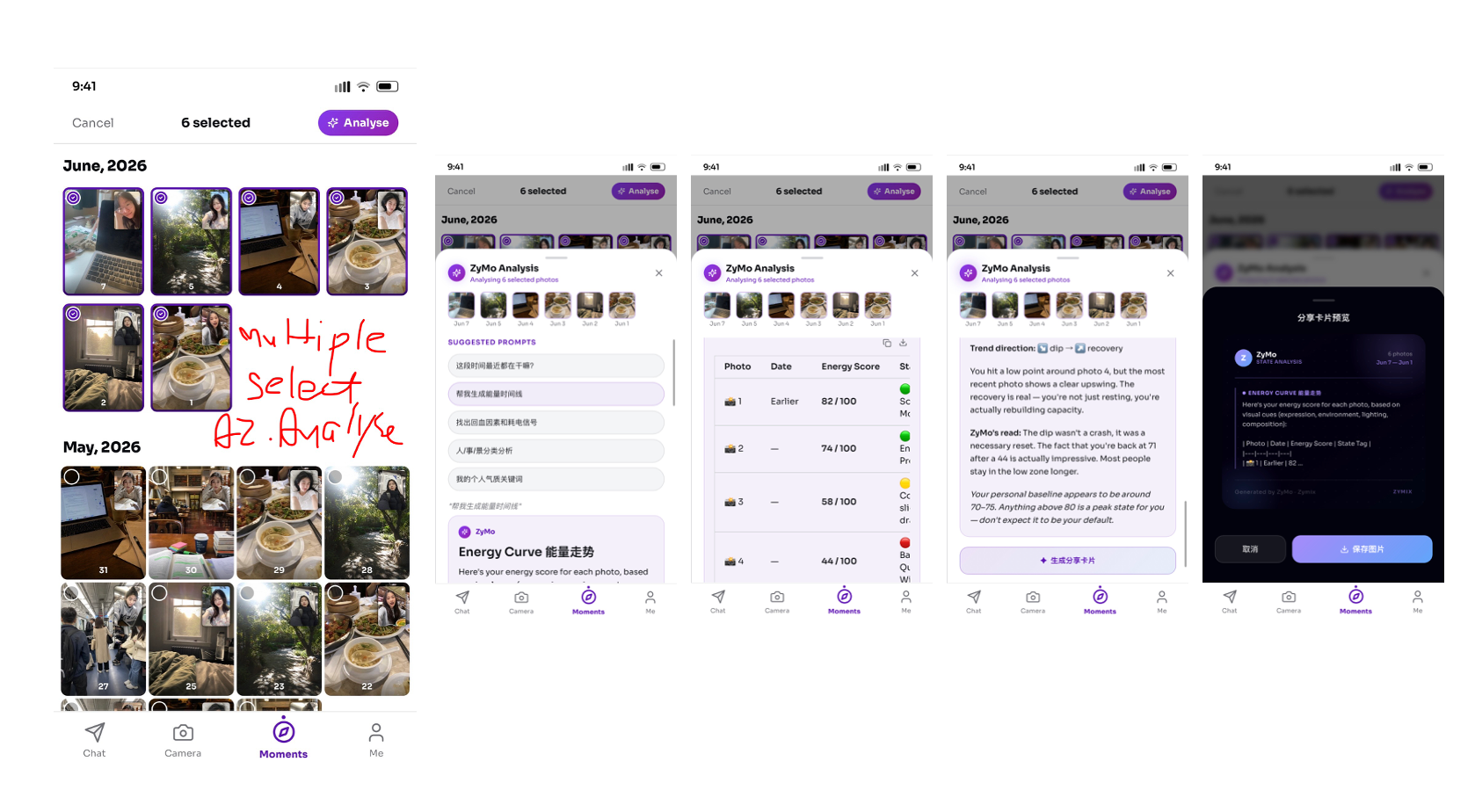
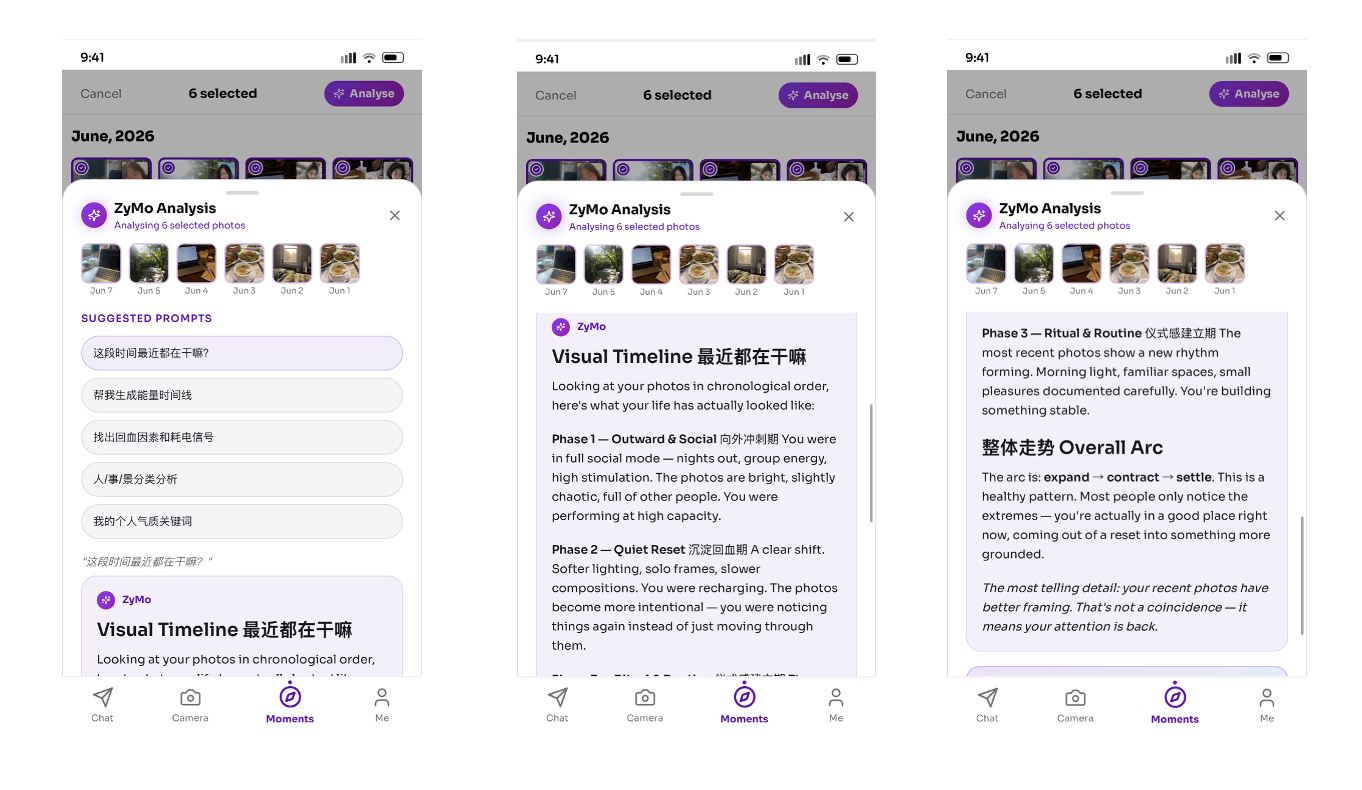
The third photo feature is multi-image timeline analysis. Select a range of photos from across days or weeks, and ZyMo analyses the whole period: generating an energy curve, summarising what's been happening in your life, identifying what's been charging you up and what's been draining you. In future versions, these results will be exportable as shareable cards — designed to be posted or sent to friends.
How We Built It
The frontend is built in React 19 with Tailwind CSS 4 and shadcn/ui components. The backend runs on Express with tRPC for end-to-end typed API calls, Drizzle ORM for database access, and Manus OAuth for authentication.
The AI layer uses a multimodal LLM (via the Manus built-in Forge API) that accepts both image and text inputs simultaneously — this is what allows ZyMo to analyse a photo rather than just a caption. We built a custom streaming proxy so responses arrive token-by-token in real time, which makes the AI feel responsive rather than like a loading screen.
The dual-camera capture is handled client-side using the MediaDevices API, with Canvas compositing to merge the selfie and environment frames into a single image before upload. Files are stored in S3 via the Manus storage layer.
The Board analytics are computed from message metadata stored in the database — frequency, timing, and style signals extracted from conversation history.
For the demo, we implemented a fast-stream mode for ZyMo's suggested prompts, so the AI responses appear instantly without waiting for API latency. This was important for showing the product's potential without the demo being derailed by network timing.
Challenges We Ran Into
Dual-camera on desktop browsers. The Web MediaDevices API doesn't support simultaneous front and rear camera capture on laptops. We solved this by building a two-step capture flow — front camera first, then rear — and compositing the frames on the client using Canvas. The result looks identical to a true dual-camera shot.
Streaming AI responses through tRPC. tRPC's standard request-response model doesn't support streaming out of the box. We built a custom SSE (Server-Sent Events) proxy that streams LLM output token-by-token to the frontend, with careful handling of connection teardown to avoid upstream abort errors.
Prompt engineering for photo analysis. Getting ZyMo to produce genuinely insightful, specific analysis of photos — rather than generic descriptions — required significant iteration on the system prompt. The current prompt architecture separates visual read, state scoring, and actionable output into distinct sections, which produces much more useful results than a single open-ended prompt.
Feed layout fidelity. Getting the Moments feed to match the reference design (full-width environment photo, selfie inset top-left, username overlay, action icons bottom-right) required careful absolute positioning and z-index management, especially across different screen sizes.
Accomplishments That We're Proud Of
We built a working product in 24 hours that demonstrates a genuinely new idea: that the conversations and photos you're already generating every day contain enough signal to power a meaningful self-awareness tool — without requiring any extra effort from the user.
ZyMo's single-photo analysis already produces outputs we find surprising. When it says things like "Social Battery: 65% — present but not performing. Today you're built for deep work and meaningful 1-on-1 conversations. Skip the crowded rooms" — that's not a horoscope. It's a specific read based on visual evidence. The fact that it often feels accurate is what makes the concept worth pursuing.
The Board feature — showing the arc of a friendship through data — is the part we're most excited about long-term. There's something genuinely moving about seeing the moment a relationship shifted, captured in a graph.
What We Learned
The most important thing we learned is that the data is already there. People don't need to be asked to track themselves — they're already doing it, in every message they send and every photo they take. The design challenge isn't data collection; it's making the existing data legible and interesting.
We also learned that AI personality matters more than AI capability for consumer products. ZyMo's tone — warm, slightly irreverent, specific rather than generic — is what makes people want to interact with it again. A technically impressive but bland AI assistant is less useful than a slightly less capable one with a distinct voice.
What's Next for Zymix
ZyMo's personality. We want ZyMo to become a character people talk about — opinionated, sarcastic in the right moments, with a voice that's recognisably its own. Think Duolingo's owl, but for self-awareness.
Shareable AI cards. Timeline analysis results exported as visually designed cards, ready to share with friends or post to other platforms.
AI Playground. A section where users can upload their own AI mini-programs — personality tests, mini-games, creative prompts — all powered by the user's own chat and photo data. The goal is to make your personal data the raw material for experiences, not just a record.
Native mobile app. True simultaneous dual-camera capture, daily capture reminders, and push notifications for ZyMo insights.
Deeper Board analytics. Relationship arc visualisation, personality profiling from language patterns, and cross-conversation comparisons.
The core thesis is simple: the richest data about who you are is already in your phone. Zymix just helps you read it.
Built With
- claude
- manus

Log in or sign up for Devpost to join the conversation.