Inspiration
Most safety tools try to stop you before you click. But for many people the hard moment comes after: they have already shared an OTP, lost control of their WhatsApp, or noticed their phone suddenly has no signal. They are stressed, often on a weak connection, and what they need is not an explanation of how scams work. They need to know what to do first.
When we looked at what a panicked person actually finds, it is usually scattered, in English, and not ordered by urgency. Freezing the money, regaining access and cleaning up should happen in that order, and that order is what we wanted to put in someone's pocket, working even with no internet.
What it does
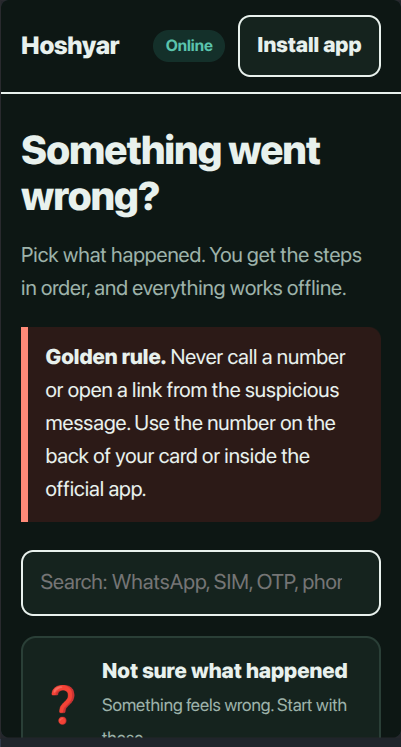
Hoshyar is an installable web app (PWA) that gives ordered recovery checklists for the most common "I think I've been hacked" situations. The user picks what happened, and gets steps grouped as Do first (next 10 minutes), Today and This week, each one tickable, with a progress bar.
It currently covers 13 situations with 83 steps in total:
- Not sure what happened
- Shared an OTP, PIN or password
- WhatsApp hijacked (with a copy-ready warning message for contacts)
- Clicked a suspicious link
- Suspected SIM swap
- Sent money to a scammer
- Unknown transaction on a card or account
- Social media account hacked
- Email hacked
- Phone lost or stolen
- Installed a suspicious app or gave remote access
- Blackmail or threats
- CNIC or ID details shared
After the first visit it works completely offline. There is no backend, no account, no AI call and no analytics. The only thing stored on the phone is which steps were ticked.
Intended user: a non-technical phone user, such as a parent, shopkeeper or first-time smartphone user, in the minutes after something went wrong.
Example of a safer outcome: someone whose WhatsApp was hijacked is told to re-register their number themselves, never share the 6-digit code, enable two-step verification, check linked devices, and warn contacts using a copy-ready message, so the attacker loses access and contacts are less likely to send money.
A limitation: the guide content is currently a draft based on general good practice. It has not yet been checked against each provider's current official guidance, and every guide says so on screen. It is also English only for now.
How we built it
Hoshyar is deliberately small and dependency-free: plain HTML, CSS and JavaScript with no framework and no build step. About 22 KB of code and content in total, plus icons.
- Content as data. All guides live in a single data file, so a guide can be reviewed, translated or corrected without touching the code.
- Rendering. A small script renders the home list and each guide from that data, using the URL hash for navigation, and stores ticked steps in
localStorage. - Offline-first. A service worker precaches the app shell on the first visit and serves cached files first afterwards. A status badge shows when the app is ready to work offline.
- Installable. A web app manifest with standard and maskable icons enables install on Android, and Add to Home Screen on iOS.
- Privacy by construction. No network requests after install, no accounts, no analytics, and no helpline numbers hard-coded, so we cannot ship a wrong one. Steps tell people to use the number on their card or in the official app.
- Accessible interface. Large tap targets, keyboard focus styles, light and dark mode, reduced-motion support and a calm high-contrast design, with the "do first" group visually distinct.
- Hosting. Deployed as a static site on Vercel.
Challenges we ran into
- Deciding the order. The hardest design problem was not the code but sequencing: what really belongs in the first ten minutes (stop the loss, regain access) versus later (review, report, harden).
- Accuracy without false confidence. Safety advice that is wrong is worse than none. We chose not to include phone numbers we could not verify, and to show a visible draft notice on every guide until it is checked against official sources.
- Offline correctness. A cache-first service worker makes the app work with no signal, but it also means phones can keep showing an old version. We handled this with versioned caches and by keeping the service worker file uncached.
- Platform differences. iOS has no install prompt, so the install flow differs between Android and iPhone.
- Sensitive situations. For blackmail and threats, the wording had to avoid blame, never suggest paying, and point under-18 users to a trusted adult.
- Scope. There are many possible problems. We chose breadth of common situations over depth in any one, and kept each guide short enough to follow while stressed.
Accomplishments that we're proud of
- A complete, working app that needs no server, no account and no connection once installed.
- 13 guides and 83 steps, each ordered by urgency.
- A privacy position that is easy to explain and verify: nothing about the incident is typed in, sent or stored.
- Honest limits shown in the product itself, not hidden in a footnote.
- A tiny, dependency-free codebase that anyone can read, review and extend in minutes.
What we learned
- In a crisis, order beats completeness. A short list in the right sequence is more useful than a long explanation.
- Offline-first is a safety feature: the moment people need help is often the moment their connection or phone is least reliable.
- Not shipping unverified details, such as helpline numbers, is part of responsible design.
- Keeping content as data makes safety guidance easier to review and translate.
What's next for Hoshyar
- Verify every guide against official provider guidance and add review dates, removing the draft notice only when checked.
- Add Urdu, including Roman Urdu search, with right-to-left layout.
- Test with non-technical users and screen-reader users and fix what they struggle with.
- Add more situations, such as loan-app harassment, fake job offers and marketplace scams.
- Let trusted organizations contribute and review guides through pull requests.
- Add a printable one-page "first 10 minutes" card.
Credits and disclosures
Built solo during the build period (Oct 17 to Nov 22, 2026), with no pre-existing components. No third-party libraries, fonts, images or datasets. All example scenarios are generic and no real personal data is used. Claude (Anthropic) assisted with planning, drafting code and guide content, and documentation.

