Inspiration
What it does
How we built it## Inspiration
Long-form creative projects accumulate decisions across timelines, character sheets, object registers, relationship maps, revisions, and working notes. As the project grows, continuity errors become harder to detect and even harder to explain.
A-Eon Continuity Workspace was inspired by a practical question:
Can a continuity check produce evidence that a human editor can verify, instead of silently rewriting the text?
What it does
A-Eon Continuity Workspace is a local continuity-auditing tool for complex creative projects.
The user provides:
- a structured continuity package;
- a new scene or chapter.
The workspace then produces:
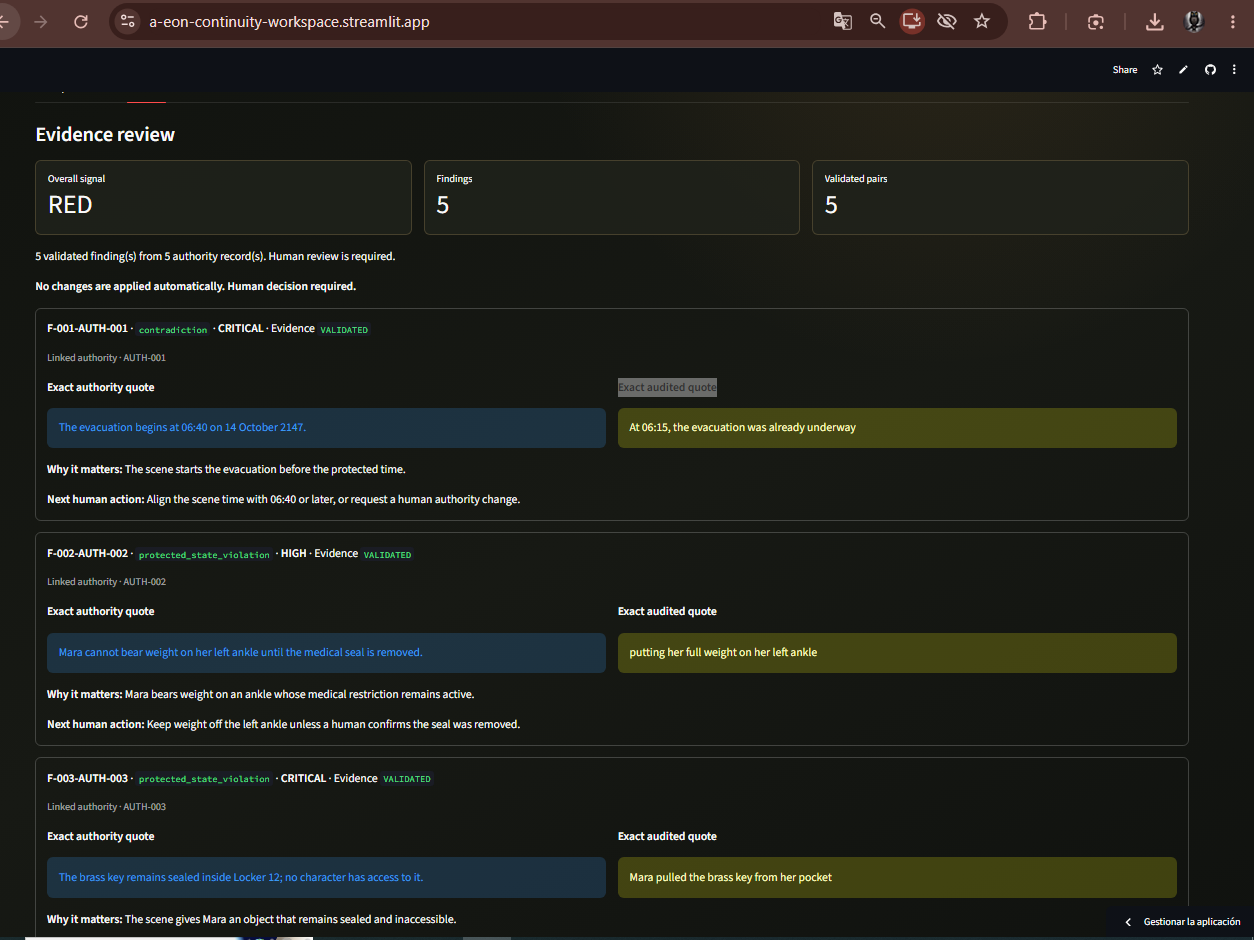
- a red, amber, or green continuity signal;
- detected contradictions and protected-state violations;
- severity for each finding;
- an exact quote from the continuity authority;
- an exact quote from the audited scene;
- a short explanation;
- a recommended next action;
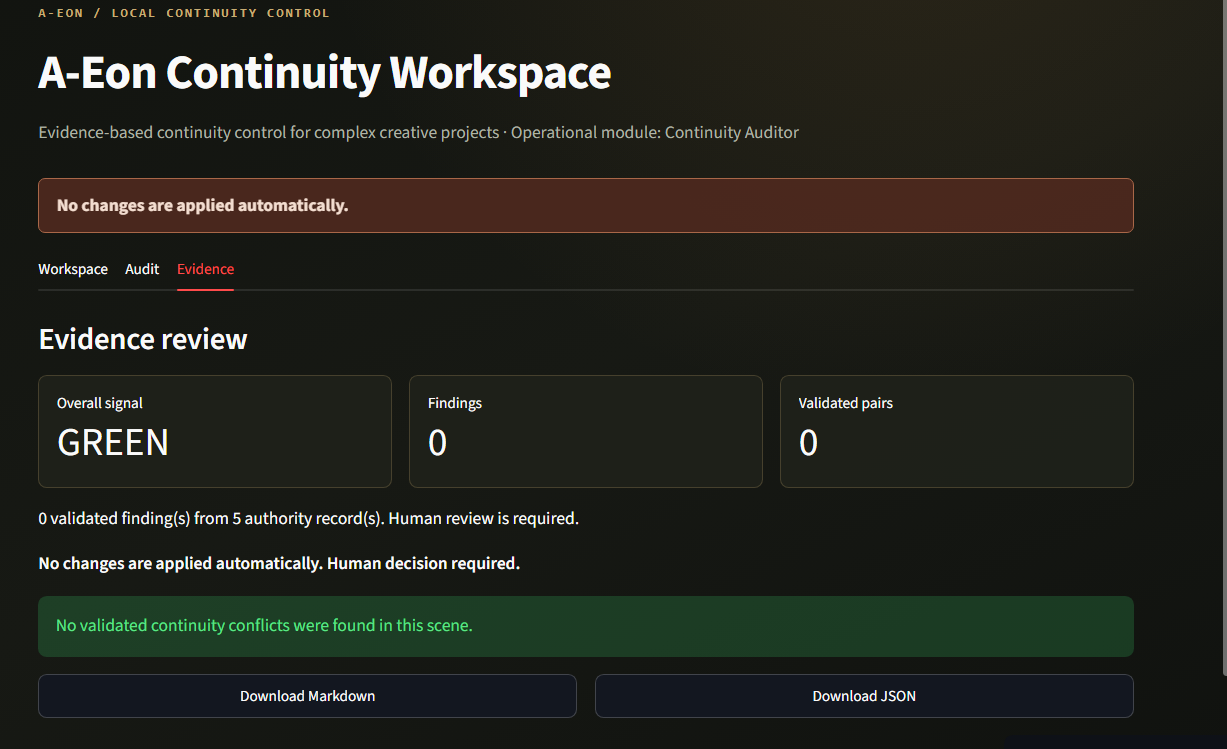
- Markdown and JSON exports.
The application never edits the submitted text and never applies changes automatically.
How it works
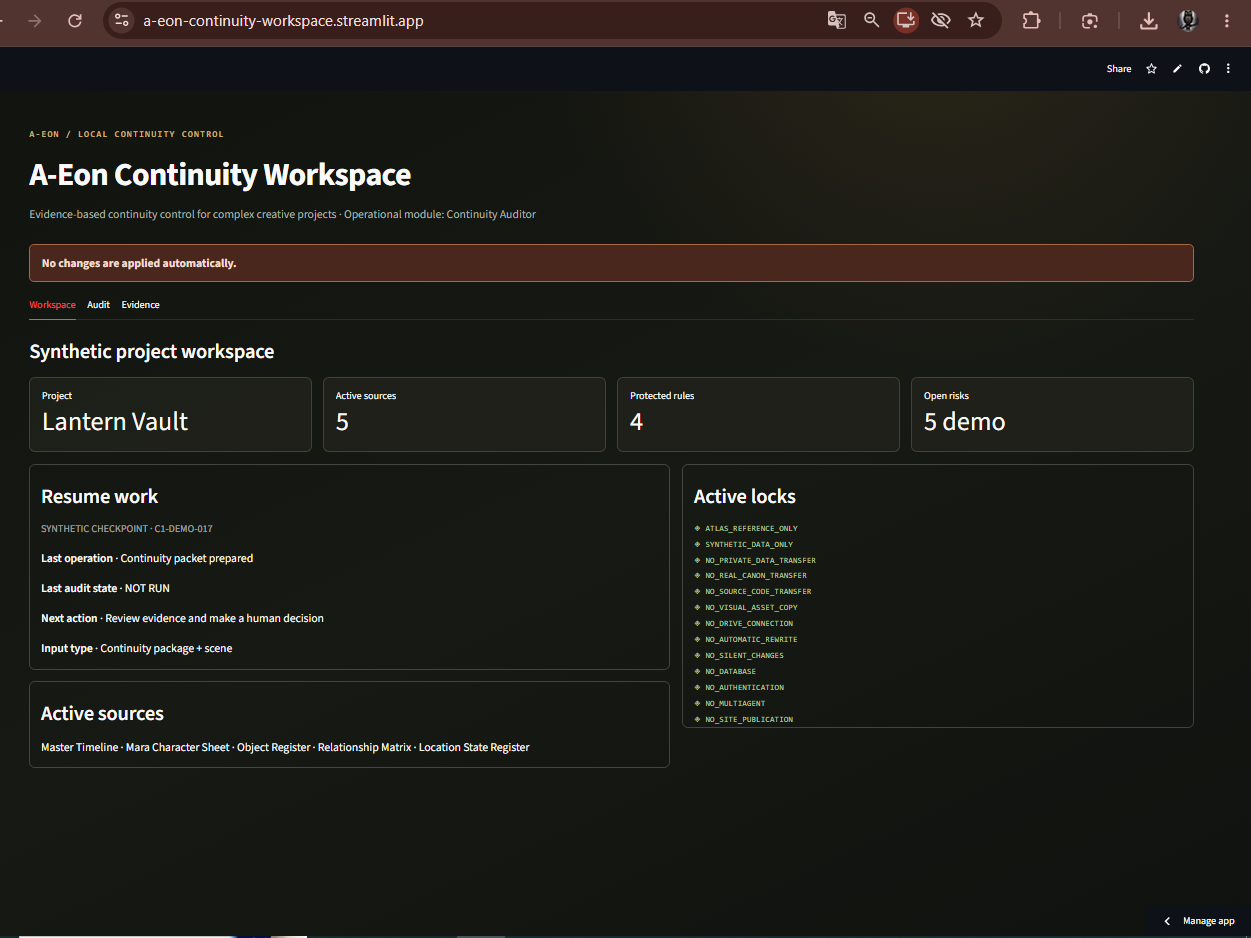
The current prototype uses a fictional demonstration project with five continuity authorities covering:
- chronology;
- character injury;
- protected objects;
- character relationships;
- location state.
A deterministic local engine evaluates the new scene against those authorities.
Every finding must pass dual evidence validation:
- the authority quote must exist literally in the linked authority record;
- the audited quote must exist literally in the submitted scene.
Only validated findings can affect the final signal.
The problematic demo produces:
- red
- 5 findings
- 5 validated evidence pairs
The clean demo produces:
- green
- 0 findings
How we built it
The primary repository was created during OpenAI Build Week in Codex using GPT-5.6 Sol.
Codex and GPT-5.6 Sol were used to:
- create the Python and Streamlit repository;
- define typed Pydantic contracts;
- implement the deterministic detector registry;
- validate evidence;
- recalculate the continuity signal;
- build Markdown and JSON exporters;
- create the Workspace, Audit, and Evidence views;
- write and run the test suite;
- document and package the final build.
The delivered application itself is fully local and deterministic. It does not call the OpenAI API and does not require an API key.
Challenges
The main challenge was preserving human authority.
A continuity system can easily become a rewriting assistant that makes decisions without showing its evidence. We deliberately avoided that approach.
Instead, the project separates:
- authority;
- detection;
- evidence;
- severity;
- recommendation;
- human decision.
Another challenge was keeping the prototype small enough to demonstrate clearly while still showing a path toward larger editorial and documentary systems.
Accomplishments
- Built a complete Streamlit workspace from a new Codex repository.
- Implemented literal dual-evidence validation.
- Recalculated the traffic-light signal in Python.
- Produced deterministic red and green demonstration cases.
- Added Markdown and JSON exports.
- Passed 15 automated tests.
- Kept the application free of private data, API keys, external services, and automatic rewriting.
- Preserved a complete build log, manifests, checkpoints, and delivery hashes.
What we learned
Continuity auditing becomes more useful when every finding is traceable.
The important output is not only:
“There is a contradiction.”
It is:
“This exact sentence conflicts with this exact authority, at this severity, and here is the next action a human may consider.”
We also learned that a narrow, auditable workflow can be more trustworthy than a larger system that hides how it reached its conclusions.
What's next
Future versions could add:
- configurable continuity-rule templates;
- larger synthetic and user-authorized corpora;
- expert correction capture;
- regression evaluations generated from human corrections;
- version comparison;
- collaborative review;
- optional AI-assisted semantic analysis behind an explicit human-controlled gate.
The long-term vision is a modular workspace for maintaining continuity, provenance, revision state, and human editorial control across complex projects.

Log in or sign up for Devpost to join the conversation.