Inspiration
In our first meeting, Eline shared with the team that she is an ambitious planner who loves to structure her day. No wonder her to-do lists are incredibly long and overwhelming to look at. When she can't check off every tasks she usually feels disappointed, unmotivated, and like she isn't accomplishing enough.
According to the research we found, those negative emotions of self-blaming and frustration that Eline feels trigger increased activity in a part of the brain linked to memories. In other words: we remember negative moments better than the positives!
But what if there is an app out there to remind you of all those happy memories? Not just recent victories but even accomplishments from years ago. Posi🌳vity was born because of that mission. We hope this app will make you a more content and balanced person, help boost your confidence and make you feel proud of yourself. It will help you live your best life by practicing gratitude and celebrating every small and big win!
What it does
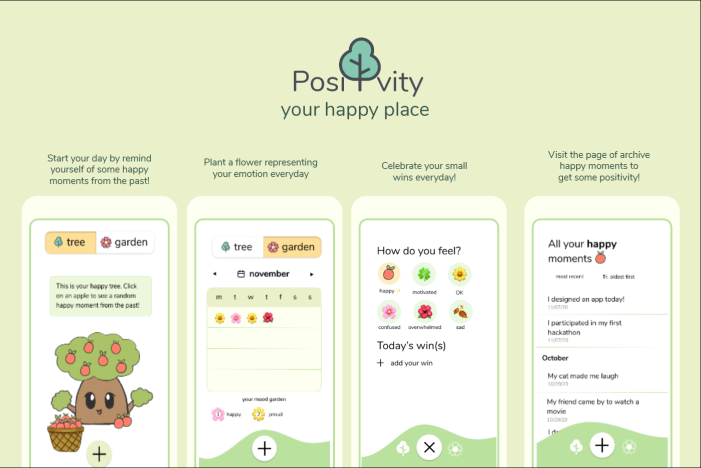
Posi🌳vity has 2 main pages: an apple tree functioned as a happy tree to suggest users some random happy memories from the past and a garden of emotions acted as a mood tracker where users can plant a flower representing their moods for today and list out their small win(s).
How we built it
First we had a brainstorming session to figure out what we wanted our app to do. On Saturday we all went to the Design Sprint workshop, and after that we did a mini version of that using Mural. We decided what we wanted the experience to feel like, what functions it should have and all made a bunch of sketches.
With this hackathon submission, we split our team into 2 small teams where one was in charge in designing the app and transforming it into a clickable prototype using Figma and Photoshop while the other team was coding the back-end using Java and Spring Boot and trying to learn how to integrate the front-end and back-end together.
Challenges we ran into
Guaidi: Like everyone in the group, this was my first hackathon with intermediate experience with Java. This app is a great idea, however, I do think it was a bit ambitious with my current skill set. Coding was not too big of an issue, except for a few concepts I couldn't translate into Spring, but that challenge was definitely no match to trying to integrate the front and back-end. We weren't too sure how to combine both aspects to fully finish our intended app, but it was definitely a great experience! I'm so grateful for this team and weekend as it was truly an eyeopener of just how much I have yet to learn!
Uditi: This was my first ever hackathon and I only know the basics of Java. Which is why, it was challenging for me to work on this very intricate and complex app. The most challenging part was figuring out where to start. After planning out the app and its purpose, we stumbled upon the question of how we were going to integrate the front-end and back-end code. Unfortunately, we did not have enough time to solve this challenge but we are definitely going to keep working and keep exploring.
Eline: This was the first time I was making a prototype in Figma, so I was learning as I was going. I definitely underestimated how much time it takes to go through every step and interactions of an app. There's so much people can click on and so many little details to think about! For most pages I made several designs before it worked well in the prototype, because some things that looked nice didn't make sense when I made it interactive. I learned a lot about UI/UX this weekend and was happy to apply some of the things from workshops in our final app.
Angie: I came to this hackathon with one learning goal in my mind: to challenge myself to be a better presenter. I was so honored that my team trusted me to present our project. But in order to speak on behalf of our team, I needed to fully understand what was other members' challenges while they were working on their parts of coding and designing. But I'm not a coder, I don't speak the language of coder and I don't have a fundamental understanding of coding either. But I decided to be vulnerable and just ask all the small and "stupid" questions that I had and fortunately, my team was so kind and supportive so we got through this bump of communication together. And I'm really grateful for what I learned through this hackathon: a little bit of UI/UX, some leadership skills, some communication skills and especially how to bring everyone together.
Accomplishments that we're proud of
- Our communication is effective and clear. We gathered twice a day for a check-in call on Zoom to see how's everyone doing and figure out the next steps together.
- We made sure no-one is sleep-deprived, self-care and health are our first priorities.
- I learned how to use Figma and gained a deeper understanding of Java.
- We worked together to build a prototype on Figma and write some back-end code.
- I learned how to code using spring boot.
- I learned how much goes into designing an app, and am proud that our team managed to create a working prototype. I would definitely enjoy using this app!
What we learned
- Throughout this weekend some of us were working on the back-end programming while the others were working on the front-end programming and, though we were working with different programming languages, we all gained a deeper understanding of the programming language that we were working on, which included JavaScript, java, and Html.
- With the help of each other we discovered many helpful websites, to help us organize our thoughts and stay on track, such as Notion, Mural, GitHub, and Figma.
- We learned how to use new important tools this weekend which included Figma and Spring Boot.
What's next for Posi🌳vity app
We plan to transform our prototype into an app by writing the front-end code and then figuring out a way to integrate that with the back-end code. That's not all we have planned; we also plan on building a community feature on our app so that users can visit other people's garden of emotions to see how they're doing. However, our team believes that emotions and memories are precious private things so users might not want to share everything. We'll provide users 3 options:
- Users can set their gardens as private so only them can view it
- Users can add some close friends to their list so that their friends can see both each other's gardens which include all the emotion flowers planted and detailed smalls wins of everyday.
- User can add close friends but they can only see the flowers not the details of daily small wins.


Log in or sign up for Devpost to join the conversation.