Inspiration
Our planet's future hangs in the balance, and nowhere is the friction more visible than in our cities, where "gray infrastructure" accelerates climate change. Urban heat islands kill 1,300+ Americans annually, disproportionately affecting low-income communities who lack the clean energy resources to adapt. Traditional planning is too slow for a planet in crisis; it relies on cold satellite imagery that misses the human cost. We asked: What if we could build a living, breathing urban nervous system to sustain the spark of our communities by sensing environmental injustice in real-time?
What it does
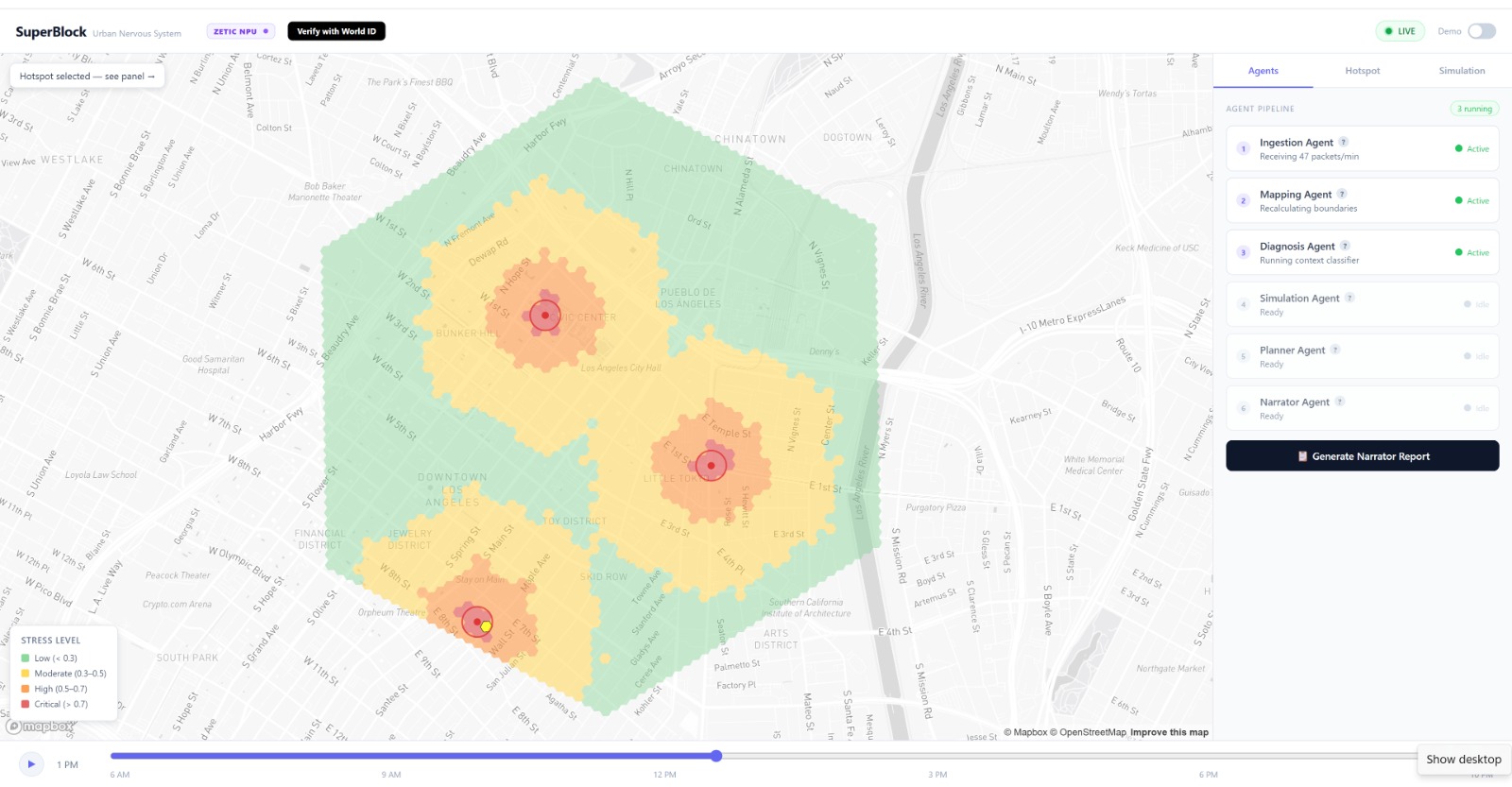
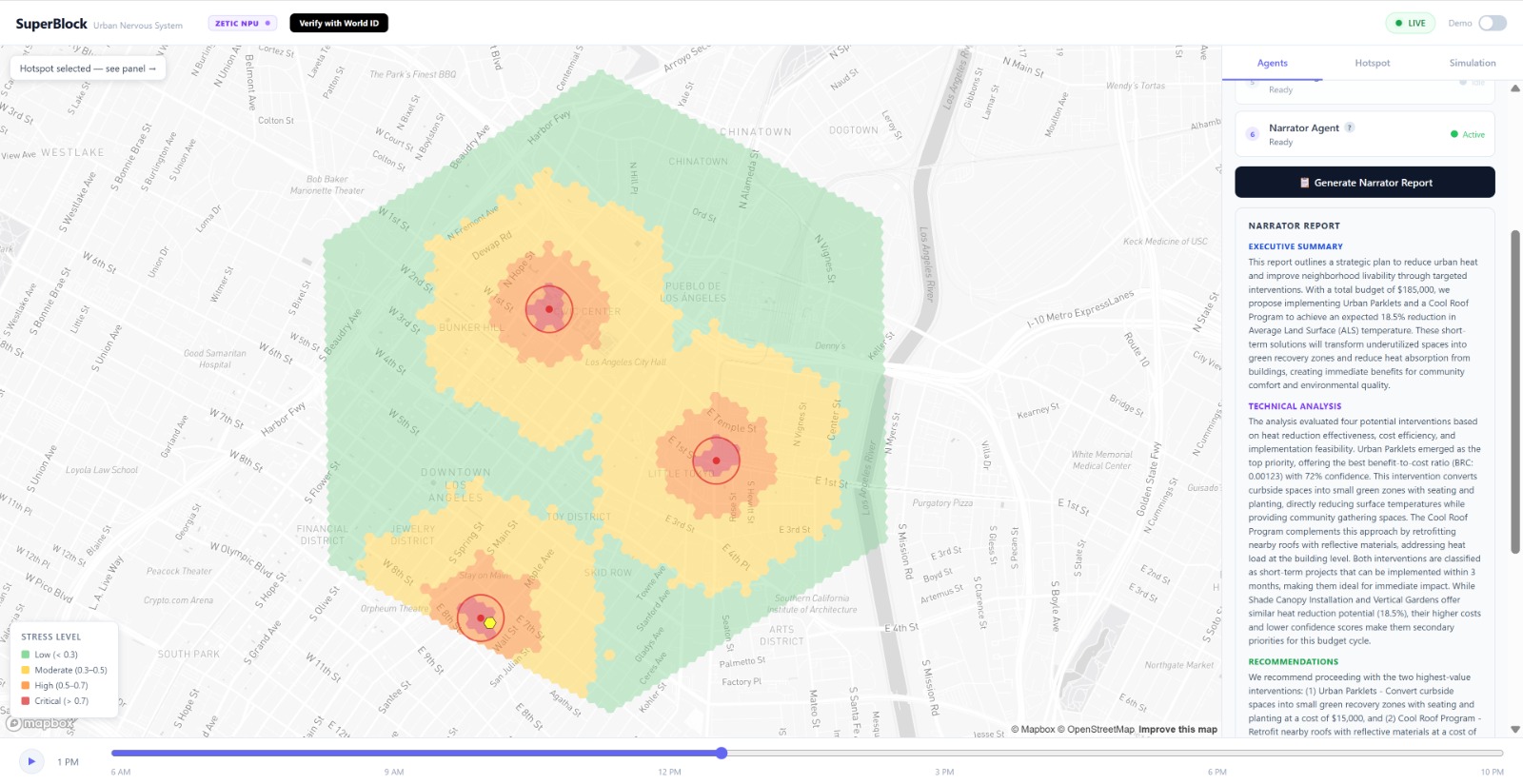
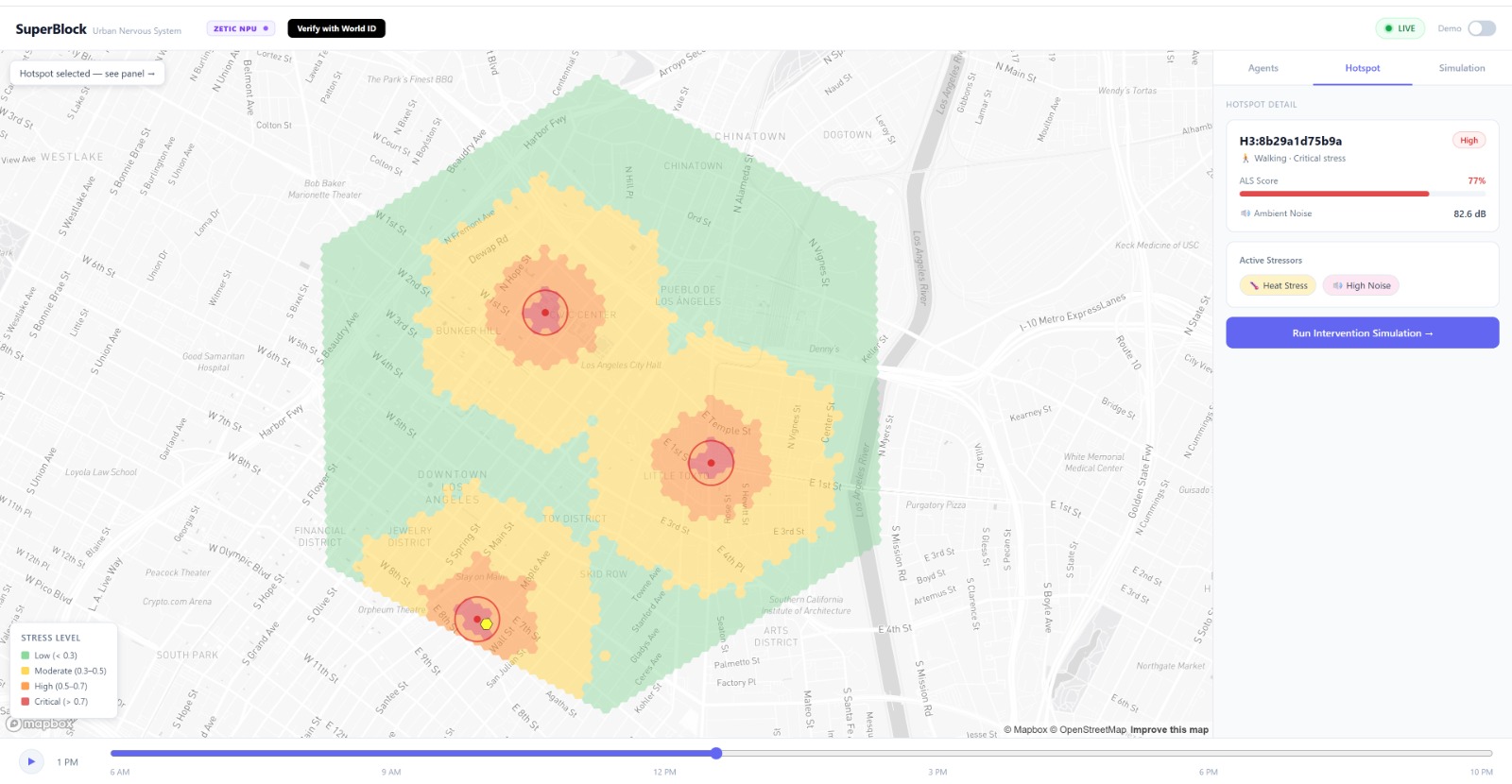
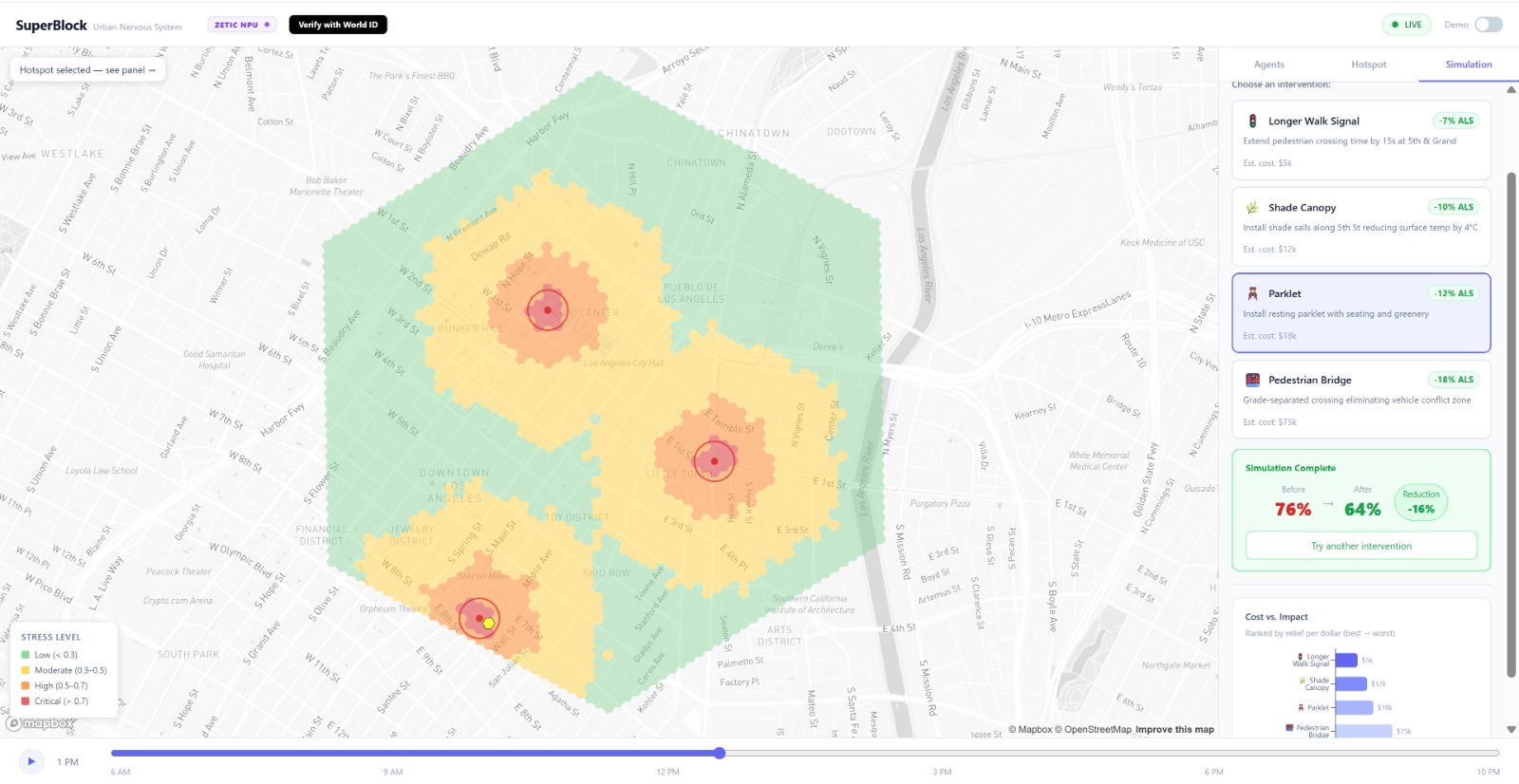
Superblock is a decentralized urban nervous system that turns citizen physiological stress into real-time diagnostic infrastructure. Apple Watch sensors (HRV, heart rate, motion, noise, temperature) are processed on-device to generate privacy-preserving stress scores. These scores stream through a 6-agent orchestration chain (Ingestion → Mapping → Diagnosis → Simulation → Planner → Narrator) to identify heat islands, diagnose root causes (heat, noise, dangerous crossings), simulate interventions (shade canopies, parklets, longer crossing times), and rank solutions by biological impact per dollar. The result: a 3D digital twin of the city where red zones pulse in real-time, and city planners can click to see AI-generated intervention recommendations with predicted stress reduction.
How we built it
Edge Layer (On-Device Privacy): Apple Watch collects 6 signal categories (cardiovascular, gait, metabolism, environmental, thermal, GPS). A quantized stress classification model runs on-device (ZETIC Melange platform optimized for NPU deployment). Only three anonymized fields leave the device: ALS score (0.0–1.0), movement context, and H3 tile ID.
Multi-Agent Orchestration (Fetch.ai Agentverse): Built a 6-agent reasoning chain using Fetch.ai uAgents framework, registered on Agentverse with handle @superblock. Agents communicate via the Almanac discovery protocol and are accessible through ASI:One chat. The Ingestion Agent validates World ID proof-of-humanity, Mapping Agent aggregates into H3 hexagonal tiles, Diagnosis Agent infers failure modes, Simulation Agent runs what-if counterfactuals, Planner Agent ranks interventions by Biological Relief Coefficient, and Narrator Agent explains reasoning in plain language.
Backend (FastAPI + MongoDB Atlas): Python FastAPI service with 17,952+ packets persisted in MongoDB Atlas. Internal orchestration endpoint /agents/orchestrate/internal allows the skill agent to trigger the full reasoning chain without authentication for demo purposes.
Frontend (React + Deck.gl): Vite + React frontend with Zustand state management. 3D map visualization using Mapbox and Deck.gl H3HexagonLayer. Time slider replays stress patterns through the day. World ID IDKit v4 integration for proof-of-humanity verification.
Networking (Arista): WebSocket + REST fallback ensures low-latency data flow from edge devices to city intelligence backend. Multi-agent orchestration routes data through specialized agents.
Authentication (Auth0): Secures agent-to-user identity management for the backend API.
Public Exposure: Cloudflared tunnel exposes the local agent to Agentverse for ASI:One discoverability.
Challenges we ran into
Dynamic Endpoint Management: Cloudflared tunnel URLs change on every restart, requiring us to dynamically update the agent's endpoint configuration and Agentverse profile to ensure the agent remains discoverable.
SSL Certificate Configuration: Initial agent registration with Agentverse failed due to SSL verification errors, which we resolved by updating Python's certificate store and configuring proper SSL contexts.
Authentication Flow Design: Balancing security with agent accessibility required us to create separate internal endpoints for agent-to-backend communication while maintaining Auth0 protection for user-facing APIs.
Mobile Integration Planning: While we optimized the stress model for NPU deployment via ZETIC Melange, we identified that full on-device inference requires dedicated mobile app development—a longer-term technical path we documented for future implementation.
Accomplishments that we're proud of
Fully Functional Multi-Agent System: 6 agents registered on Fetch.ai Agentverse, discoverable via ASI:One chat with handle @superblock, responding to queries like "What's the best $10k fix for the heat island in DTLA?"
Privacy-First Architecture: Raw biometrics never leave the device—only anonymized stress scores and coarse location tiles are transmitted, with World ID proof-of-humanity ensuring sybil resistance.
Real-Time Digital Twin: 3D map with 2,791 tiles across Downtown LA, showing stress gradients from green zones (Grand Park) to critical red zones (Arts District, Skid Row).
18,000+ Packets in MongoDB Atlas: Durable telemetry persistence with 999 unique simulated users demonstrating scale.
World ID IDKit v4 Integration: Actual proof verification in frontend, not just mock integration—verified humans can submit data.
End-to-End Demo Workflow: From edge data ingestion through agent orchestration to ranked intervention recommendations, all working in a single cohesive system.
What we learned
Agentic Architecture Design: Multi-agent systems require careful protocol definition and state management. The separation of concerns across Ingestion, Mapping, Diagnosis, Simulation, Planning, and Narration agents created a modular, testable architecture that scales well.
Edge-Cloud Balance: Privacy preservation and real-time responsiveness require thoughtful architecture decisions. Keeping raw biometrics on-device while streaming aggregated scores enables both privacy and actionable insights.
Discovery vs. Registration: Agentverse offers two registration paths—API registration (free, sufficient for basic discovery) and Almanac contract registration (requires FET tokens, enables full ASI:One monetization). Understanding this distinction is crucial for production deployment planning.
Cross-Platform Integration: Connecting wearables, mobile devices, web frontends, and cloud backends requires careful API design and protocol selection. WebSocket for real-time streams, REST for control operations, and standardized data formats enable seamless interoperability.
What's next for Superblock
The "Clean Corridor" Expansion: We are integrating air quality (PM2.5) and humidity sensors to track the transition away from fossil-fuel-heavy transit corridors. This creates a data-backed mandate for expanding green transit and clean energy microgrids in the neighborhoods that need them most.
Direct-Action Micro-Payments: By implementing the Fetch.ai Payment Protocol, we will enable city planners—and eventually community DAOs—to fund hyper-local climate interventions (like cooling centers or solar-powered shade structures) directly through our agentic marketplace.
Almanac Contract Registration: Acquire FET tokens to register the agent on the Almanac contract for full ASI:One discovery and monetization capabilities.
Real User Testing: Deploy to a small neighborhood with actual Apple Watch users to validate thermal stress detection and intervention recommendations.
City Pilot Program: Partner with Los Angeles Department of Transportation and Planning Department to pilot in a real corridor, with actual shade canopy and parklet deployments based on AI recommendations.
Expanded Sensor Suite: Add air quality (PM2.5, NO2) and humidity sensors to improve diagnosis accuracy and detect compound stressors.
Multi-City Deployment: Extend to other cities facing extreme heat (Phoenix, Houston, Miami) with local calibration and neighborhood-specific interventions.
Built With
- auth0
- cloudflare
- fastapi
- fetch
- git
- javascript
- mapbox
- mongodb
- npm
- python
- react
- typescript
- uagents
- vite
- worldid
- zetic


Log in or sign up for Devpost to join the conversation.