-
-
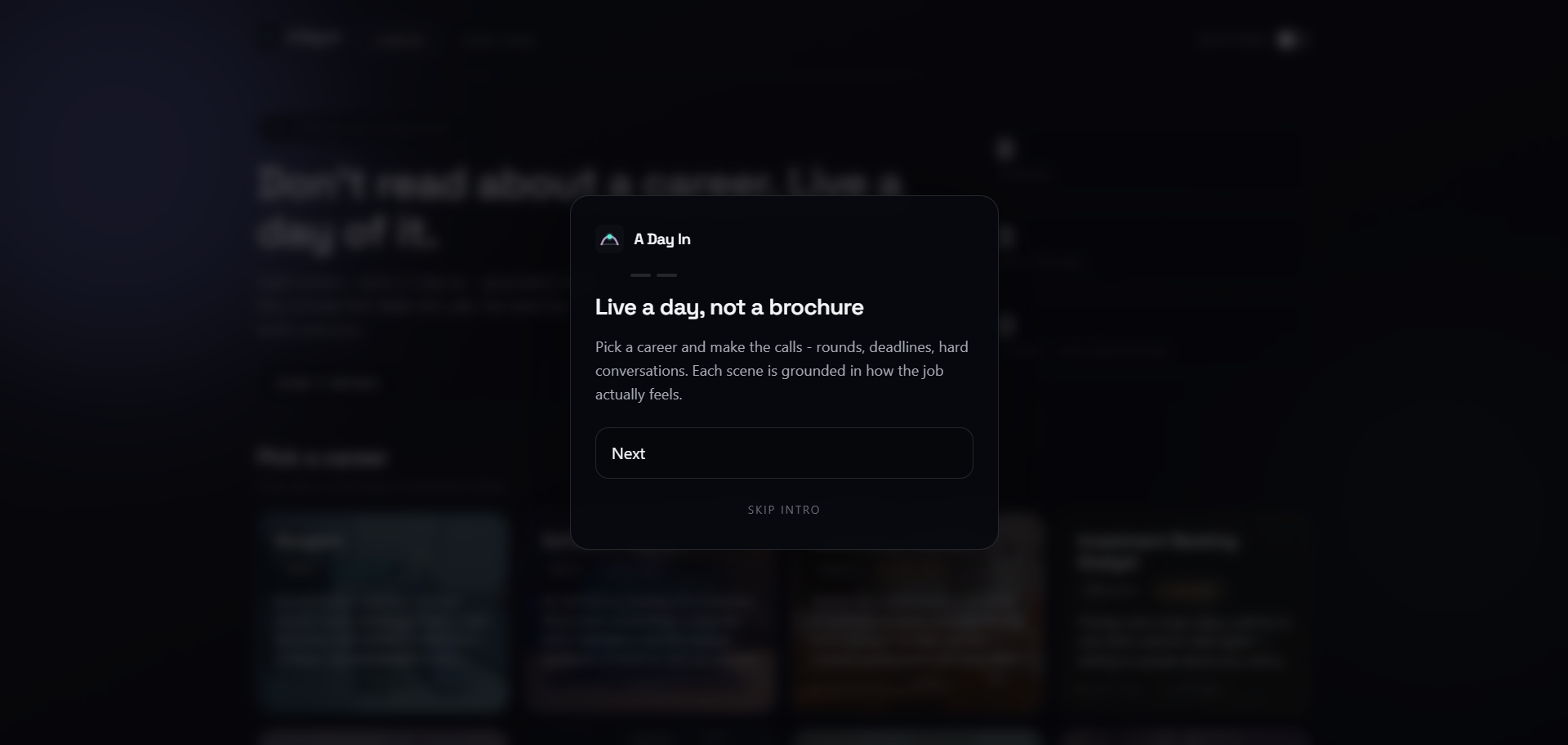
Onboarding
-
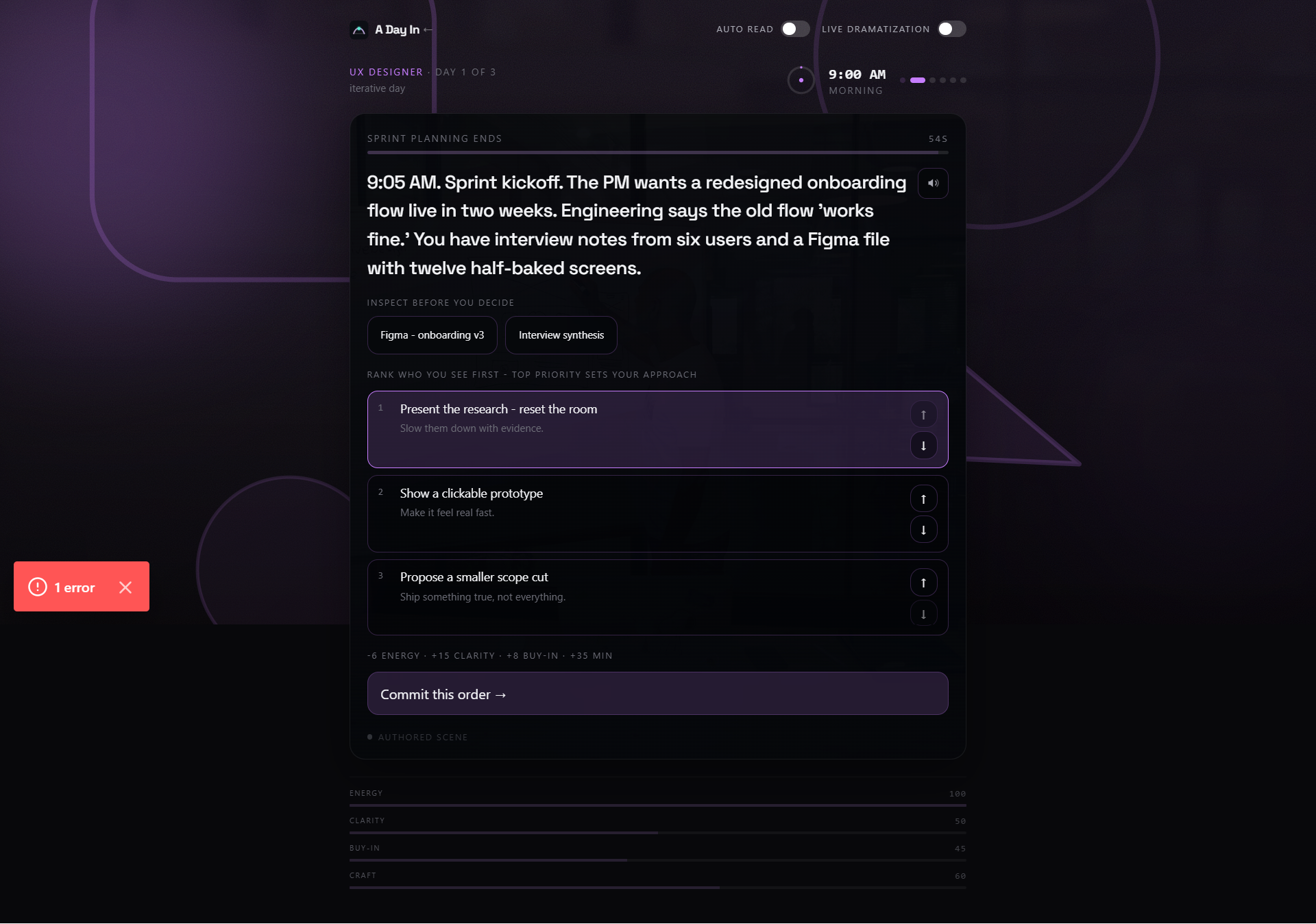
UX Designer Simulator
-
Landing Page
-
Compare
-
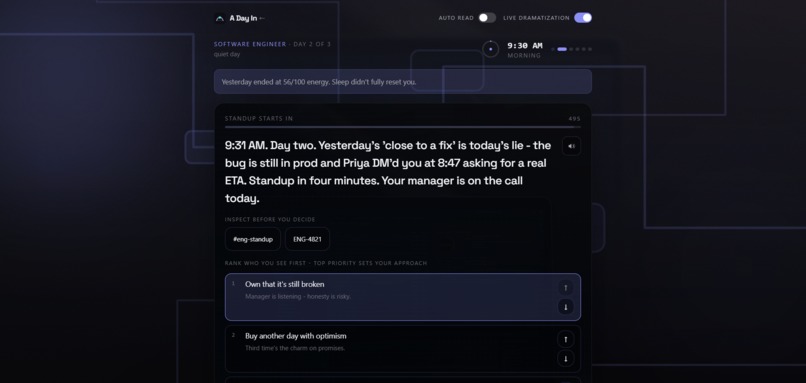
Software Engineer Simulator
-
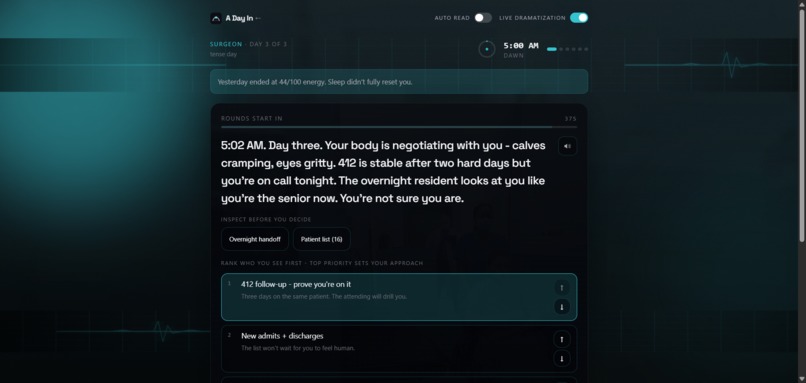
Surgeon Simulator
Inspiration
I'm seventeen and I'm supposed to know what I want to be. So is everyone around me. We're picking majors and applying to schools and signing up for four years of debt based on a job title and a vibe - usually a vibe we got from a TV show.
I kept watching friends do this. One picked pre-med because of Grey's Anatomy. Another picked finance because they liked the word "analyst." None of us actually knew what those people do on a Tuesday. We had read about it. We had never lived a minute of it.
The AI tools that are supposed to help here mostly make it worse. You ask ChatGPT what a surgeon's day is like and you get a paragraph that could be a Wikipedia summary. You read the paragraph. You feel nothing. You still don't know.
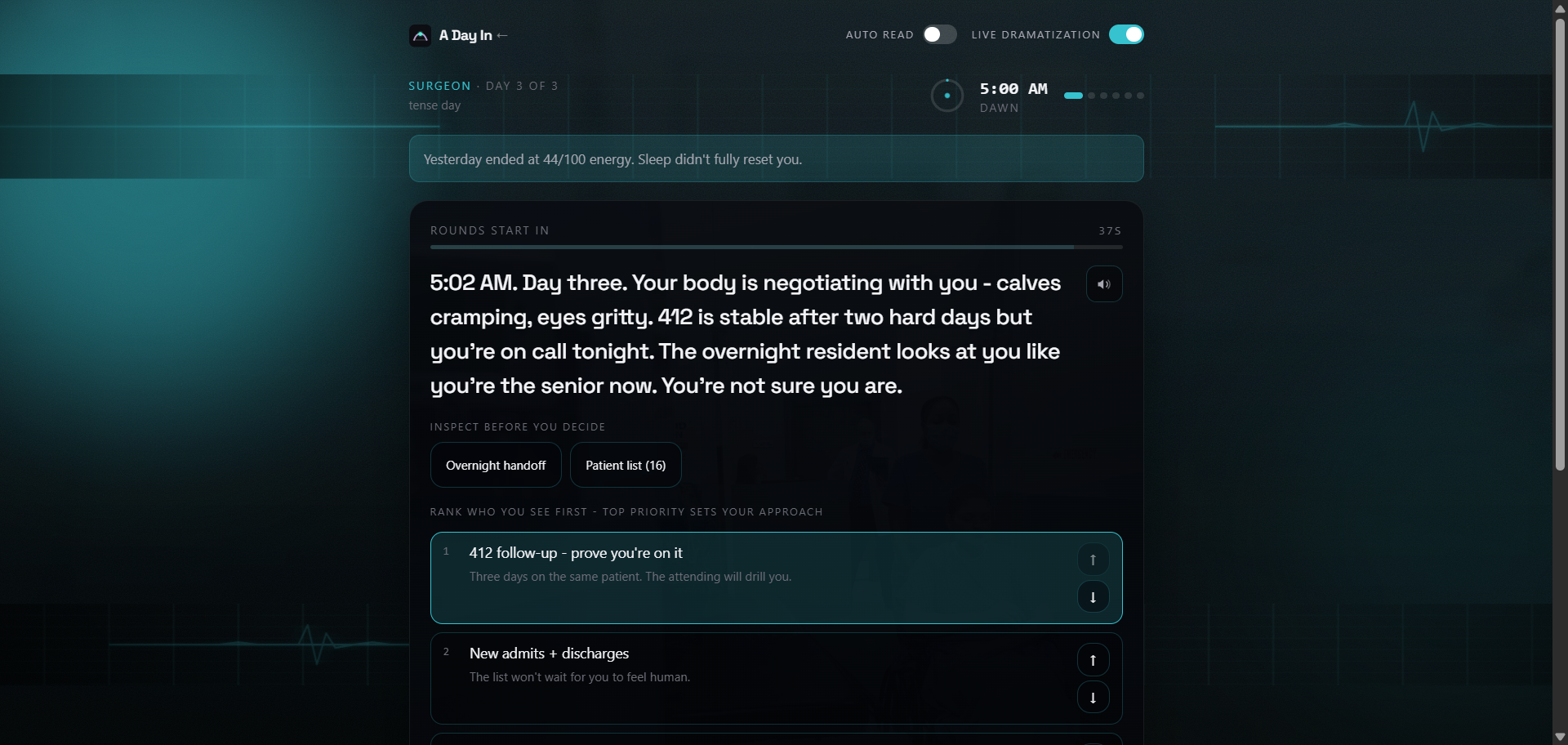
I wanted to build the thing that would have helped me. Not advice. Not a quiz that gives you a personality label. Something where you actually sit at 5:02 AM in a hospital with fourteen patients on your list and one of them is spiking a fever and rounds start in twenty minutes and you have to decide.
What it does
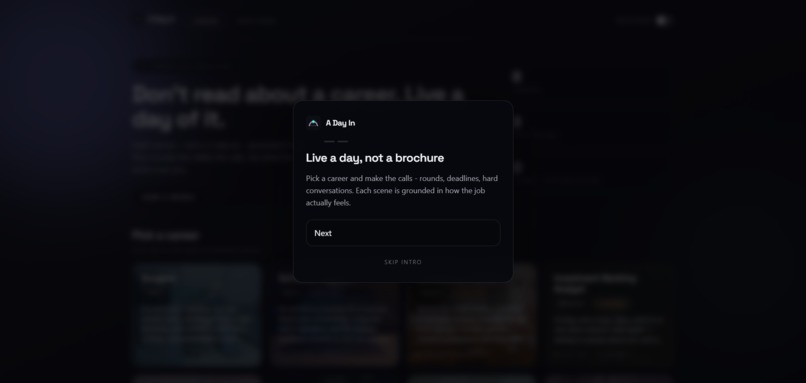
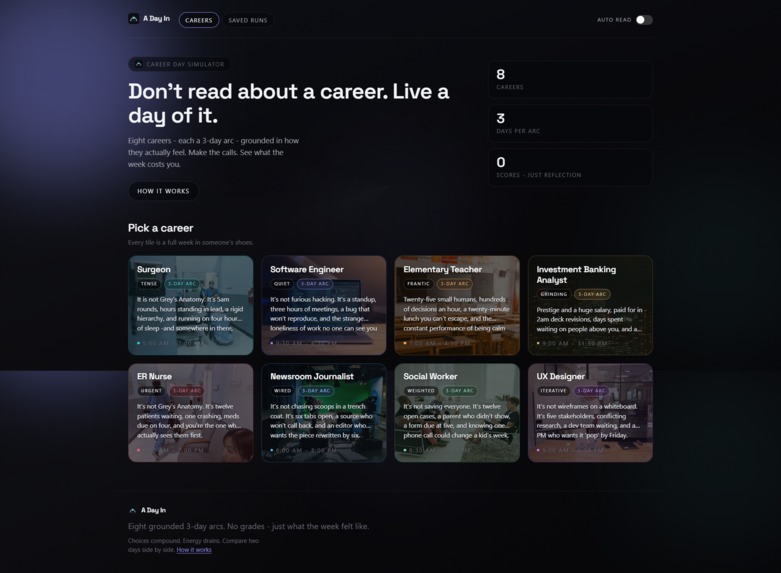
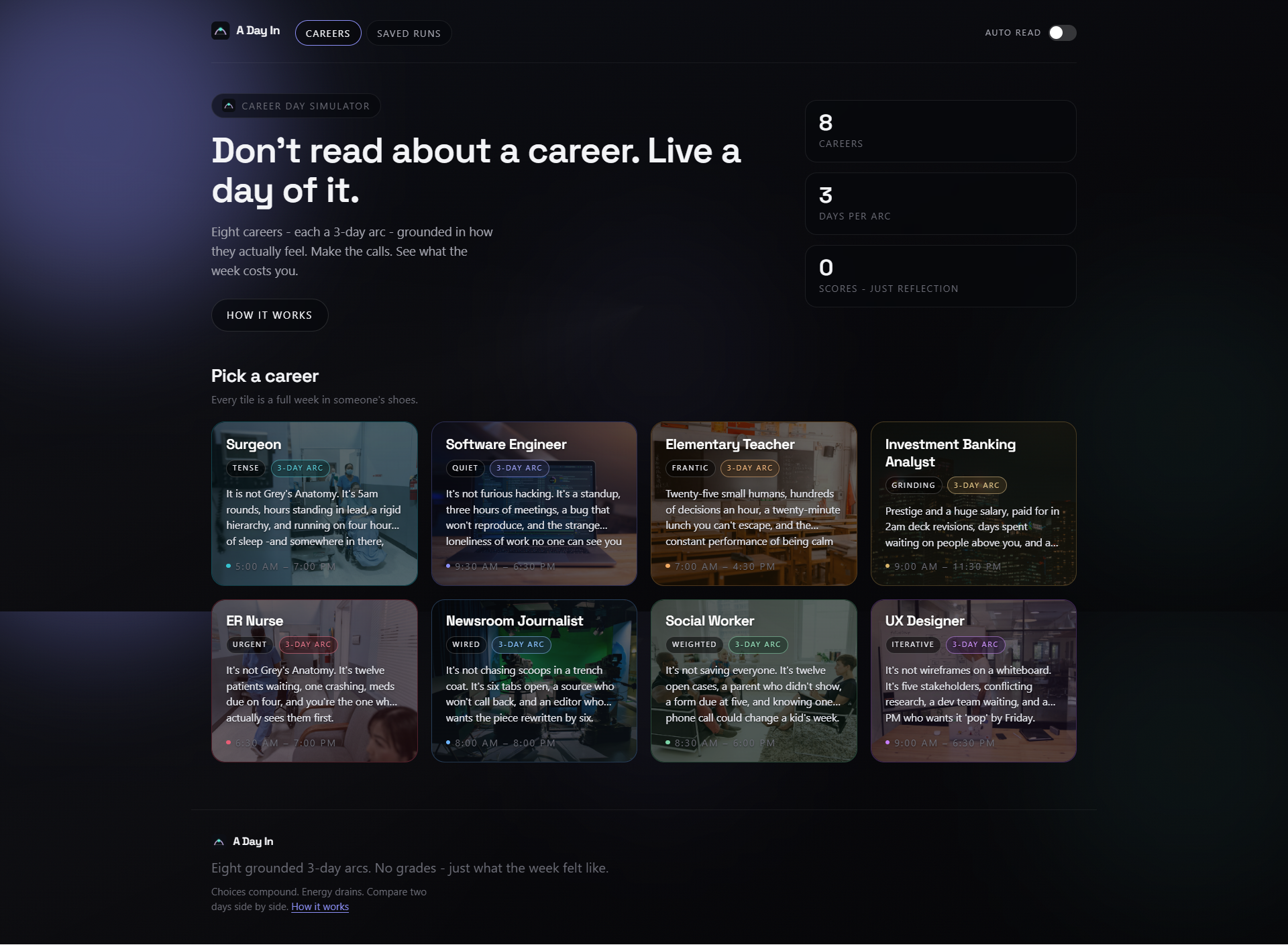
A Day In is a grounded, branching career simulator built for Youth Code x AI - Track 04: Career/Life. You pick a career - surgeon, software engineer, elementary teacher, investment banking analyst, ER nurse, journalist, social worker, UX designer - and you live a three-day arc in their life.
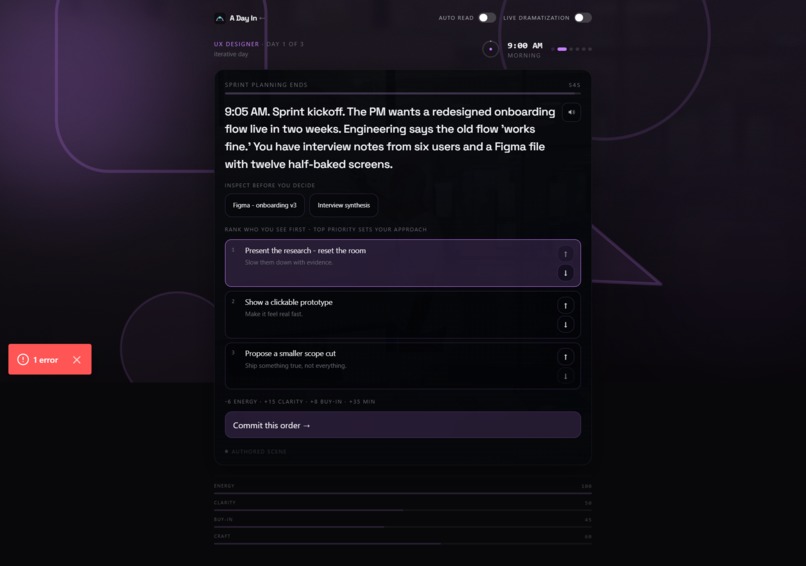
Every scene is built from real day-in-the-life material. Every choice carries real consequences: the clock advances, your energy drains, the career's three specific meters (Standing, The List, Composure for a surgeon; Clarity, Buy-in, Craft for a UX designer) move with you. The decisions you made on Monday change what Tuesday even offers you.
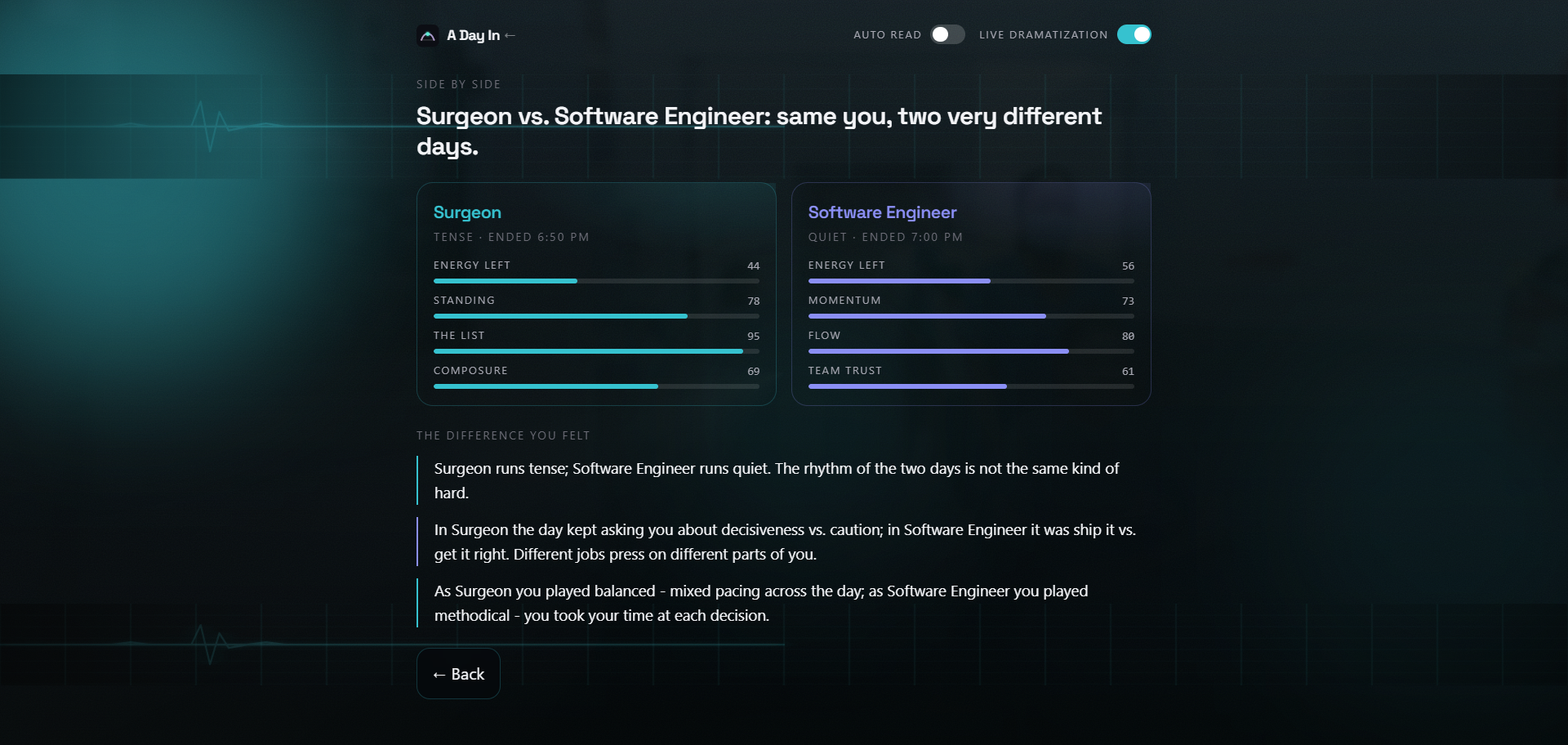
There's no score. There's a mirror. At the end of each day, the app reads your choices back to you - not as a personality type, but as a pattern: "You consistently leaned toward voice over deference. When it mattered, you chose to speak." Then you can run a second career and put both days side by side: same player, two very different Tuesdays. Same hours. Different kind of hard.
How I built it
The architecture has one rule and the whole thing hangs on it: the engine owns the world, the model only owns the words.
The deterministic scenario engine is the source of truth. Every consequence, every meter change, every branch is pre-defined, immutable, fully tested offline. The language model (Claude Sonnet 4.6) is allowed exactly one job: re-dramatize the authored scene prose into fresher, more specific language, grounded in the same cited sources the engine was built from. It cannot touch what choices do.
This isn't paranoia, it's the whole point. AI career tools fail because they default to the Hollywood version of every job. The structural fix is to separate the grounding work (sourced, human-written, immutable) from the dramatization work (model). When the model returns anything that would violate the contract - added choices, dropped choices, runaway length, malformed JSON - a validator rejects it and the authored text fires as a seamless fallback. The sim runs a complete day without a single network call. The demo cannot break.
I shipped:
- Eight career packs, each with 6–7 scenes per day across a 3-day arc, three sourced tensions, three career-specific meters, an authored mood (palette, tempo, ambient image), and 3–4 cited day-in-the-life sources in code.
- A real state machine - energy, meters, clock, lean log, visited beats - where state genuinely compounds. The surgeon's fatigue beat only fires if you've drained yourself; pacing players never see it. Arc carryover means Tuesday remembers what Monday cost you.
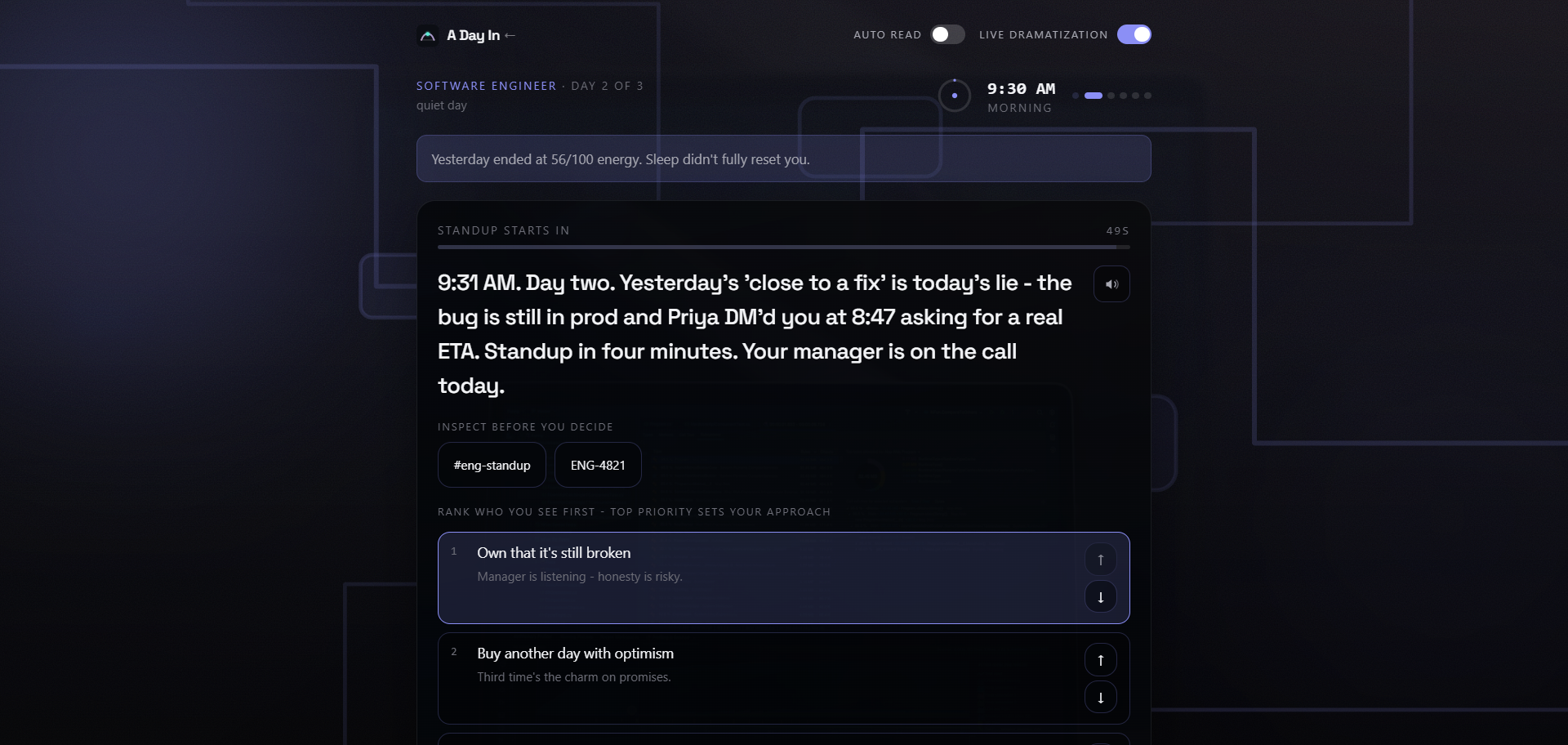
- Rich decision mechanics - ranked triage beats where you reorder a list and the top item sets your approach, clickable inspect artifacts (overnight handoff, patient list, colleague email) you read before deciding, soft pressure timers that auto-default if you stall, delta previews on hover so you see the cost before committing.
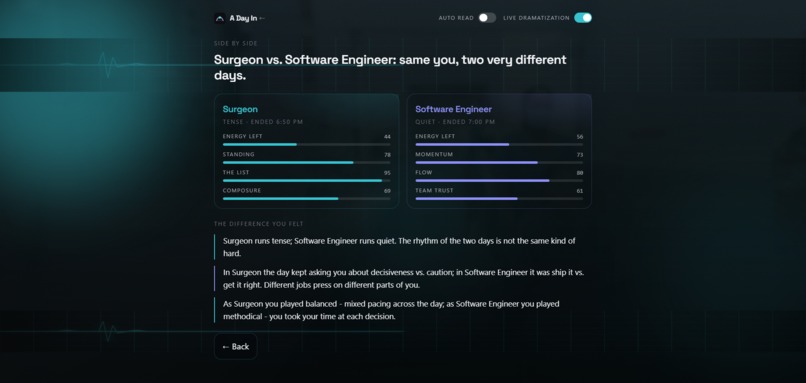
- A cinematic UI - per-career palette/grain/glow, day-clock that advances as the spine of the screen, meters that react the moment you commit, tempo-as-character (surgeon brisk, engineer languid, teacher frantic), photo-backed ambient backgrounds, auto-read narration, and a Compare screen that puts two completed days side by side in their own living palettes.
- A deterministic reflection agent that reads your actual choice log into a debrief - pattern, tension leans, fit signals, adjacent careers to try next.
Stack: Next.js 14, TypeScript, Tailwind, Framer Motion. Engine is a pure-TS monorepo package with 34 passing tests (18 scenario/arc, 15 generation-contract). Claude Sonnet 4.6 server-side only - key never reaches the client. Self-hosted Space Grotesk so the build doesn't depend on Google Fonts at deploy time. Deployed on Vercel.
Challenges I ran into
The authenticity problem. Models default to the TV version of every job. The fix isn't a better prompt, it's structural: ground the engine in cited real sources and forbid the model from touching the engine's world. Writing eight grounded career packs is real work - I read more than thirty primary day-in-the-life accounts (Henry Ford Health's surgical residency docs, Today's Parent's elementary-teacher day, Mergers & Inquisitions on IB hours, The Coding Diaries on software engineering, and on). That research is the hard 20%, and it is not automatable.
Making "live AI in a demo" actually safe. The first version of the dramatization path had everything you'd expect (try/catch, a timeout). It still wasn't safe enough. A model that returns a valid-looking response with one choice ID renamed silently breaks the engine. So I wrote a real validator that asserts exact ID match, length bounds, type guards, JSON shape, and a hard 6-second abort. Anything that fails falls back to authored text without the player ever knowing. I tested it by injecting transports that return garbage, throw, time out, and return mismatched IDs - all fall back silently.
The day kept ending too early. Early on, the engine would pick a finale beat in the middle of the day because phase ordering and priority were fighting each other. I rebuilt selection to order primarily by clockAnchor - the real wall-clock minute each scene begins at - so narrative time always flows forward and finales can't fire while non-finale beats are still eligible.
The cause-effect gap. The first build applied the choice's delta only after you hit Continue, which meant you'd read "you're already moving, you haven't eaten" while Energy still said 100. The fix was a two-step commit/advance flow: when you commit, the meters react immediately and the consequence text shows up. You feel the choice land before you move on.
Accomplishments I'm proud of
The Compare screen. After you've finished one day as two different careers in the same session, the app puts them side by side, each in its own palette, and names what was different - the rhythm, the depletion, the kind of decision each day forced. "Surgeon runs tense; Software Engineer runs quiet. The rhythm of the two days is not the same kind of hard." That sentence comes from the engine's own state, not from a model describing it. The moment two panels load in their different palettes is the moment the whole idea lands.
Also: eight careers. The spec asked for three to four deep. I did eight because the contrasts were too good to leave out. Surgeon vs. UX Designer is a different conversation than Surgeon vs. Engineer.
What I learned
The most useful idea I had on this project was naming the contract first and never bending it: the engine owns the world; the model owns the words. Every later question - demo safety, grounding integrity, the authenticity problem, how to make the AI a feature instead of a liability - got cleaner once that line was drawn. The model is the right tool for prose. It is the wrong tool for consequences. Most "AI apps" don't get this distinction right, and you can feel it.
The other thing I learned is that cinematic small details - a clock that advances as an arc, meters that pop the instant you commit, tempo that differs per career, contrasting palettes when Compare loads - do more work than any animation library could. You don't need motion everywhere. You need motion that means something.
What's next for A Day In
- More careers. ER physician, public defender, startup founder, chef, athletic trainer, museum curator. The bottleneck is grounding research, which is the right bottleneck.
- Arc-end debrief. The engine already has
reflectArc()and a "what broke" surfacer. They need a screen of their own at the end of day 3. - Energy-and-meter timeline. Show the player how their arc actually went, hour by hour, scene by scene.
- Compare from saved runs. Today you can only compare runs from the same session. Lifting that to a real history is a small change with a big effect.
- Counselor/classroom mode. Share a sim with someone. Have them play it. Look at their patterns together. This is where it stops being a hackathon project and starts being a tool.
Built With
- ai
- css3
- eslint
- framer-motion
- html5
- javascript
- llm
- markdown
- monorepo
- next.js
- node.js
- npm-workspaces
- react
- space-grotesk
- tailwind-css
- typescript
- vercel
- web-speech-api


Log in or sign up for Devpost to join the conversation.