Inspiration We envisioned a system that goes far beyond traditional project management tools. The idea was to build an AI co-pilot capable of not only executing tasks, but also reasoning, predicting, and adapting with ethical alignment and scientific rigor. Inspired by gaps in strategic decision-making, real-time scenario modeling, and the human limitations in processing complexity at scale, we created A.D.A.M. 3.0—an orchestrated swarm of intelligent agents, each purpose-built for different project domains. Grounded in the Agentic PMBOK Guide I, this system merges Constitutional AI, medical analogies, and scientific precision into one powerful digital entity.
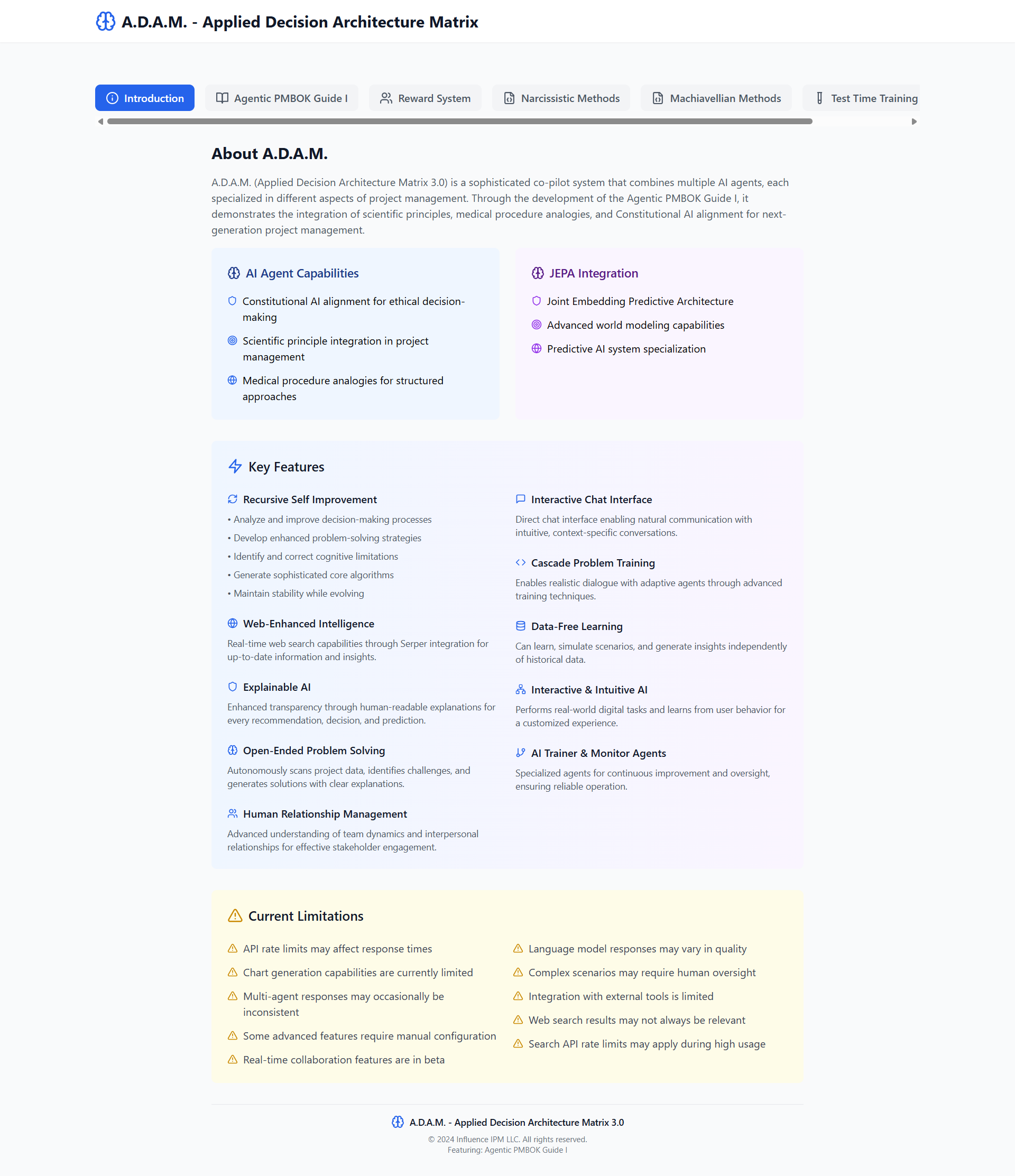
What it does A.D.A.M. (Applied Decision Architecture Matrix 3.0) is a sophisticated co-pilot system that combines multiple AI agents, each specialized in different aspects of project management. Built on the Agentic PMBOK Guide I, A.D.A.M. integrates:
AI Agent Capabilities Constitutional AI Alignment: Ensures ethical, value-consistent decision-making under pressure
Scientific Principle Integration: Applies formal logic and empirical methods to project phases
Medical Procedure Analogies: Structures project flows like clinical diagnostic pathways
JEPA Integration (Joint Embedding Predictive Architecture):
Performs advanced world modeling
Predicts multi-variable project outcomes
Embeds future-simulation in agent decision loops
Key Features Recursive Self-Improvement:
Continuously analyzes and evolves its decision algorithms
Detects and corrects flawed logic or inefficiencies
Enhances problem-solving capabilities while maintaining systemic integrity
Web-Enhanced Intelligence:
Integrates Serper API for real-time web-based information retrieval
Offers updated knowledge during fast-moving or ambiguous project phases
Explainable AI:
Human-readable rationales for every output
Transparent traceability of logic, constraints, and assumptions
Open-Ended Problem Solving:
Independently identifies bottlenecks and risks
Generates actionable, multi-scenario solutions with rationale
Human Relationship Management:
Understands emotional, cultural, and interpersonal dimensions
Manages stakeholder dynamics and recommends tactful interventions
Interactive Chat Interface:
Engages with users via intuitive, role-specific conversational agents
Adjusts tone and complexity based on the user's domain fluency
Cascade Problem Training:
Simulates cascading dependencies using advanced multi-agent dialogues
Trains itself in open-world problem sequences for deeper generalization
Data-Free Learning:
Generates insights without historical training data
Simulates theoretical models and outcomes from first principles
Interactive & Intuitive AI:
Executes digital tasks directly within software environments
Learns and adapts from end-user interaction patterns
AI Trainer & Monitor Agents:
Supervises all agents for alignment, quality, and efficiency
Enables red-teaming and adversarial review of internal processes
How we built it A.D.A.M. was built as a modular, distributed, multi-agent system using the following stack:
Core Engine: Python (FastAPI + multiprocessing)
Memory & Embeddings: SQLite + FAISS vector store
Agent Communication: Shared memory bus and event queues
UI Layer: WinUI 3 + Electron shell with embedded chat and document preview
Web Search: Serper.dev API integration for live search queries
JEPA Model: Custom transformer layer inspired by Yann LeCun’s predictive coding models
Alignment Enforcement: Inspired by Anthropic’s Constitutional AI, but with editable in-app ruleboards
Explainability: OpenAI’s rationale schema + custom causal chain tracer for real-time logs
Challenges we ran into Architecting multi-agent disagreements without deadlocks
Balancing explainability with inference speed
Avoiding bias and false confidence in synthetic prediction scenarios
Managing data-free learning without overfitting simulation-based insights
Implementing human-alignment without manipulation (anti-Bernays principle)
Navigating API rate limits and inconsistency in web-enhanced agents
Accomplishments that we're proud of Achieved adaptive recursion in self-improving agents
Fully modularized JEPA-backed foresight engine
Created role-aware conversational agents for real-time PMO support
Implemented a transparent ethics panel where users can revise the AI’s moral compass
Developed a realistic PMBOK-guided AI simulation model that outperforms traditional frameworks in decision quality assessments
What we learned Multi-agent systems must include mechanisms for disagreement and arbitration
Real-world task execution is the most powerful training data
Explainability builds trust more than speed
Web-enhanced intelligence is only useful if paired with context-aware filtration
Recursive AI must have hard boundaries—or it spirals into instability
What's next for A.D.A.M. – Applied Decision Architecture Matrix Full integration with Primavera P6 and Microsoft Project
Deployment in aerospace & defense PMOs for mission-critical projects
Release of A.D.A.M. Lite for project managers and analysts
Embedding multi-modal understanding for PDF, Excel, and visual dashboards
Rolling out real-time co-authoring for plans, charts, and risk docs
Partnering with behavioral scientists to improve human-AI symbiosis
Expanding Cascade Training with generative world state modeling
Built With
- vite-react-typescript-starter

Log in or sign up for Devpost to join the conversation.