-
-
Thumbnail
Describe your project (max 150 words)
Have you ever been pulled into a story your parents told about a moment that happened before you were born? Or stumbled across an old photo of them and wondered what the story behind it was?
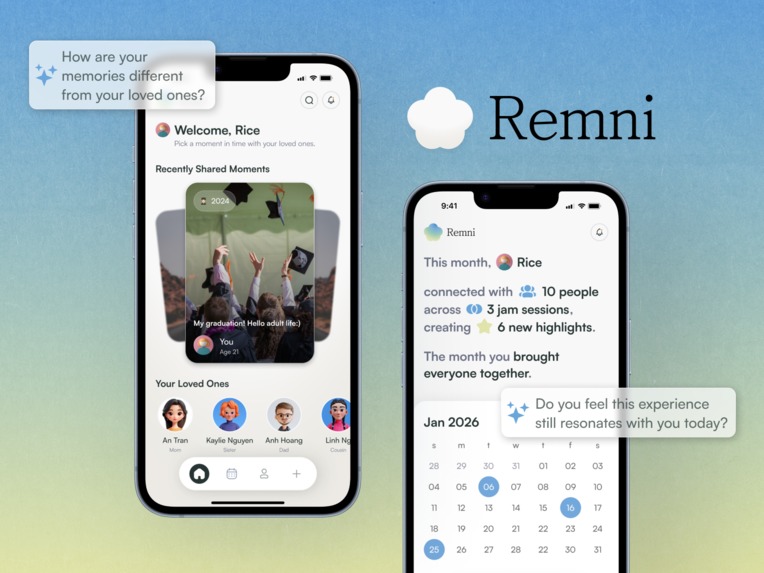
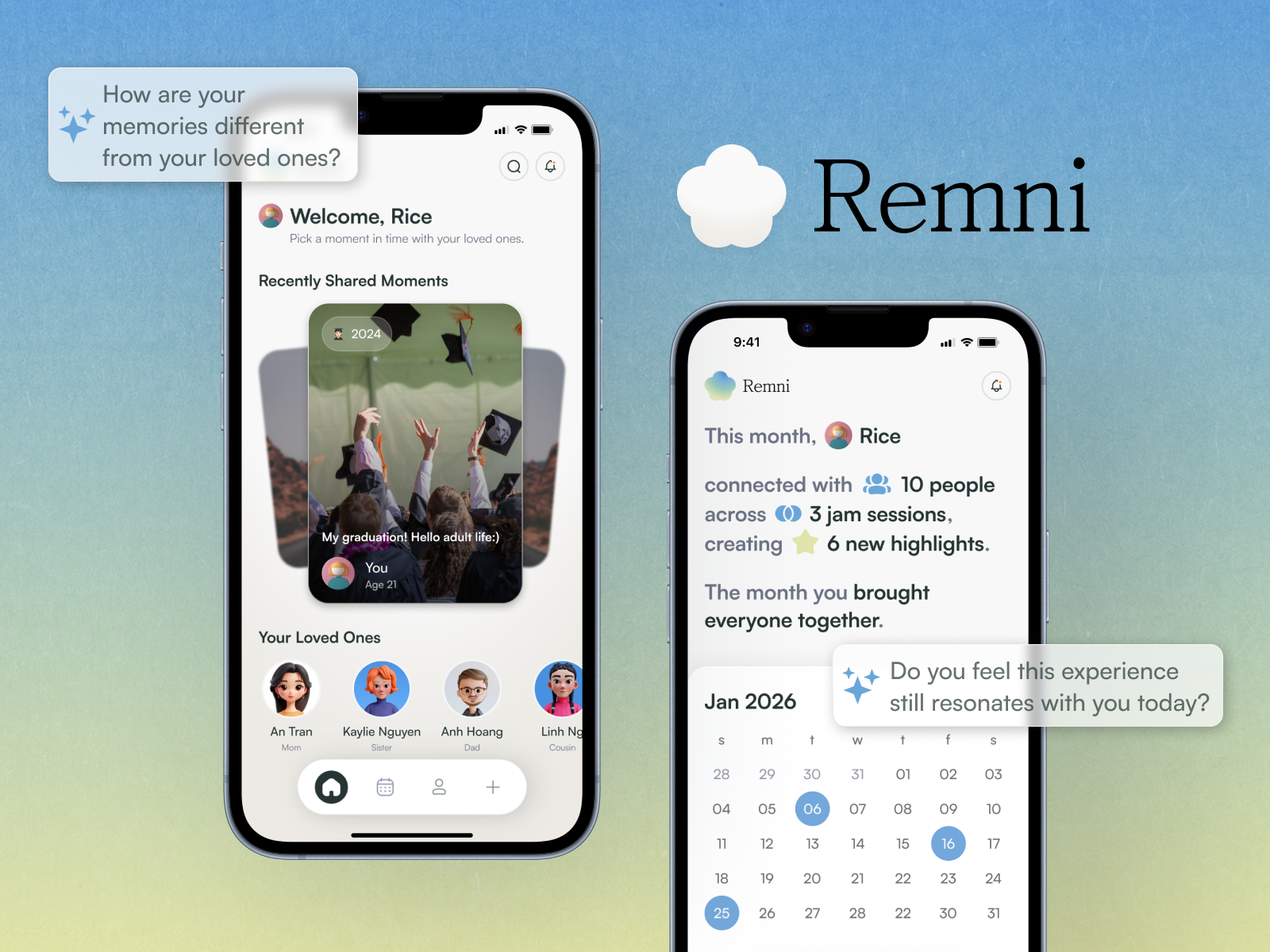
Storytelling is how we connect, and photos are how we revisit memories. Together, they become little time capsules that reveal how the same moment meant something different to each generation. We created Remni (inspired by reminiscence), an app that sparks meaningful conversations across generations by revisiting moments in time. You can start a “jam” with your loved ones, let the app pick a year from the past, and see photos from everyone’s camera rolls during that same period. Thoughtful prompts are created to invite each person to reflect, share, and compare their experiences, creating a parallel snapshot of your lives.
One moment in time. Many perspectives. Endless stories.
Describe your research process and findings.
If you conducted any surveys or interviews, please include the survey form and/or interview questions here. If you conducted secondary research by pulling from online sources, please include a link to your sources. (max 500 words)
To better understand how people connect across generations, we surveyed 14 participants and conducted in-depth interviews with 5 individuals from different age groups. Our findings reveal a strong emotional desire for intergenerational connection, paired with significant communication and technological barriers that prevent meaningful engagement.
A majority of respondents (approximately 73%) reported feeling disconnected from loved ones from a different generation. While participants expressed care and curiosity about their family members’ lives, many struggled to translate that sentiment into regular, meaningful interactions. Communication emerged as the most prominent challenge: 80% identified differing communication styles as the biggest barrier, and many shared that they often “don’t know how to start deeper conversations.”
Despite these challenges, participants are already using digital tools to stay connected. About 70% rely on sharing photos, 60% use video calls, and 53% engage through social media. However, these interactions tend to remain surface-level. One interviewee explained, “We send pictures back and forth, but it usually stops there. I wish I knew more about what my grandparents were like when they were younger.” This sentiment aligns with survey results showing that 84% of respondents felt curious to learn more about their loved ones’ lives after seeing old photos or hearing brief stories.
Story-sharing currently happens inconsistently: only 53% said they sometimes share personal memories across generations, while 33% rarely do so. Several interviewees described feeling unsure about what to ask or worried about being intrusive. As one participant noted, “I want to ask my parents about their past, but it feels awkward or random. I don’t want it to sound forced.”
Importantly, there is strong demand for more intentional opportunities to connect. About 70% of participants expressed interest in having more ways to share stories and memories with loved ones, and 60% said they wanted easier ways to revisit photos and past moments. Participants also emphasized the need for conversation prompts and guided activities to help initiate meaningful dialogue. One interviewee shared, “If there were simple prompts or questions, I’d definitely use them. Sometimes you just need a starting point.”
Together, these insights highlight a clear gap between people’s desire for deeper intergenerational relationships and the tools currently available to support them. While existing platforms enable basic communication, they lack structure, emotional depth, and storytelling support. This research validates the opportunity for Remni to bridge this gap by transforming everyday photos and memories into shared experiences—providing gentle prompts, curated reflections, and accessible storytelling tools that help families move beyond passive connection toward more meaningful, lasting relationships across generations.
Describe your most important design decisions.
What research findings and/or user testing results led you to make these decisions? (max 500 words)
Our design decisions for Remni were directly shaped by research insights that highlighted both emotional gaps and usability barriers in cross-generational connection. While participants expressed strong curiosity about their loved ones’ pasts and a desire for deeper relationships, they also struggled with initiating conversations and navigating existing technologies. These findings guided us toward building a product that minimizes friction, supports storytelling, and accommodates diverse levels of digital literacy.
Photo Retrieval with Conversation Prompts
Since 70% of participants currently connect through photo sharing and 80% identified communication styles as their biggest barrier, we designed Remni to automatically retrieve photos and pair them with AI-generated conversation prompts. This reduces the cognitive load of deciding what to share or ask, addressing the common concern of not knowing how to start meaningful conversations. By minimizing required user input, the experience becomes more intuitive for older adults and less tech-savvy users, while also helping younger users move beyond surface-level exchanges. This approach directly supports the 60% of respondents who wanted easier ways to revisit memories and built-in prompts to guide deeper dialogue.
AI-Generated Images via Voice-to-Text
Our research revealed that 84% of participants wished they knew more about their loved ones’ lives after seeing old photos or hearing stories, yet many older family members lack digitized memories. To address this gap, Remni allows users—especially grandparents or elderly relatives—to verbally describe memories that are then transformed into AI-generated images. This feature enables storytelling even when physical photos are unavailable. Voice-to-text input also supports inclusive design, acknowledging that typing detailed prompts can be challenging for older adults. By letting users speak naturally, we lower barriers to participation and empower seniors to share their experiences in their own words. Additionally, using present-day photos to help generate younger representations creates continuity across time, making memories feel more personal and tangible for younger generations.
Wrap: Shared Memory Reflection
Finally, we introduced Remni Wrap—a reflective feature that visualizes family engagement through a calendar and activity stats, highlighting dates when memories were most actively shared and compiling a collective album of photos and stories. With 70% of participants wanting more opportunities to exchange memories, this feature reinforces connection by celebrating shared moments and making participation visible. Wrap also helps transform sporadic interactions—reported by many participants who only “sometimes” or “rarely” share stories—into an ongoing ritual. By surfacing patterns of engagement, Remni encourages families to reconnect intentionally while preserving their collective history in one accessible space. Together, these design choices respond to users’ desire for meaningful intergenerational relationships while addressing technological and emotional barriers—transforming passive communication into guided, inclusive, and memory-rich experiences.
If applicable, describe how you utilized AI in your design process in detail.
Please explain where AI fit into your workflow, which tools you used, and the specific purpose AI served at that stage. Include a concrete example of how AI influenced a design decision. (max 500 words)
Our team primarily used AI as a brainstorming and ideation partner throughout the early stages of the project. Each member first developed their own concepts grounded in research insights, then we used ChatGPT to help analyze the pros and cons of each idea and generate additional directions we might not have considered. This allowed us to quickly explore a wider design space and pressure-test our concepts. From there, we came together as a team to discuss tradeoffs and align on a product that meaningfully addresses user needs while remaining feasible to build within a short timeframe. We also leveraged AI to help generate potential app names, using it as a creative catalyst rather than a decision-maker.
Built With
- figma

Log in or sign up for Devpost to join the conversation.