Inspiration
In response to the escalating environmental challenges of our times, our project envisions a future where technology and nature coexist in harmony. Through the lens of augmented reality, we aim to create an immersive, imaginary cityscape – a testament to what our urban environments could become. This project is not just about visualizing green spaces; it's a bold statement against the backdrop of current ecological crises, a call to action to reimagine and reshape our cities. By blending lush greenery, sustainable architecture, and interactive ecological elements, we offer a glimpse into a future where cities are not just habitable, but thriving ecosystems that prioritize the planet's health and our own.
What it does
Futuristic City Visualization: This aspect of our project offers a captivating AR experience, inviting users to immerse themselves in a visionary cityscape where the boundaries between urban and natural environments blur seamlessly. The experience is enriched with dynamic visualizations showcasing marine life ingeniously adapted to terrestrial existence. It vividly illustrates how these marine creatures, reimagined in a land-based setting, coexist with contemporary architecture, creating an intriguing blend of the natural and the man-made. This interactive and imaginative portrayal not only captures the essence of a harmonious future city but also prompts users to reflect on the evolving relationship between our urban spaces and the natural world.
Educational and Awareness Tool: The project serves as a multifaceted educational tool, playing a crucial role in heightening awareness about critical environmental concerns and promoting the principles of sustainable urban planning. By harnessing the immersive power of AR technology, it offers an engaging and interactive platform for users to explore and understand the impacts of human activities on our planet's ecosystems. The vivid and realistic depictions of future cityscapes, where nature and urban environments coexist, not only captivate the imagination but also serve as a visual narrative about the importance of ecological balance and urban sustainability.
How we built it
Ideation and Brainstorming: We engaged in extensive brainstorming sessions to envision the future ecology. These discussions likely covered various aspects, including environmental challenges, urban development, and the potential interplay between technology and nature. We decided to imagine mutant creatures as a response to environmental changes based on the current environmental issues, like ocean pollution, and their potentail long-term impacts on wildlife and ecosystems. The idea to have marine creatures adapt to land environments due to ocean pollution is both imaginative and reflective of real-world ecological concerns.
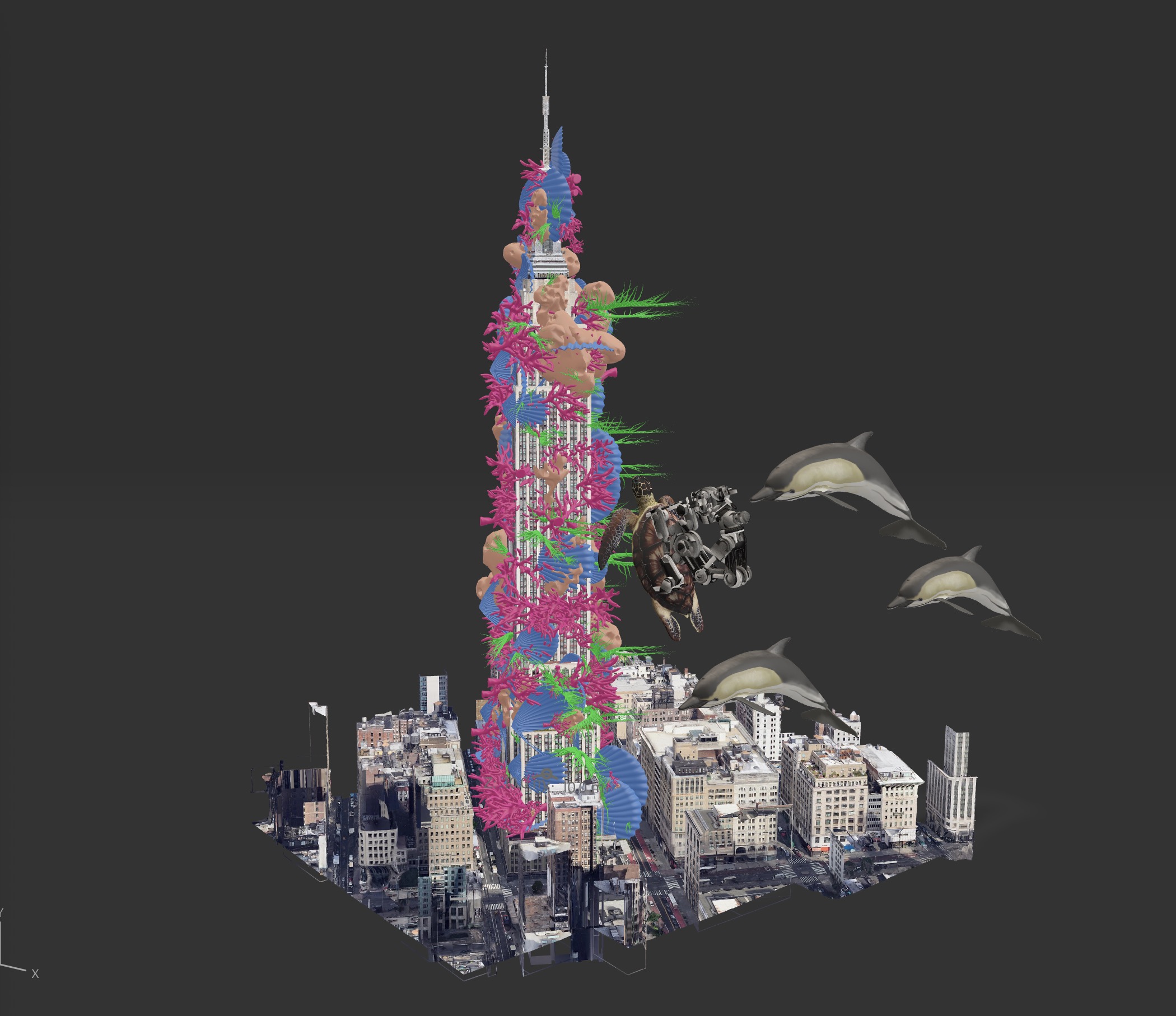
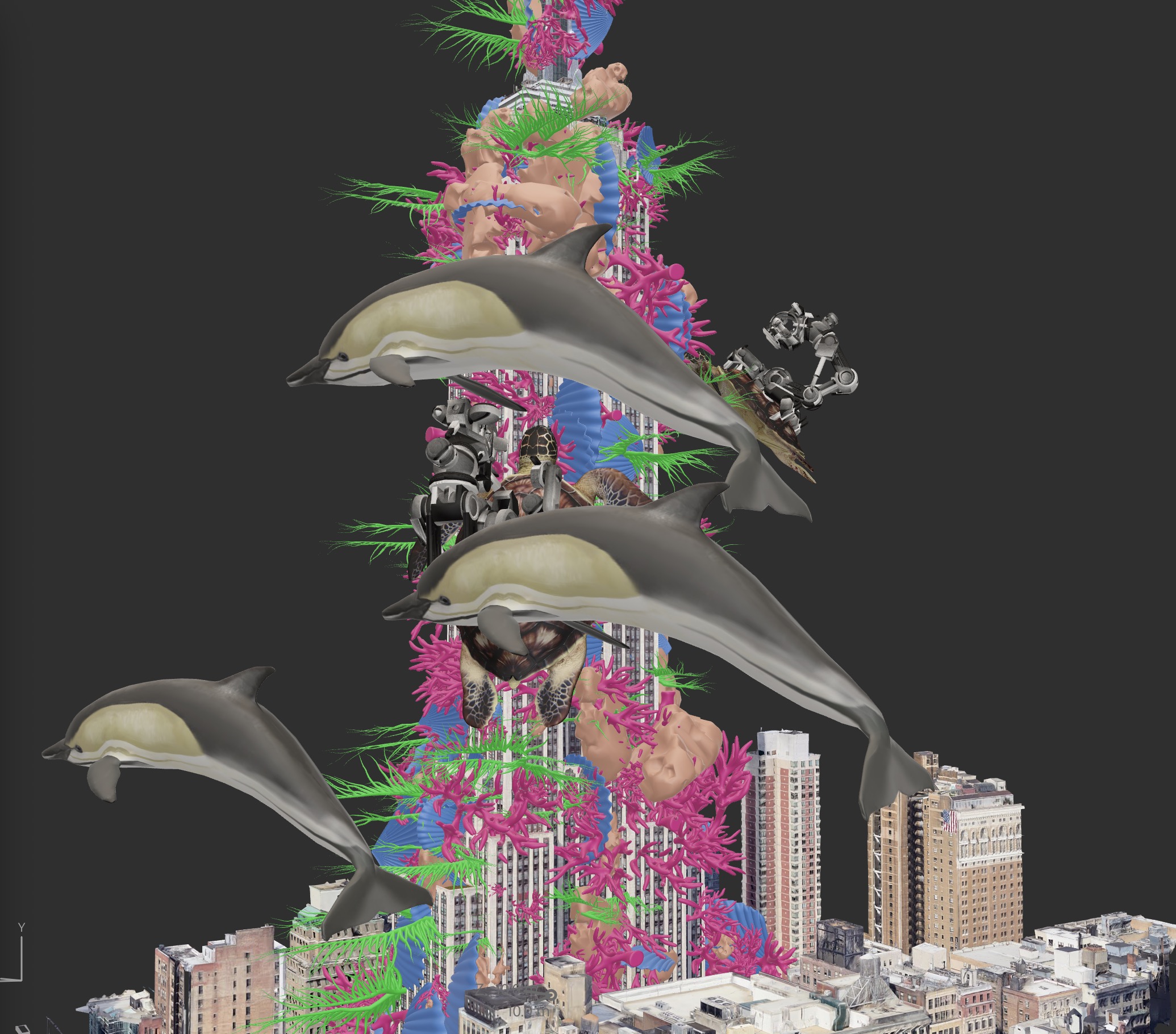
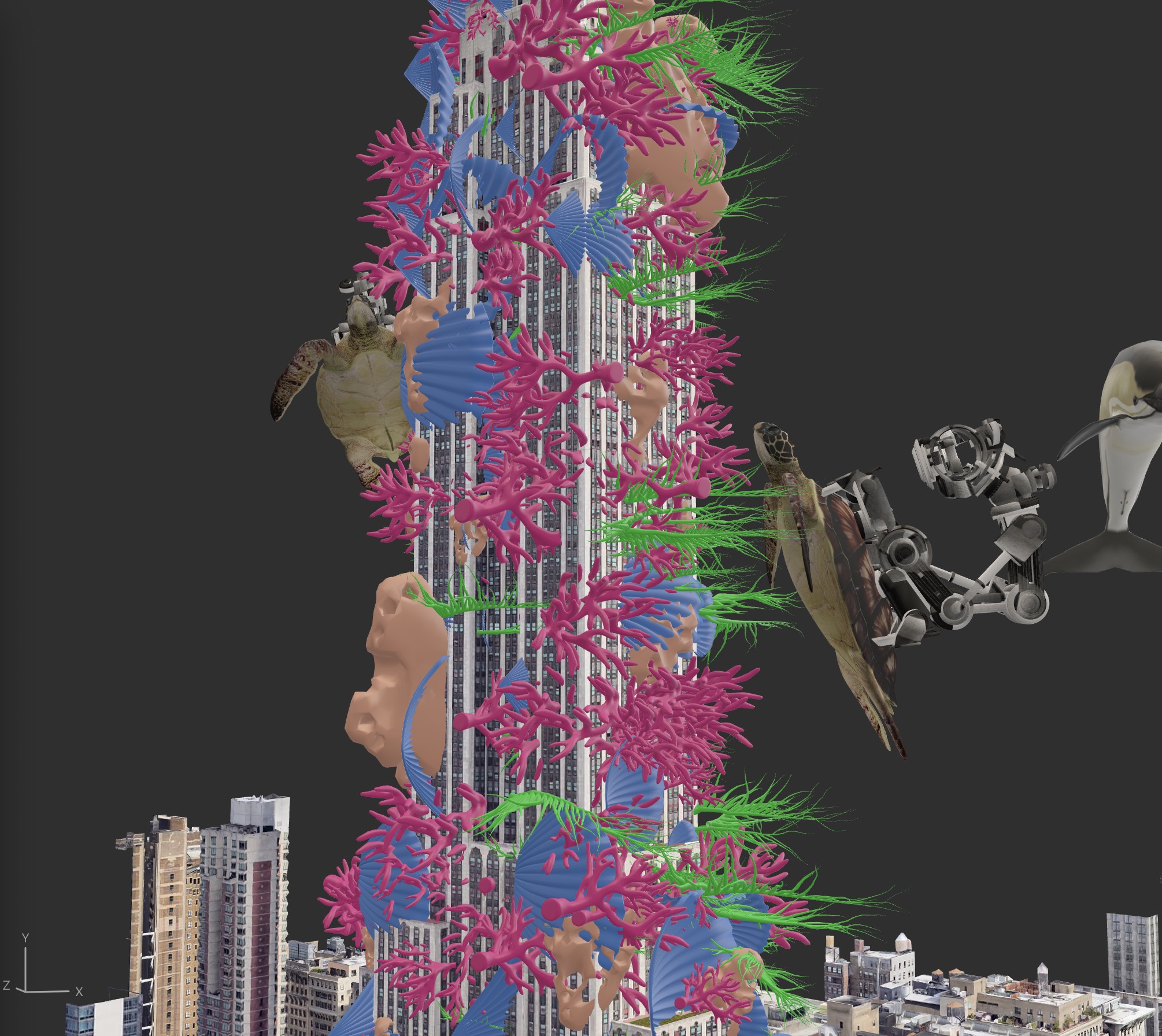
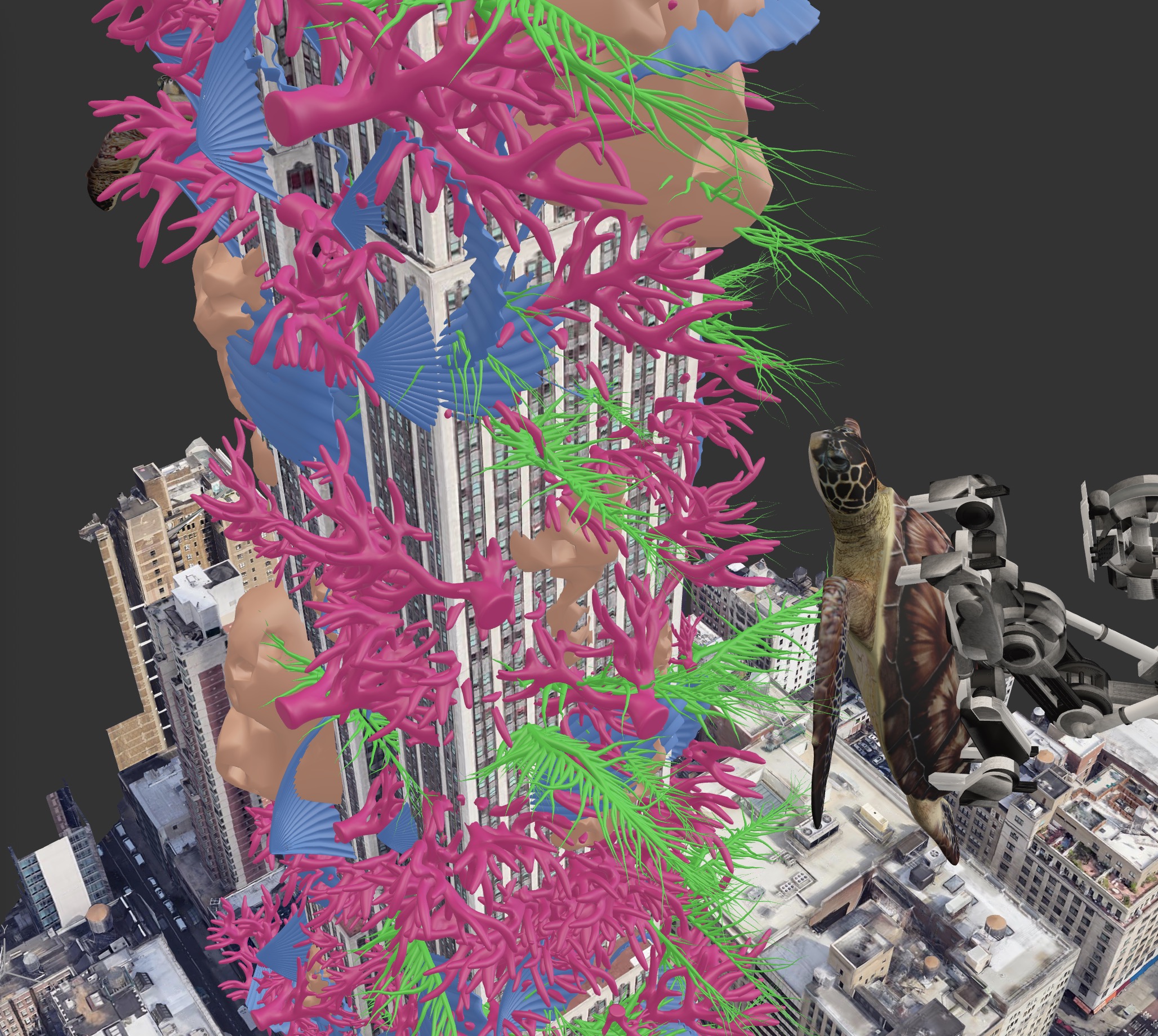
Designing Mutant Creatures: In this creative phase, we transformed existing 3D models to conceive mutant creatures, melding organic and mechanical elements. Our design process involved adding machine-like components to animals, exemplified by sea turtles with mechanical arms. We also re-envisioned coral reefs adapting to urban structures, making iconic buildings their new habitats. The Empire State Building, a symbol of New York's architectural grandeur, was chosen as the focal point of this interaction.
Using Geospatial Creator and Adobe Aero, we strategically positioned these elements in a virtual representation of New York. The coral reefs were designed to encase the Empire State Building, symbolizing their takeover of urban spaces. Sea turtles were animated to swim gracefully around the building, defying traditional boundaries between sea and city. Above the cityscape, we placed dolphins floating in the air, adding a surreal yet thought-provoking aspect to the experience. This blend of natural elements with urban architecture in an AR setting creates a striking and imaginative visual narrative, emphasizing the adaptability of nature in the face of human-induced environmental changes.
Challenges we ran into
Texture Recognition in Aero: One of the initial challenges we faced was with Adobe Aero's limitation in recognizing only images as textures. This posed a problem when we tried to use plain colors in our 3D models, as Aero didn't properly render them. This required us to adapt by converting plain colors into image textures to make them compatible with Aero, ensuring our models retained their visual integrity.
Managing Polygon Count: A persistent technical issue was balancing the polygon count of our 3D models for optimal AR performance. High polygon counts can lead to longer loading times and decreased performance in AR, particularly on less powerful devices. We had to carefully optimize our models, reducing polygons while striving to maintain visual quality, to ensure a smooth user experience in the AR environment.
Optimization Challenges with Particle System: We utilized Blender's particle system to efficiently design reef structures around the Empire State Building. This method allowed us to create complex virtual elements with fewer individual objects, streamlining the design process and enhancing the detail of our AR environment. However, employing the particle system led to a loss of control over the project's optimization. The system significantly increased the geometry count, which could negatively impact performance in AR. This exponential increase in geometry posed a challenge in maintaining a balance between the rich detail desired and the practical necessity of manageable geometry counts for smooth AR performance.
Accomplishments that we're proud of
Innovative Integration of Nature and Technology: We successfully merged elements of nature with advanced technology, creating an immersive AR experience that reimagines how urban and natural environments can coexist. This integration is not just a technical achievement but also a creative triumph, showcasing our ability to envision and craft a future where technology serves ecological harmony.
Designing Mutant Creatures with Blended Elements: We're particularly proud of our creatively designed mutant creatures, which blend organic and mechanical aspects. This required not only technical skill in 3D modeling but also a deep level of creativity and imagination, resulting in unique, captivating designs that became a highlight of our project.
Reimagining Iconic Architecture: Choosing the Empire State Building as our central structure and reimagining it as part of a new, nature-infused urban landscape was a bold and imaginative decision. It allowed us to demonstrate how even the most iconic urban elements can be re-envisioned within an eco-friendly future.
Technical Problem-Solving: Overcoming the challenges related to texture recognition in Aero and optimizing the polygon count for AR performance showcased our problem-solving skills and adaptability. These accomplishments underline our team's ability to navigate and resolve complex technical issues effectively.
What we learned
We gained substantial expertise in augmented reality (AR) technologies and 3D modeling software, particularly in using tools like Blender and Adobe Aero. This included learning how to create and animate detailed 3D models, optimize them for AR environments, and overcome technical challenges like texture recognition and polygon count management.
We improved our ability to work with geospatial data, learning how to accurately integrate and manipulate this data within an AR context. This skill is invaluable in ensuring that virtual elements align correctly with real-world environments.
What's next for The Civic Oasis
Interactive Storytelling Enhancements: The Civic Oasis can be enriched with deeper narrative layers, creating a more immersive storytelling experience. This could involve developing story arcs where the user's interactions have a direct impact on the unfolding narrative, perhaps influencing the evolution of the virtual city and its ecosystems.
User-Generated Content: A significant advancement would be enabling users to add their own objects, such as custom-designed animals or plant life, into the AR environment. This feature not only enhances interactivity but also allows users to contribute creatively to the evolving story of The Civic Oasis.
Dynamic Storylines Based on User Interaction: Implementing algorithms that adapt the storyline based on user interactions can make the experience more personalized and engaging. For instance, the addition of certain animals or plants by users could trigger specific environmental changes or unlock new story elements.
Built With
- aero
- blender

Log in or sign up for Devpost to join the conversation.