-
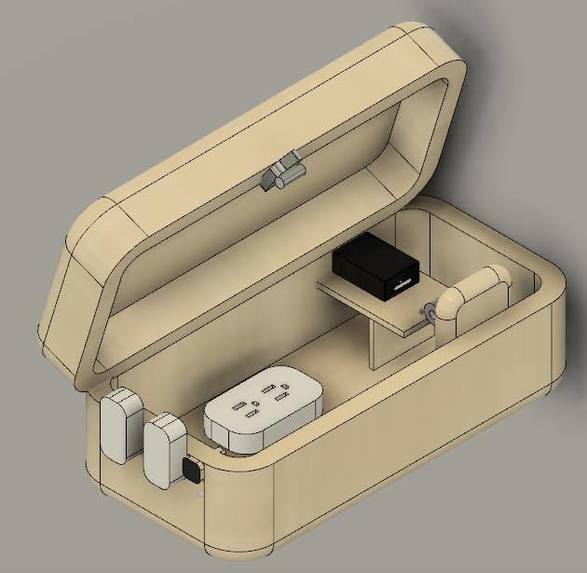
CAD model for this phone charging box

Inspiration
Our project aims to improve the treatment process of patients in Psychiatry Departments’ Inpatient Units. More specifically, an issue was identified in the ineffectiveness of the current methods of charging patients’ phones. Patients within the inpatient unit suffering from severe mental illnesses commonly have a higher suicide rate. Thus hospitals have strict restrictions on what is allowed in units. Items that risk causing harm to the patients are confiscated. One of the restricted items is phone chargers, since there is a possibility that the patients would use the cable to strangle themselves or others. Strangulation is one of the most common methods of suicide in psychiatric hospitals and can be fetal after only five minutes. This means that patients are not allowed to charge their own phones. To do so, they need to hand their phone over to the nurses, who put the phone to charge out of the patient’s reach. When they want it back, patients must ask for it at the nursing station.
Charging a phone is problematic for both patients and nurses. The patients can no longer use their phones while charging and the nurses have to temporarily stop their work to charge and return a patient's phone. Patients might stay in the hospital for weeks at a time. Regular contact with friends, family, and outside resources through the use of a cellular phone might be a strong need of the patient, and could be a source of comfort. Patients might also use their phones to help ground themselves, set alarms and reminders, and keep track of their recovery. When a patient asks for their phone to be placed to charge or for their phone back, nurses temporarily stop their work to return the phone to the patient. Nurses cannot give back a patient’s phone if they are preoccupied with an emergency or a meeting. They may be distracted and give the patient someone else’s phone, leading to a confidentiality problem.
Therefore, the current charging system is required to be improved.
What it does
Our design is a wooden box with a pin pad lock wrapped in memory foam. It is mounted onto the charging outlet on the wall in each patient’s unit. When a patient moves into this unit, a nurse would open this box with a unique passcode and place the charging cable inside the box. The openings in the front are for the cords to go through. The length of the cord outside the box is restricted by a stopper so that patients can not extend it for strangulation. The pin pad lock ensures that the patients have no access to the interior. The password is randomly refreshed every 30 seconds, and nurses can acquire the current password through a terminal on their cell phones. The random-password-refresher mechanism ensures that the charging box has a very high level of security. The same password mechanism is employed by banks such as BOC and ICBC to make sure that international transmissions are secure.
How I built it
We initially had a drawing of our design and then one of our teammates did a CAD model (quite different from the final design, but just for a demo) . Then two of our teammates started to calculate the specific dimensions and do the carpentry work of our box. The other teammate worked on the mechanism for the password pin pad and generating random passwords from Arduino Uno.
Challenges I ran into
(Fortunately, we resolved all of these issues in the end.) We had trouble generating random passwords at selected time intervals without pausing the entire program. We were unfamiliar with the use of bluetooth on Arduino. The screws we selected were too long to fit in the side of the box.
Accomplishments that I'm proud of
There are several highlights of this design that we want to point out. Firstly, the stopper mechanism ensures that only a portion of the cable is exposed at all times, addressing the safety concerns of chargers related to suiside from strangulation via the cable. The gate is easily adjustable by the nurses. Secondly, the use of a pin pad code limits the access of the patient to the charger. The box is locked at all times during the patient’s stay, only to be unlocked when the nurse sets up the phone charger at the beginning of the stay. The 6-bit passcode is generated through a random generator and would change automatically over a preset cycle, which is set to 30 seconds in our demo for demonstration purposes. In reality this cycle can be set to days, or weeks, depending on the hospital’s specific needs and computational capacities. In order to get the passcode, the nurse only needs to send a command on their cell phones and the system would report the current passcode needed to unlock the box. Moreover, not all patients have the same type of phone chargers. The design of a secure box works as a housing that allows the patients to use their own phone chargers without any risk. The individual phone chargers can be swapped in and out when new patients come. This also saves money since a Psychiatry Department cannot afford to purchase adapters for different charger types. Lastly, the memory foam works as a coating to protect the patients from any violence.
What I learned
The implementation of bluetooth on Arduino Mega board. The implementation of random generator using Arduino. The hands on experience with basic carpentry skills. The ethical responsibility of an engineer as an element of this society.
What's next for a Charging mechanism for patients in Psychiatric Departments
Building awareness of fire safety regulations into our prototype, gaining awareness about fire codes related to electrical wiring. Developing prototype with materials other than wood that can be implemented in production
Built With
- arduino
- atmega328
- bluetooth-because-why-not
- cad
- fine-carpentry-craftsmenship
- glue-gun-that-glues-them-all
- membrane-pinpad
- nuts-and-bolts

Log in or sign up for Devpost to join the conversation.