-
-
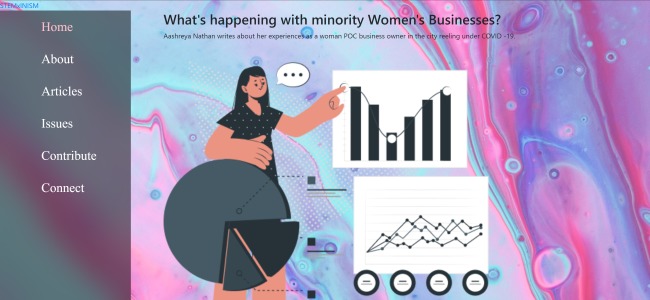
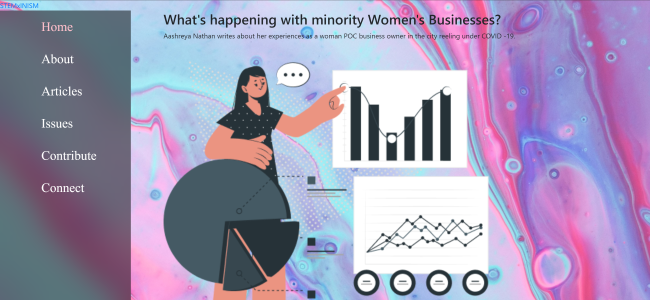
Home Page
-
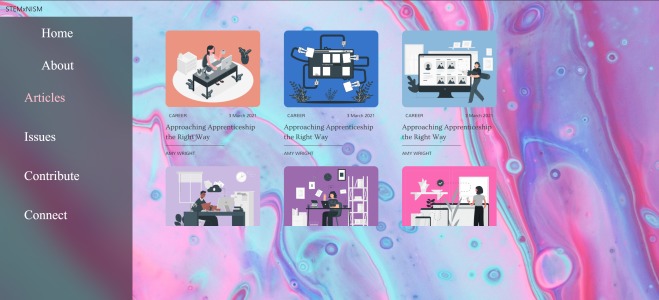
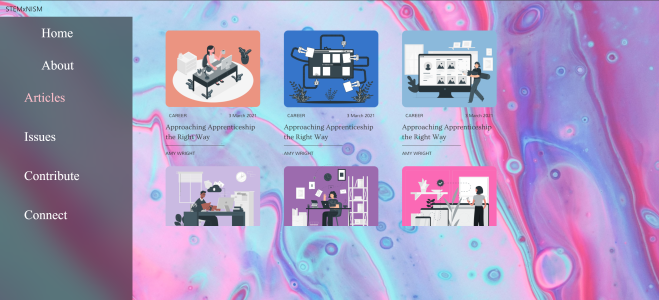
Article Page: Read Stories from Women in STEM
-
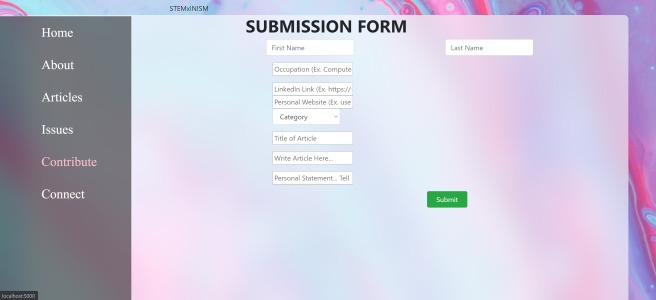
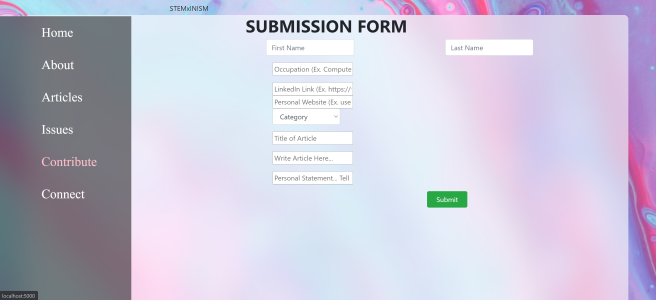
Contribute Page: Submit Articles
Inspiration
As our respective societies around the world have grown to be more technologically advanced, the demand for careers in science, technology, engineering, and mathematics (STEM) has also increased. Despite the baby steps towards inclusivity of women in these industries on a global scale, there still persists a concerning gender gap in STEM careers. According to Catalyst.org, the average percentage of women employed in scientific research and development positions across regions around the world only accounts to less than a third at 29.3% out of the total positions. Many other STEM job opportunities face a similar deficiency in female representation. And unfortunately, these percentages continue to decrease when looking higher up the leadership ladder. With that in mind, it can often feel daunting trying to build a career around an environment where women are not always adequately represented. In light of this issue, we were inspired to build STEMxNISM as a safe space for women at any stage of building their STEM careers, whether that be in academia or at any point navigating job positions in their respective industries. This digital media collective hopes to inspire women to continue building their STEM careers with a sense of confidence and a sense of belonging by curating STEM related stories and resources by women for women. We firmly believe that Women are the future of STEM. However, in order to reach that point, we must pay attention to and uplift the voices of women who are pursuing STEM careers in the present, and STEMxININE digital media collective is a reflection of that sentiment.
A large part of our decision to make a digital media collective that allows women in STEM to control their own narratives through writing articles is the rising trend of start up online magazines in the past couple of months. As followers of some of the zines, we noticed a pattern of many of them bringing out the talent of young creatives whose works often tend to be shadowed by others within their respective communities. Many of these online media collectives are more geared towards art and literature, however. We have not seen many that are solely focused on women in STEM, allowing them to have a sense of community and share their works amongst each other.
What it does
STEMxNISM is a digital media collective website meant to curate stories and helpful resources by women in STEM for women in STEM at ANY stage of their careers, whether that be in academia or in the midst of navigating their respective industries. In doing so, this website aims to provide a safe space for women, allowing them to feel a sense of belonging within the STEM community and a stronger sense of confidence when pushing forward with their career goals.
This website has two main features: It has a submission form under the Contribute page that allows women to submit articles about the following topics: careers, education, research, and breaking the glass ceiling. Thus, this provides women an outlet to amplify their voices in regards to pursuing their goals. It functions as a hub for all the submitted articles to be seen. Under the Articles page, visitors of the website can view all the valid submissions, allowing those that are reading to take inspiration from the writers, to potentially learn from resources provided, and to celebrate the accomplishment of those who have shared their milestones.
How we built it
The UI/UX design of STEMxNISM was created utilizing the software Figma. We then hashed out the front-end and back-end development within the online IDE, Replit. For front-end development, we utilized the languages HTML, CSS, and Bootstraps. The back-end development was put together utilizing Python and the Flask framework.
Challenges we ran into
We ran into a lot of trouble trying to integrate between the frontend and the backend. Also, we had troubles trying to convert the figma prototype into CSS properties for our website.
Accomplishments that we're proud of
Overall we efficiently divided the workload, and got many of the necessary parts of the demo website to work as intended. We were able to finish the figma prototype, integrate the backend and the frontend using Flask, and successfully set up the website. Our main feature of that we were the most proudest of was utilizing a combination of the back-end and front-end development to be able to directly submit your article to the website. As this tricky task it is a large part of how this digital media collective functions, we were excited to have pulled it off. Last, we would love to show off the cohesiveness and the liveliness of the UI/UX design that was intended within the Figma prototype and closely replicated within the website itself.
What we learned
We learned how to debug HTML files and how to test the files on a local server. We also learned how to use Flask in order to operate the back-end of the website. In addition to that, we adopted important tips on how to deliver an impactful demo of a start up project. Finally, the last skilled strengthened was being comfortable with using version control in Git.
What's next for STEMxNISM
First, we would like to implement two other features. The first proposed feature would allow users to subscribe their email addresses to the STEMxNISM Mailing List database which allows them to later be notified by email of when the quarterly issue of the STEMxNISM online magazine, a curation of the most compelling articles posted within an allotted period of time coupled with outstanding visuals, is available to be seen on the Issues page. Then, STEMxNISM provides contact information and a brief summary of all authors whose articles are published on the website under the Connect page. This allows viewers to view other significant works by the authors and form connections with them. With these features embedded into the program, we would then proceed to work on the front-end development to make it more cohesive to the intended UI/UX design. After that seems to be finished, we will then proceed to upload the website to a domain where it can be enjoyed by the public!
Our overarching end goal is to be able to expand our partners and collaborators, outreaching to other professionals in STEM to get a better insight of the our targeted audience and how we can cater to them.


Log in or sign up for Devpost to join the conversation.