-
-
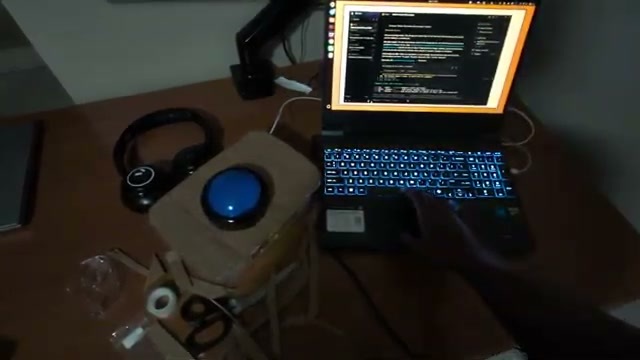
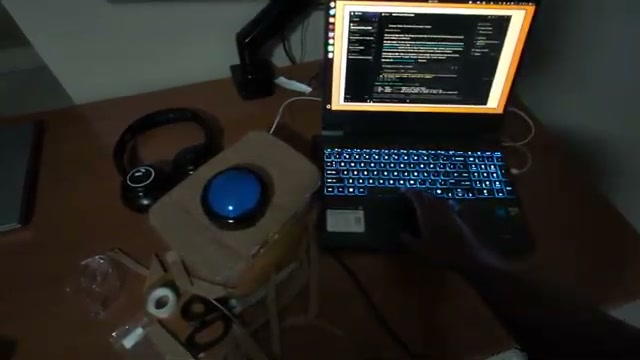
The real prototype: an Arduino UNO R4 drives the big "I'm fine" button and its warm light.
-
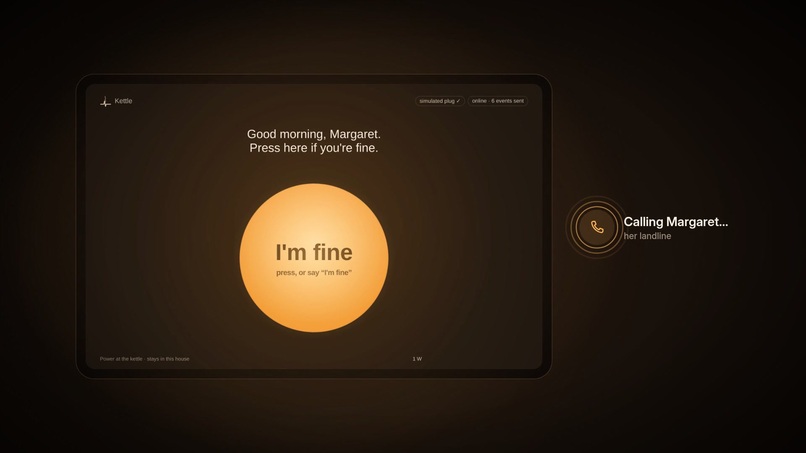
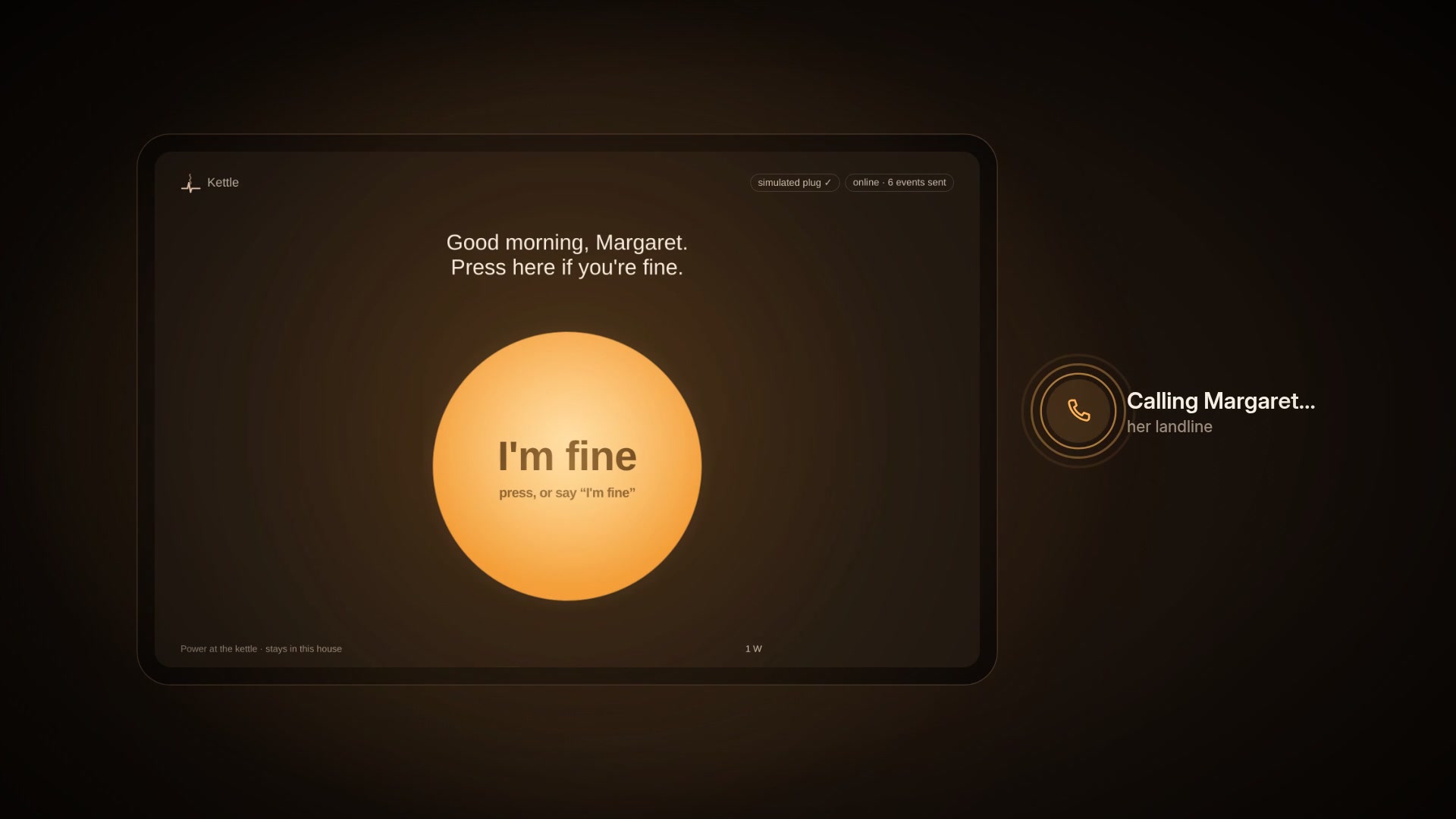
The kitchen display: one big "I'm fine" button.
-
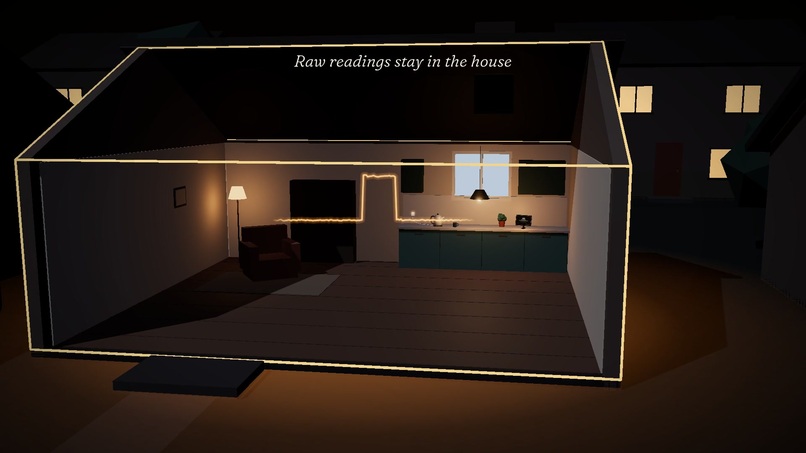
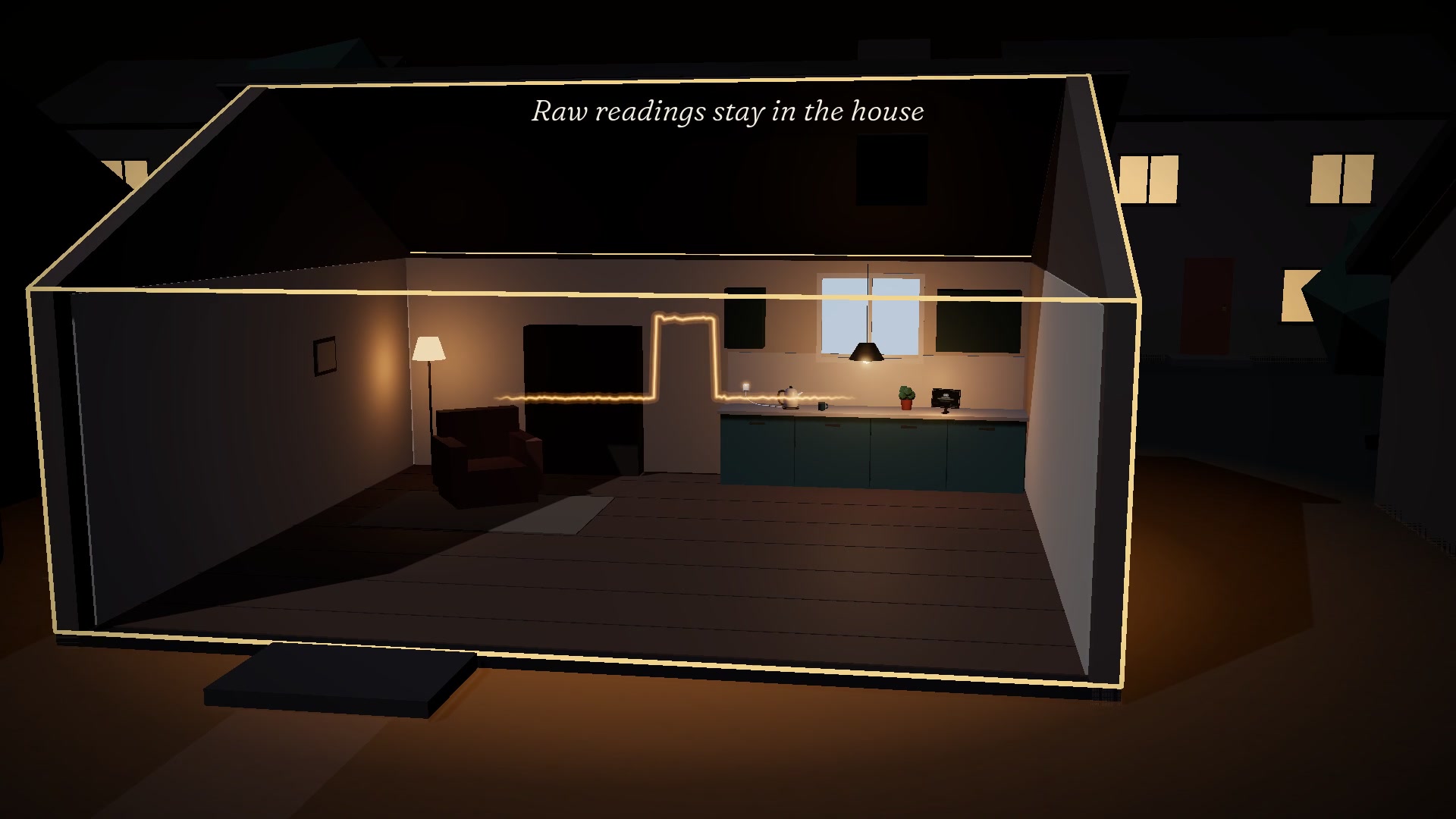
Raw readings stay in the house: only events like "kettle on, 7:48" leave the hub.
-
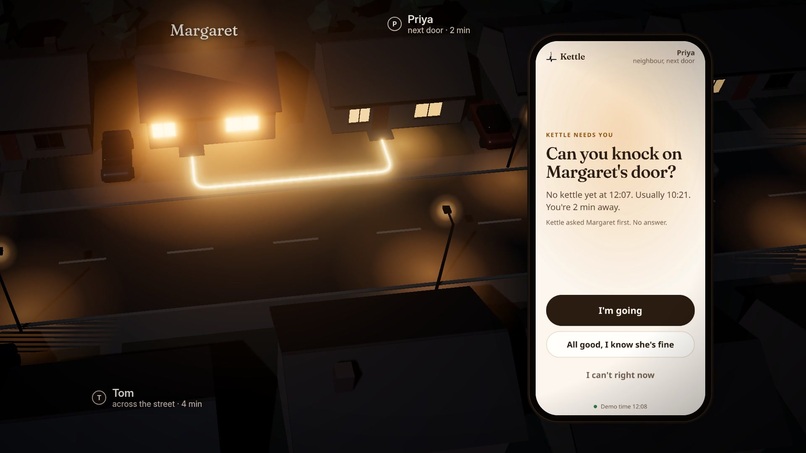
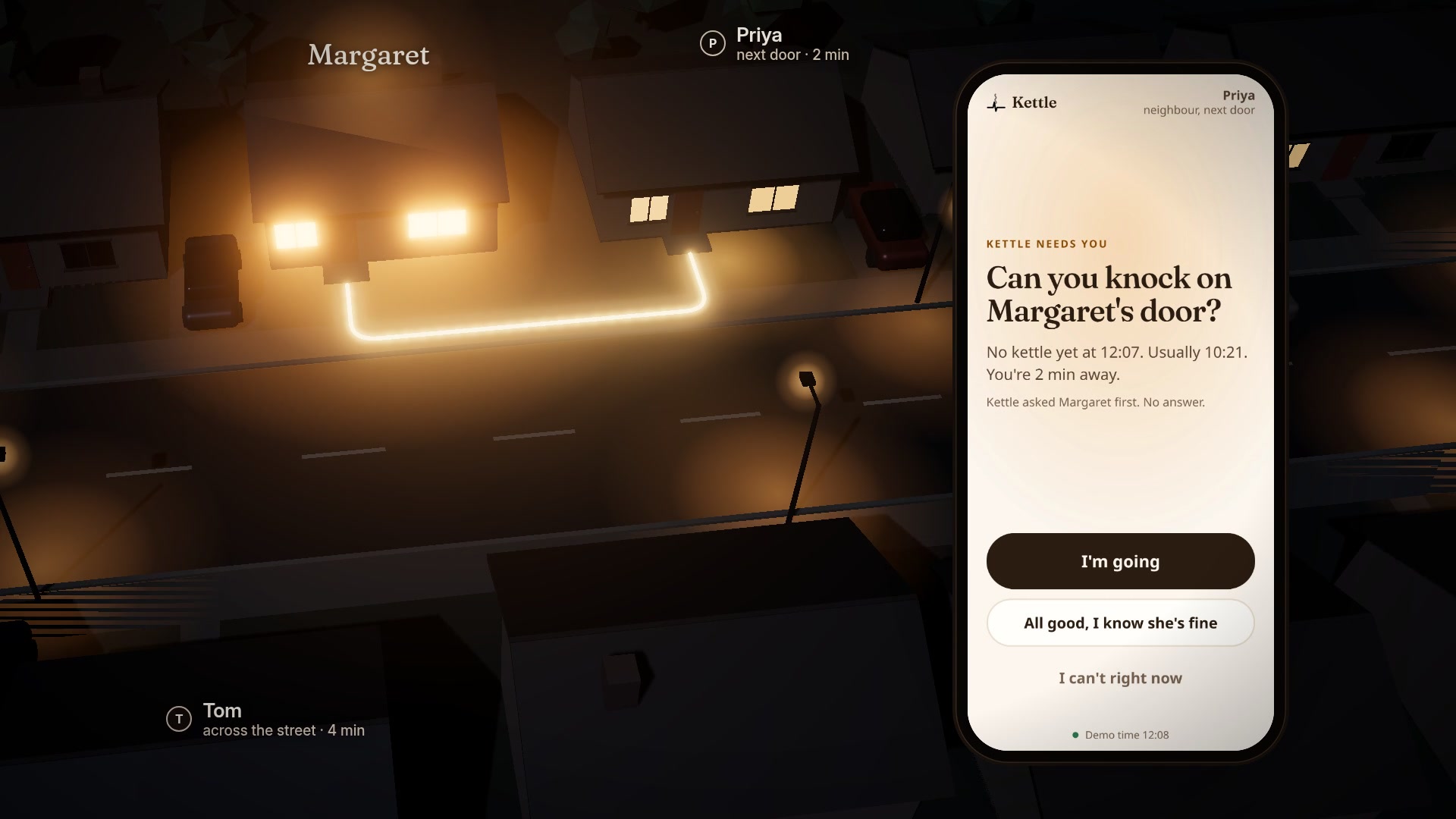
A neighbour's phone: "Margaret's morning hasn't started. You're 2 min away. Can you knock?"
-
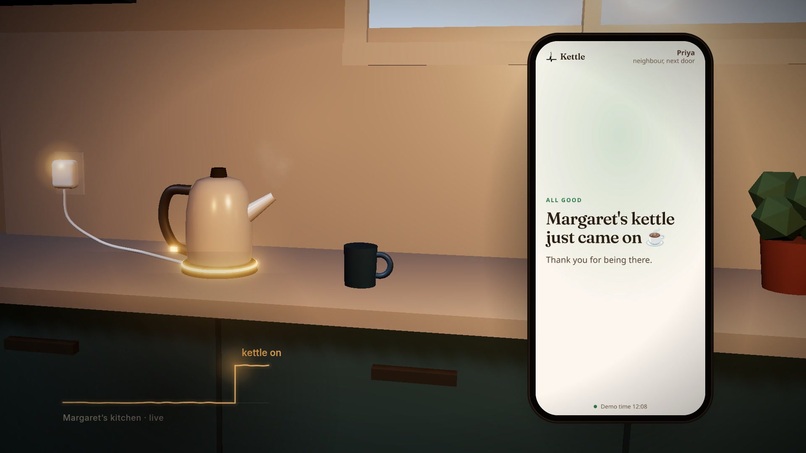
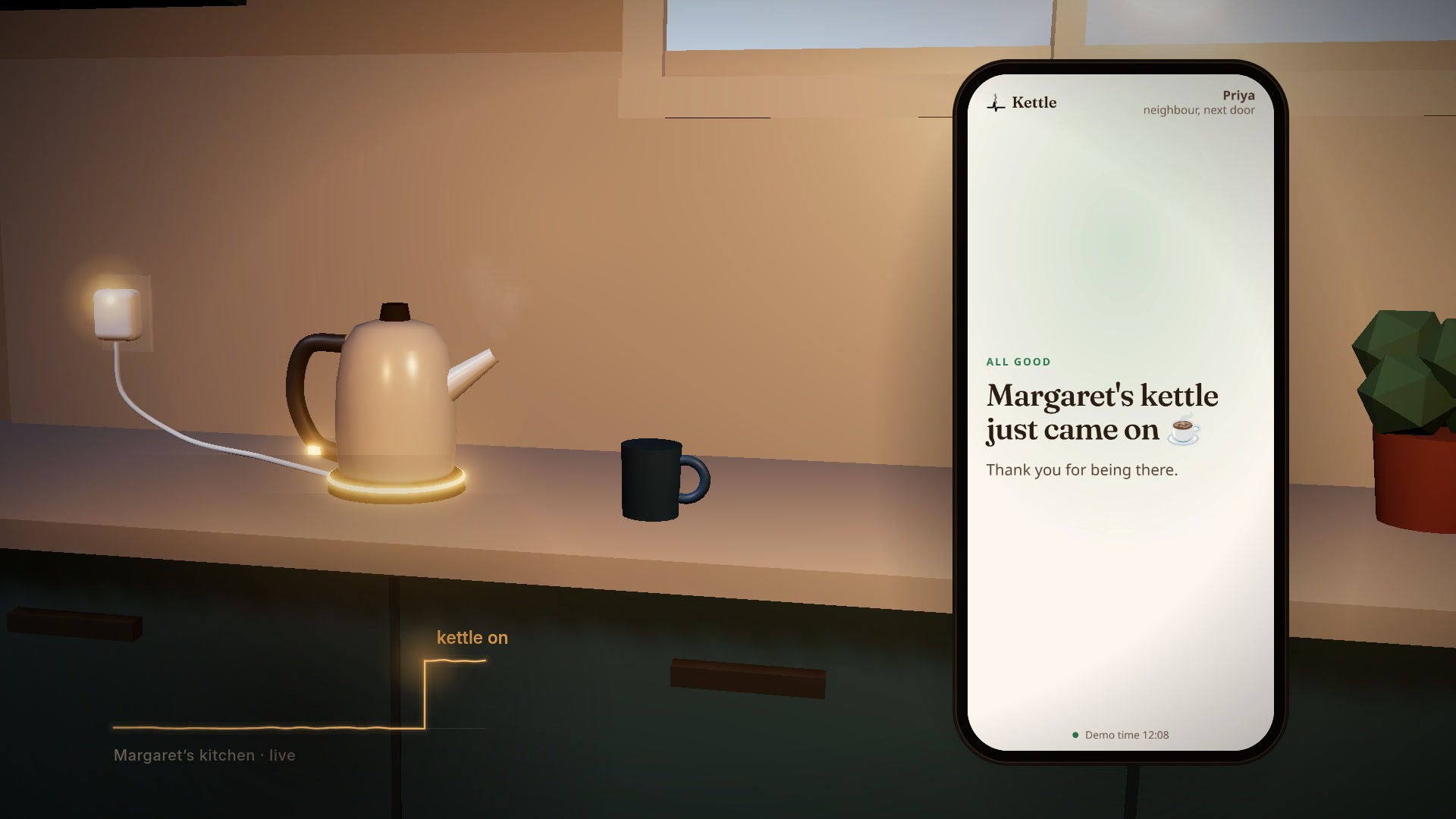
The kettle comes on and everyone involved hears it.
Inspiration
42% of Canadians aged 85+ live alone. In a BMJ study of people over 90, 80% of those who fell while alone and couldn't get up didn't use their call alarm. Pendants only work if you wear them and press them. But almost every home already has an honest signal: the morning cup of tea. Japan's Zojirushi i-Pot has emailed families when an elderly parent uses their hot-water pot since 2001. We wanted the same quiet signal, without a special appliance, answered by neighbours instead of a call centre.
What it does
- Senses at the edge. A $25 smart plug on the kettle (v0), or a $15 ESP32 on the meter's pulse LED (v1). A small hub in the home detects appliance events from their power signatures. Raw readings never leave the house; only events like "kettle on, 7:48" do.
- Learns a personal rhythm. Kettle learns when each person's day usually starts (median and spread, weekdays and weekends) from about a week of mornings. Every alert explains itself: "No kettle by 10:40. Usually 7:52."
- Responds with dignity. It asks the person first (a phone call and a pulsing light on a big "I'm fine" button), then the nearest neighbour in their circle ("You're 2 min away. Can you knock?" [I'm going] [All good]), then family, then suggests a welfare check. The moment the kettle goes on, everyone involved hears "Margaret's kettle just came on ☕".
- Works the other way too. "Thinking of you" makes a warm light glow in the kitchen.
- Cold mode (the Alberta twist). Live Environment Canada data tightens the thresholds, and a Kettle that goes dark in a cold snap asks the circle to check. We replay January 13 2024 with real AESO and ECCC data: at 18:44, when Alberta's emergency alert went out, Kettle tells each circle to check on Margaret.
How we built it
- Edge (Python): streaming steady-state edge detector (after Hart's NILM), ON/OFF cycle pairing, explainable appliance signatures (step, duration, flatness), store-and-forward, local plug drivers (Shelly, Tasmota, Kasa) with no vendor cloud.
- Hardware: an Arduino UNO R4 drives a big arcade "I'm fine" button with a warm LED that pulses during a check-in and glows for "thinking of you". ESP32 firmware for meter-pulse or CT-clamp sensing compiles in all 4 modes.
- Cloud (FastAPI): rhythm model (median and MAD, weekday/weekend, cold policy), a pure, tested escalation state machine, WebSockets to the circle and to devices, Twilio voice and SMS (texts link to one-tap answers).
- Tiger Data / TimescaleDB: an
eventshypertable (no raw readings), adaily_activitycontinuous aggregate for each person's first activity per "Kettle day" (04:00 to 04:00, America/Edmonton), and retention policies. - Real-world energy data (Voltex): the live AESO Current Supply Demand report, archived AESO hourly pool price, Alberta Internal Load and System Marginal Price for Jan 2024, live and archived ECCC weather and alerts, and REFIT (20 UK homes, real 8-second measurements) for evaluation.
- Front-ends: circle phone app (large targets, events only), kitchen display (one giant "I'm fine" button), presenter stage (live trace, rhythm band, Calgary map, Jan 13 replay). Vanilla JS, no build step. axe-core: 0 WCAG A/AA violations on the circle and kitchen screens.
- The film is code too: rendered frame by frame from HTML and three.js, with every number on screen loaded from our data, and the soundtrack synthesized in Python.
Evidence
We replayed REFIT (20 UK homes, 9,242 home-days of real 8-second data) through the same detector and rhythm code we ship:
- Kettle detection F1: 0.96 with a plug on the kettle, 0.66 from the whole-home meter (0.69 on held-out houses, 0.72 with three calibration boils).
- 4.7 check-in calls per home per month with a kettle plug, 2.5 if people pause Kettle when away. Each check-in is a call to the person first.
- Median 76 minutes after the usual time before Kettle asks (51 in cold mode).
- Honest limits: UK families, not Calgary seniors; no true incidents, so every check-in counts as false; microwave detection from the whole-home meter is unreliable. Full method in
docs/refit-evaluation.md.
What's real and what's simulated
The detector, rhythm model, escalation, cloud, circle app, kitchen display and the Arduino button are real, working code (27 tests). The grid, weather and REFIT data are real. On stage the kettle plug is simulated (the waveform goes through the same detector), Margaret, Priya, Tom and Daniel are personas, and Margaret's routine is a real single-occupant REFIT home's mornings. No pilot homes yet; the consent form and protocol are in the repo.
Challenges
- North American kettles draw 1500 W, half a UK kettle's 3 kW, so whole-home detection is harder here than in the UK data we evaluated on.
- Choosing the deadline trades false check-ins against time-to-help. We use robust statistics with a minimum margin, and the first step is a call to the person, so a false alarm costs one phone call.
What's next
A consented pilot in 3–5 homes, outreach to Calgary seniors organisations (e.g. Kerby Centre), a v2 adapter for utility interval data (no hardware at all), and a utility partnership.
AI disclosure
Built with AI coding assistance (Claude Code) for code, docs and the film. The product itself uses no AI model at runtime. Details in docs/ai-disclosure.md. The closing photo is by kawilson on Pixabay.
Kettle is not a medical device or an emergency service.
Built With
- aeso
- arduino
- environment-canada
- esp32
- fastapi
- javascript
- postgresql
- python
- refit
- three.js
- timescaledb
- twilio
- vercel
- websockets
