Inspiration
As a PC gaming enthusiast, I’ve always been drawn to immersive racing games, but I felt that something was missing from the experience. The thrill of driving wasn’t fully captured by just a keyboard or a basic game controller. I wanted to feel the realistic sensation of shifting gears, steering, and controlling a car like I would in real life. This passion for gaming and a desire to enhance the experience led me to create my own DIY driving simulator setup.
What it does
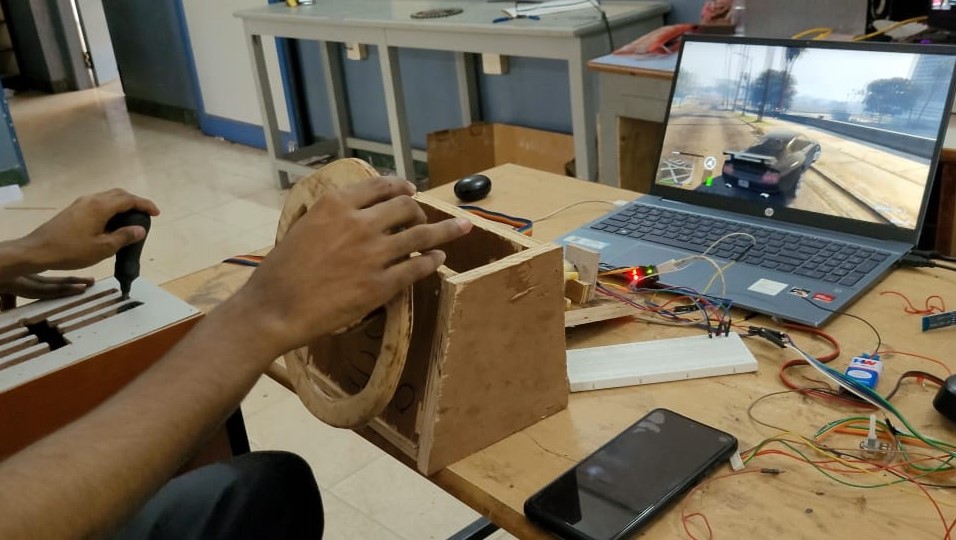
The 6+1 Speed Shifter Driving Simulator is a custom-built interface that replicates the physical controls of a real car. It features potentiometers for steering, acceleration, braking, and clutch control, giving the player a lifelike driving experience. The highlight of the setup is the 6+1 speed shifter, which uses reed switches to enable precise gear shifting. This setup, combined with an Arduino Pro Micro, processes the input signals and interfaces with simulation software, allowing for immersive gameplay or even practical training simulations.
How I built it
To build the simulator, I started by designing the physical components, including the steering mechanism and the pedal setup using potentiometers. For the gear shifter, I implemented reed switches, which detect the exact position of the gear stick, enabling accurate gear changes. The Arduino Pro Micro was programmed to process these inputs and send them to the PC, where they were mapped to the controls in the simulation software. I also ensured that the entire setup was ergonomically designed for comfort during extended gaming sessions.
Challenges I ran into
One of the biggest challenges was calibrating the potentiometers and reed switches to ensure they provided accurate and responsive control. I had to fine-tune the sensitivity of each component so that the simulator could faithfully replicate real-world driving dynamics. Additionally, integrating the Arduino with the simulation software required careful coding and troubleshooting to ensure seamless communication between the hardware and software.
Accomplishments that I'm proud of
I'm particularly proud of how the gear shifter turned out, as achieving precise and responsive gear changes was a significant technical challenge. The fact that I was able to create a setup that not only worked but also significantly enhanced the realism of racing games is something I’m very proud of. It’s incredibly rewarding to see how this DIY project has taken my gaming experience to the next level.
What I learned
Through this project, I gained a deeper understanding of how to translate real-world physical controls into digital inputs. I learned about the intricacies of using potentiometers for analog control and how reed switches can be employed for precise detection in a compact space. Additionally, this project honed my skills in programming microcontrollers like the Arduino Pro Micro and taught me a lot about interface design and user experience.
What's next for 6+1 Speed Shifter Driving Simulator
Looking ahead, I plan to expand the simulator by adding more advanced features like force feedback for the steering wheel and pedal resistance adjustments to simulate different driving conditions. I’m also considering developing a more polished version of the setup that could be shared with other gaming enthusiasts who want to build their own simulators. Eventually, I hope to integrate this setup with virtual reality (VR) for an even more immersive driving experience.
Built With
- arduino-pro-micro
- embedded-c
- potentiometer
- reed-switches

Log in or sign up for Devpost to join the conversation.