-
-
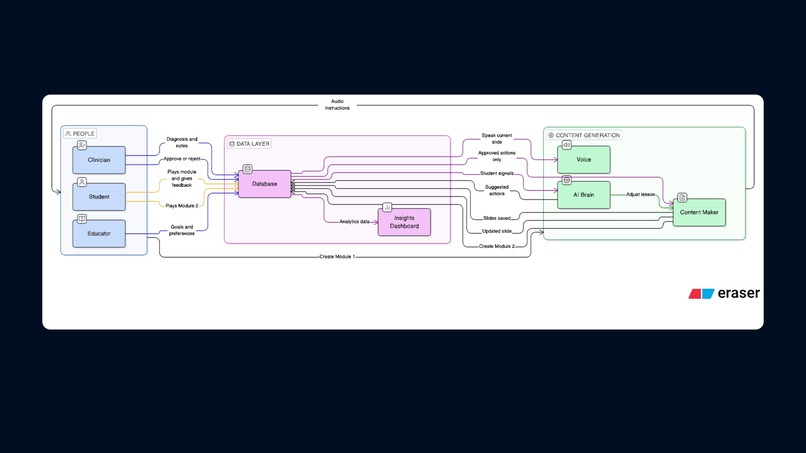
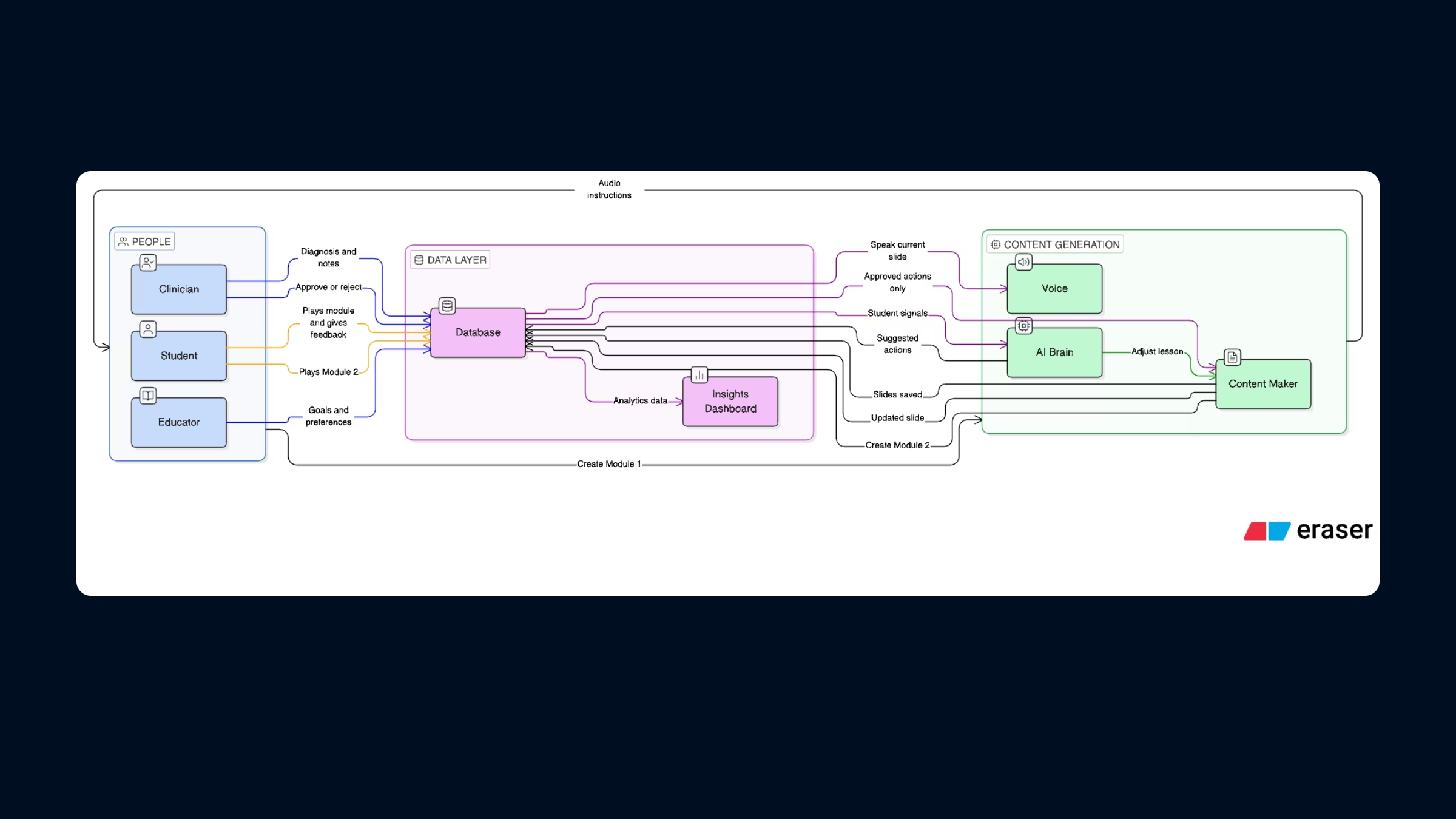
System Architecture
-
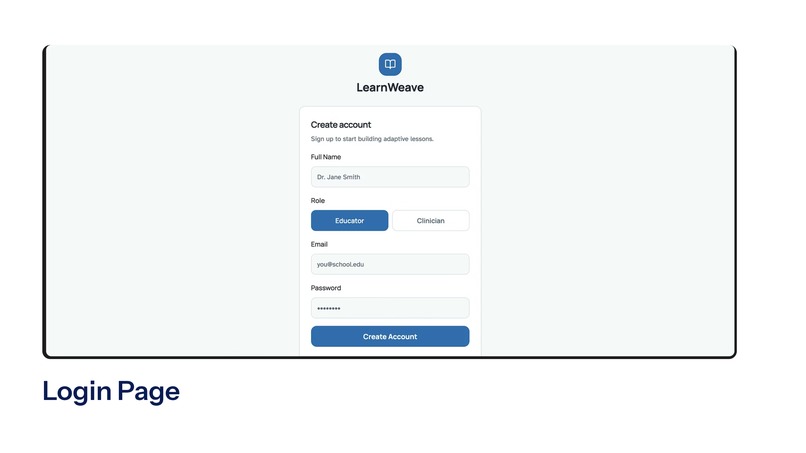
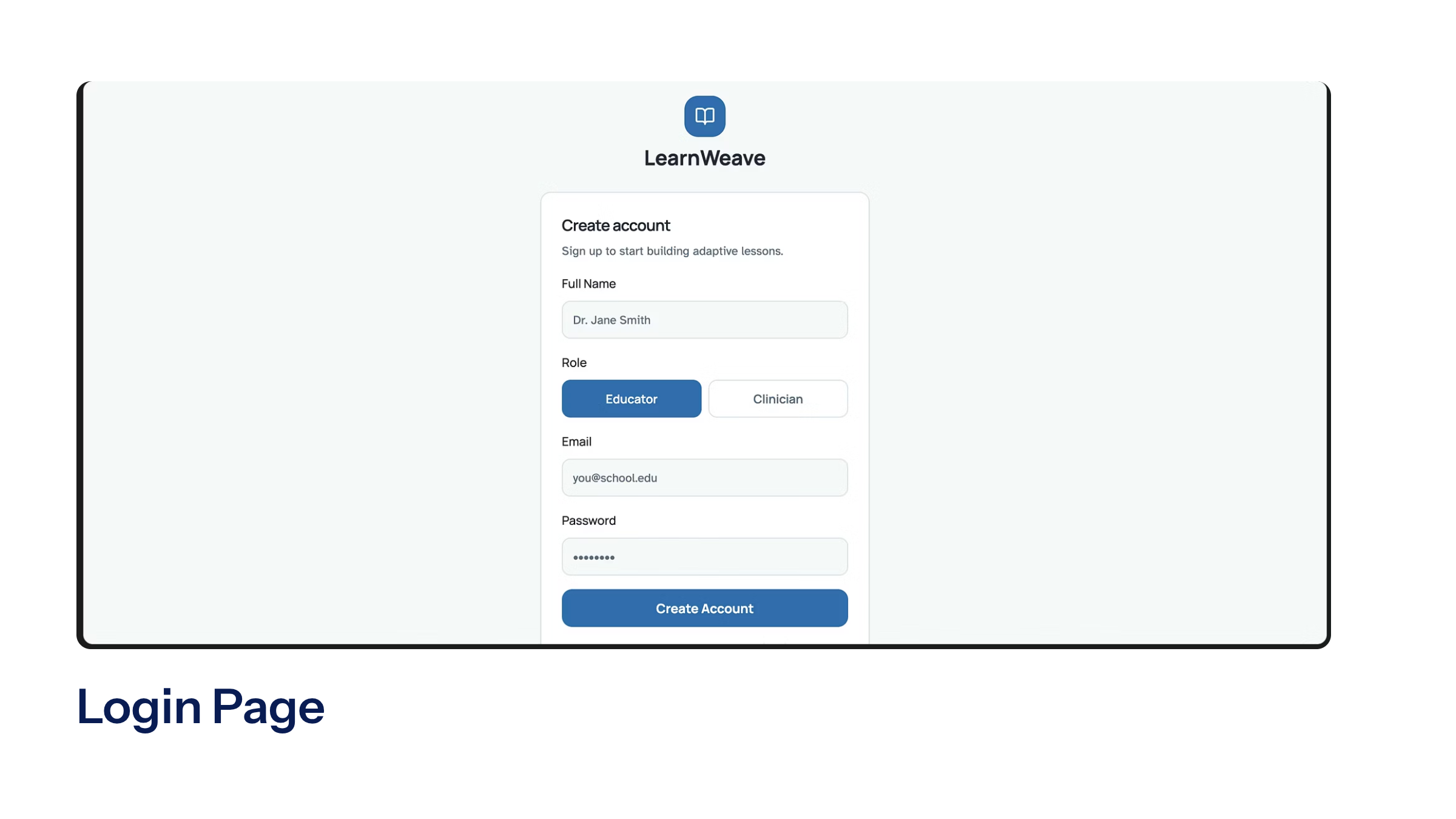
Login Page
-
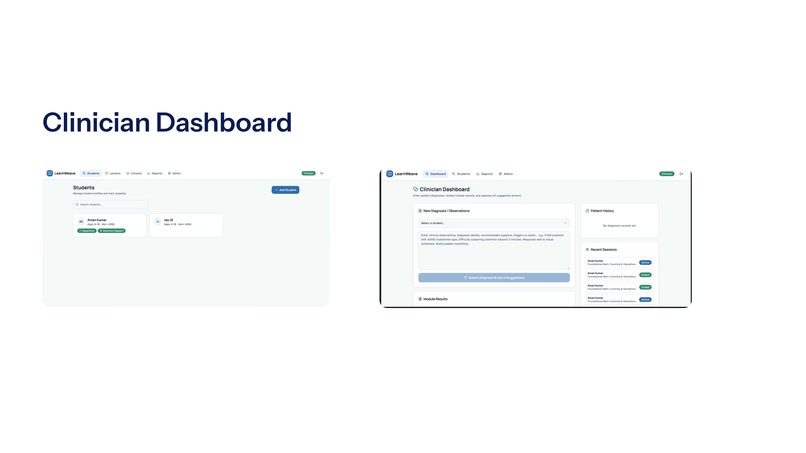
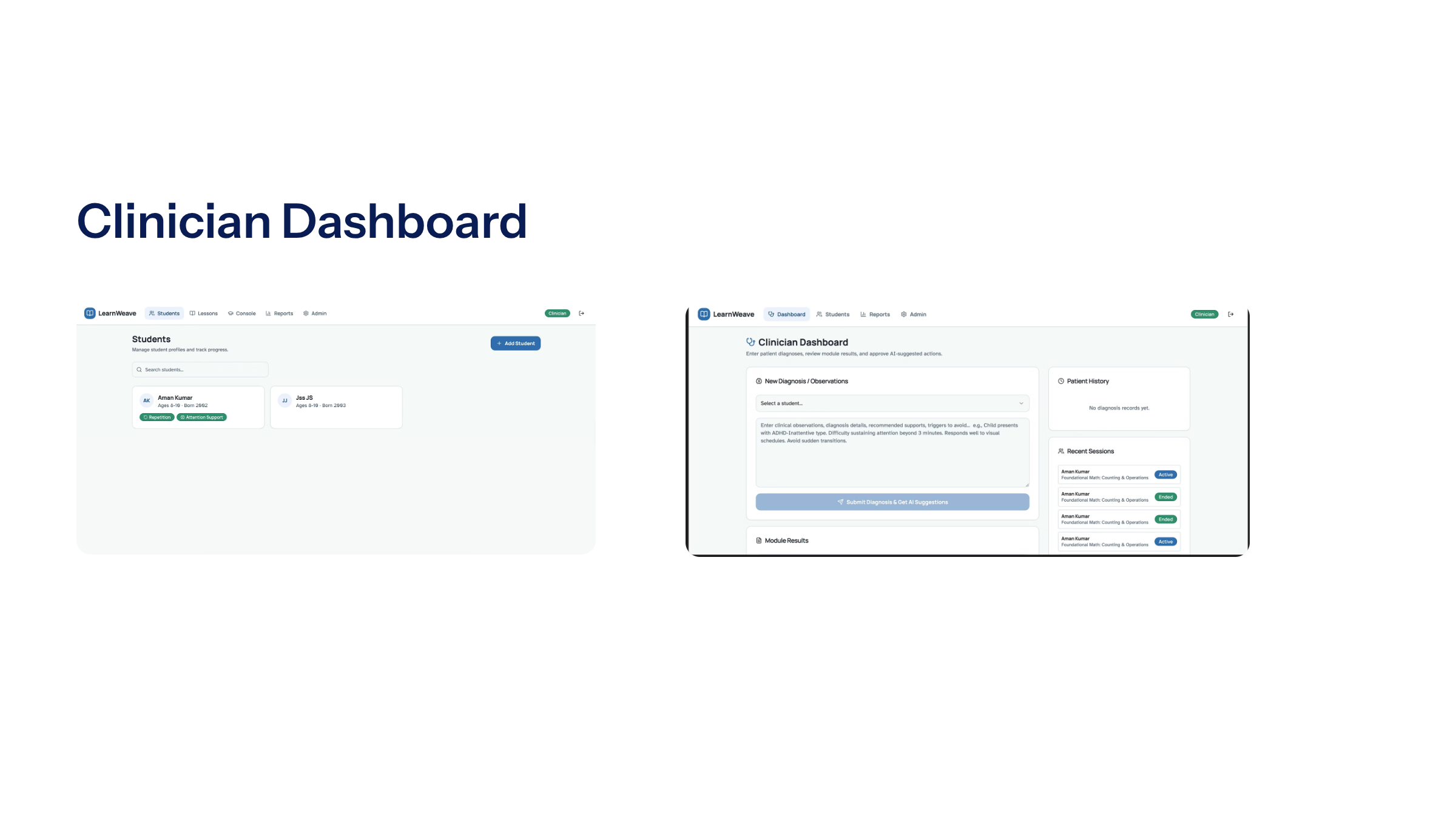
Clinician Dashboard
-
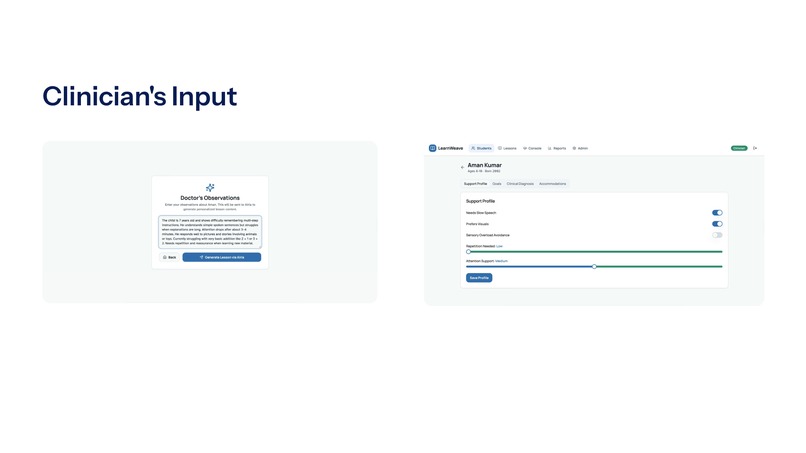
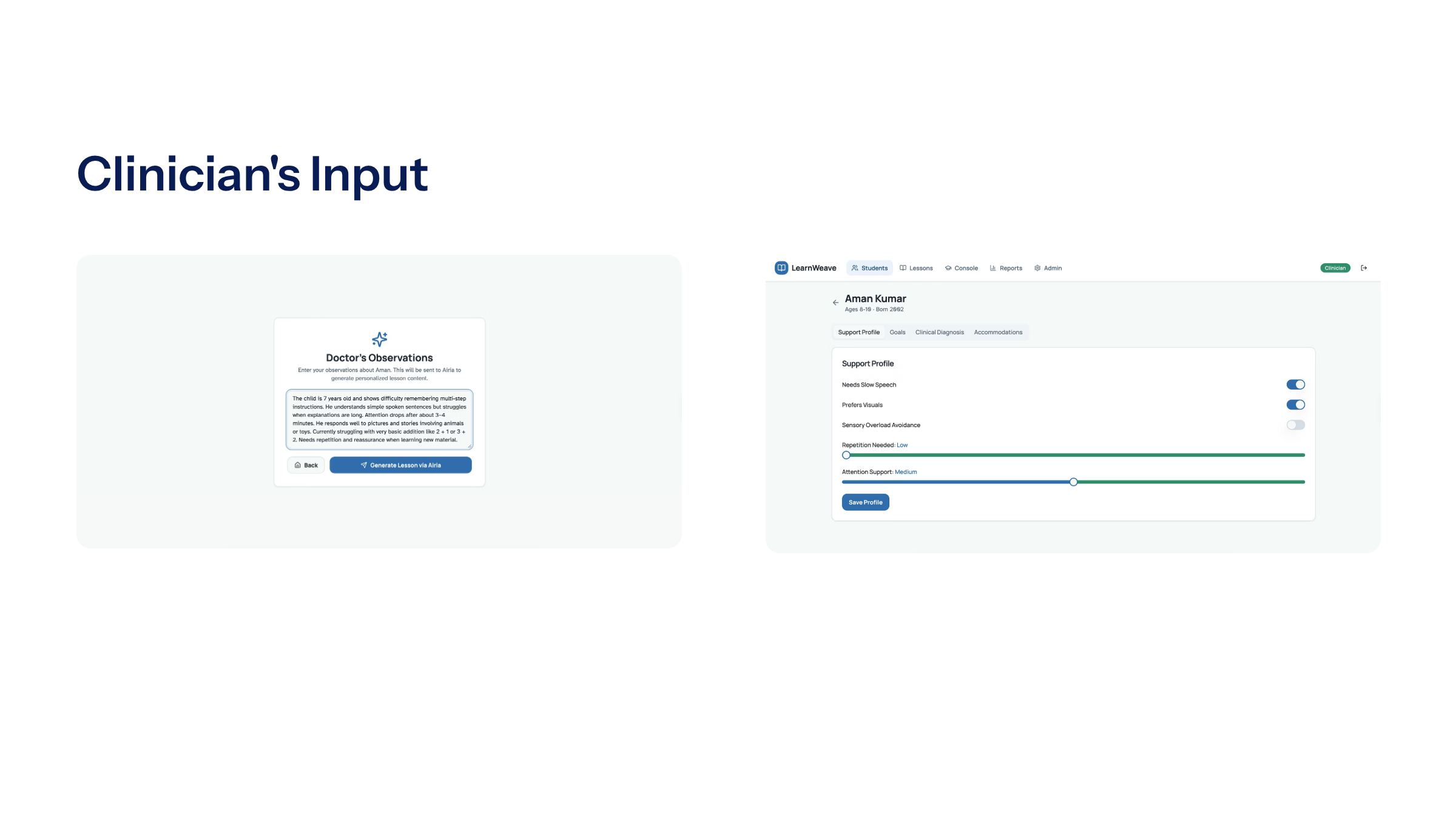
Clinician's Input
-
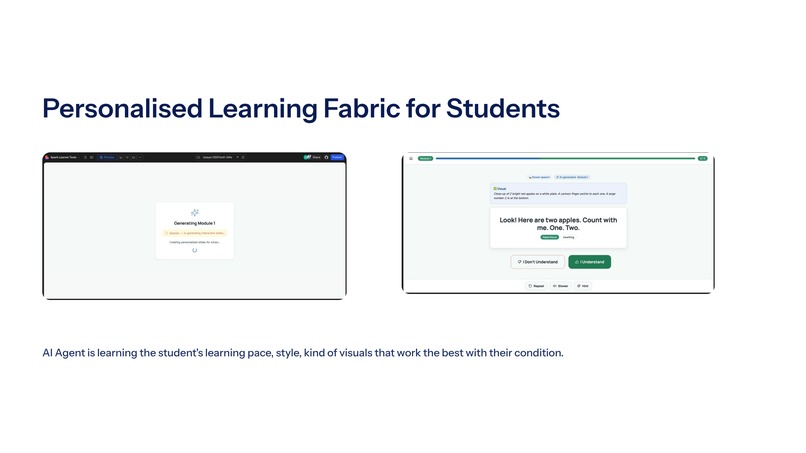
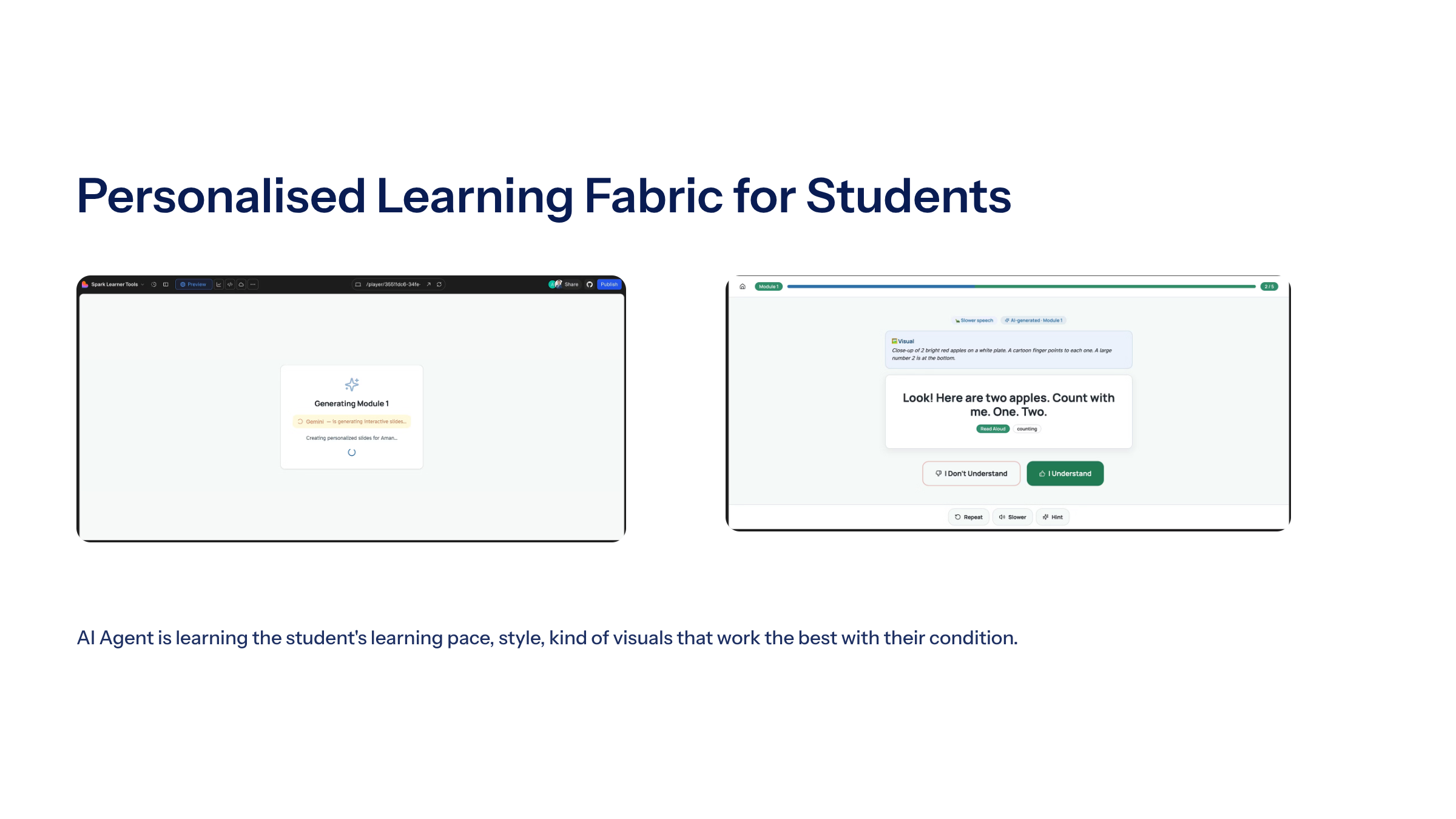
Learning Fabric
-
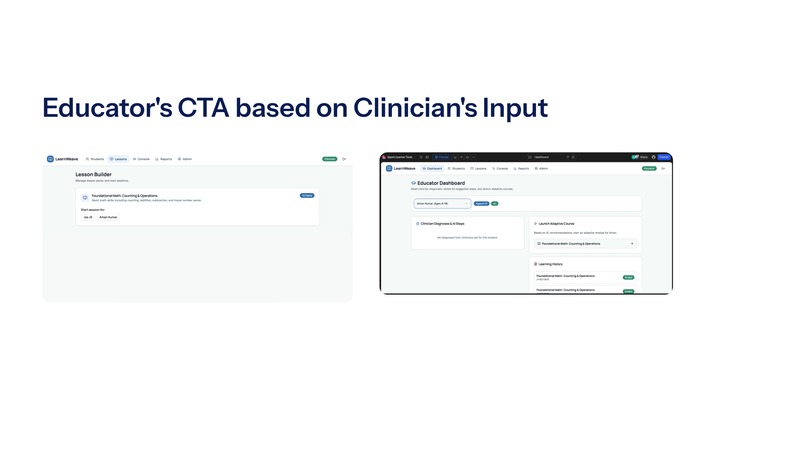
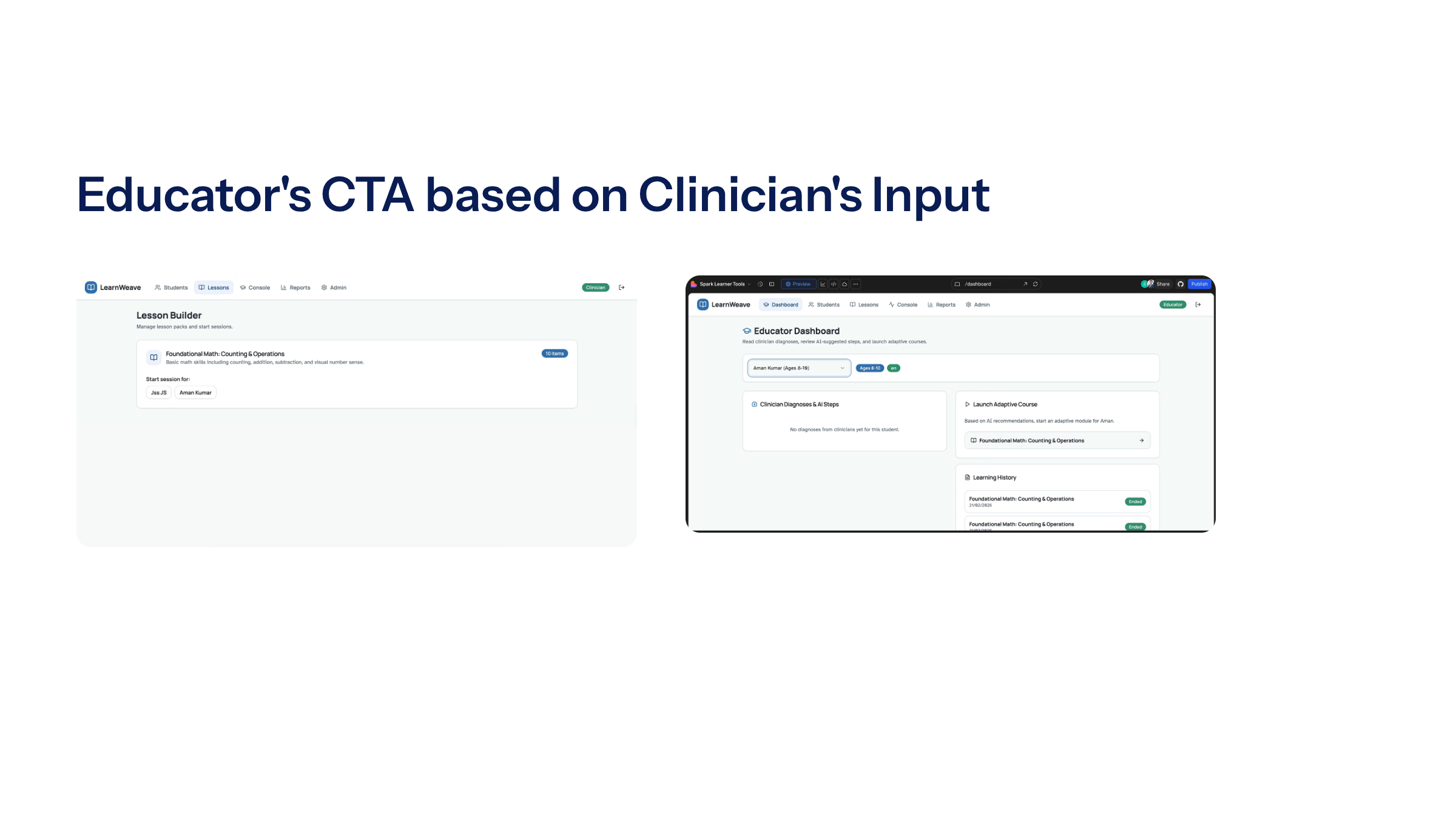
Educator's CTA
-
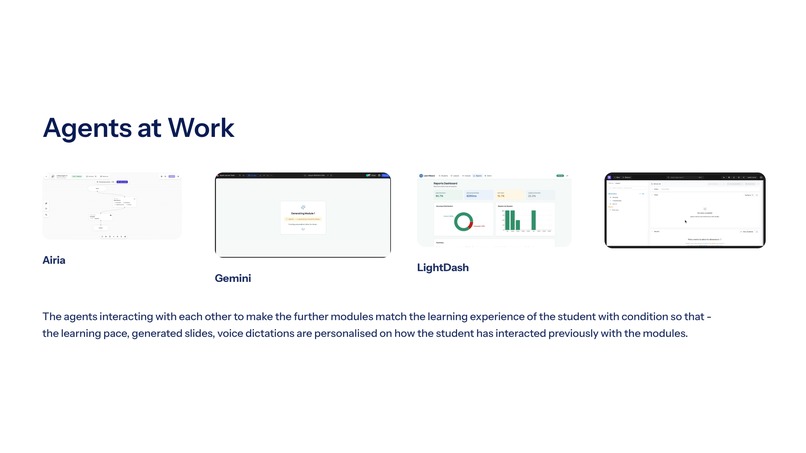
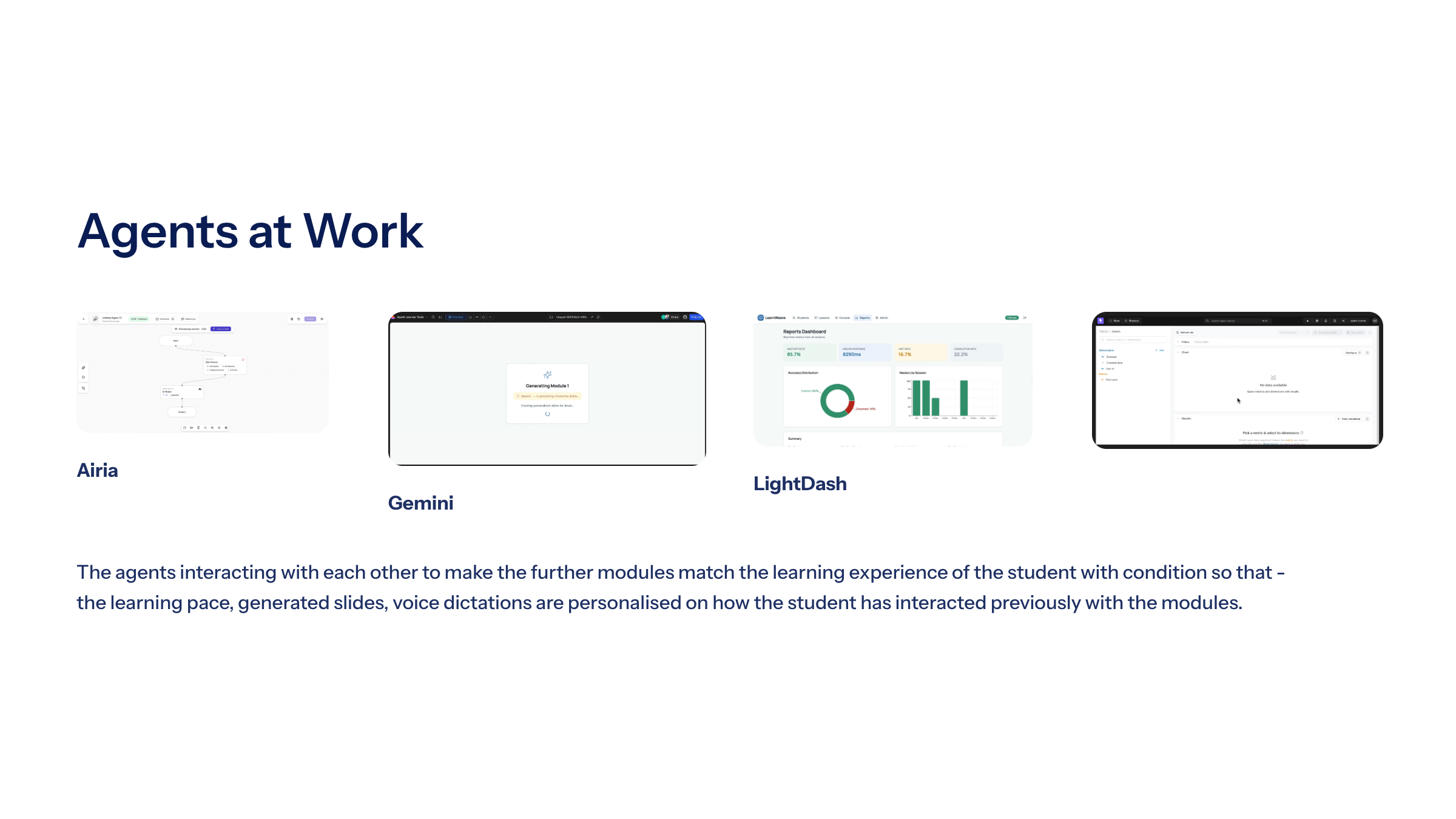
Autonomous Integration of Agents
\documentclass[11pt]{article} \usepackage[margin=1in]{geometry} \usepackage[T1]{fontenc} \usepackage{enumitem} \usepackage{hyperref}
\setlist[itemize]{noitemsep, topsep=4pt} \setlist[enumerate]{noitemsep, topsep=4pt}
\begin{document}
\section*{LearnWeave Overview}
\subsection*{What it does} \textbf{LearnWeave} is a governed, adaptive learning fabric for learners who need extra support.
\begin{itemize}
\item \textbf{Clinician module (Patient history):} Clinician enters observations + diagnosis summary $\rightarrow$ reviews AI-suggested actions $\rightarrow$ approves/rejects what can be used downstream.
\item \textbf{Educator module (Learning history):} Educator sets learning goals + preferences $\rightarrow$ sees diagnosis (read-only) + session outcomes $\rightarrow$ generates the next learning module.
\item \textbf{Student module (Core demo):}
\begin{enumerate}
\item \textbf{Module 1: Calibration} (5 interactive slides) to learn the student’s learning pattern.
\begin{itemize}
\item Each slide has two big buttons: \checkmark\ \textbf{I get it''} / \texttimes\ \textbf{Not yet''}
\item The system adapts in real time (pace, simpler text, more visuals, extra hints).
\end{itemize}
\item \textbf{Module 2: Personalized slides} generated using what Module 1 learned + clinician-approved actions.
\end{enumerate}
\end{itemize}
\subsection*{How we built it} We built LearnWeave as an event-driven loop with three sponsor tools at the core:
\begin{itemize} \item \textbf{Supabase} as the system of record (students, modules, slides, events, approvals). \item \textbf{Airia} as the orchestrator: converts clinician input + student signals into \begin{itemize} \item (a) adaptation rules, \item (b) suggested actions, and \item (c) the next-module plan. \end{itemize} \item \textbf{Gemini} as the content generator: produces slide JSON + visual prompts for Module 1 and Module 2. \item \textbf{ElevenLabs} as the voice layer: reads instructions aloud (with speed control + fallback). \item \textbf{Lightdash} as the dashboard layer (planned): we designed the data model for it, but kept integration pending until embed details. \end{itemize}
\noindent \textbf{Key design choice:} the student’s clicks are the product—every \checkmark/\texttimes\ becomes an event that drives the next adaptation and produces measurable evidence.
\subsection*{Challenges we ran into}
\begin{itemize}
\item \textbf{Role separation:} making clinician and educator truly different (not same UI with different labels'') while keeping the flow fast for a demo.
\item \textbf{Governance vs autonomy:} balancing real-time adaptation for students with clinician approval gates for bigger instructional changes.
\item \textbf{Keeping the demo crisp:} proving autonomy in $< 2$ minutes without building a huge content library.
\item \textbf{Sponsor-native integration reality:} we needed the system to actually call orchestrator/TTS/content generation instead ofmocking'' it.
\end{itemize}
\subsection*{Accomplishments that we're proud of} \begin{itemize} \item A clear, demoable loop: Module 1 calibration $\rightarrow$ real-time adaptation $\rightarrow$ clinician approval $\rightarrow$ Module 2 personalized. \item Clinician governance built-in (approve/reject actions) so the system stays supportive—not diagnostic. \item Student-first UX: simple interaction model (\checkmark/\texttimes) that is accessible, fast, and data-rich. \item Measurable by design: every interaction becomes structured evidence (events + module summaries). \item Sponsor visibility without ``logo-washing'': Airia decides, ElevenLabs reads, Gemini generates; Lightdash is staged correctly. \end{itemize}
\subsection*{What we learned} \begin{itemize} \item The real unlock isn’t ``AI makes content''—it’s AI closes a governed feedback loop with evidence. \item For special learning support, simplicity beats cleverness: two buttons can generate better signals than complex quizzes. \item Trust mechanisms matter: clinician approval makes the system feel safe and credible. \item If you want a BI dashboard later (Lightdash), you must design clean events + schema early—not after the demo. \end{itemize}
\subsection*{What's next for 56 — LearnWeave} \begin{itemize} \item \textbf{Lightdash integration:} connect dashboards to Supabase metrics for module outcomes and action effectiveness. \item \textbf{More module types:} beyond foundational math—reading comprehension, attention training, and life-skills micro-lessons. \item \textbf{Better personalization policy:} expand Airia rules (modality preference, reinforcement schedules, sensory-friendly variants). \item \textbf{Clinician workflow depth:} structured templates for patient history + accommodations, plus review summaries per module. \item \textbf{Evaluation + safety:} introduce rubric-based checks (non-diagnostic language, accommodation alignment, content safety) and A/B testing of adaptation policies. \end{itemize}
\end{document}
Built With
- airia
- elevenlabs
- gemini-2.5
- lightdash
- nextjs
- react
- ts

Log in or sign up for Devpost to join the conversation.