-
-
51/51
Inspiration
In many couples, the two partners don't see the split of work at home the same way. A June 2026 Pew Research Center survey found that 63% of working mothers say they do more of the parenting and chores, while fathers are much more likely to say the split is equal. Only 26% of mothers are very satisfied with how chores are shared, compared with 49% of fathers. Money adds to the tension: couples argue about it 58 times a year, and 32% are uncomfortable even discussing it (Talker Research for Wise, 2025).
Most apps in this space count chores or split bills. But a number is an excuse to start a fight, and a tally can't see that one partner went part-time to be home more, or that the other works until 8 pm. My inspiration was Shoulder, a project that gives each sibling caring for a parent their own private AI agent. I wanted to bring that idea to married couples, built around one principle: both partners give a little more than half. That's 51/51.
What it does
51/51 is a web app for married couples, with or without kids. Each spouse has a private AI agent that knows their real situation: their hours, the sacrifices they've made, what's impossible for them, and how they feel. Neither partner ever sees the other's private answers.
- Log: both partners log what they do, as text or a receipt photo, and the AI sorts each entry into kids, home or money.
- This week: the agents describe each week in words, never numbers, with labels like "Mostly Emily", "A bit more Ryan" or "Shared".
- Ideas for you: each partner gets 2–3 practical ideas from their own agent, chosen for their situation.
- Talk it out: a private chat with a neutral mediator. It can point to plain facts from the logs, so a frustrated partner is taken seriously. The other partner never sees the complaint, only a kind, practical nudge, like suggesting a shared calendar for dentist appointments.
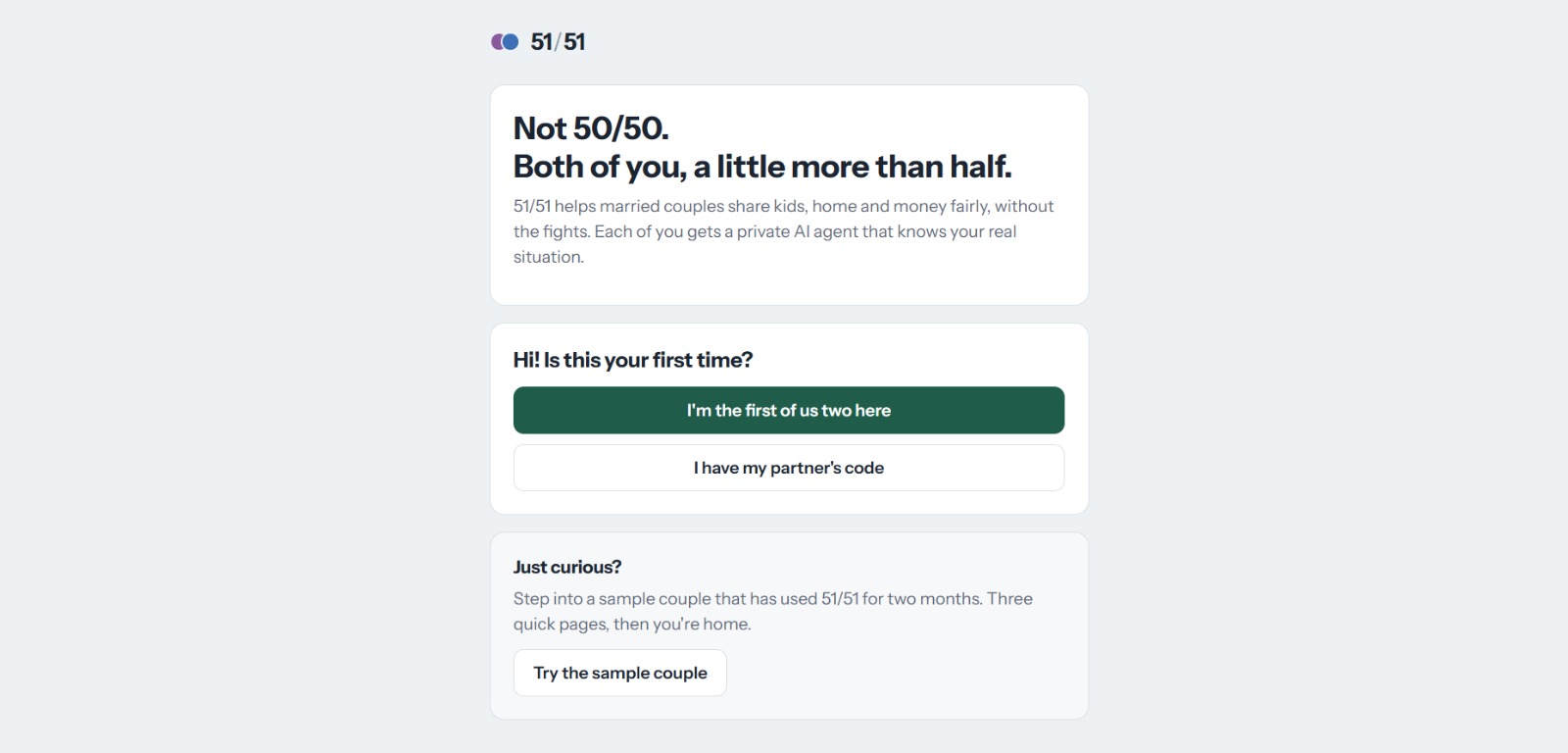
- Sample couple: anyone can try the app instantly with Emily and Ryan, a demo couple with two months of history.
How we built it
I built 51/51 with Claude as my AI coding assistant: I made the product decisions, and Claude helped write the plan and the code. The backend is Python 3.12 with FastAPI and SQLite, and the frontend is plain HTML, CSS and JavaScript, with no framework. The AI is Google Gemini's free tier, used for both text and receipt photos. The app is deployed on Render's free plan and auto-deploys from GitHub. Before any code was written, we put together a scope, a PRD, a technical spec and a build checklist, all in the repo.
Each partner's private agent runs as its own Gemini call, in parallel. Each agent sees only its own person's private answers plus the shared log, and returns a private load rating, a note and personal ideas. A separate mediator call combines both views into the weekly story. Code guards then check the AI's output before anyone sees it:
- The weekly view and messages never show digits or percentages.
- No phrases are copied from anyone's private answers.
- No nudge repeats the complaint.
101 automated checks cover normal use as well as prompt injection, XSS, misbehaving AI responses and privacy leaks.
Challenges we ran into
The hardest rule to enforce was "words, never numbers." Language models love percentages, so instructions in the prompt weren't enough. The app needed a code-level guard that replaces any unsafe sentence with rule-based wording built from the logs. Privacy was just as hard: the mediator needs both sides of the story, but nothing private can ever reach the other partner, so outputs are checked for leaks.
The free tier was another challenge. Gemini often returns "busy" or quota errors, so the app waits, retries, then falls back through several models. If every model is busy, entries are still saved, the last weekly view is shown, and the chat asks you to try again. Without a key, a clearly labelled practice AI runs instead, so the app and the tests work offline.
Accomplishments that we're proud of
I'm proud of shipping a working, deployed app where two private agents and a mediator cooperate without ever leaking one partner's words to the other. The conflict feature turns a complaint into a kind suggestion instead of passing on blame. All 101 checks pass, including prompt-injection and privacy attacks.
I'm also proud that the whole project runs at zero cost, on a free AI tier and free hosting, and that it has a calm, human design ("Fog & Evergreen") after I threw away a first version that looked AI-generated.
What we learned
I learned that a rule that must never break needs a check in code after the AI responds, not just an instruction in the prompt. I also learned how to build reliably on top of free, unpredictable AI services, with retries, fallbacks and a graceful busy state.
Planning first changed how I work. I usually jump straight into building, but starting with a scope and spec made the build faster and kept the product focused. I also saw how much tone comes from small choices: a serif font for the agents' voice, or "A bit more Ryan" instead of a score.
What's next for 51/51
- Real accounts and a database that persists between restarts
- Voice notes for logging
- A shared family calendar and push notifications for nudges
- A mobile app
- A monthly story alongside the weekly one
- A "See the other side" view for the sample couple

Log in or sign up for Devpost to join the conversation.