The Core Idea Behind 4DL
Our starting point is a concept we call 4DL, or Fourth Dimensions Learning.
We want to use AI and digital spaces to create an experience in which people can take meaningful detours while learning and teach and learn together with different people and AI agents.
Through this process, learners discover different pieces of knowledge as individual “points.” They then connect those points into their own “lines” and apply what they have learned to their work and daily lives.
This idea of creating a new kind of learning experience and learning environment is the foundation of this project.
What We Tried to Explore with 4DLseed
Our ultimate goal is to create an environment where people can enter a VR space, or what is commonly described as the metaverse, and learn with a strong sense of immersion.
For this hackathon, we decided to begin by testing that concept as a working 2D environment.
A multi-agent system makes it possible for multiple AI agents to operate at the same time and along parallel timelines.
While I am acting within my own timeline, another digital timeline is also moving. Even in places where I am not directly involved, AI agents may be learning or working on something.
With 4DLseed, we attempted to build that kind of learning environment.
What We Implemented
At the core of the project is an experience in which people interact with GPT-5.6 and other GPT models through Codex App Server.
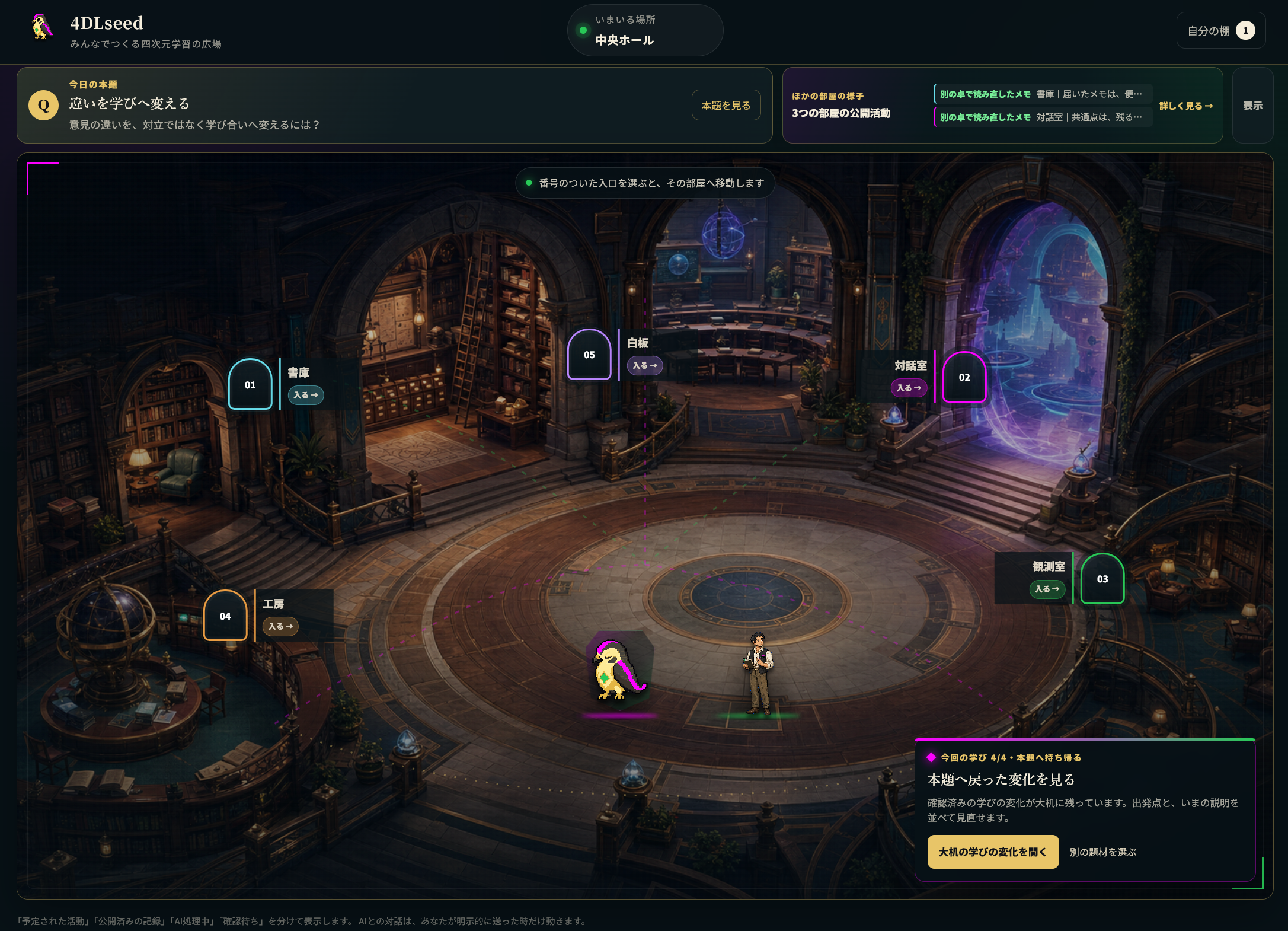
However, rather than keeping all AI interaction inside a single chat interface, we created several rooms and placed different characters inside them.
We also introduced a bird character as the main companion. Learners can move through the environment and between rooms, encounter different perspectives, and gradually deepen their understanding.
Creating every part of the environment as a 3D model was not realistic within the scope of this hackathon. Instead, we used image generation to create the background scenes and placed 2D characters within them.
This approach allowed the concept to become visible as a space with a degree of immersion, while also giving it some of the qualities of a game.
Ideas We Took from MMORPGs
MMORPGs offer a particular kind of game experience.
They contain main quests, side quests, and NPCs. Players move through the world by interacting with different places and characters.
Because I regularly play games myself, I have experienced how games can make people want to keep playing almost without thinking about it. I began to wonder whether some of those qualities could also be applied to learning.
How should a learner cooperate with an NPC? How should the learner’s words affect the NPCs and the direction of the learning experience?
We incorporated these game-inspired ideas into the current system.
Developing the Project with AI
For this project, I used GPT-5.6 Sol with Ultra reasoning. I shared my full concept and requirements, worked with it to refine the plan, and organized those ideas into a specification.
Once the plan and specification had been established, I had it turn them into the final program.
It is already possible to learn through a one-to-one conversation with a generative AI system such as ChatGPT. However, that is fundamentally a one-to-one relationship.
What I wanted to explore was a space where I could speak and participate, while the same timeline continued in other places beyond my direct involvement.
AI agents also exist and act within those other areas. I imagined this as an environment for co-creation between people and AI.
What I Learned by Building It
Experiences in which multiple AI agents operate at the same time are still not common in everyday life.
At the beginning, I could not fully imagine how those agents should be controlled or how a person should become involved.
Once I built a working version, the necessary elements gradually became clearer.
When NPCs exist inside an environment, the UI and UX surrounding how they are presented and how people interact with them become extremely important.
Building the prototype also made me realize the potential importance of giving NPCs enough autonomy and initiative to begin conversations with the learner.
The current experience is mainly initiated by the learner approaching an NPC. However, if an NPC could also speak to the learner, it could create a stronger feeling that both sides are communicating with each other and make the interaction feel more natural.
This is not a feature completed in the current version. It is something I discovered through building the prototype and would like to explore in the future.
Why It Is Called 4DLseed
I named the project 4DLseed because it was created as a “seed” of Fourth Dimensions Learning.
This is not the final form of the idea. It is the first seed from which it can grow.
By running the system several times and reflecting on the experience, we can begin to understand what needs to become clearer and how conversations can be made easier to deepen.
We also want the environment to support a wide range of subjects, from familiar and approachable topics to more difficult and specialized ones.
At present, the questions and learning process are partly fixed so that the prototype can operate reliably. In the future, we will need to support a wider range of subjects and difficulty levels with greater flexibility.
Future Vision
The following sections describe our future vision. They are not features completed in the current prototype.
Multiple People and AI Learning in the Same Space
In the current demo, there is one human learner, while the other participants are represented as NPCs.
In our future vision, multiple people will also be able to enter the environment.
Several people could join the same classroom or learning space. Human-to-human, human-to-AI, and AI-to-AI learning could all take place there.
The roles of teacher and learner could continue to change depending on the moment and the subject, allowing everyone in the same environment to learn with one another.
One reason we chose Codex App Server was not only the capability of the LLM itself, but also its potential to connect with tools and information.
For example, an agent may be able to access information from the internet or work with internal materials before responding.
For that reason, the concept and system were designed around the assumption that generative AI would exist within the environment and participate alongside people.
Expanding into VR and the Metaverse
The current prototype combines generated background images with 2D characters, creating a space that sits somewhere between 2D and 3D.
In the future, we want to expand this into a VR or metaverse-like environment where learners can feel as though they have actually entered the world.
They could move between multiple rooms, meet people and AI agents, and sense that learning activities are taking place elsewhere in the environment.
Time would continue to move not only in the place where the learner is directly involved, but also in other places they may not yet know about.
A World That Changes Through Learning
Learning can be enjoyable and exciting. It can inspire curiosity and create a sense of discovery.
At the same time, depending on how it is presented, learning can also feel boring or difficult to continue.
The current version of 4DLseed is primarily built around dialogue. In the future, we also want continued learning to produce visible changes in the surrounding world.
For example, the main bird character, inspired by a hawk or falcon, could level up or change its appearance as it grows. The building and surrounding environment could also evolve.
As a person continues to talk, learn, teach, and collaborate with AI agents in different ways, changes could occur not only within the learner but also throughout the environment.
By using LLMs and image generation to visualize those changes, we could give learners a clearer sense that they are moving forward.
Developing the Characters and Game Experience
When we adapted the Codex pet feature and placed a character in the environment, the space immediately began to feel more like a game.
Simply placing a character in the space created a small sense that someone was present in the world, rather than leaving the experience as another dialogue interface.
By adding character autonomy, growth, relationships, and changes to the world, we believe the project could develop into an enjoyable learning environment with a stronger sense of immersion and reality.
The Need for Deeper World-Building
As a company, we have already spent time considering and organizing the world we want to create through 4DL and Fourth Dimensions Learning, as well as the things we want to achieve.
However, we had not yet fully defined the world of this particular environment or the background and role of each character.
As a result, some of the parts left to AI became inconsistent in their tone and world-building.
In the future, we want to define the origins of the environment, the roles and backgrounds of its characters, and their relationships with learners more carefully.
By connecting that world-building not only to the visual design but also to the learning system and the behavior of the AI agents, we believe we can develop 4DLseed into a better and more coherent experience.
The 4DLseed prototype created during this hackathon is our first experiment toward that goal—a seed of Fourth Dimensions Learning that we intend to continue growing.
Built With
- codex-app-server
- css
- gpt-5.6
- html
- javascript
- node.js
- typescript
- vitest
