-
-
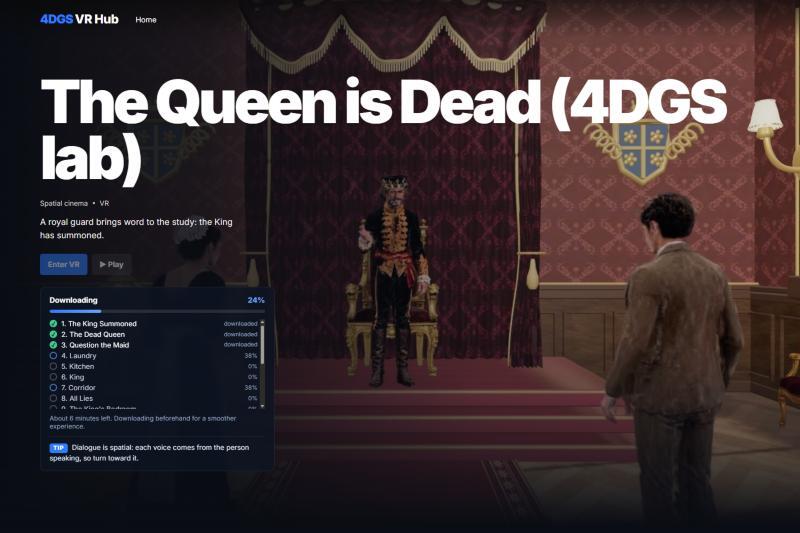
Home Screen
-
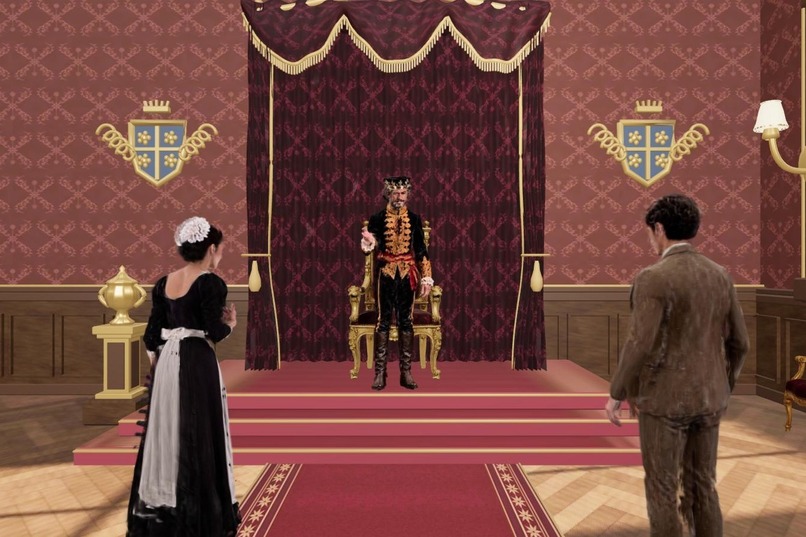
4DGS Characters
-
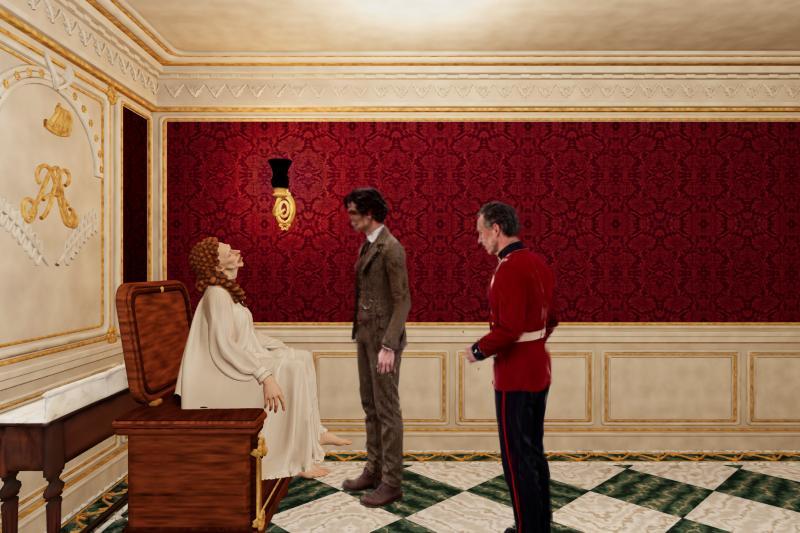
4DGS Characters
-
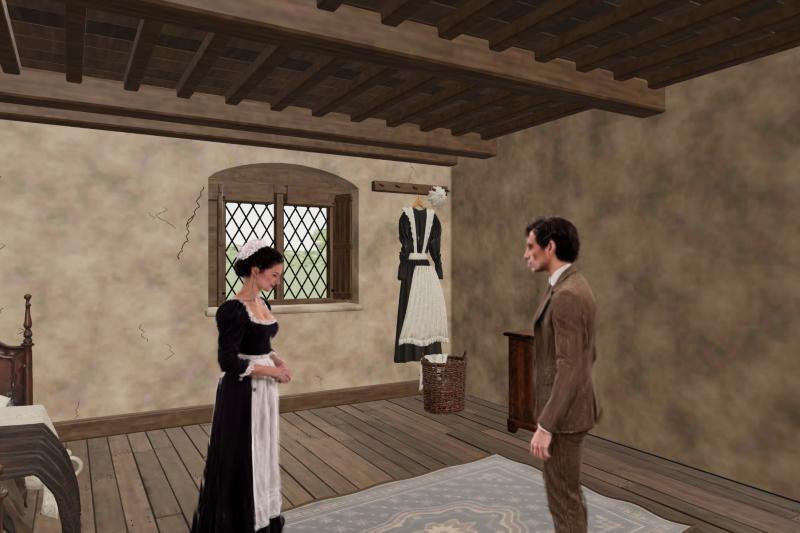
4DGS Characters
-
4DGS Characters
-
4DGS Characters
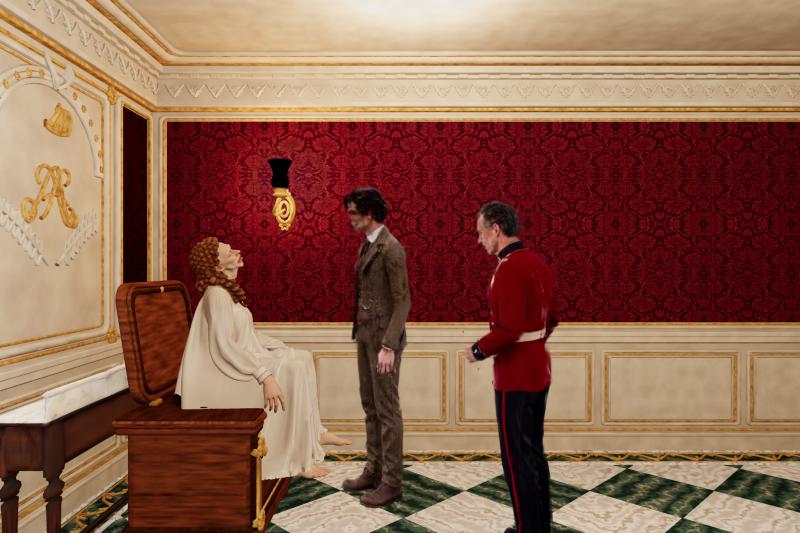
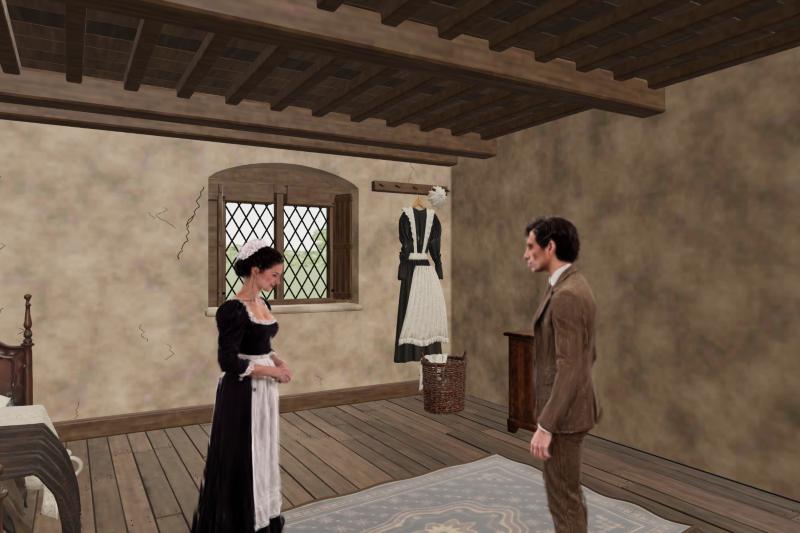
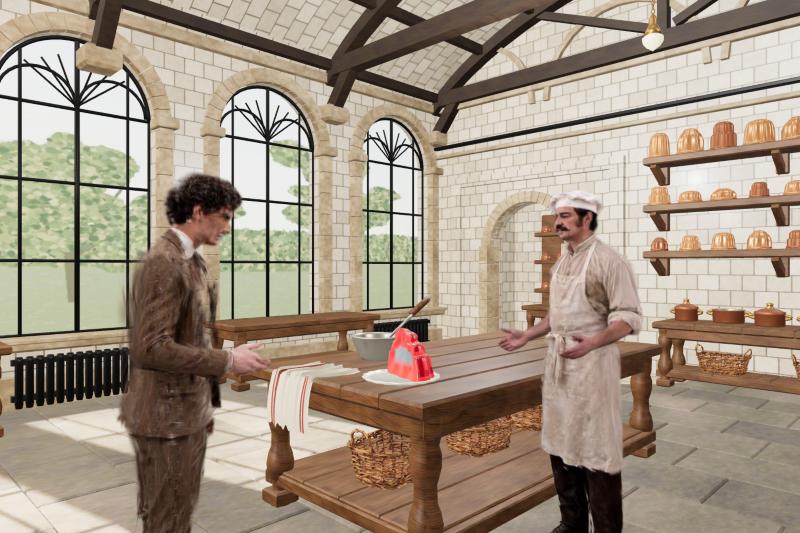
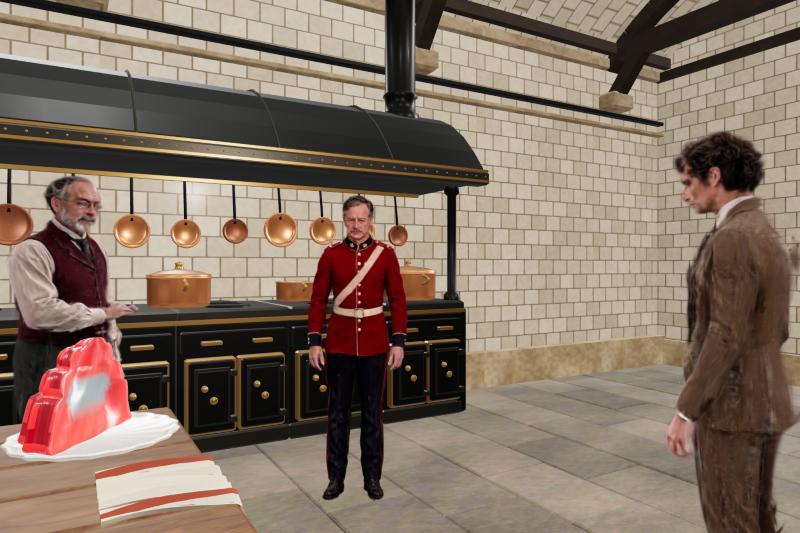
Inspiration
Spatial cinema today usually means one of two things: a flat video floating in front of you, or game-engine characters that never quite feel like people. We wanted a short film you sit inside, performed by real actors, with every glance, fidget and fold of cloth intact.
Recent research turns an ordinary monocular video (one camera, one take) into a 4D Gaussian splat: hundreds of thousands of tiny 3D blobs that move over time. If one video of an actor can become a living 3D performer, a whole cast can be filmed cheaply and placed in a virtual set. We wanted to know if that could play, as a story, on a standalone Quest in the browser.
What it does
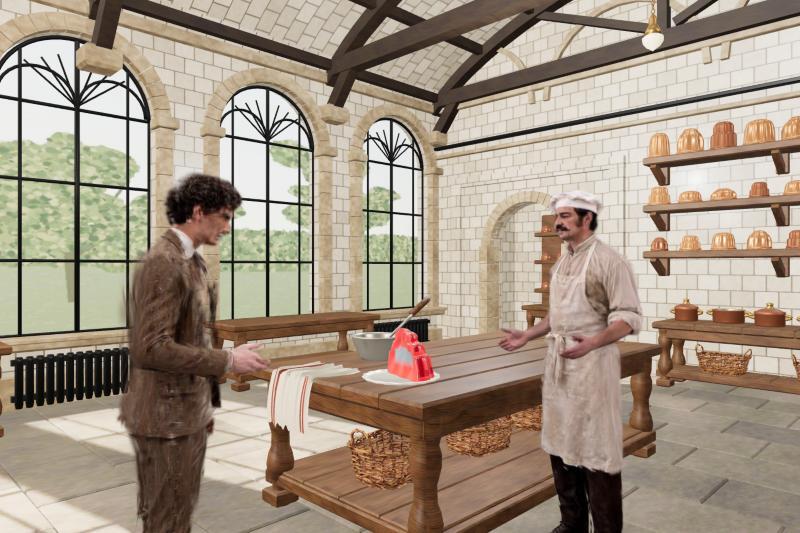
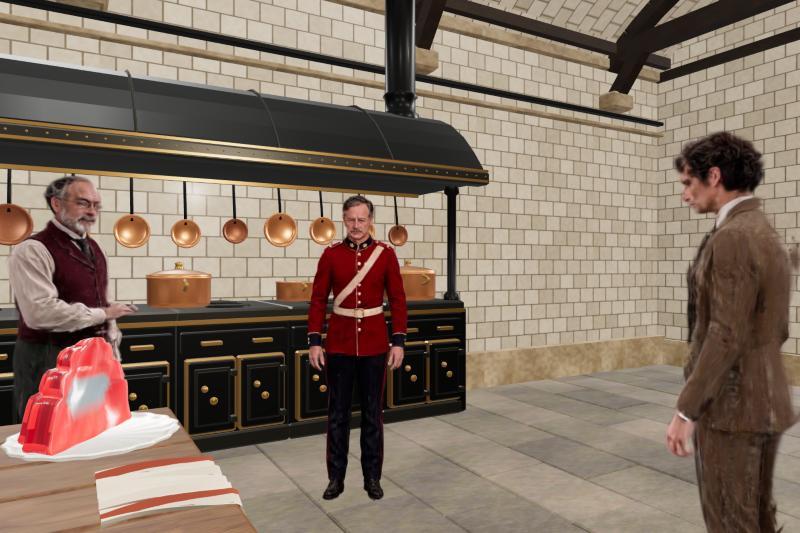
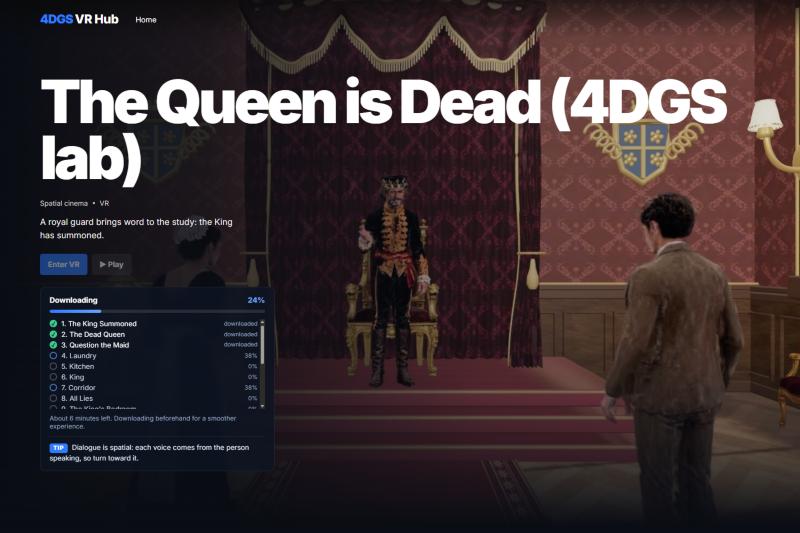
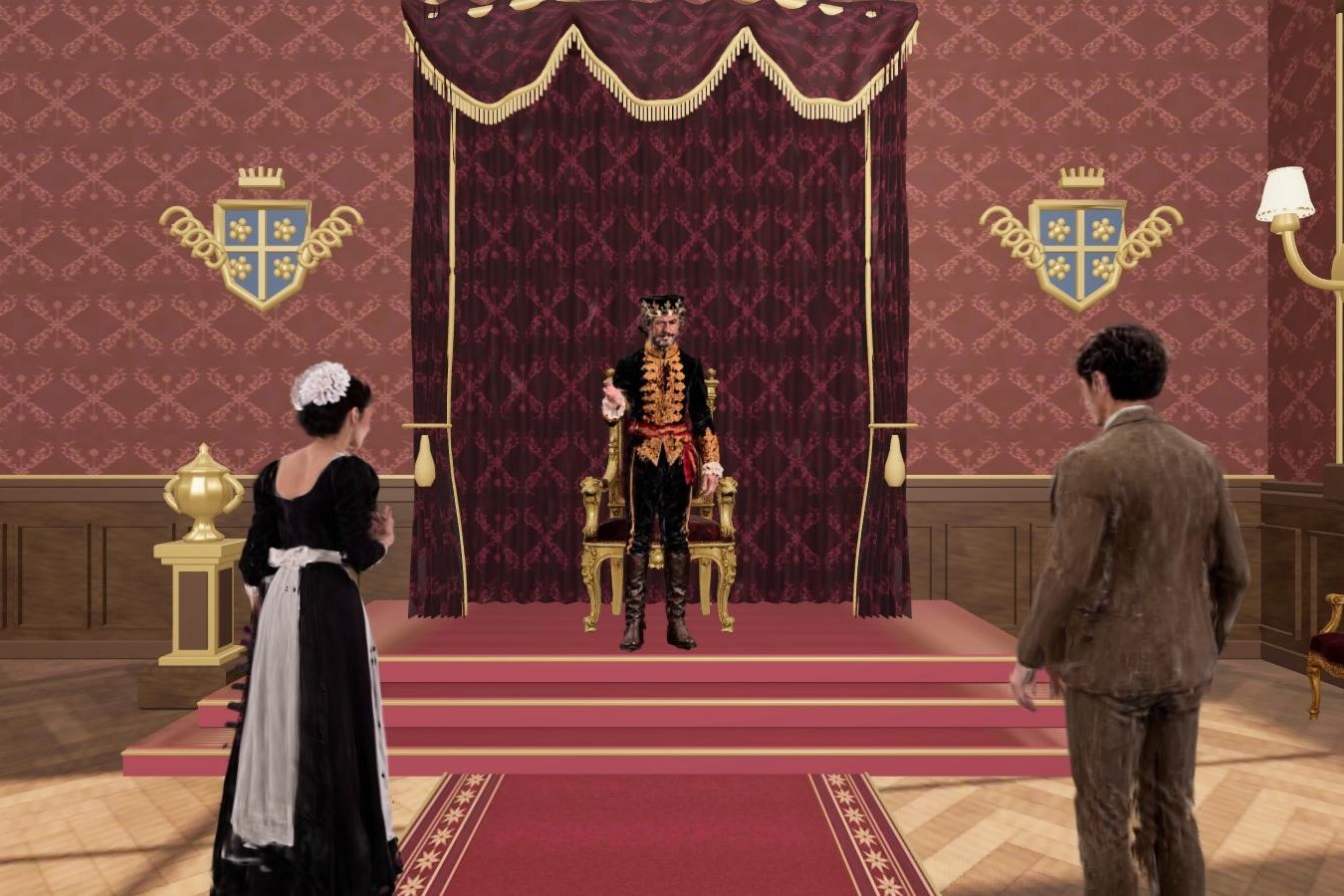
4DGS VR Hub plays The Queen is Dead, a Victorian murder mystery in 17 short scenes, performed entirely by real actors captured from monocular video as 4D Gaussian splats.
- A detective is summoned to the palace, the Queen is found dead, the maid, laundry woman and cook are questioned, the poisoned jelly is tested, and it ends in a confrontation in the throne room.
- You watch from inside the room, with spatial dialogue coming from each speaker's mouth.
- Step inside any performer and watch the scene through their eyes.
- Hands-first: turn your left palm toward your face for playback controls (Play/Pause, Replay, Teleport, Exit VR) and press them with your right index finger. Pointing rays stay off while you watch, so nothing interrupts the story. Touch Teleport for one deliberate pinch: move to a new spot, or step inside a performer.
How we built it
Capture. Each actor is filmed with one camera, and 4DAnyone turns the video into a 4D Gaussian splat. Each splat is a 4D Gaussian conditioned on time $t$: at any moment it is a 3D Gaussian whose centre moves and whose opacity fades in and out:
$$ \mu(t) = \mu_{xyz} + \frac{\Sigma_{xt}}{\Sigma_{tt}}(t - \mu_t), \qquad \alpha(t) = \alpha\,\exp!\left(-\tfrac{1}{2}\frac{(t-\mu_t)^2}{\Sigma_{tt}}\right), \qquad \Sigma_{3D} = \Sigma_{xx} - \frac{\Sigma_{xt}\Sigma_{tx}}{\Sigma_{tt}} $$
Authoring. Our own editor, 4DGS Studio, places performers in scenes, times them and their dialogue on a timeline.
Playback. A WebXR app on Meta's Immersive Web SDK and three.js, hosted as a static site on Cloudflare Pages.
- Each performance is pre-decoded into a ready-to-draw file, so the headset reads it with no extra CPU load.
- One Web Worker per performer depth-sorts its live splats every frame with a linear-time 16-bit bucket sort, off the main thread; hidden performers do no work.
- Splat data streams into the GPU about 1.5 MB per frame, so neither playback nor cuts stall.
- A service worker keeps every file on the headset; scenes download strictly in story order.
Challenges we ran into
- Decoding speed: one scene took 154 s to get ready on Quest. An allocation-free decoder with half-float lookup tables was 1.8× faster with 40% less memory and identical output. Pre-decoding on the server then cut loading from 2.5 s to 0.4 s per performance.
- Main-thread stalls: sorting up to 125,000 visible splats per performer froze the picture until each performer got its own worker.
- Upload hitches: a single 64 MB texture upload could stall a frame for half a second, so we stream textures in slices instead.
- Wi-Fi: we measured 5 to 7 MB/s to the headset. A speed test built into the page showed gzip transfer is 2 to 3× faster than raw on the Quest.
- Hosting limits: static hosts cap files at 25 MB, so large files ship in 20 MB pieces that the headset joins and unzips as they stream in.
Accomplishments that we're proud of
- Real performers captured from a single ordinary video each, playing as a 17-scene story on a standalone Quest, in the browser, from just a link.
- Stepping inside a splat performer and seeing through their eyes, with no skeleton to work from.
- A fully hands-first experience that ignores your hands until you ask, which suits lean-back viewing.
- Pre-decoding performances so loading takes about a sixth of the time (2.5 s down to 0.4 s per performance), with bit-for-bit identical splats.
- Our own end-to-end pipeline: capture, editor, runtime and hosting.
What we learned
- On standalone VR, the network and the main thread matter more than the GPU: most of our wins came from moving work off the critical path.
What's next for 4DGS VR Hub
- Branching investigations: choose whom to question and follow your own lead.
- More cases shot with the same one-camera pipeline.
- Watching together: friends each inside a different performer, comparing what they saw.
- Lighter files and faster first visits, so the show starts sooner on slow connections.
- Your own captures: film yourself on a phone and drop into the scene.


