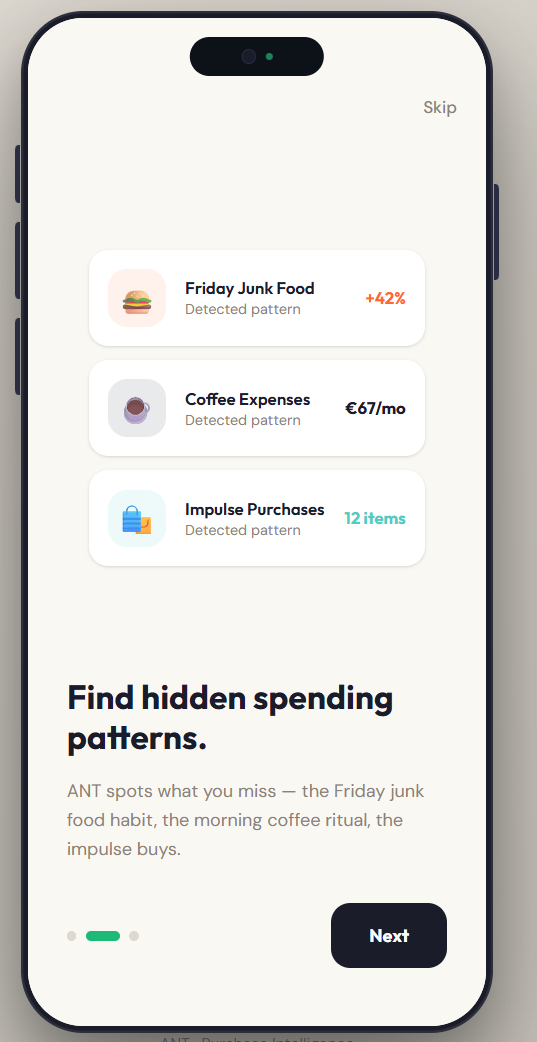
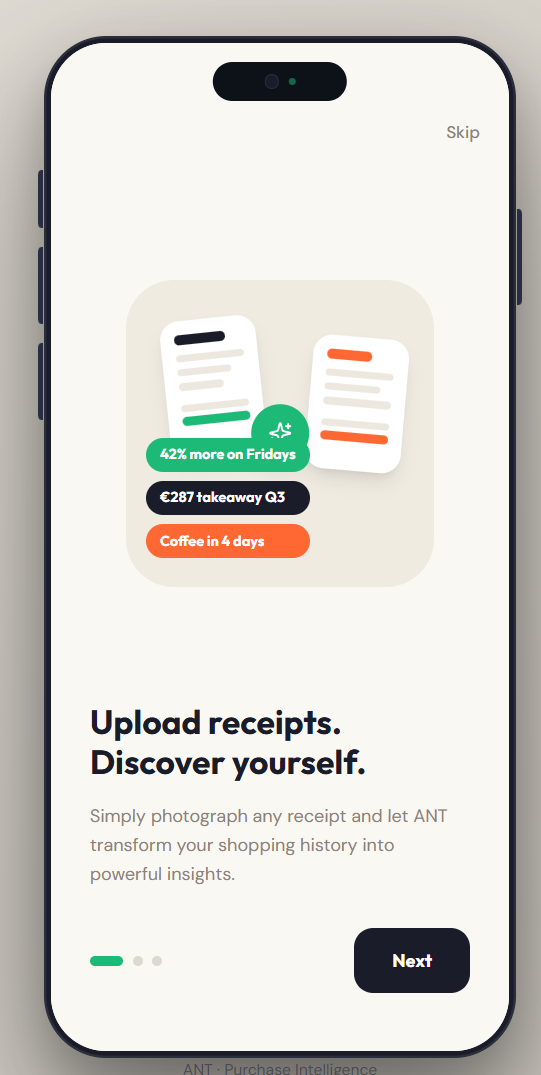
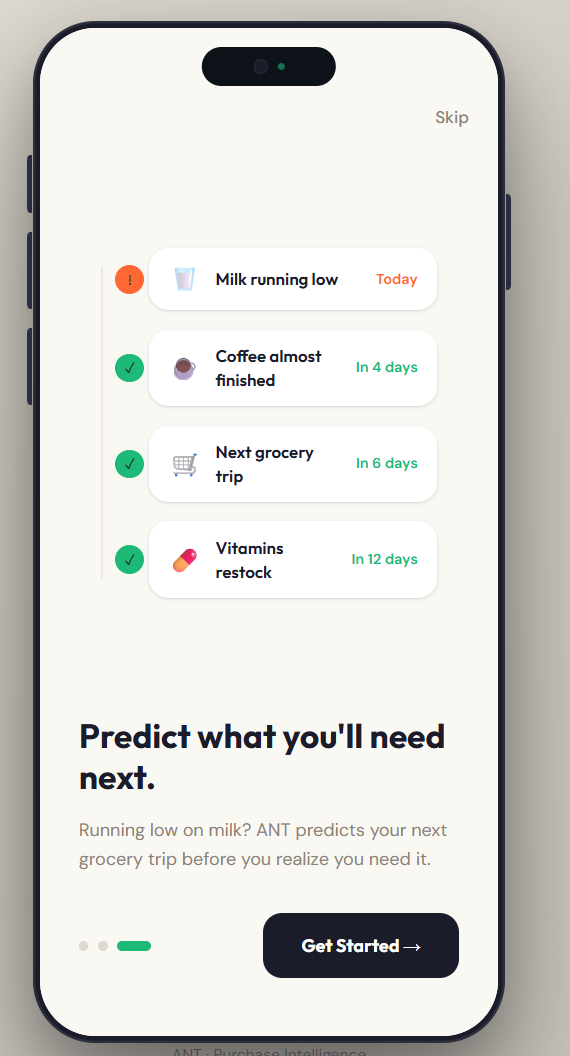
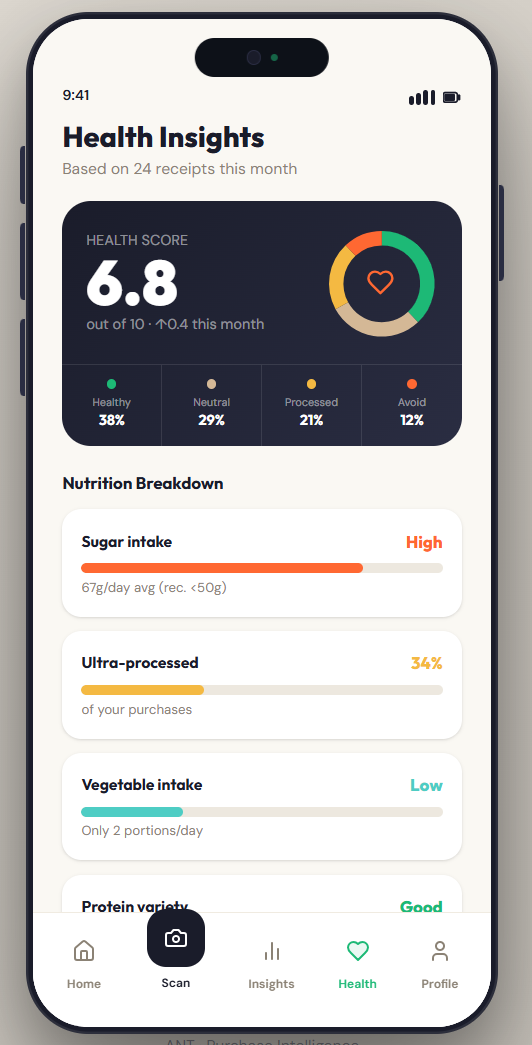
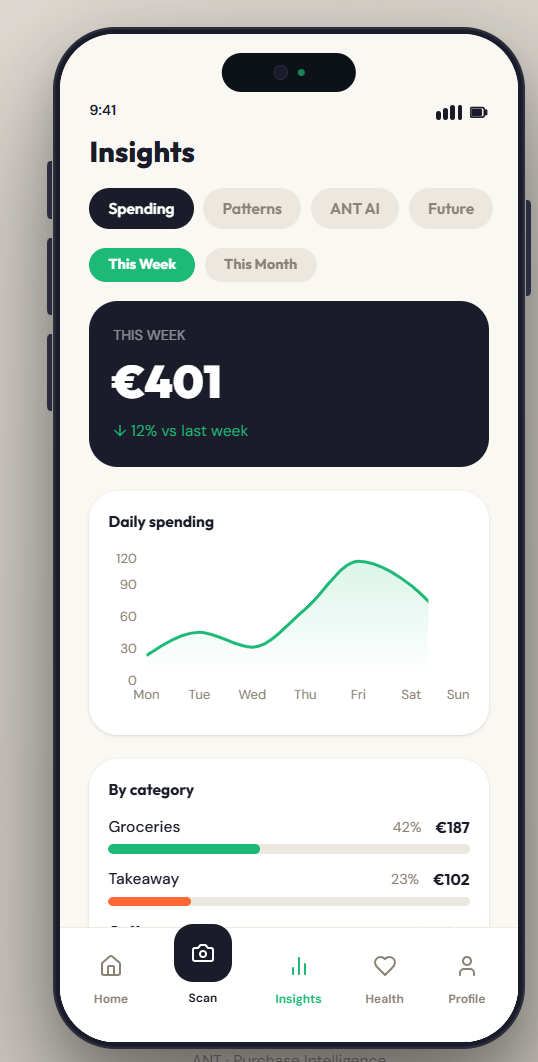
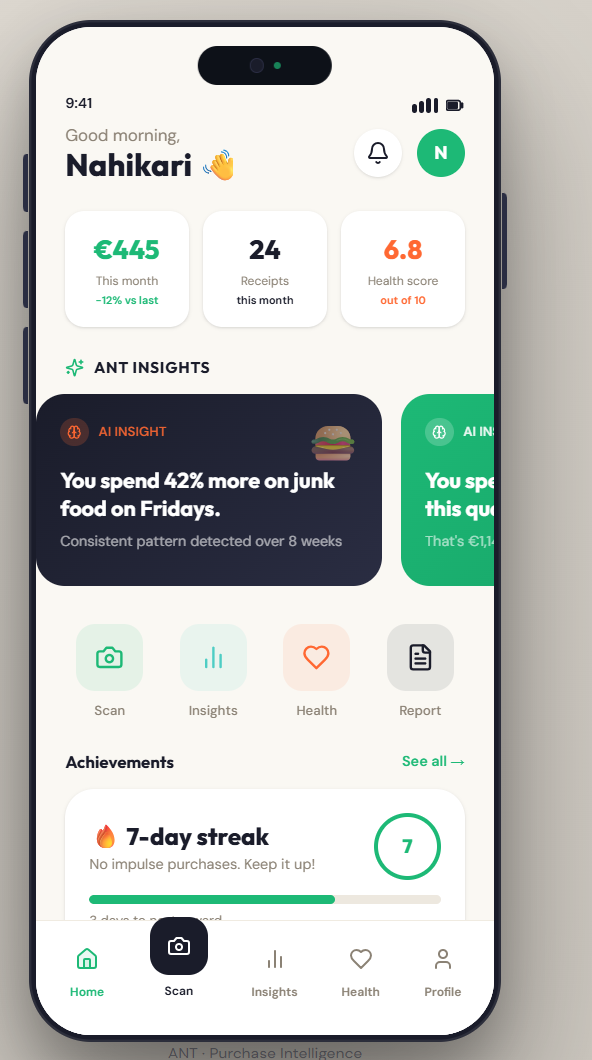
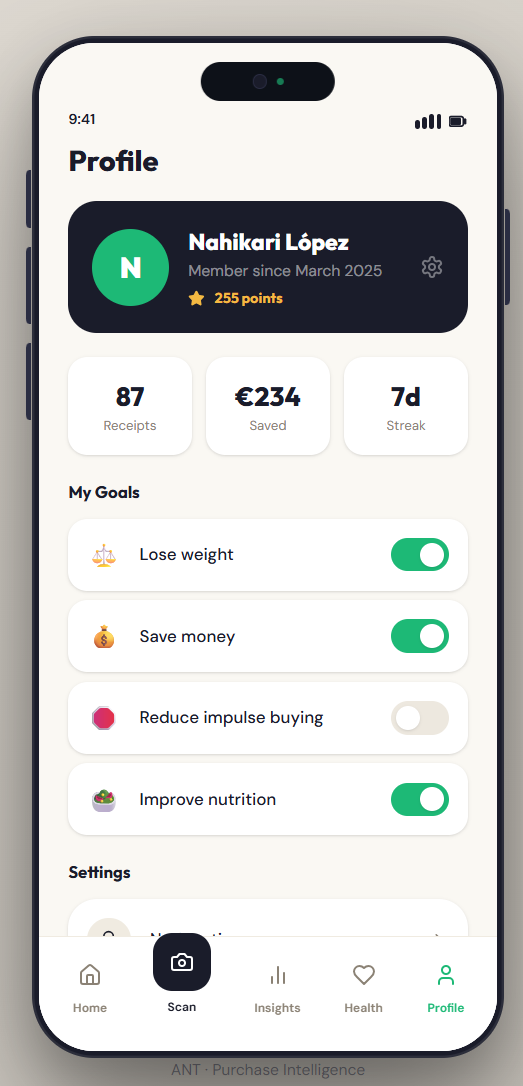
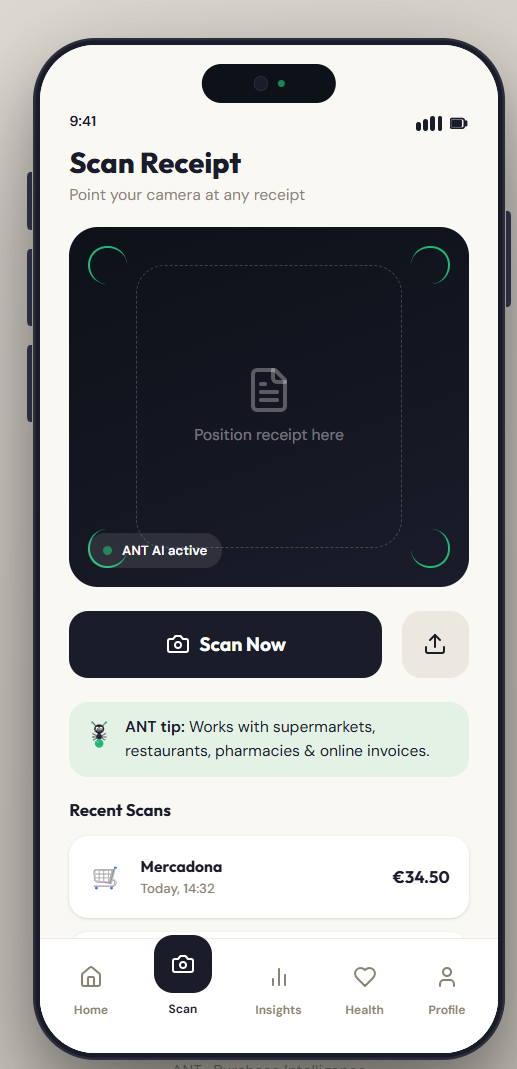
Inspiration Most spending does not feel like a decision. It feels like a coffee between meetings, a snack on Friday, or one more item placed in the basket. Each purchase is small enough to disappear from memory. Over time, though, those moments can become a pattern: money people did not realize they were spending, products that do not support the habits they want to build, and recurring purchases they only notice when they run out. ANT was born from a simple belief: People should not need perfect memory or a spreadsheet habit to understand their everyday purchases. We wanted to create something more human than a budgeting dashboard. Not an app that judges people for what they buy, but one that helps them see their own reality clearly, with evidence. What it does ANT is a mobile purchase-intelligence companion. Users scan receipts, review the extracted items, and receive clear discoveries based on confirmed purchase data. ANT can surface patterns such as: “Your Friday snack spending is 42% higher than other days.” “Coffee appeared in 47 purchases this quarter.” “Vegetables appeared in 2 of your last 8 receipts.” “You may need these recurring products this week.” Every meaningful insight can open an evidence screen showing the receipts, dates, amounts, period analysed, and calculation behind it. Users can then create a practical goal, save the discovery, mark it as incorrect, or inspect the receipts used. ANT deliberately separates what it knows from what it cannot know. A receipt can show that a sugary product was purchased; it cannot prove who consumed it, how much they ate, or whether it was shared. That distinction is central to the product. How we built it We built ANT as a native Android application with Kotlin and Jetpack Compose, while structuring its domain layer for progressive Kotlin Multiplatform sharing with iOS. The app includes receipt scanning and review, local persistence with Room, evidence-backed insights, recurring-need predictions, goals, privacy controls, accessibility support, and a complete mobile navigation flow. For production receipt extraction, ANT includes a backend integration designed around OpenAI’s GPT-5.6. The model is configured to turn receipt information into structured, reviewable data; the mobile experience never treats AI output as unquestionable truth. Users see and can correct extracted items before ANT creates discoveries from them. Codex was part of the build process throughout: helping us shape the architecture, implement the Android experience, strengthen testing, document the product boundaries, and refine the language so ANT feels useful rather than moralising. Challenges we ran into The hardest challenge was not building charts or extracting receipt lines. It was deciding what ANT should not claim. It would have been easy to say “your sugar intake is high” or “you need to lose weight.” But receipts are not a record of consumption, health, or personal worth. They are records of purchases. So we redesigned the product around careful language: “estimated sugar purchased,” “products appearing in recent receipts,” and evidence that users can inspect themselves. This made the app more rigorous, more trustworthy, and more respectful. We also faced the challenge of making financial information feel approachable. Traditional dashboards can make people feel guilty or overwhelmed. ANT uses short discoveries, practical actions, and a warm mobile interface to turn “I should probably pay attention” into “now I understand what I can do next.” Accomplishments that we're proud of We are proud that ANT does not hide behind AI language. Instead of presenting a vague conclusion, it shows its work. An insight is not just a claim; it is a trail back to the receipts and numbers that produced it. We are also proud of the product’s tone. ANT is built to support people who are trying to save money, reduce impulse buying, shop more intentionally, or make food choices that better match their goals—without shame. Finally, we built a functional Android demo that judges can install and explore, with a public repository, reproducible build documentation, automated tests, and a downloadable release. What we learned We learned that the most valuable insight is often not a complicated prediction. Sometimes it is simply making the invisible visible. People do not always need to be told what to do. They need an honest, understandable picture of what is already happening—then the freedom to decide what small change feels possible. We also learned that trustworthy AI is as much about restraint as capability. Knowing the limits of the data is not a weakness. It is what makes a product worthy of trust. What's next for ANT Next, we want to connect ANT to a production OCR and AI extraction service, expand testing across more receipt formats and languages, and add encrypted account synchronisation for people using multiple devices. Longer term, ANT can become a private purchase-memory layer for everyday life: Helping households notice recurring costs. Making goals feel concrete through real purchase evidence. Identifying small patterns before they become financial stress. Supporting healthier shopping intentions without pretending to be a medical app. Giving people a calmer, clearer relationship with what they buy. Our vision is simple: Not another budgeting app that tells people to spend less. A companion that helps them finally see where everyday life is taking them.
Ant
ANT turns everyday receipts into clear, evidence-backed insights—helping people notice spending patterns, make healthier choices, and take small actions that add up.
Updates

Leave feedback in the comments!
Log in or sign up for Devpost to join the conversation.