-
-
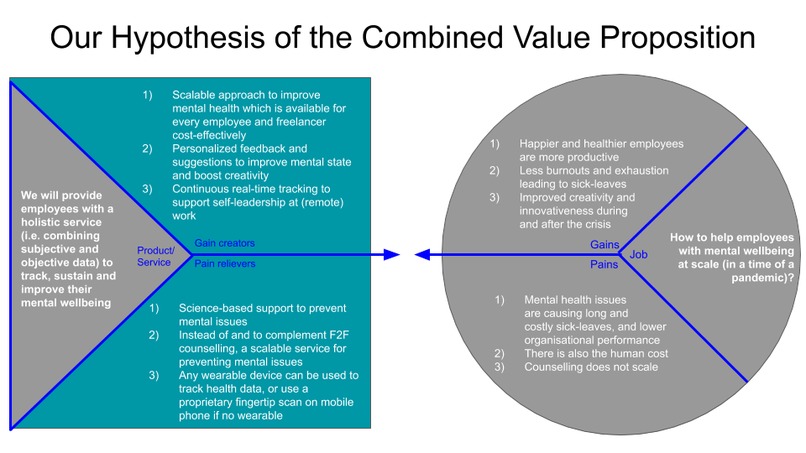
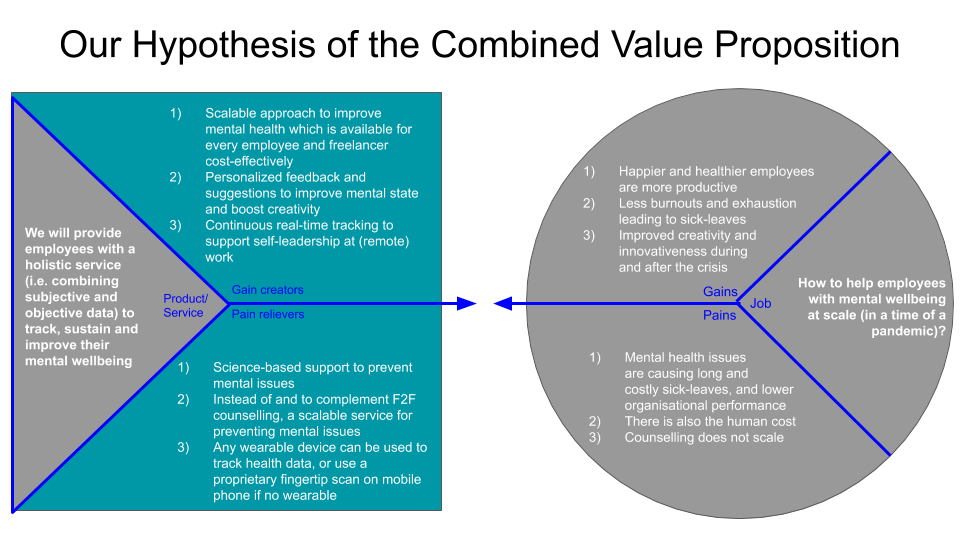
Combined Value Proposition
-
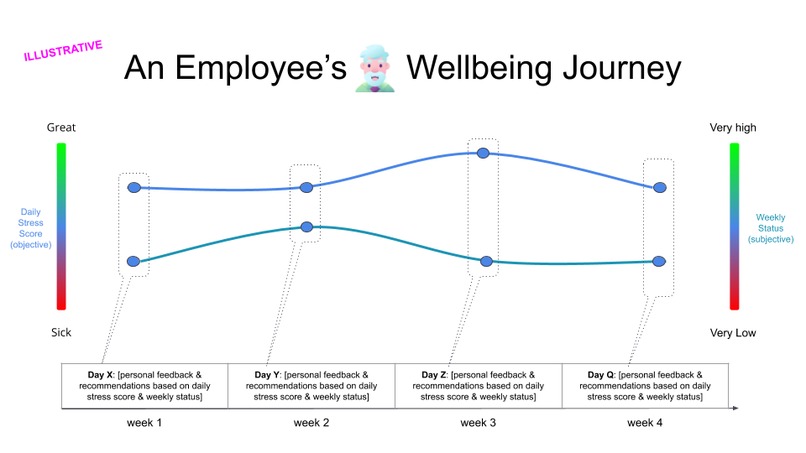
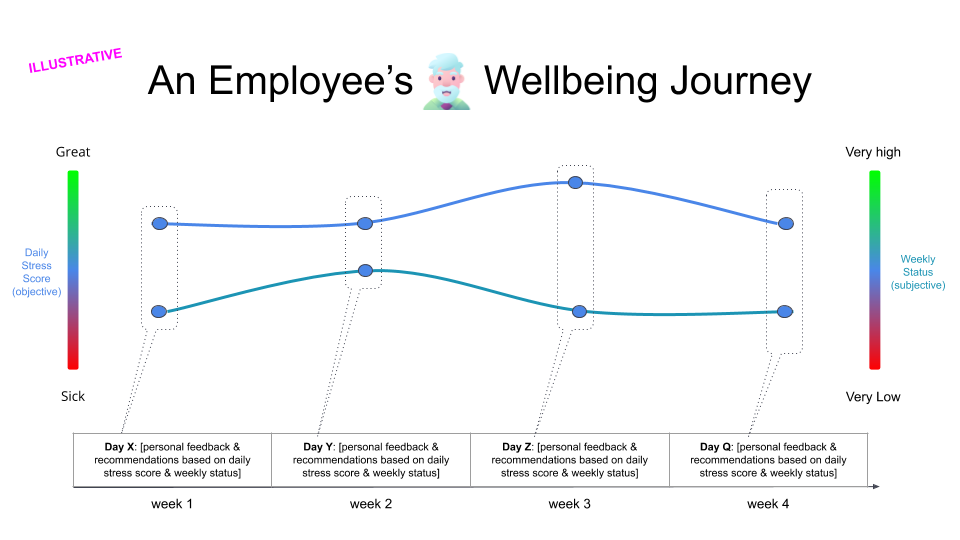
An Employee's Wellbeing Journey
-

Healthzilla logo
-
Emooter logo

Descriptions of team members
Emooter; Teemu Jäntti and Dani Pärnänen are mental health professionals on a journey to build better tools for people and organizations so that they can take care of their well-being at work better.
Healthzilla; Laura Ranin, Tommi Ryyppö, Aki Ranin, and Niko Ratala are health and wellbeing geeks who have come together around a shared purpose of making healthy living easier and more approachable to all people.
The initial idea and why you wanted to build it
The initial idea is a preventive, real-time, science-based approach to employee wellbeing combining subjective and objective metrics on an individual level. Subjective perception of (mental) wellbeing is measured through a mobile pulse survey whereas objective metrics are derived from wearable devices such as Apple Watch, Oura ring, and Fitbit bracelets. In case of no wearable, the individual can also use the proprietary fingertip scan technology to measure and track her recovery and stress levels. Based on the individuals’ data she is given highly personalised feedback and recommendations to sustain and improve her overall wellbeing.
Why? The 4th industrial revolution is underway and people need new tools to help them monitor and improve their wellbeing at work. Burn-out, bore-out and disengagement are increasingly relevant issues in work life. In the future of work, we will see more and more people working in networks and ecosystems as freelancers or solopreneurs. The same mental and wellbeing challenges apply also to freelancers.
There is a well-researched increase globally in (mental) health issues relating to these phenomena. This is why more emphasis and investment on wellbeing is required from both organizations and workers themselves. To do this, they need to have modern and simple tools to track and improve their physiological and psychological wellbeing.
This issue is especially current given the COVID-19 pandemic and its effects on people and organisations. The issue has been extensively researched also in previous pandemics such as Sars, H1N1, and others. Focus on (mental) wellbeing will be the key to survive the aftermath of the pandemic crisis. We believe that combining our strengths and services we can help employees, freelancers and employers to get through the corona crisis better and faster, and with less long sick-leaves or other (mental) health issues.
What the product does and which problem it solves
The problem with existing, reactive measures to (mental) wellbeing at work is that they do not provide sufficient and preventive support for the individual and thus can also lead to weakened performance for the employer in the long-term. Our product offers a concrete and measurable approach for individuals and organisations who wish to take preventive measures to sustain and improve their (mental) wellbeing and performance.
In practice, our product provides individuals with daily or weekly measurement of their (mental) wellbeing by utilising an online survey and biometric and behavioural data from their wearable device. Based on the real-time subjective and objective data (weekly and daily, respectively) the employee is given science-based feedback and recommendations to sustain and improve their (mental) wellbeing. For the employer, on the other hand, the product offers an aggregate view and trends of the wellbeing of the employees in the form of a dashboard. Since we let employees themselves track their wellbeing continuously they become aware of the impact on the changes they have done based on our recommendations to their improved wellbeing.
Our product is available in English and needed languages can be easily added. Both existing services are built directly for global markets and thus are scalable. In terms of wearables the service is device-agnostic and -independent due to the proprietary fingertip scan technology. The combined service can be accessed via mobile phones and is built with modern tech stacks to ensure smooth development and an excellent user experience. The mobile (app) use also enables collecting and incorporating feedback from end users easily.
How you built it and with what tech stack, tools, APIs
Vue, node.js, and MongoDB have been used to develop the Emooter web app (PWA) whereas Android, iOS, React Native, Python, and Heroku have been used to develop the Healthzilla app.
What were the biggest challenges while building it?
Combining and integrating two previously separate services into a coherent, user-friendly and value-creating offering for potential customers by means of service design without the involvement of real customers. During the HR Hackathon online we also have identified technological bottlenecks and possibilities to define and build the joint offering.
How did you solve them?
We created hypotheses about the wants and needs of our prospective customers which we aim to validate with real customers after the hackathon.
What are you proud of about this product
We believe it will bring novel value to our customers by combining real-time subjective and objective data about employee (mental) wellbeing and thus provide a preventive approach to tackle some of the most pressing issues of the current workplace.
What are the next steps for the product after the HR Hackathon online?
Discuss with HR experts and directors our joint offering to get feedback on how it would work in the real corporate and business environment. Also to get feedback from (end) users on how they feel about our joint product after the initial trial period and if it is easy and simple enough for them to use. We are also committed to conducting a research on the actual impact on the wellbeing and performance of our future customers with relevant partners.
What are the necessary resources and plan to implement the product
A handful of customers and/or partners who are willing to invest in the Proof-of-Concept phase validating the employee and employer impact of our joint offering. Total investment to build the joint offering is estimated to be between 30-60 k€.



Log in or sign up for Devpost to join the conversation.