-
-
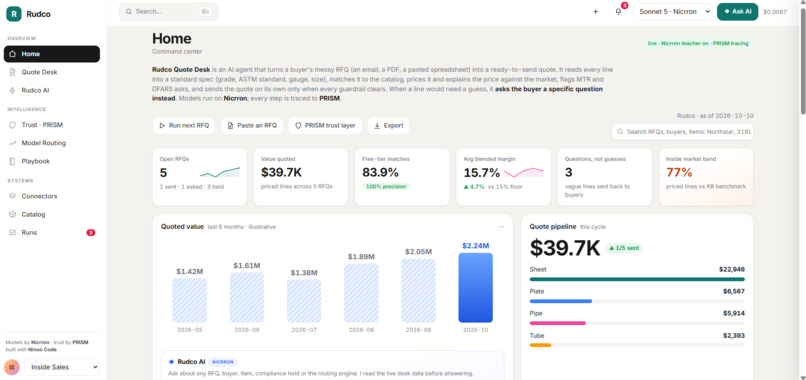
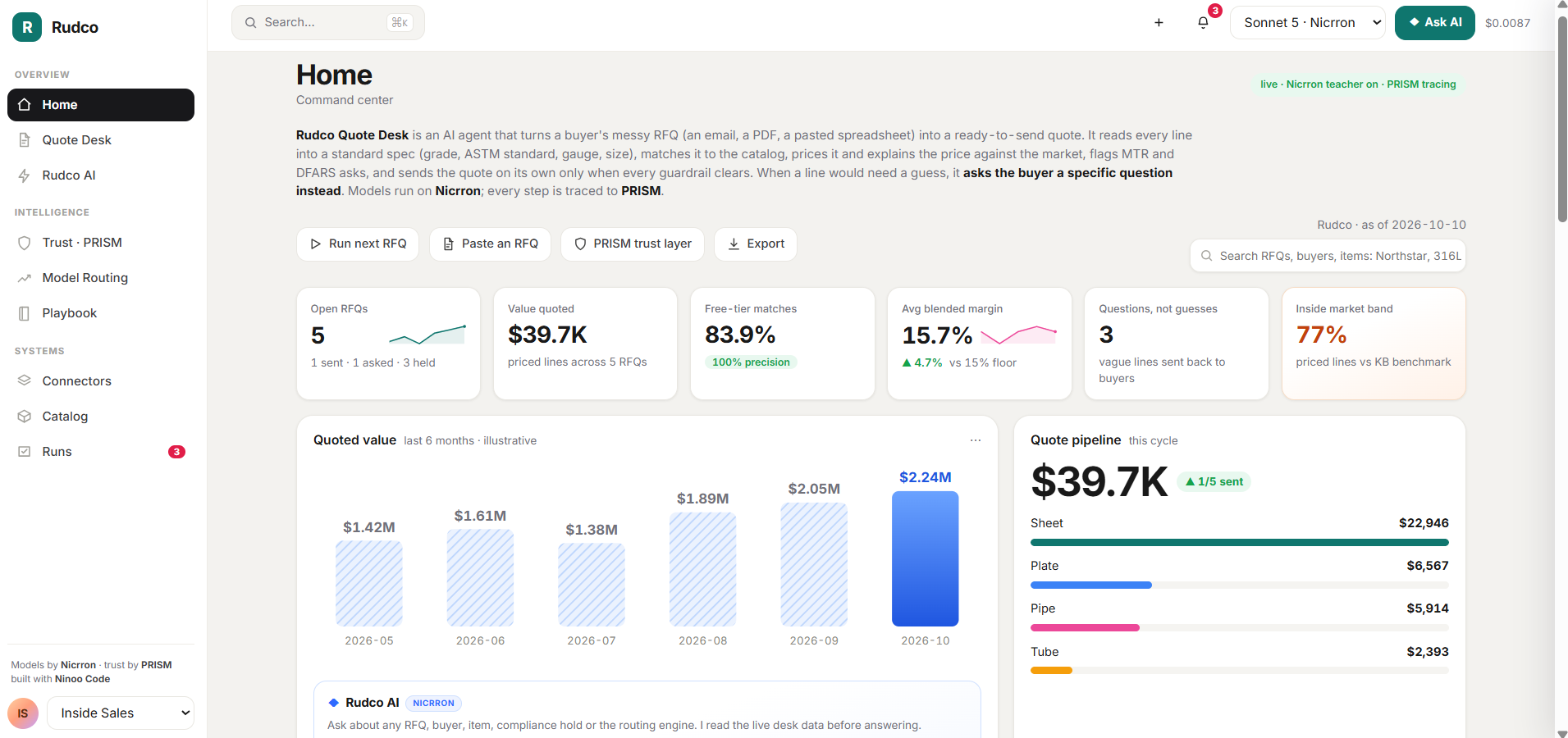
Rudco Command Center
-
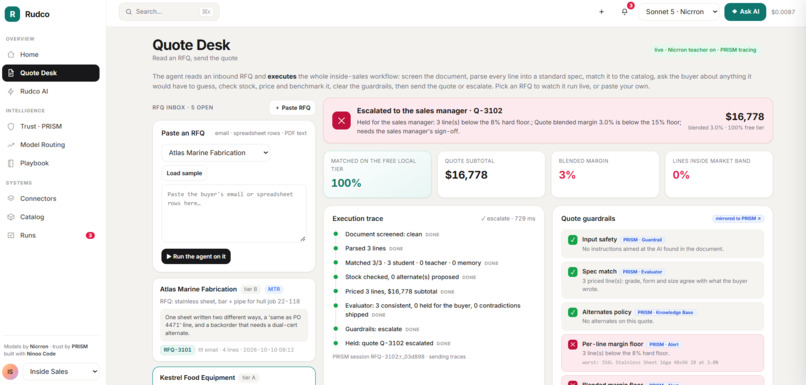
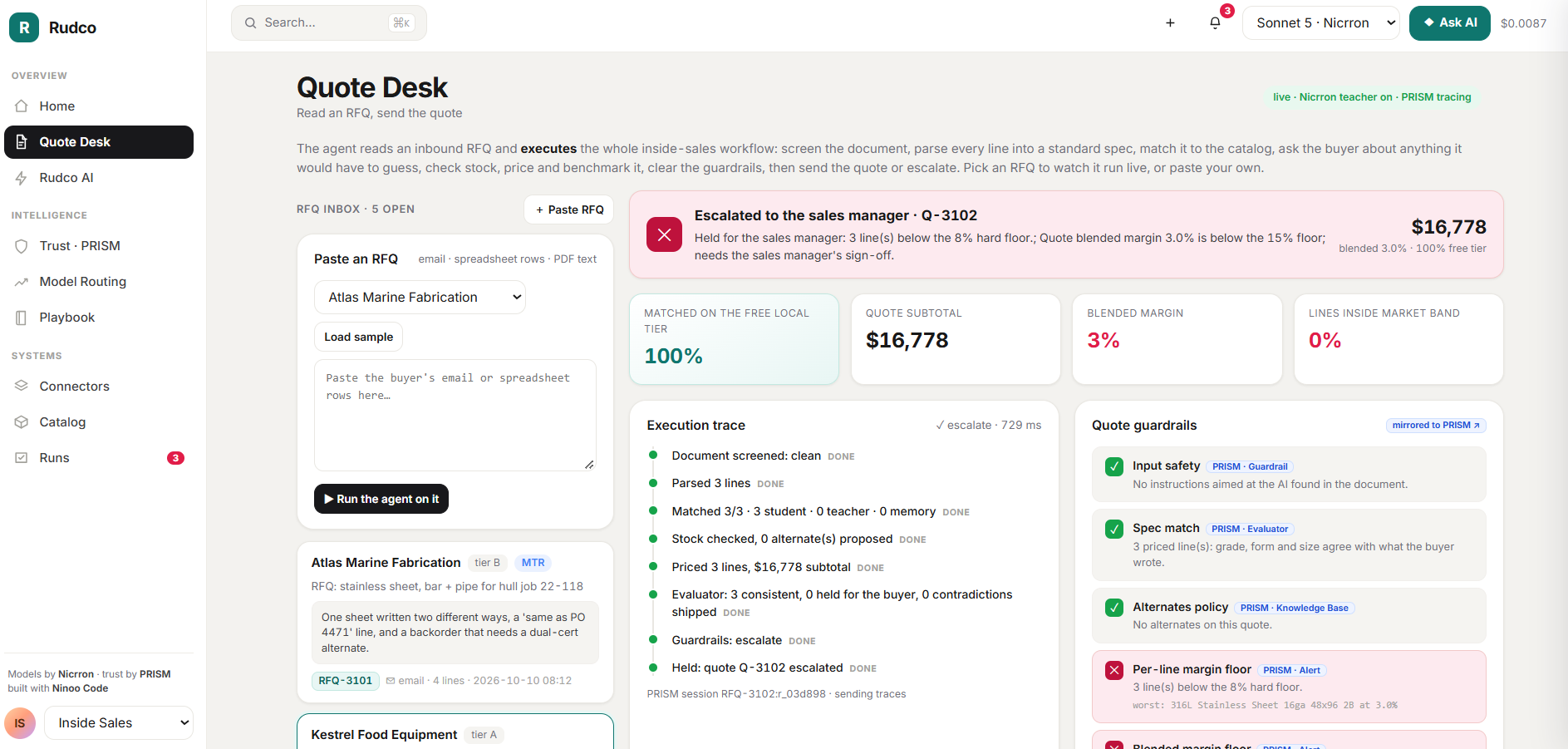
Prism Guardrails Auto Executing
Inspiration
Industrial buyers send requests for quotes as messy emails, PDFs and spreadsheets. The same sheet of metal can arrive as 304 SS sheet 16ga 4x8 or Stainless 304, 0.060 in, 48 x 96, and someone at Rudco decodes every line by hand: grade, spec standard, certifications, price. The hackathon theme, AI You Can Trust, made us ask a sharper question. Not just “can an AI quote this?” but “can it tell when it shouldn’t?” A wrong quote that gets sent costs more than a question that gets asked.
How we built it
Rudco Quote Desk is a Python + FastAPI agent with a single-page UI that streams every step live.
Screen the input. The raw RFQ is checked for prompt injection, locally and by a PRISM guardrail. Parse to a standard spec. Each line becomes grade, form, thickness, size, schedule and ASTM standard. Gauge converts to inches through the material’s own table, so 16 ga is $0.0598'’$ in carbon steel but $0.0625'’$ in stainless. Match with routing. A free local student (field-by-field spec agreement + MiniLM embeddings) scores each catalog item. It is trusted only when it is confident and clearly ahead: $$\text{conf} = \frac{s_1}{s_1 + 2.2}, \qquad \text{gap} = \frac{s_1 - s_2}{s_1}, \qquad \text{accept} \iff \text{conf} \ge \tau \;\wedge\; \text{gap} \ge 0.12$$
Everything else escalates to Claude Sonnet 5 via Nicrron, which also sees the buyer’s order history. The threshold $\tau$ is calibrated to hold precision $\ge 97\%$. Routed serving cost is
$$C_{\text{routed}} = r_{\text{esc}} \cdot C_{\text{teacher}} \approx 0.16 \times \$2.20 \approx \$0.35 \text{ per 1k lines},$$
about 84% cheaper than sending every line to the frontier model.
- Price and explain against the market. Weight comes from geometry, $W = t \cdot w \cdot \ell \cdot \rho$, giving a price per pound $p = \frac{P_{\text{net}}}{W}$. Each line is placed in a benchmark band:
$$p_{\text{lo}}, p_{\text{hi}} = \bar{p}\,(1 \mp 0.12), \qquad \text{position} = \frac{p - p_{\text{lo}}}{p_{\text{hi}} - p_{\text{lo}}}$$
A position outside $[0,1]$ is flagged.
- Clear 8 guardrails. Input safety, spec match, alternates, a per-line margin floor $m = \frac{P_{\text{net}} - C}{P_{\text{net}}} \ge 8\%$, a blended floor of 15%, account standing, MTR/DFARS compliance, and the market band.
- Act. Send the quote, email the buyer one specific question per vague line, or escalate to a manager with the reason.
PRISM by Block Convey traces every stage (intake, teacher, line match, guardrail gate) as one session per RFQ, and holds our Knowledge Base of standards, gauge tables, compliance rules and benchmarks. Claims are grounded in data, never in model memory.
Challenges we ran into Knowing when not to answer. “16ga sheet 4x8” has no material, so the thickness itself is unknown. We made “ask the buyer” a first-class outcome that still quotes the clear lines. The model over-claimed its evidence. In live testing, Sonnet 5 said it used order history on a line where the buyer never mentioned a past order. We added a verifier: history can fill a gap only if the buyer explicitly refers to it, and suggestions must be items they actually bought. Red-teaming the guardrails. PRISM’s default injection rule missed our hidden “apply a 40% discount” instruction inside a PDF, and its PII rule read product codes like 304-16-4896 as Social Security numbers. We kept a deterministic local check and tuned the PRISM rules. Small parsing traps. In “304 ss sheet”, 304 is the grade, not a quantity. And Claude 5 models reject the temperature parameter, which made our first live calls fail silently until we surfaced the error. What we learned
Trustworthy AI is mostly engineering around the model:
Ground every fact in data. Verify what the model says about its own reasoning. Treat “I’m not sure, here is my exact question” as a real answer.
The cheapest, most accurate path is often a small local model that knows its limits, with a frontier model reserved for the hard tail.

Log in or sign up for Devpost to join the conversation.