-

Identify and archive authentic records alone or among others, before impermanence erases them and the rest of the internet forever.
-
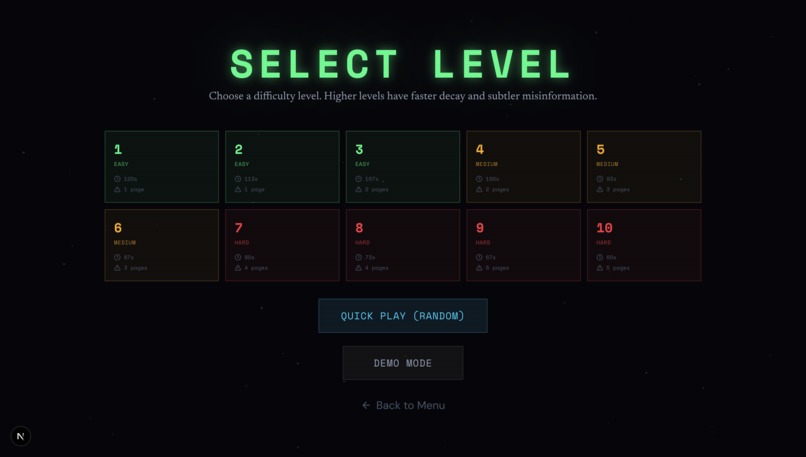
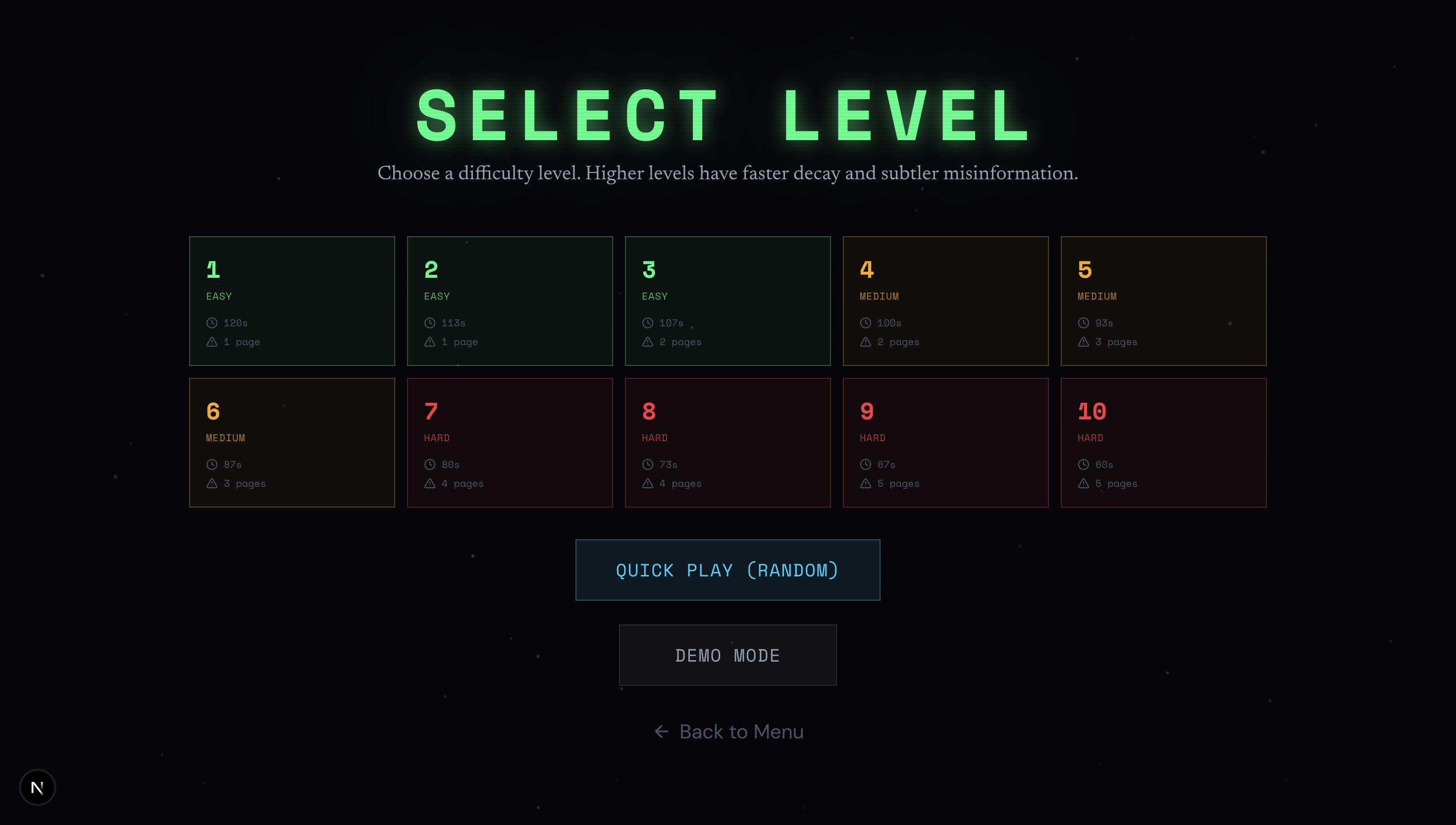
Pick your level. Higher difficulties feature faster decay and subtler fabrications. Can you preserve truth under pressure?
-

Critically analyze decaying sections under time pressure to identify and preserve the legitimate archives before they vanish forever.
-

Race against other archivists or work together to identify and preserve authentic records before time runs out.
-

See how you rank against archivists around you. Filter by level and mode to find your rivals and chase the ultimate preservation record.




DUST - Truth Under Decay
Inspiration
Misinformation spreads rapidly when people are overwhelmed with content and short on time. Most media-literacy tools are static or lecture-based, while misinformation itself is dynamic, emotional, and urgent.
We wanted to build something that mirrors the real problem: time pressure, uncertainty, and imperfect decision-making. That idea became DUST.
What It Does
DUST is a real-time fact-checking game where players inspect decaying web pages and archive what they believe is true before the page collapses.
Game Modes
Solo Mode
- Progressive difficulty
- Faster decay over time
- Increasingly subtle misinformation
Multiplayer Race
- Head-to-head timed rounds
- Competitive scoring
Co-op Mode
- Shared time pressure
- Combined team score
- Separate leaderboard from solo play
Scoped Leaderboards
- Solo leaderboards are separated by level.
- Co-op has its own leaderboard.
Core Scoring System
** Score = ∑ (correct picks × combo multiplier) + clutch bonuses − penalties **
- Combo multipliers reward accuracy streaks.
- Clutch bonuses reward strong late-game decisions.
- Penalties discourage reckless or random selections.
Core Game Systems
Decay Engine
Implements time pressure and progressive difficulty scaling.
Archive / Reveal Loop
Players select content, reveal correctness, and receive scoring in a tight loop.
Multiplayer Presence
- Reconnect handling
- Default wins on disconnect
- Rematch logic
Challenges
- Keeping state transitions deterministic across playing, revealing, and gameover phases
- Preventing leaderboard inconsistencies across game modes
- Handling multiplayer edge cases such as disconnects and rematches
- Balancing difficulty so later levels feel challenging but fair
Accomplishments
- Delivered a polished real-time full-stack game under hackathon constraints
- Implemented mode-aware leaderboard architecture
- Built a save-status UX that reflects true backend completion
- Successfully shipped both competitive and collaborative multiplayer modes
Lessons Learned
- Data modeling decisions (such as leaderboard scope keys) directly impact correctness.
- Explicit and idempotent mutations simplify real-time system evolution.
- Spec-driven development reduces regressions and improves shipping speed.
- Small UX details around persistence and feedback build user trust.
What’s Next
- Seasonal ladders and weekly challenge boards
- Improved anti-cheat validation for multiplayer scoring
- Expanded content generation and moderation tools
- Team mode, tournaments, and richer post-match analytics
Built With
- clerk
- convex
- nextjs
- shadcnui
- tailwindcss
- turborepo
- zustand

Log in or sign up for Devpost to join the conversation.