Inspiration
A meeting room can be booked by anyone in a shared space. Why not a 3D printer?
Sharing a printer still involves disconnected conversations, files, slicer settings, material ownership and assumptions about who may use a machine. Even at home, switching between users can mean changing accounts and restoring settings. In makerspaces and coworking spaces, that friction becomes a question of availability, responsibility and trust.
We built 3DA—pronounced “Three-D-A,” and affectionately called Freeda—to make fabrication equipment understandable and safely usable by both people and AI agents.
What it does
3DA turns a fleet of 3D printers into bookable, agent-ready shared infrastructure.
A member can ask Codex to prepare an existing design for printing. Through structured WebMCP tools, the agent can:
- Discover authorised printers and their availability
- Recommend a compatible machine
- Reserve a conflict-free time window
- Validate the artifact, material, printer profile and estimated duration
- Prepare an auditable print job
- Monitor its status and notify relevant stakeholders
The most important capability is what the agent cannot do: authorise a physical action.
When Codex attempts to submit a print, 3DA returns APPROVAL_REQUIRED. A space manager must review the exact printer, artifact, material, execution mode and cryptographic job fingerprint. Approval is valid once and becomes invalid if any consequential detail changes.
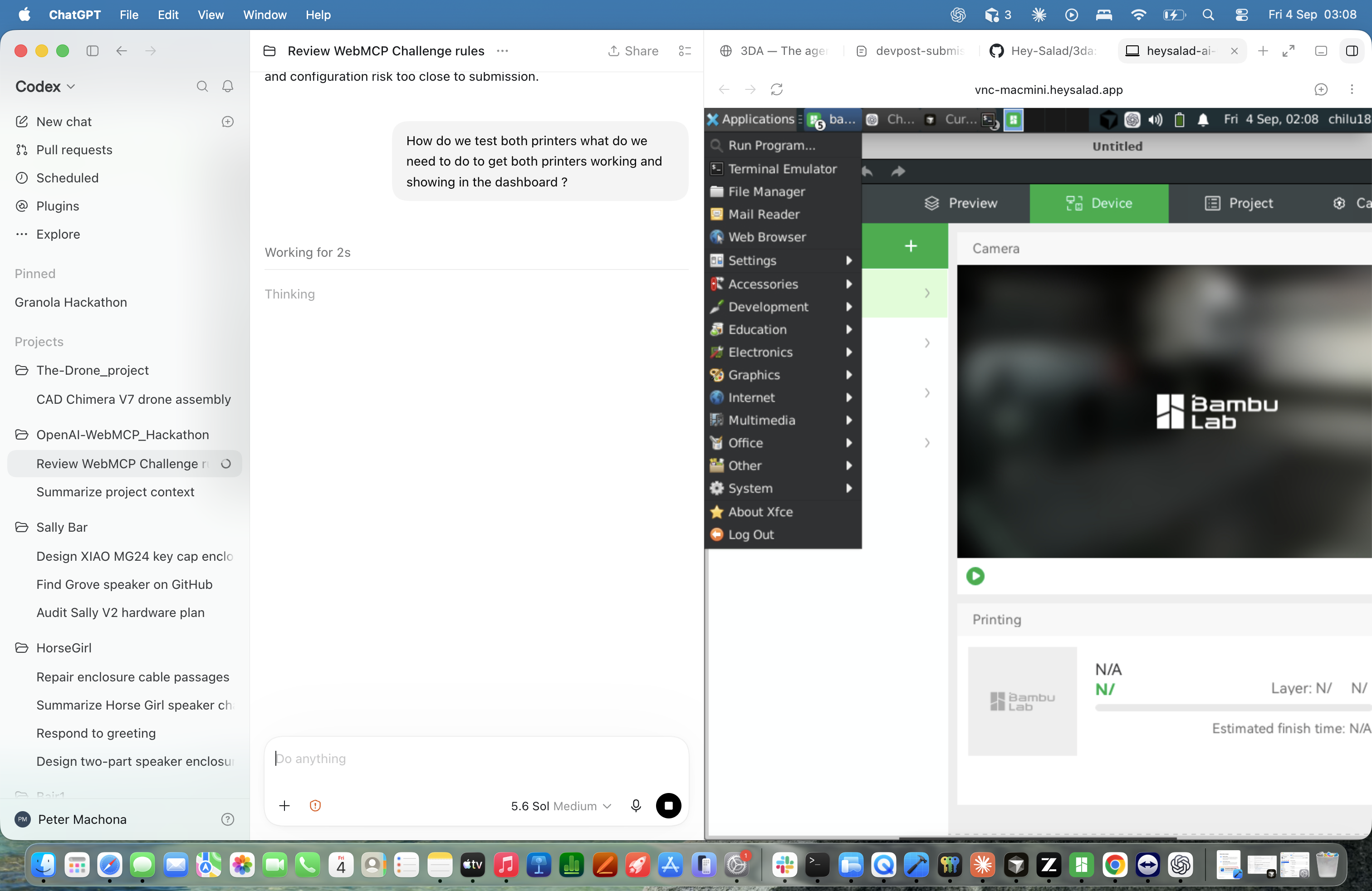
Our public demonstration uses simulated command execution, clearly labelled in the interface. We separately verified two real Bambu Lab A1 printers on our private network through a local Mac mini bridge, without exposing printer credentials to the browser or hosted application.
How we built it
3DA is an open-source TypeScript monorepo centred on a Next.js application and shared domain contracts.
The browser registers structured WebMCP tools including:
list_printersreserve_printerprepare_print_jobsubmit_print_jobget_print_status
Reservation conflicts and safety decisions are deterministic rather than delegated to a language model. Mutable operations use explicit state transitions, audit identifiers and idempotency boundaries.
The interface presents a warm, character-led London coworking fabrication room. Printers have memorable names—Samantha, Simone, Sanda, Sacha and Solange—while the guided operations view exposes the serious data underneath.
For hardware investigation, we configured two Bambu Lab A1 printers in LAN Developer Mode. A Mac mini acts as the intended local bridge: printer credentials stay on site, while narrowly scoped events and commands can cross the hosted boundary.
The architecture is designed to use Cloudflare D1 as the system of record and R2 for private artifact storage. The web experience is deployed through Vercel.
Challenges we ran into
The hardest challenge was safely connecting an agent workflow to physical equipment.
Bambu printers can operate through cloud accounts or LAN-only Developer Mode, and local access requires careful handling of device credentials. We had to separate three very different claims:
- Discovering and identifying real hardware
- Preparing a valid print job
- Authorising and executing a physical command
We deliberately refused to collapse those into one misleading “AI prints things” button.
We also learned that slicer automation varies by installed Bambu Studio version. Instead of pretending to replace the slicer, 3DA treats it as an adapter and focuses on the missing coordination layer around it.
Finally, building a convincing WebMCP experience under hackathon time pressure required ruthless scope control. We cut AI-generated CAD, autonomous camera cancellation and universal printer support so we could demonstrate a coherent safety contract.
Accomplishments that we're proud of
We are especially proud that:
- Codex can discover and operate a complete shared-printer workflow through browser-native WebMCP tools.
- The agent reaches a visible, testable
APPROVAL_REQUIREDboundary. - Approval is bound to an exact job fingerprint and cannot be silently reused.
- Reservation conflicts are handled deterministically and audibly.
- Two real Bambu Lab A1 devices were discovered and identity-verified on the private LAN.
- Hardware credentials remain on the Mac mini rather than entering browser tools, logs or the public repository.
- The public demonstration clearly distinguishes verified hardware connectivity from simulated command execution.
- We made infrastructure feel approachable without hiding its operational seriousness.
- The project is open source and designed to run locally.
What we learned
WebMCP is most powerful when it exposes meaningful capabilities rather than merely reproducing interface buttons.
An agent does not need unrestricted access to Bambu Studio. It needs well-defined tools that express intent: find capacity, reserve a machine, validate a job, request approval and monitor the outcome.
We also learned that human approval is not just a confirmation modal. It is a capability boundary. The person must understand precisely what will happen, and the system must prove that the approved action is the action eventually executed.
Most importantly, AI agents can make physical infrastructure easier to use without removing human agency.
What's next for 3DA (Freeda)
Next, we plan to:
- Complete the guarded Mac mini execution bridge
- Add real-time printer telemetry and job reconciliation
- Persist reservations and audit events with Cloudflare D1
- Store versioned print artifacts privately in R2
- Add collection and build-plate-clear workflows
- Notify members and space managers when prints finish or require attention
- Apply computer vision to failure detection and plate readiness, with humans retaining cancellation authority
- Support additional Bambu models and eventually other printer manufacturers
- Package the local bridge so families, schools, libraries, studios and makerspaces can self-host it
Our long-term goal is simple: make every shared fabrication room as easy to coordinate as a calendar—while keeping physical actions safe, visible and accountable.
Built With
- bambu
- cloudflare
- codex
- next.js
- node.js
- openai
- r2
- react
- typescript
- vercel
- webmcp

Log in or sign up for Devpost to join the conversation.