-
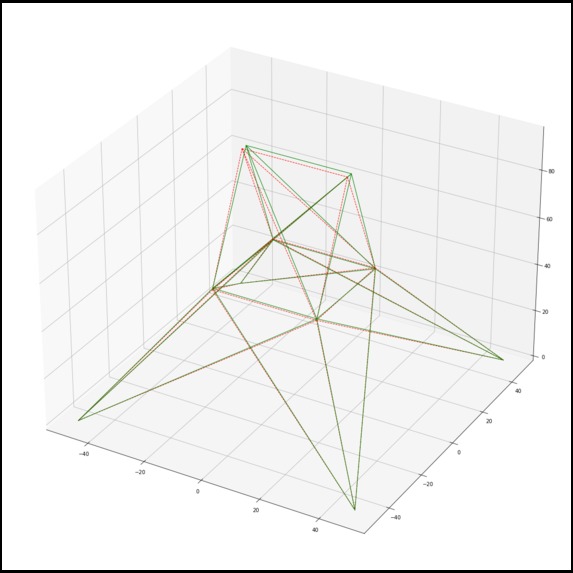
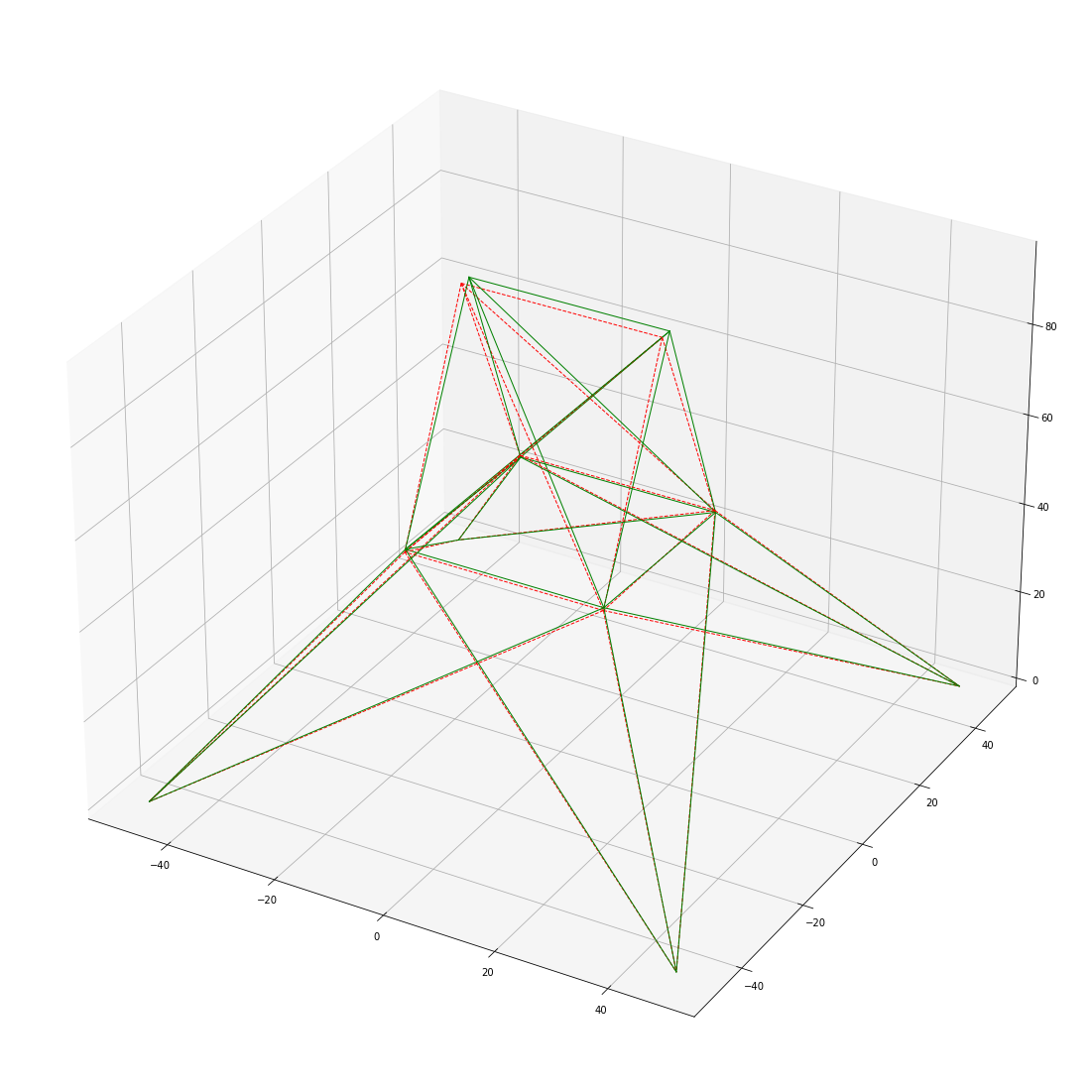
Example Problem (Solved): Deformed Structure Plot (Scale = 20x)
3D_Truss_Solver_FE
Description:
A generalised code that would solve for any 3D truss structure was developed using the principles of direct stiffness method in FEM. This can be then used for analysing the nodal displacements, element stresses, and check if any element is subject to failure using yield stress of that material. An example problem is solved here to show how the program works. The program can be broken into these segments:
Importing libraries:
The required libraries (numpy, numpy, matplotlib.pyplot) were imported
Getting inputs:
Number of elements, Number of nodes, Number of fixed nodes, Fixed nodes, Starting and ending node for each element, Area of each element, Modulus of Elasticity of each element, Coordinates of each node are accepted from user, and are stored accordingly for further computations.
Transformation of stiffness matrix:
The transformed stiffness matrix for each element (in global coordinates) is computed using transformation matrix (Direction ratios). More details are given in the report.
Computing Global stiffness matrix (Assembling):
The global stiffness matrix is computed by assembling the individual stiffness matrices of each elements.
Boundary Conditions:
The boundary conditions (fixed nodes, nodal loads) are applied using the inputs from user. The fixed nodes’ entries are made zeros and stored in a new variable.
Solving for nodal displacements:
The fixed nodes entries (all zeros) are removed to solve for the other nodal displacements using numpy’s linalg.solve. These are then stored in the displacement variable for later analysis
Computing elemental quantities:
The elemental quantities (in local coordinates)- axial displacements, elemental forces and stresses are computed from nodal displacements.
Results:
The required results (Nodal displacements, Element stresses) were printed, and the scaled deformed structure is plotted.


Log in or sign up for Devpost to join the conversation.