-
-
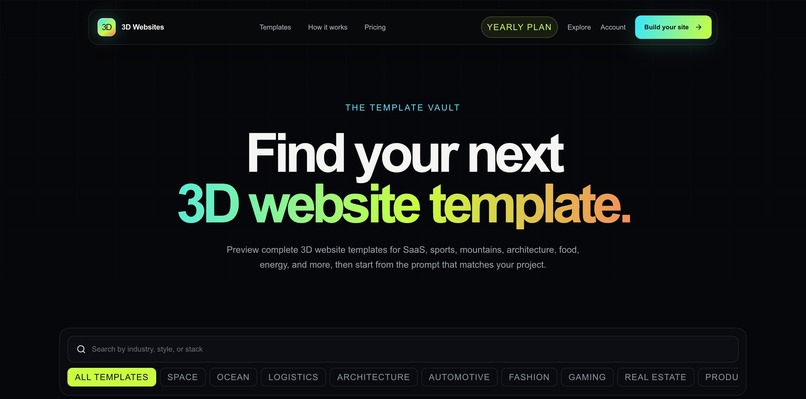
Main Website
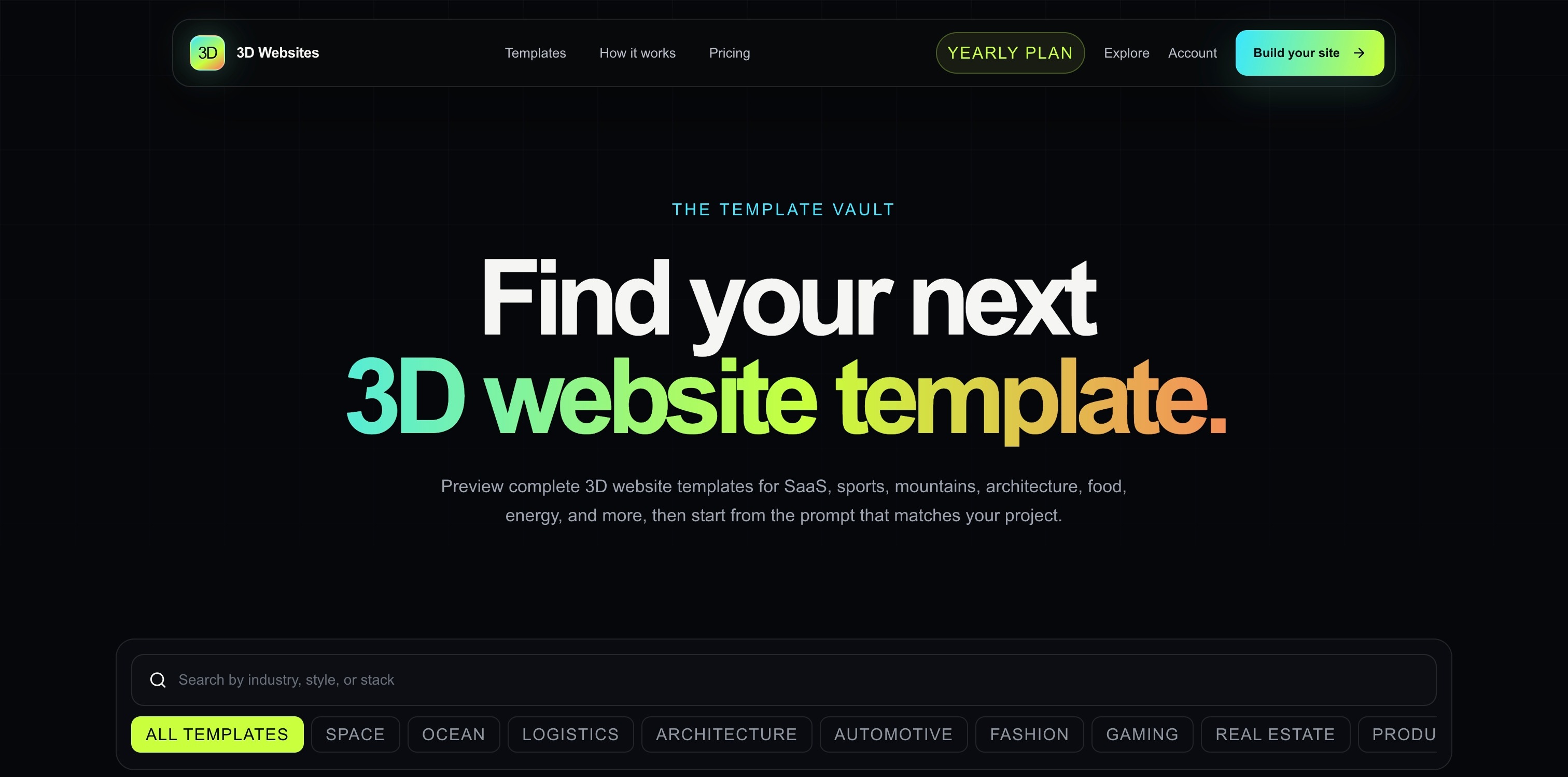
Inspiration
Most websites still follow the same flat layouts, repeated sections, and familiar animations. Creating a truly immersive 3D website normally requires a large budget, specialist developers, 3D artists, several revisions, and weeks of production. Developers are charging up to $30k for creating 3D websites.
We created 3D Website Templates to make cinematic 3D web experiences more accessible. Our goal was to replace the blank canvas with detailed production prompts that help creators turn ambitious ideas into working websites through Claude, ChatGPT, or Gemini. Instead of paying agency-level costs, users can begin with a complete visual and technical direction.
What it does
3D Website Templates is a library of production-focused prompts for building interactive 3D websites.
Users can browse templates by industry, visual style, and interaction type. Each template includes a live responsive preview, recommended technologies, difficulty level, scene direction, animations, interactions, mobile behavior, accessibility guidance, and technical requirements.
After choosing a template, the user copies its prompt into Claude, ChatGPT, or Gemini and uses the AI coding workflow to generate and refine the website.
The library covers categories such as space, oceans, automotive, architecture, gaming, education, healthcare, robotics, real estate, fashion, coffee, furniture, solar systems, 3D printing, coding, portfolios, and car tuning.
How we built it
We built the platform around a preview-first template library. Visitors can explore complete website concepts before choosing a prompt, rather than purchasing a description without seeing the expected result.
The platform includes:
A searchable and filterable template library Individual pages for every 3D website concept Responsive live previews Free and premium prompt access User accounts and protected prompt delivery Yearly and lifetime access options Clear technology and difficulty labels Related-template recommendations
Challenges we ran into
One of our biggest challenges was converting a visual idea into instructions that an AI coding model could understand consistently. A 3D website prompt must explain much more than colors and sections. It must describe camera paths, object positions, transitions, lighting, physics, responsive behavior, and the relationship between each scene.
Performance was another major concern. 3D websites can quickly become slow on mobile devices when they contain large models, complex materials, particles, shadows, and continuous animations. Each concept therefore needed clear guidance for model compression, lazy loading, reduced-motion settings, quality controls, and mobile fallbacks.
Accomplishments that we're proud of
We are proud that we turned a complicated 3D website production process into a clear workflow:
Choose a template, preview the complete experience, copy one structured prompt, and build it with an AI coding model.
We created dozens of detailed concepts across a wide range of industries. These are not simple landing-page descriptions. Many templates include complete visual journeys, such as travelling through a solar system, descending into the deep ocean, configuring a performance car, exploring a furnished home, following coffee from farm to cup, or moving through a football stadium on match day.
We are also proud that both free prompts and premium previews are available, allowing people to understand the format and test the workflow before purchasing access.
What we learned
We learned that the quality of AI-generated websites depends heavily on the quality of the creative and technical instructions/prompts.
A strong prompt needs to explain not only what the website should look like, but also how it should move, react, load, and behave across different devices.
We also learned that creators do not always need another blank website builder. Many need a strong starting direction that helps them understand what is possible and gives the AI model enough detail to produce a consistent result.
Live previews were equally important. Showing the complete experience before giving access to the prompt makes it easier for users to choose the right concept for their project.
Most importantly, we learned that AI coding tools can make advanced 3D web development more accessible when they are given clear scene descriptions, interaction rules, performance limits, and implementation requirements.
What's next for 3D Website Templates
Our next goal is to grow the template library with more industries, visual styles, interaction types, and free examples.
We also plan to introduce:
A browser-based prompt customization workspace AI-assisted editing for text, branding, scenes, and animations Easier template personalization User-submitted templates and community creations Ratings, collections, and saved templates Starter assets and recommended 3D models Direct project export and deployment options Better guidance for mobile and lower-powered devices Team and agency workspaces More integrations with AI coding platforms
The long-term goal is to develop 3D Website Templates from a prompt library into a complete creation workspace where users can choose a concept, describe their changes, preview the result, and publish an immersive 3D website from one place backed by Sol 5.6.
Note: Maximum templates are created using Codex (Sol 5.6 Extra High). All prompts are created with Sol 5.6 Extra high. Main Website 3D Prompt is also created with codex.

Log in or sign up for Devpost to join the conversation.