Inspiration
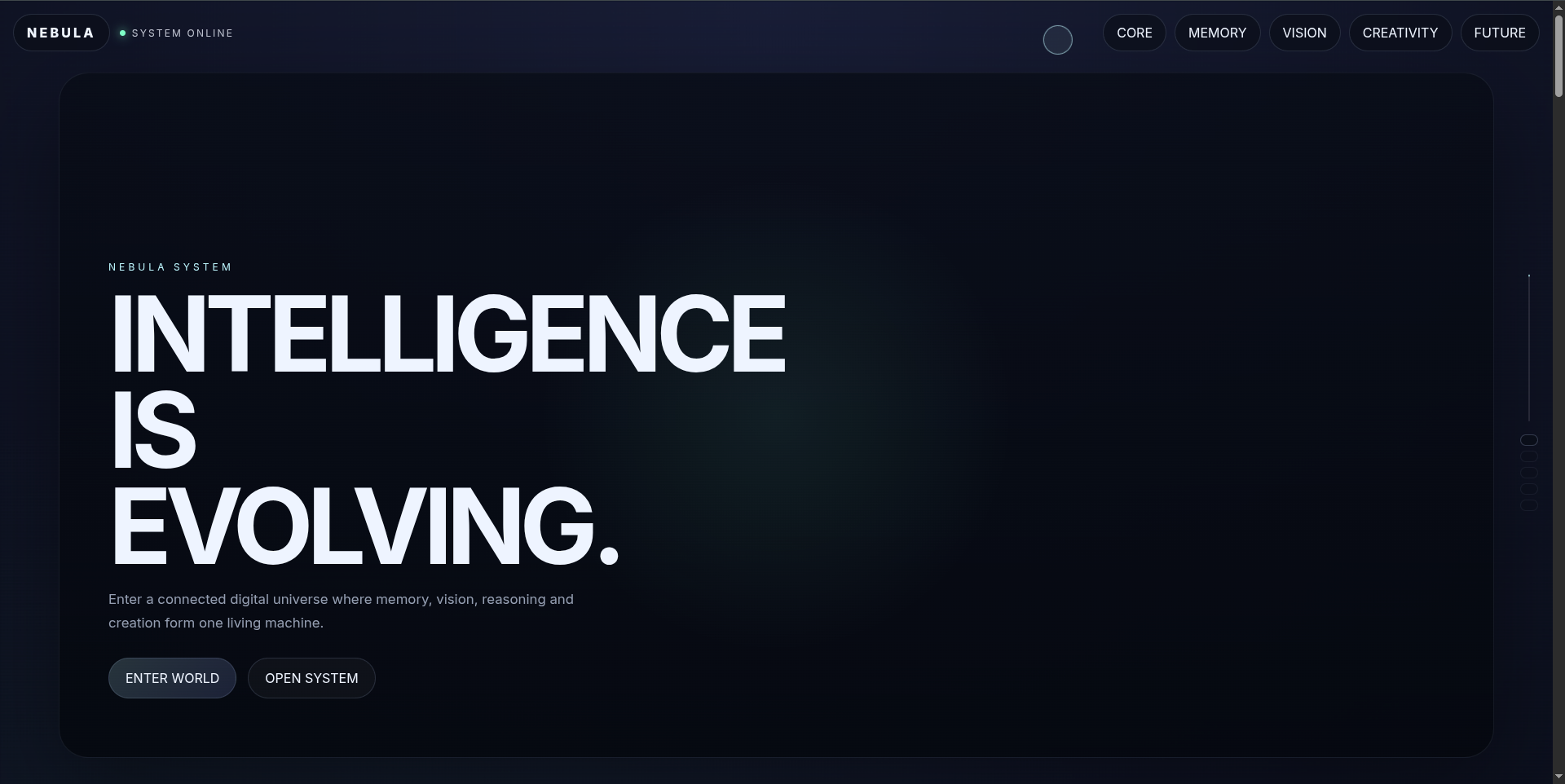
NEBULA was inspired by the idea of making artificial intelligence feel less like a traditional software interface and more like a world that people can actually explore.
Most AI websites rely heavily on text, dashboards, and static interfaces. We wanted to create something different — an immersive 3D experience where users can visually explore concepts such as intelligence, memory, vision, creativity, and the future.
Our goal was simple: create a website that makes people stop scrolling and say "Wow."
What We Built
NEBULA is an interactive 3D digital universe centered around an AI Core.
Users can explore a futuristic environment, interact with 3D objects, discover different AI concepts, and move through a cinematic visual journey.
The experience includes:
- An interactive 3D AI Core
- Procedural particles and futuristic environments
- Interactive exploration nodes
- AI-inspired visualizations
- Interactive memory, vision, and creativity environments
- A simulated AI command interface
- Interactive 3D planet
- Cinematic camera transitions
- Smooth scrolling animations
- Responsive desktop and mobile experiences
- Custom micro-interactions and cursor effects
How We Built It
The project was built with modern web technologies.
The main stack includes:
- React
- Vite
- Three.js
- React Three Fiber
- React Three Drei
- GSAP
- Framer Motion
- Modern CSS
React handles the application structure and user interface, while Three.js and React Three Fiber power the immersive 3D environments.
We used procedural 3D elements wherever possible so the experience could remain lightweight and flexible without depending heavily on external assets.
Animations and transitions were carefully designed to connect the 3D world with the interface and create a continuous sense of movement.
What We Learned
One of the biggest lessons from building NEBULA was that creating a 3D website is not just about adding 3D objects.
Performance, composition, lighting, camera movement, interaction design, and typography all have to work together.
We learned how to:
- Build interactive 3D scenes for the web
- Connect React interfaces with Three.js environments
- Create smooth camera and object animations
- Design interactions around 3D objects
- Optimize WebGL experiences
- Create responsive 3D layouts
- Balance visual effects with usability
- Design a digital experience rather than just a traditional website
Challenges We Faced
The biggest challenge was balancing visual complexity with performance.
It is easy to make a 3D scene look impressive when adding more particles, lights, effects, and objects. However, too many effects can quickly make a website slow, especially on mobile devices.
We therefore focused on using controlled animations, efficient geometry, optimized particle systems, and responsive behavior.
Another challenge was making the 3D environment meaningful rather than decorative. Every major interaction was designed to support the story of exploring an artificial intelligence system.
What's Next
NEBULA is designed as a foundation for a much larger interactive experience.
Future improvements could include:
- Real AI integration
- Voice interaction
- Multiplayer exploration
- More interactive worlds
- Advanced procedural environments
- Personalized AI experiences
- WebXR and VR support
Final Thoughts
NEBULA is our attempt to explore what happens when artificial intelligence meets immersive web design.
Instead of simply reading about the future, we wanted users to step inside it.

Log in or sign up for Devpost to join the conversation.