-
-
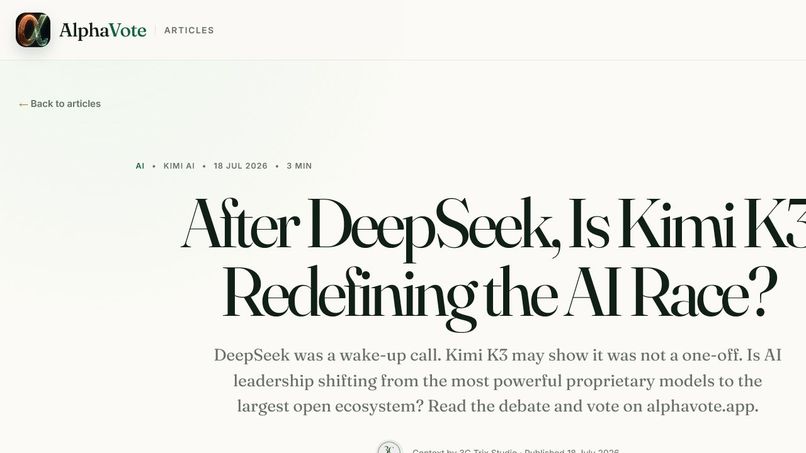
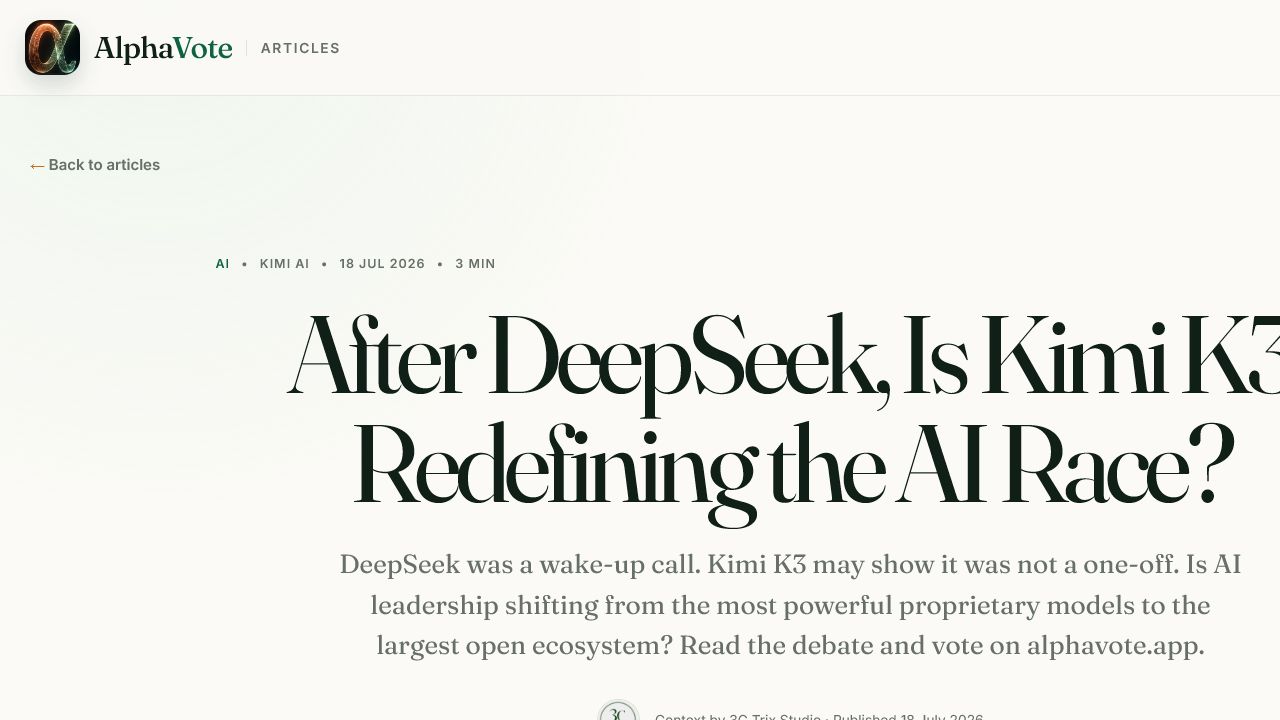
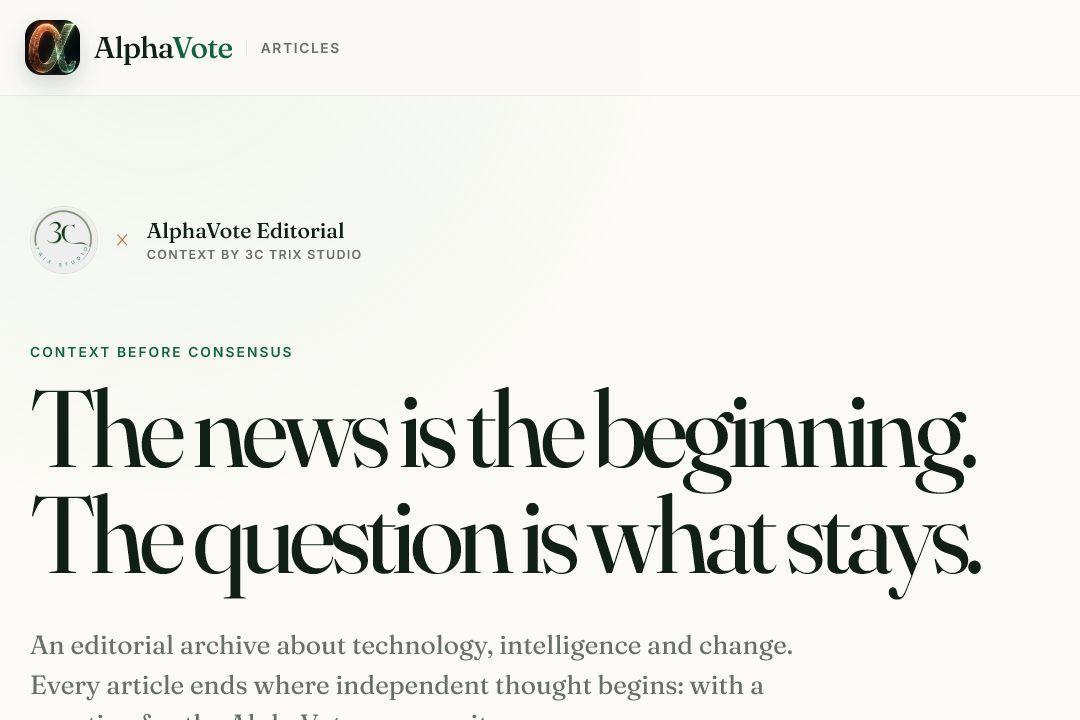
Public 3C Trix archive: sourced articles that turn current news into questions worth thinking through.
-
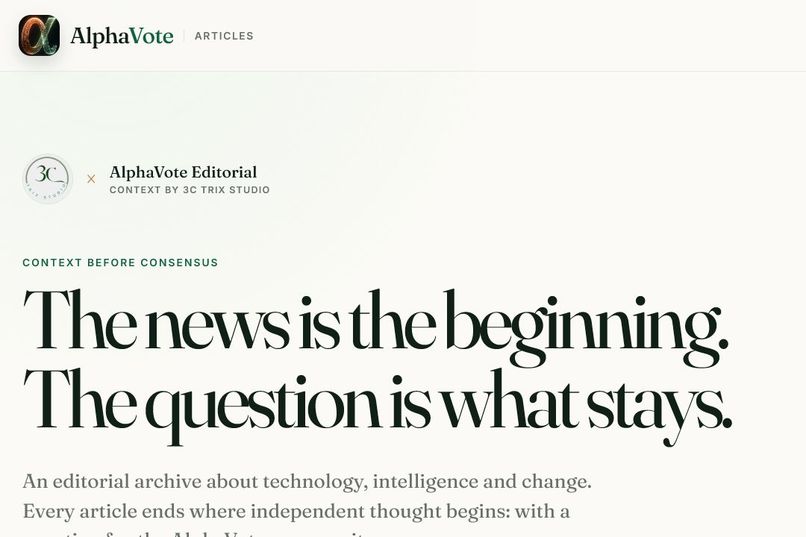
Article reader with named sources, rich context, and a direct path to a live AlphaVote Debate.
Inspiration
Most news and social media products optimize for attention, not understanding. People consume more, remember less, and rarely reach a considered decision.
AlphaVote explores a different model: a knowledge product that helps people slow down, compare perspectives, remember what matters, and turn information into a reasoned vote. 3C Trix is my editorial framework for explaining complex AI, technology, and financial-infrastructure news. During OpenAI Build Week, I connected both ideas into one content-to-consensus workflow.
The goal is not to automate more content. It is to help a founder transform a timely source into useful context, a balanced question, and informed community participation—while keeping every public action under human control.
What it does
3C Trix × AlphaVote turns one news source into a complete go-to-market loop:
- Create a structured, sourced article in a private editorial workspace.
- Use GPT-5.6 to suggest one neutral Debate question and exactly two concise, balanced options.
- Review and edit every suggestion before publishing.
- Create a real AlphaVote Debate card from the article, with the article source, image, description, category, and community context.
- Publish the article with a direct link to the live AlphaVote card.
- Let readers vote through the same shared voting data used by the main AlphaVote feed.
- Ask GPT-5.6 for a reader-first LinkedIn draft based on the article, sources, question, and exact URLs.
- Keep the draft in a private approval queue for manual publication.
The public experience includes a responsive article archive, topic filters, named sources, rich Markdown, images, captions, responsive tables, full article pages, and live paths into AlphaVote. The creation, management, AI suggestions, and LinkedIn queue remain owner-only.
Nothing is posted automatically to LinkedIn, and the application stores no LinkedIn access token.
How we built it
The public archive, reader, private editor, article management, Debate creation, shared voting, and LinkedIn queue use semantic HTML, responsive CSS, and vanilla JavaScript. Supabase provides authentication, PostgreSQL data, media storage, and owner-only Edge Functions running on Deno.
Two authenticated Edge Functions call the OpenAI Responses API:
- generate-debate-card uses gpt-5.6-luna with strict structured output to produce one neutral question and exactly two balanced options.
- generate-linkedin-post uses gpt-5.6-luna to transform the reviewed article and its source context into editable LinkedIn copy.
The OpenAI API key remains server-side in Supabase. Both functions verify the authenticated owner, restrict allowed origins, constrain input and output lengths, set store: false, and treat supplied article text as source material rather than instructions.
The article workflow connects to the existing AlphaVote data model instead of creating a visual mock. A published article can create a real card in public.cards, store the relationship in the article, and reuse the shared AlphaVote voting component and vote records.
How Codex helped
Codex was my implementation partner throughout Build Week. I used it to:
- translate the product narrative into an editorial information architecture;
- implement the archive, reader, private editor, management views, and approval queue;
- connect article creation to real AlphaVote cards and shared vote records;
- design GPT-5.6 prompts, JSON schemas, authentication checks, and safe failure paths;
- prepare Supabase migrations and Edge Function deployment steps;
- test responsive layouts in a real browser and improve table and article rendering;
- review diffs, manage Git changes, document the project, and support production deployment.
I made the core product decisions: preserve original sources, keep publication human-controlled, create AlphaVote cards inside the article workflow, reuse real voting data, minimize LinkedIn permissions, and maintain the combined 3C Trix and AlphaVote brand system.
Challenges
The hardest challenge was turning an editorial prototype into a trustworthy production workflow without weakening the existing product.
We had to keep public reading simple while protecting every creator action behind owner authentication. We also had to connect articles to live AlphaVote cards and voting data, make Markdown tables and images safe and responsive, preserve source attribution, and ensure AI suggestions never silently became published content.
A second challenge was scope clarity. AlphaVote existed before Build Week. This submission is specifically the new 3C Trix editorial and go-to-market extension, built from July 17 to July 20, 2026. The repository history and dated commits separate the new work from the pre-existing application.
Accomplishments that we're proud of
- One coherent flow now turns research into context, a balanced Debate, a live vote, and an approval-ready distribution draft.
- GPT-5.6 is used where judgment support is valuable, while the founder retains final editorial control.
- Debate creation publishes to the real AlphaVote experience rather than a demo-only screen.
- Articles and the main feed share voting records.
- The public archive is available without credentials, while the private workflow remains protected.
- The system supports named sources, rich articles, tables, images, and responsive desktop and mobile layouts.
- The workflow avoids automatic LinkedIn publishing and excessive account permissions.
What we learned
The most useful AI workflow is not “generate and publish.” It is “collect evidence, propose structure, make the decision legible, and require approval.”
We also learned that one well-researched artifact can support several useful outputs without becoming repetitive: an article for context, a Debate for participation, a voting record for community intelligence, and a LinkedIn draft for distribution.
Most importantly, AI can help a small team build an integrated go-to-market system quickly, but product constraints—source transparency, neutral framing, privacy, and human approval—are what make that speed trustworthy.
What's next
Next, I want to add opt-in LinkedIn publishing only after explicit final approval, connect article engagement to meaningful voting analytics, create reusable editorial workspaces for AlphaVote communities, and measure learning and retention instead of clicks alone.
The longer-term vision is for AlphaVote to become a knowledge app rather than another social feed: a place where communities can compare arguments, retain information, make forecasts, and build collective intelligence.
Built With
- cloudflare
- codex
- css3
- deno
- edge
- github
- html5
- javascript
- markdown
- openai
- postgresql
- responses
- supabase

Log in or sign up for Devpost to join the conversation.