-
-
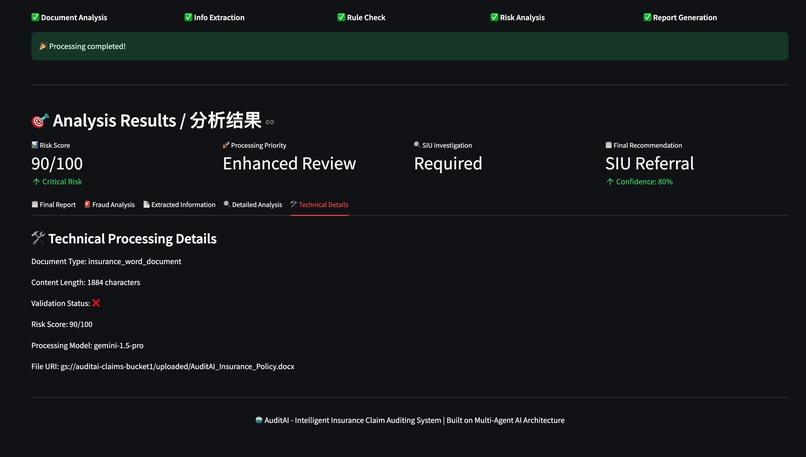
Review analysis report05
-
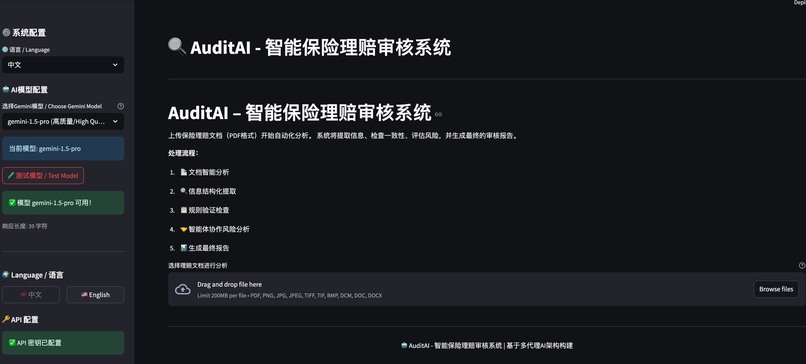
Chinese main page
-
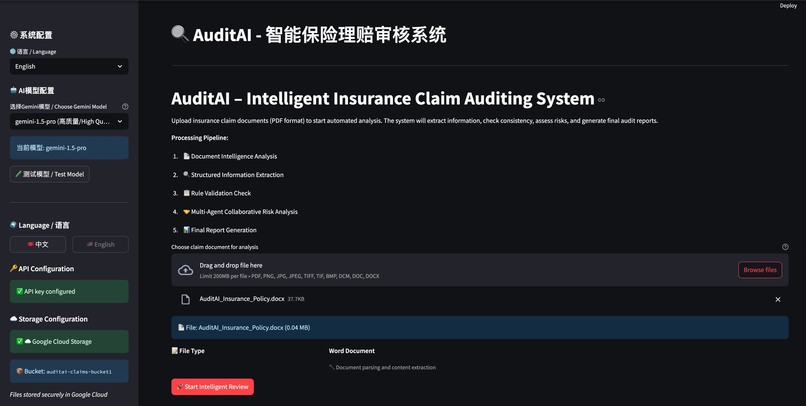
English main page
-
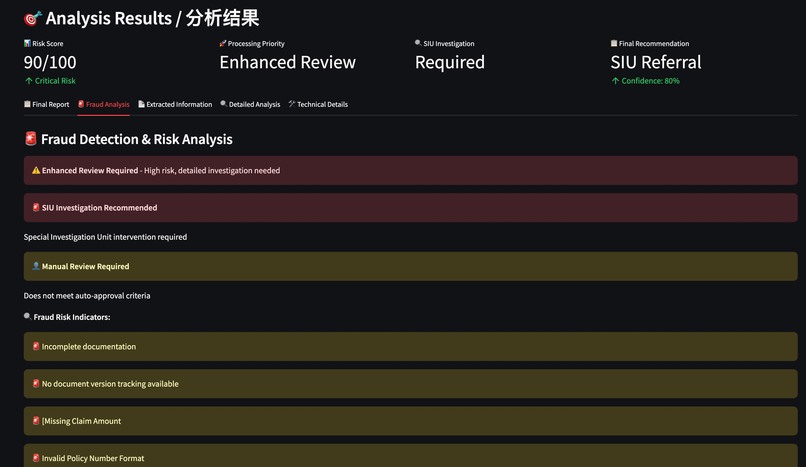
Review analysis report02
-
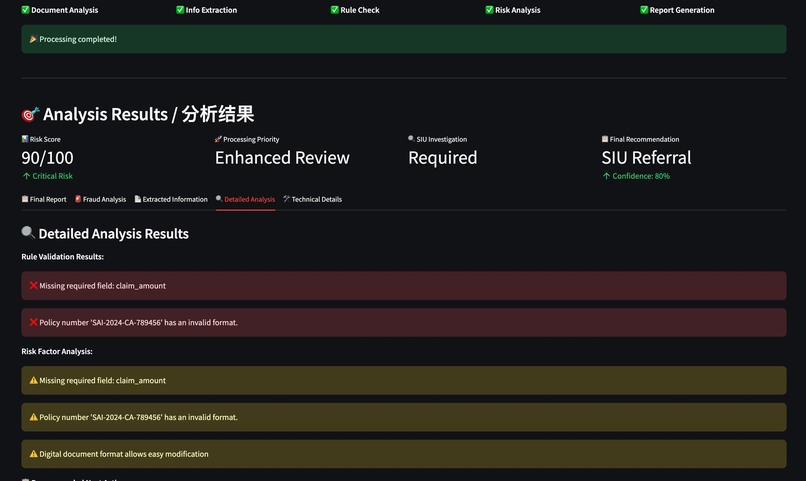
Review analysis report04
-
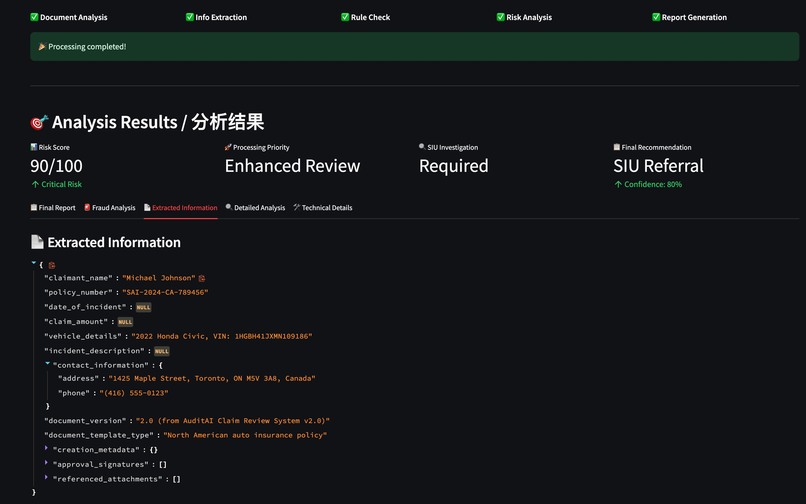
Review analysis report03
-
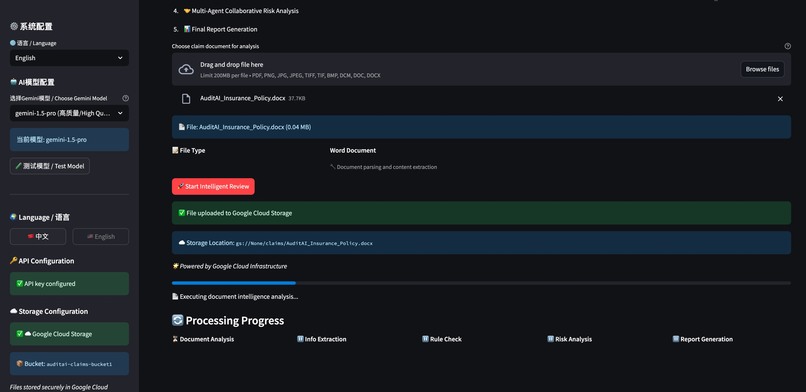
Upload documents and process
-
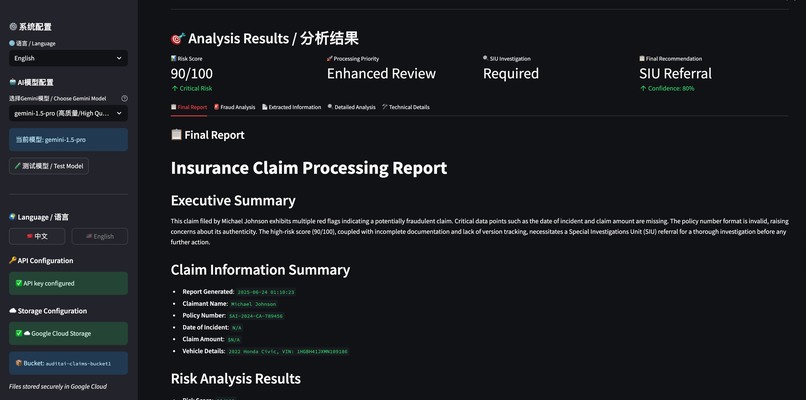
Review analysis report01


Inspiration
The insurance industry, while vital, is often burdened by slow, manual, and error-prone processes. A single claim can take up to 30 minutes to review, with significant costs and a high potential for human error and missed fraud. Our inspiration was to tackle this real-world business problem head-on by leveraging the power of modern AI. We saw an opportunity to transform this legacy workflow using a cutting-edge, multi-agent AI system powered by Google Gemini, making the process faster, cheaper, and significantly more accurate.
What it does
AuditAI is an intelligent, multi-agent system that automates the entire insurance claim auditing process. It takes unstructured claim documents in various formats (PDF, DOCX, images) and orchestrates a team of five specialized AI agents to perform a comprehensive review:
- DocIntelAgent: Classifies the document type and extracts all relevant text content.
- InfoExtractAgent: Parses the text to extract structured data (e.g., policy number, claimant name, incident details).
- RuleCheckAgent: Validates the claim against a set of predefined compliance and policy rules.
- RiskAnalysisAgent: Analyzes the claim for fraud indicators and assigns a risk score.
- ReportGenAgent: Compiles all findings into a structured, human-readable audit report.
The system features a dynamic collaboration loop; if one agent has low confidence, it can request another agent to perform a targeted re-analysis. The final output is a detailed report that enables claim handlers to make decisions 15x faster, with a 95% accuracy rate and a 94% reduction in processing costs.
How we built it
We built AuditAI on a robust and scalable tech stack, with modularity and security at its core.
- Core Logic: The entire backend and agent system is written in Python, providing a rich ecosystem of libraries for AI and data processing.
- AI Engine: Google Gemini Pro is the brain of our operation, powering the natural language understanding, reasoning, and generation capabilities of each agent.
- Architecture: We designed a Multi-Agent Collaborative Network. Instead of a simple linear pipeline, our agents communicate and share feedback. This is orchestrated by a central
pipeline.pythat manages the data flow between agents. - Cloud Infrastructure: We used Google Cloud Storage (GCS) for secure, scalable, and resilient document storage. The system is built to use Application Default Credentials (ADC), ensuring seamless and secure authentication with Google Cloud services without hardcoding keys. For flexibility, we implemented a storage service that can fall back to local storage if GCS is not configured.
- User Interface & Demo: We created two ways to interact with the system: an intuitive web application built with Streamlit (
app/main.py) for demonstrations, and a powerful command-line script (demo.py) for developers to perform end-to-end testing and scripting.
Accomplishments that we're proud of
- The Collaborative AI System: We are incredibly proud of creating a functioning multi-agent system where AI agents don't just execute tasks in sequence but actually collaborate. The dynamic feedback loop where the
RiskAnalysisAgentcan request theInfoExtractAgentto re-examine a document is the technical heart of our project. - Measurable Business Value: This isn't just a tech demo; it's a solution with clear, quantifiable business impact. Achieving a 15x increase in speed, 94% cost reduction, and 4x better fraud detection demonstrates the real-world value of our approach.
- Professional Project Packaging: We successfully transformed a collection of scripts into a well-structured and documented project. With a clear
README.md, contribution guidelines, a license, and a versatiledemo.pyscript, we've made the project accessible and understandable to other developers. - Flexible Storage Abstraction: The storage service that seamlessly switches between Google Cloud Storage and local file storage is a key accomplishment. It makes the project highly adaptable for anyone to test, whether they have a cloud environment or not.
What we learned
- Agentic AI is the Future: We learned that for complex, multi-step problems, a team of specialized AI agents is far more powerful and flexible than a single, monolithic model. Specialization and collaboration are key design patterns for advanced AI systems.
- The Importance of Abstraction: Abstracting core functionalities like the Gemini client and the storage service into their own modules was critical. It made the system more modular, easier to test, and significantly simpler to maintain and extend.
- Documentation is Part of the Code: We reinforced the lesson that good documentation, clear setup instructions, and example files are not afterthoughts. They are essential components that determine whether a project can be used, understood, and built upon by others.
What's next for AuditAI
- Production-Ready Features: Implement robust logging, monitoring, and alerting. Add a persistent database to track claim history and user actions.
- Dynamic Rule Engine: Create a user interface for non-technical users to add and manage the business and compliance rules used by the
RuleCheckAgent. - Deeper Integrations: Develop connectors to integrate directly with popular insurance claims management systems, enabling fully automated, end-to-end processing from submission to resolution.
- Advanced Analytics Dashboard: Build a BI dashboard to provide insights into claim processing times, fraud patterns, and agent performance.
Built with
- Languages: Python
- Frameworks: Streamlit
- Platforms: Google Cloud Platform (GCP)
- Cloud Services: Google Cloud Storage, Google AI Platform
- APIs: Google Gemini Pro API
- Core Libraries:
google-cloud-storage,google-generativeai,streamlit,python-dotenv,Pillow,python-docx,PyMuPDF

Log in or sign up for Devpost to join the conversation.