-
-
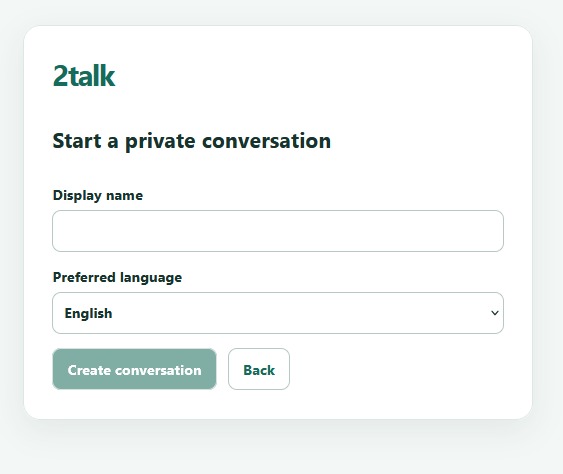
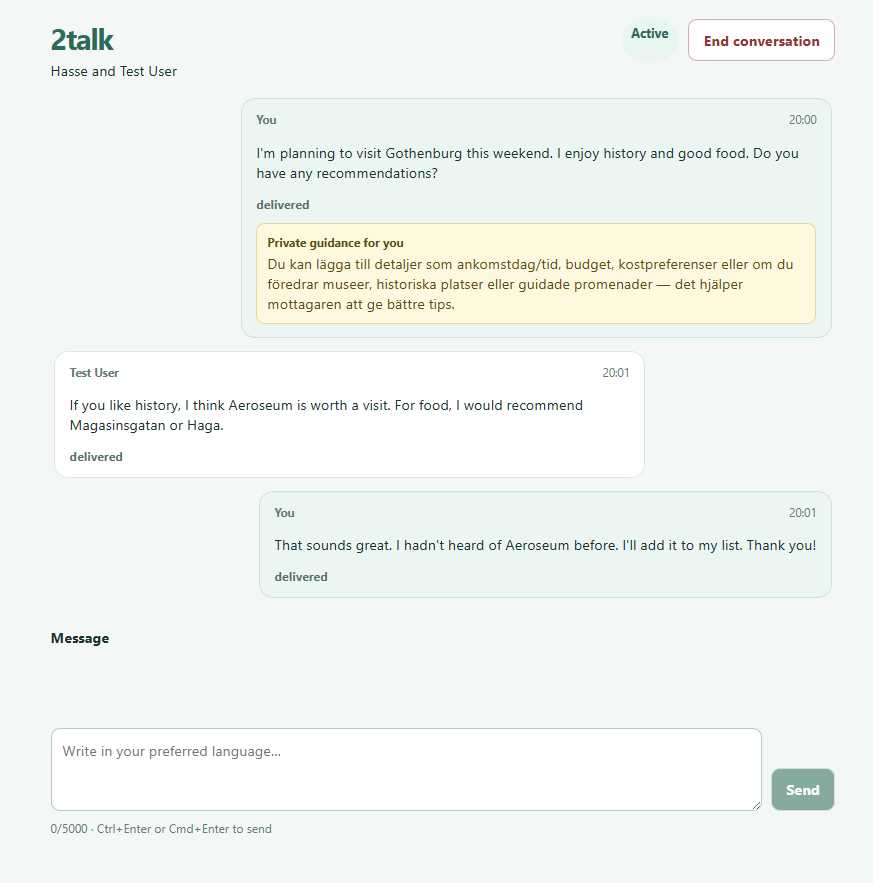
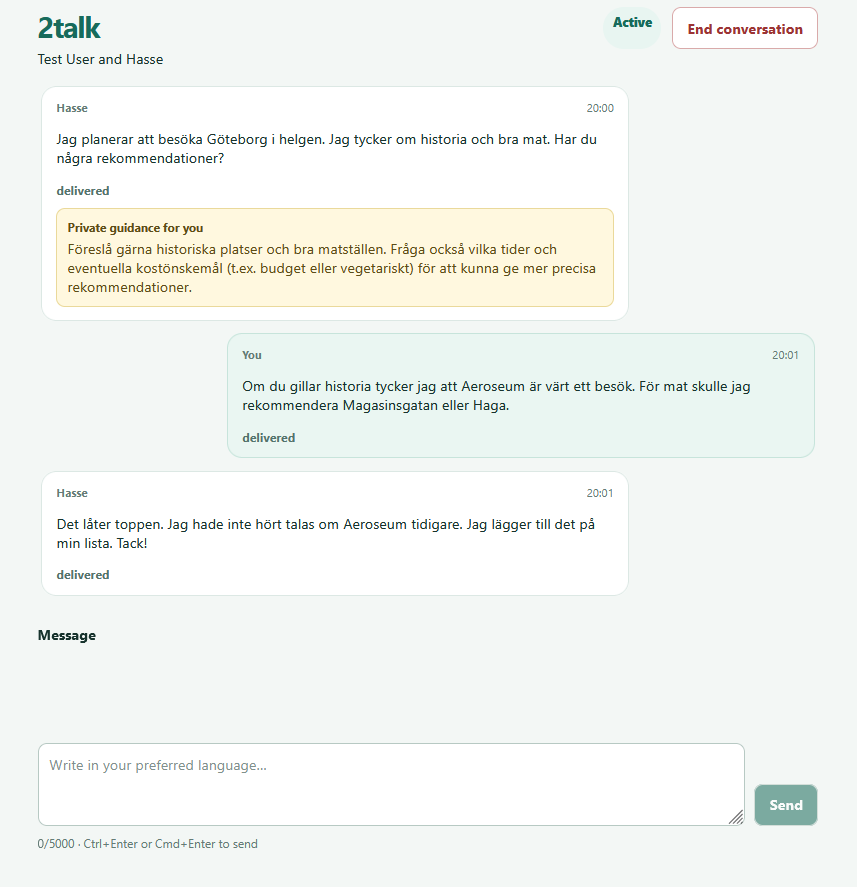
Start Screen
-
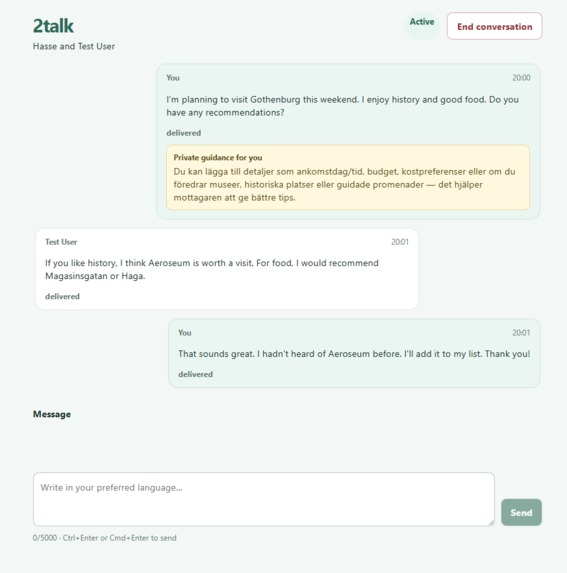
English Speaker User
-
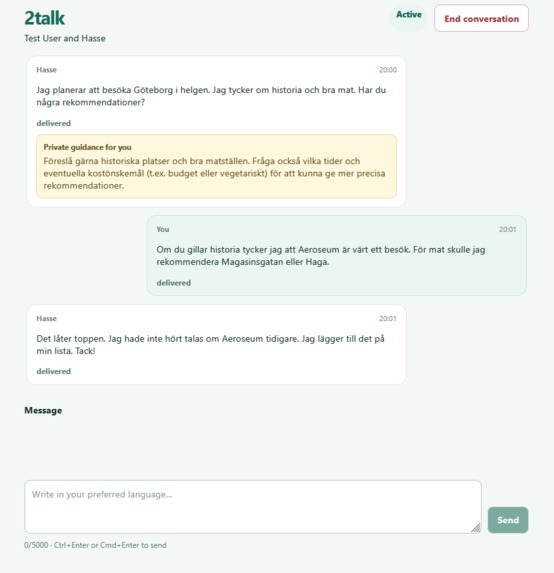
Swedsih Speaker User
Inspiration
Most communication problems are not caused by different languages—they are caused by misunderstandings, emotional reactions, and the way messages are expressed.
While translation tools help people understand words, they do not help people communicate better. We wanted to explore whether AI could act as a neutral communication mediator instead of simply translating text.
That idea became 2talk: a private conversation platform where AI helps two people communicate more clearly while respecting each person's preferred language.
What it does
2talk creates a private conversation between two participants.
Every message is processed by an AI mediation layer before reaching the other participant.
The platform can:
Translate messages into the recipient's preferred language. Preserve the sender's original message for the sender. Provide private AI guidance tailored to each participant. Help conversations remain clear, respectful, and easier to understand.
Each participant experiences the conversation naturally in their own language without exposing private coaching or internal AI reasoning.
How we built it
We built 2talk as a full-stack application using:
FastAPI for the backend API. React and TypeScript for the frontend. PostgreSQL for persistent conversation storage. Docker Compose for reproducible local deployment. OpenAI models to mediate conversations, translate messages, and generate participant-specific guidance.
The system separates original messages from AI-mediated messages and generates different projections for each participant, ensuring that privacy boundaries are maintained while providing a seamless conversation experience.
Challenges we ran into
The biggest challenge was maintaining different views of the same conversation without compromising privacy.
Each participant should see a different version of the same message:
the sender sees their original message, the recipient receives the AI-mediated version.
During testing we discovered a subtle frontend bug where polling updates replaced the sender's original message with the translated version intended for the recipient. Although the backend projections were correct, the frontend rendering logic had to be redesigned to ensure each participant always received the correct representation.
Building reliable AI software required much more than integrating an API—it required careful engineering around state management, privacy, and user experience.
Accomplishments that we're proud of
We are proud that 2talk demonstrates AI as more than a chatbot.
The application successfully combines multilingual communication, AI mediation, participant-specific guidance, and privacy-aware message delivery into a single workflow.
We also built the project with automated tests, Docker-based deployment, and a clean separation between backend services, AI workers, and the frontend, making it easy to reproduce and extend.
Most importantly, the final implementation preserves each participant's original experience while allowing AI to quietly improve communication behind the scenes.
What we learned
We learned that building AI applications is as much a software engineering challenge as it is an AI challenge.
Good prompting alone is not enough. Reliable AI systems require careful separation of user data, message representations, privacy boundaries, asynchronous processing, and frontend state management.
We also learned that small implementation details can dramatically affect how users perceive trust in an AI-assisted conversation.
What's next for 2talk
The current hackathon submission focuses on a two-person conversation MVP.
Our long-term vision is to expand 2talk into a broader AI communication platform with:
Group conversations. Conversation summaries and shared outcomes. Richer mediation strategies based on conversation context. Voice conversations with live AI mediation. Additional languages. Secure cloud deployment and real-time communication using WebSockets.
Ultimately, we want to explore how AI can become a trusted communication partner that helps people understand each other—not by speaking for them, but by helping them express themselves more clearly.
I think this version strikes a good balance. It is ambitious without exaggerating, accurately reflects what you've built, and highlights the engineering challenges that make the project interesting to judges.
Built With
- ai
- alembic
- api
- compose
- conversation
- css
- docker
- fastapi
- gpt-5
- html
- learning
- machine
- multilingual
- natural
- openai
- playwright
- postgresql
- pytest
- python
- react
- rest
- sqlalchemy
- translation
- typescript
- vite

Log in or sign up for Devpost to join the conversation.