Inspiration
I used to spend a lot of time playing Minesweeper when I was younger, and I have fond memories of opening it for a quick game every now and then.
On a whim in September, I started looking for that kind of experience on Quest. When the Meta VR Start Developer Competition 2026 began, I remembered that search and thought it would be the perfect project to build and submit.
That became the starting point for 26 Neighbors: what happens when Minesweeper gains another dimension?
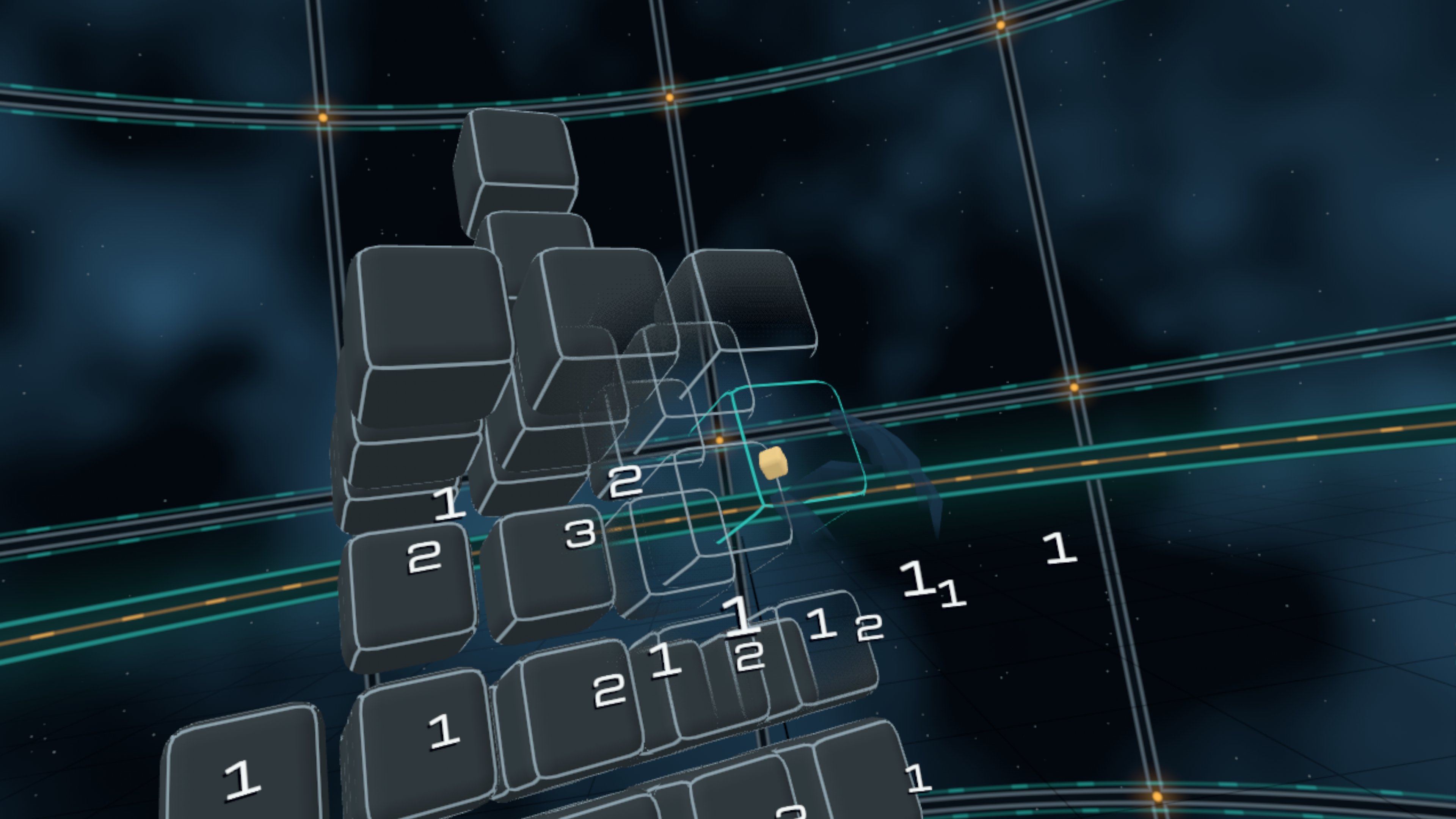
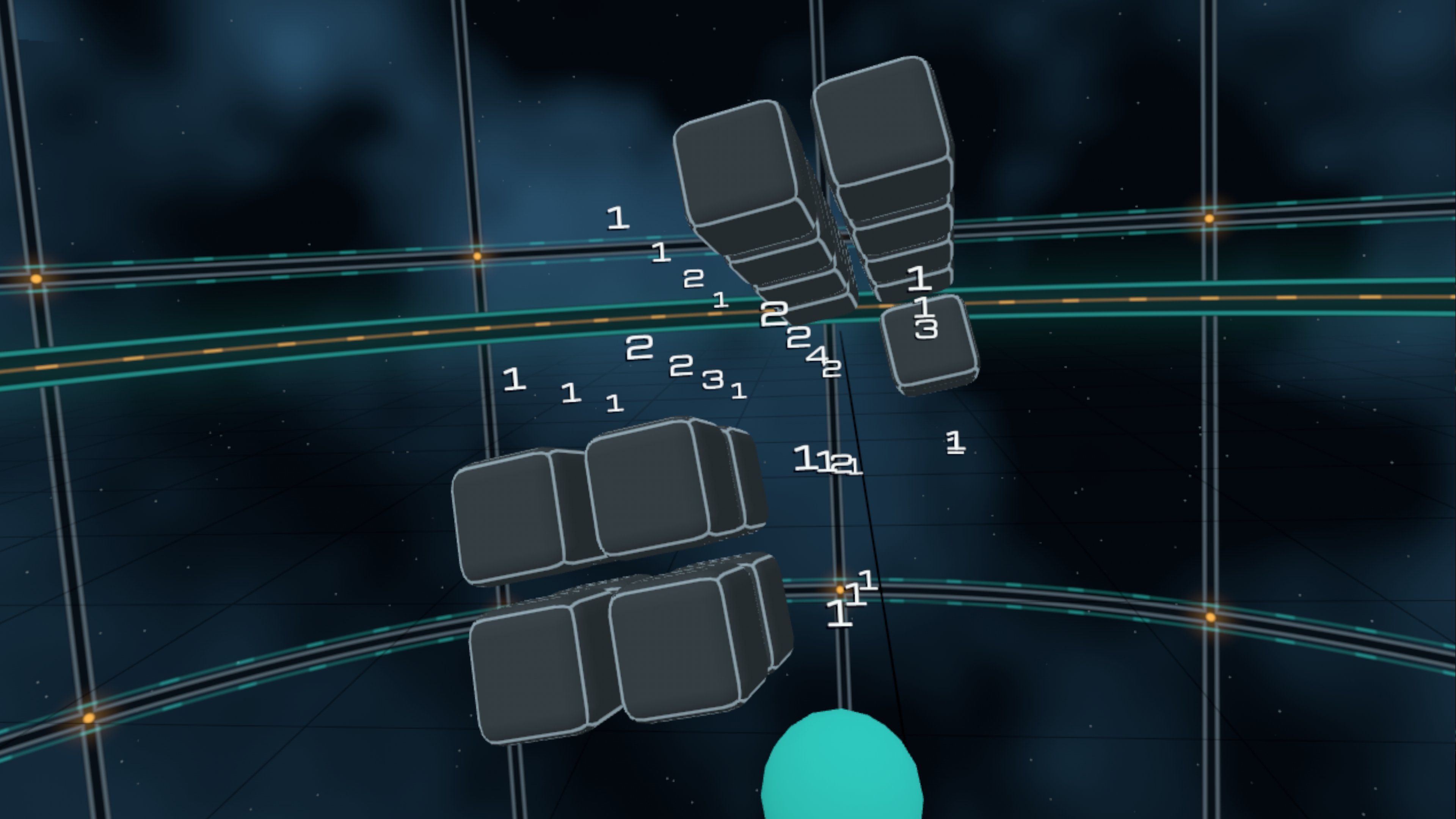
On a flat board, a cell has up to eight neighbors. In a three-dimensional grid, it can have 26. Suddenly, every clue asks you to think around corners, through layers, and across space.
What it does
26 Neighbors is a hands-first VR puzzle set inside the Deep Grid, a sci-fi setting where players act as Operators stabilizing sectors filled with hidden, unstable cores.
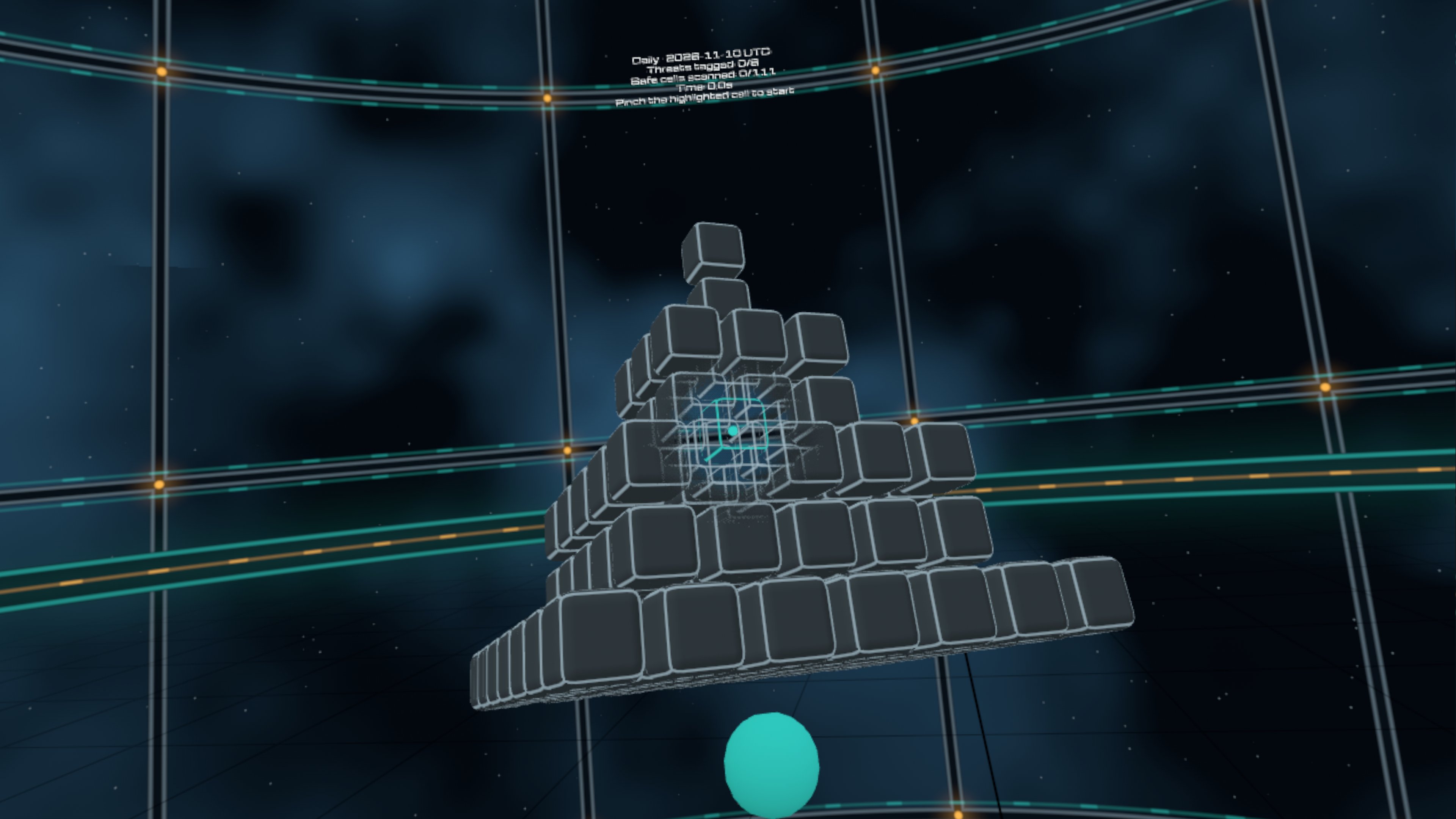
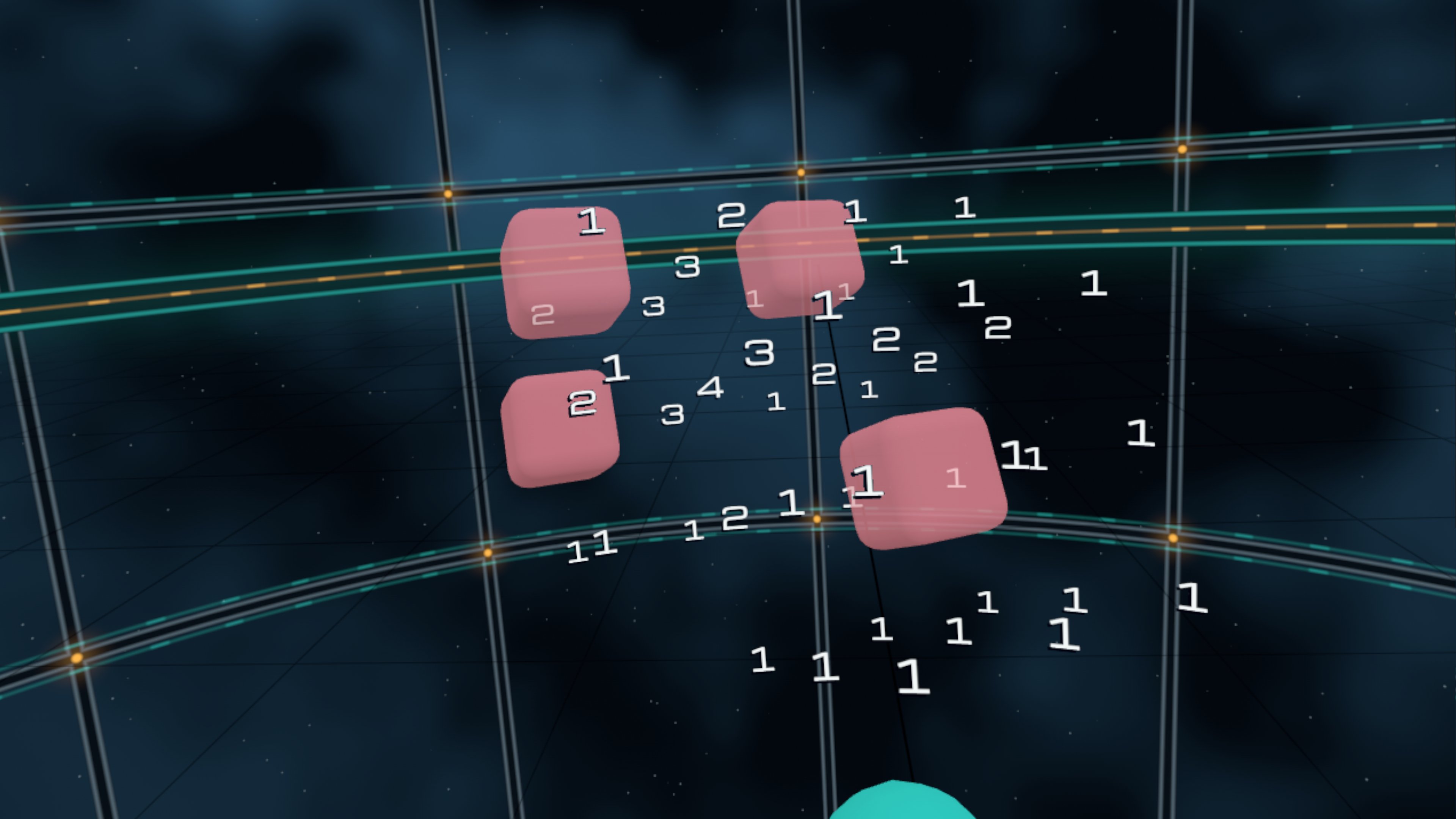
Players briefly pinch to reveal a cell and hold the pinch to flag a suspected mine. They can move and rotate the field to inspect it from different angles. Bringing a hand close opens an X-ray window, helping them investigate cells inside the grid.
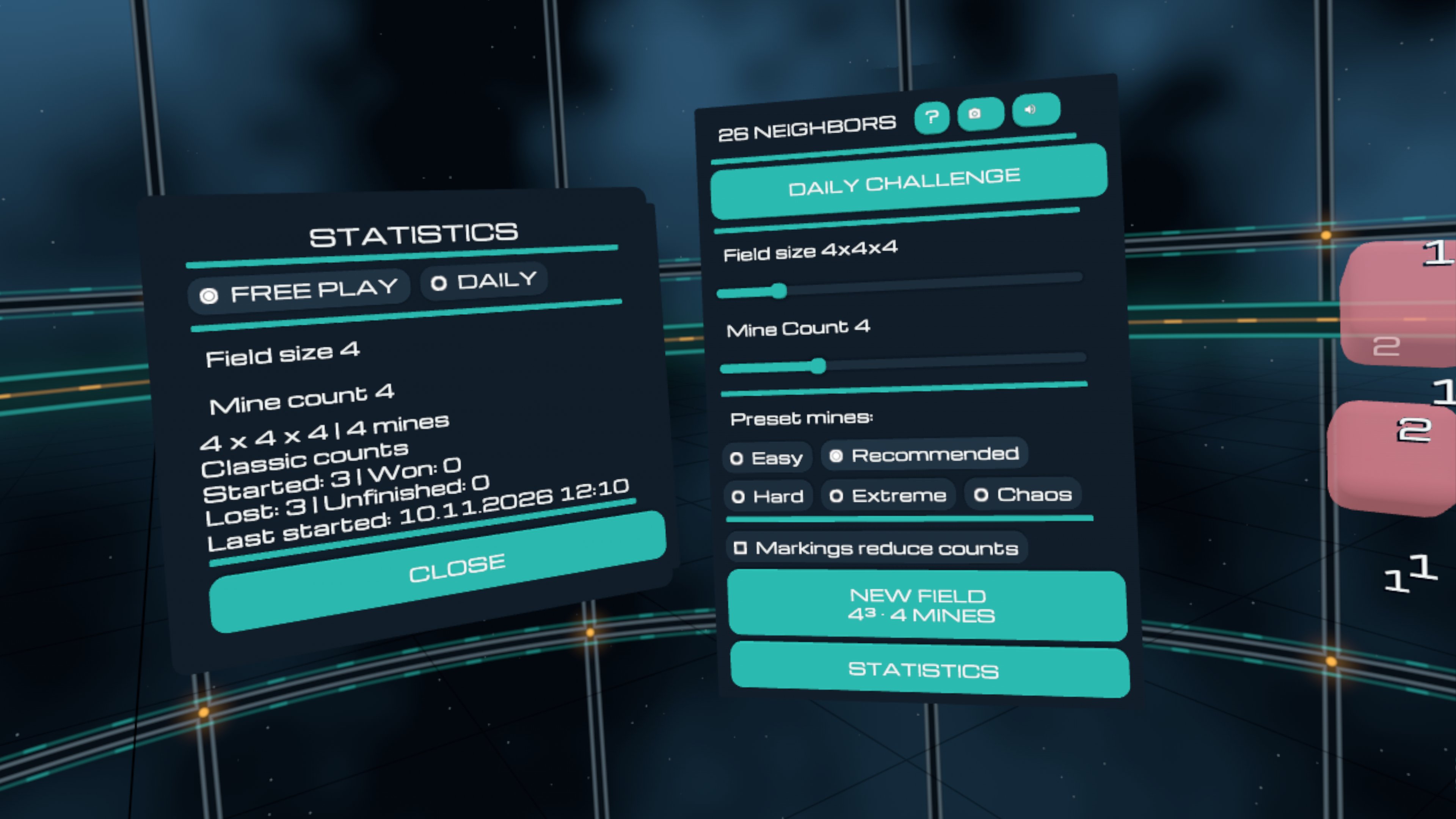
Free Play offers customizable cube fields from 3×3×3 to 9×9×9. The Daily Challenge gives every player the same sector, alternating between sphere and pyramid fields, with one attempt per day and a reset at 00:00 UTC.
Animated hand demonstrations introduce the controls, while local statistics record results and best Free Play times. Players can choose between a virtual environment and passthrough on supported devices.
How I built it
I built the application in C# using StereoKit and OpenXR.
I created the first working prototype in roughly three days (with manual coding ;) ). From there, I continued developing through a combination of manual coding, Codex with cloud model, and Cline with a locally hosted Qwen3.8 model. This was also my first project in which I made substantial use of agentic development.
The foundation is a three-dimensional Minesweeper implementation: generating fields, evaluating the 26-cell neighborhood, revealing connected empty areas, handling flags, and tracking the game state.
The interaction layer translates hand gestures into deliberate actions. A short pinch reveals a cell; holding that same gesture marks it. Hover feedback, sound, and reveal animations help communicate what the game is responding to.
Visibility became its own design problem. Players need access to clues inside a volume, so I combined field manipulation with a hand-proximity X-ray window. This gives players a way to investigate the interior while keeping the interaction connected to their hands.
The core gameplay and statistics run completely locally. The Meta Platform SDK is also integrated to meet the age-category requirements for a release intended for mixed ages.
I plan to release 26 Neighbors as a paid app on the Meta Horizon Store.
Challenges I ran into
The biggest challenge was making a dense three-dimensional puzzle readable and comfortable to manipulate.
An outer layer can hide the information needed to understand an inner cell. Moving, rotating, and looking into the field therefore became essential parts of solving it. The challenge was giving players enough visibility while preserving their sense of where each cell belongs.
Hand input also requires careful feedback. Revealing and flagging share a gesture, but have very different consequences. Making the current target and the progress of the hold gesture clear was an important part of the interaction design.
Throughout development, I kept returning to seated play: positioning the field within comfortable reach and letting players bring the puzzle to them.
Accomplishments that I’m proud of
I’m proud of turning a familiar puzzle into a spatial experience with its own interaction language.
The combination of direct hand interaction, a movable field, and the X-ray window makes investigating the grid feel tangible. The animated tutorial also lets me demonstrate those interactions inside the experience.
The Daily Challenge adds a shared ritual: everyone receives the same problem and gets one attempt to solve it.
What I learned
This project made me think much more carefully about the relationship between information and physical interaction.
In a spatial puzzle, visibility, reach, and feedback directly affect the player’s ability to reason. Even a small interaction decision can change how understandable the entire game feels.
It also reinforced how much depth can come from extending one simple rule and exploring its consequences.
On the development side, I learned to work with LLMs running both locally and in the cloud through different coding agents. I was even able to check out the project on my Android phone and run the Codex CLI in Termux to request changes while on the go.
What’s next for 26 Neighbors
My next focus is gathering more player feedback and refining hand interactions, readability, and comfort—especially on larger fields.
I also plan to add a sharing feature that lets players send a specific field together with their completion time as a link through any chat app. Each field can be represented by a code, so the idea is to include the information needed to recreate the puzzle in the link itself, without requiring a custom server. Friends could then play the same field and try to beat each other’s times.
I want 26 Neighbors to become an easy game to return to: sit down, bring the grid into reach, spend a few minutes thinking in every direction—and perhaps send a challenge to a friend.
Built With
- openxr
- stereokit
