-
-
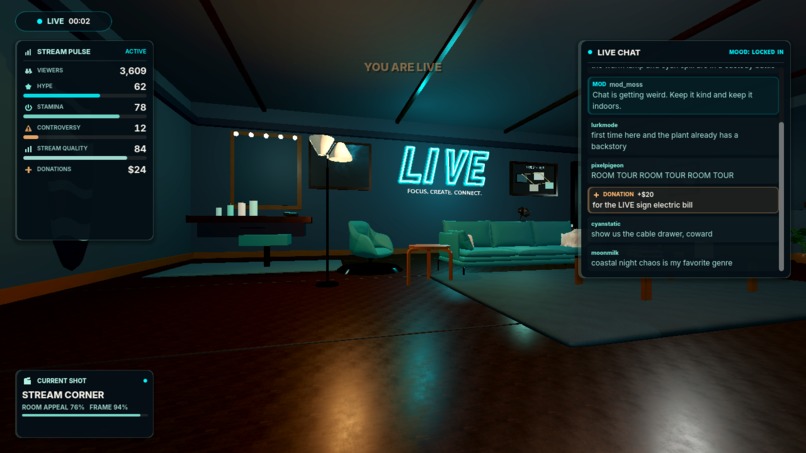
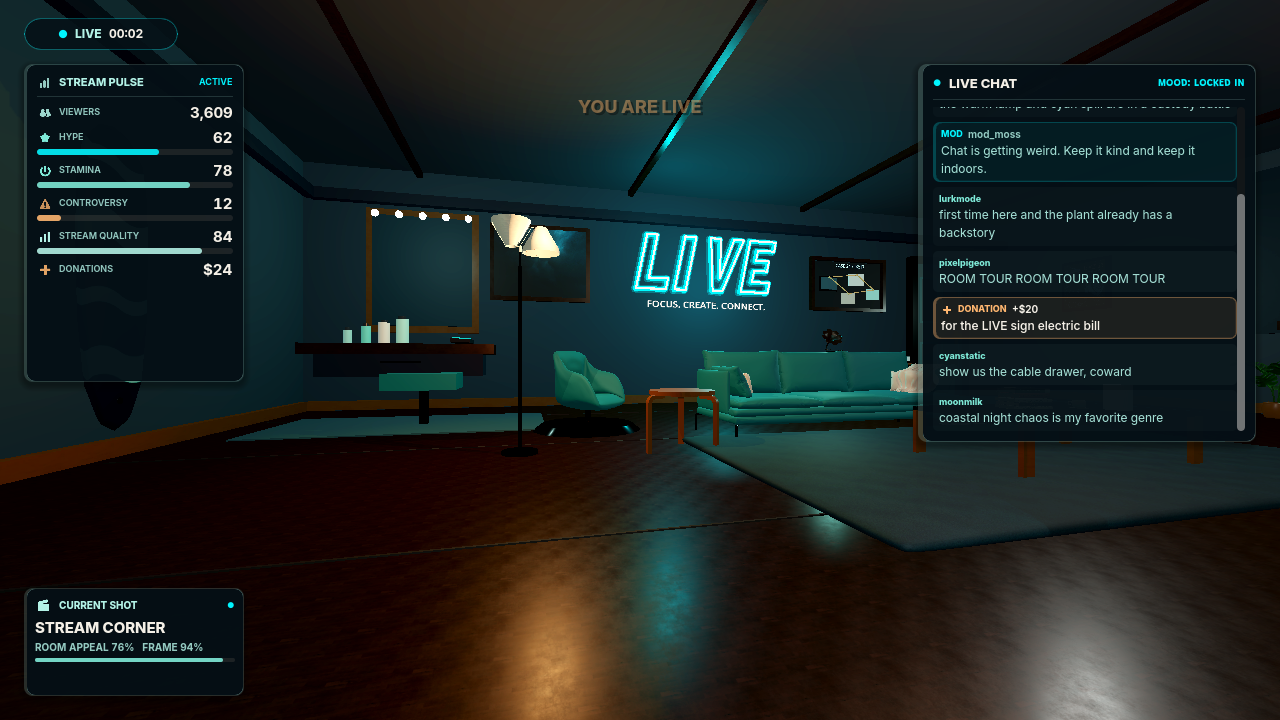
Core Gameplay - Start
-
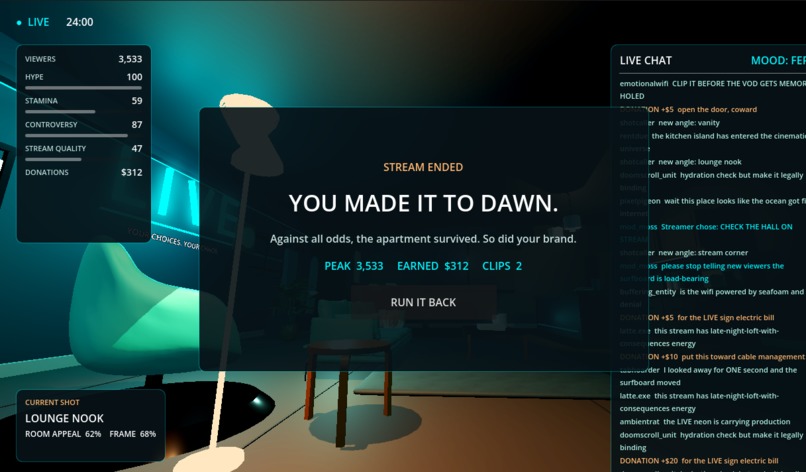
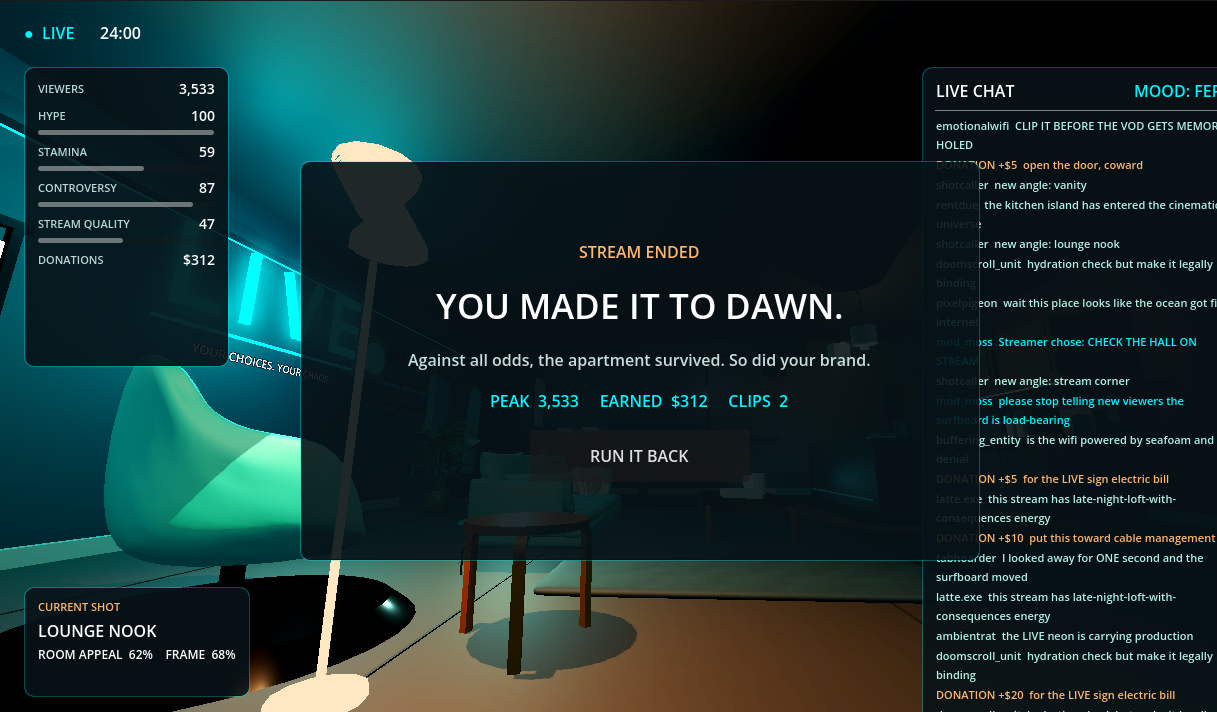
Core Gameplay - End Scene
-
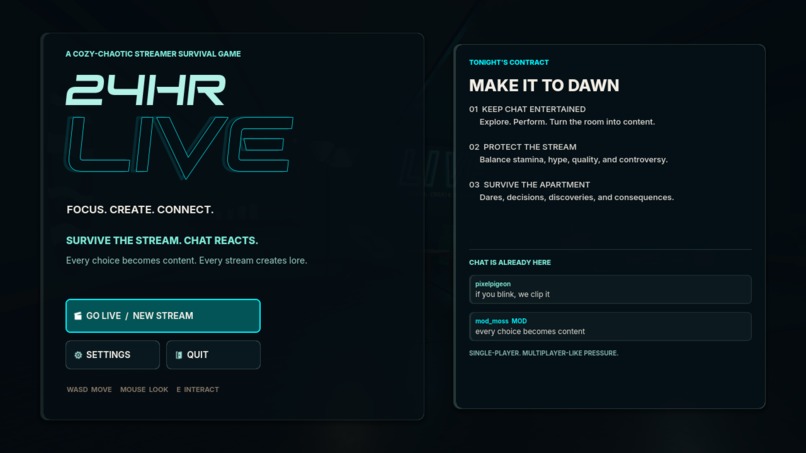
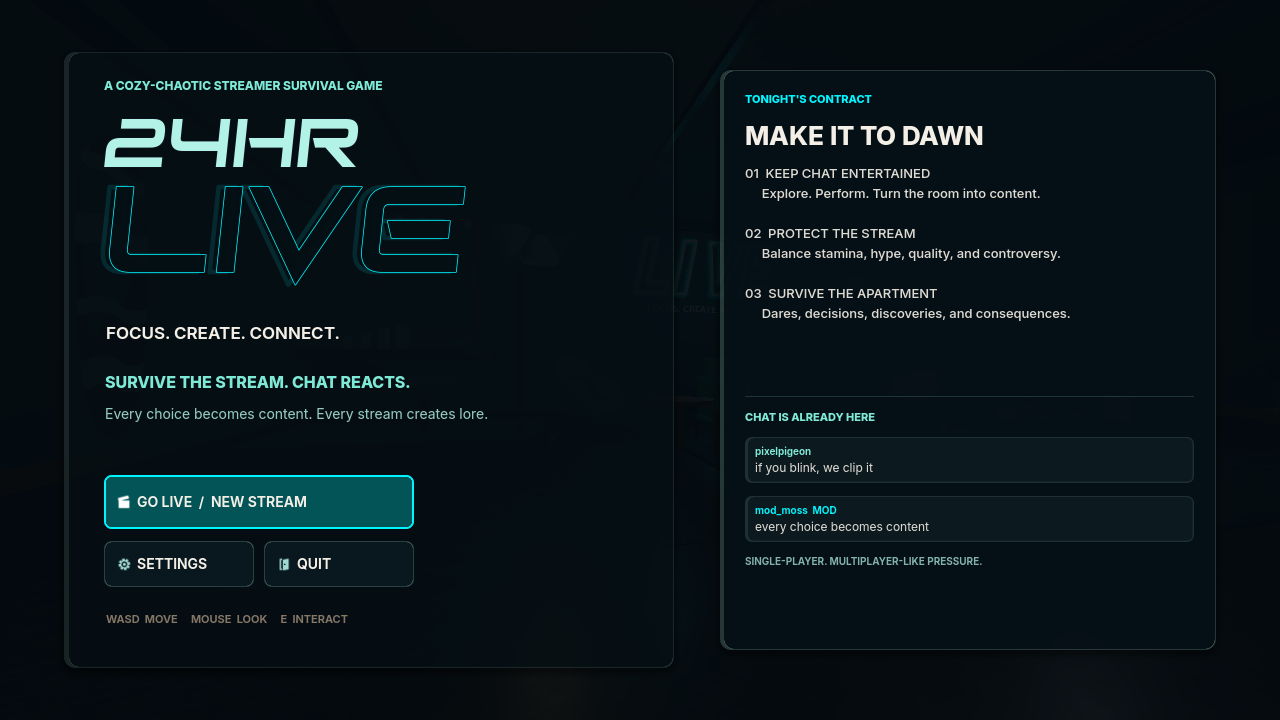
Menu
-
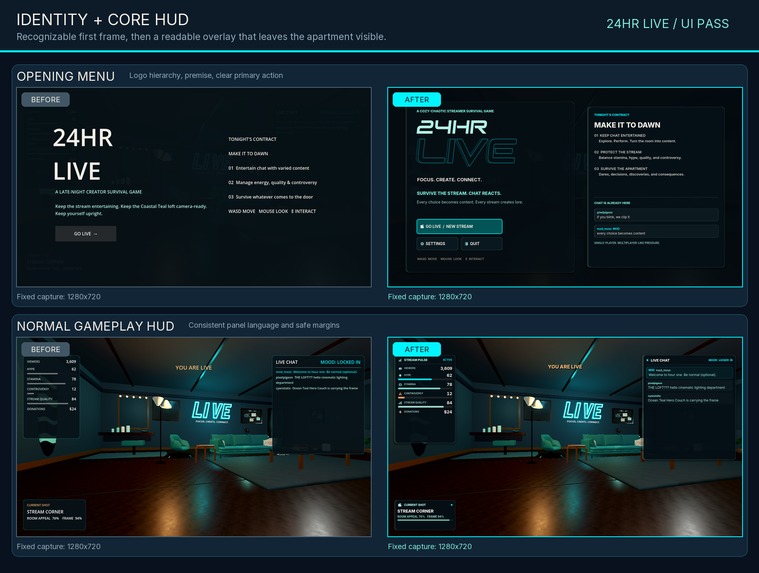
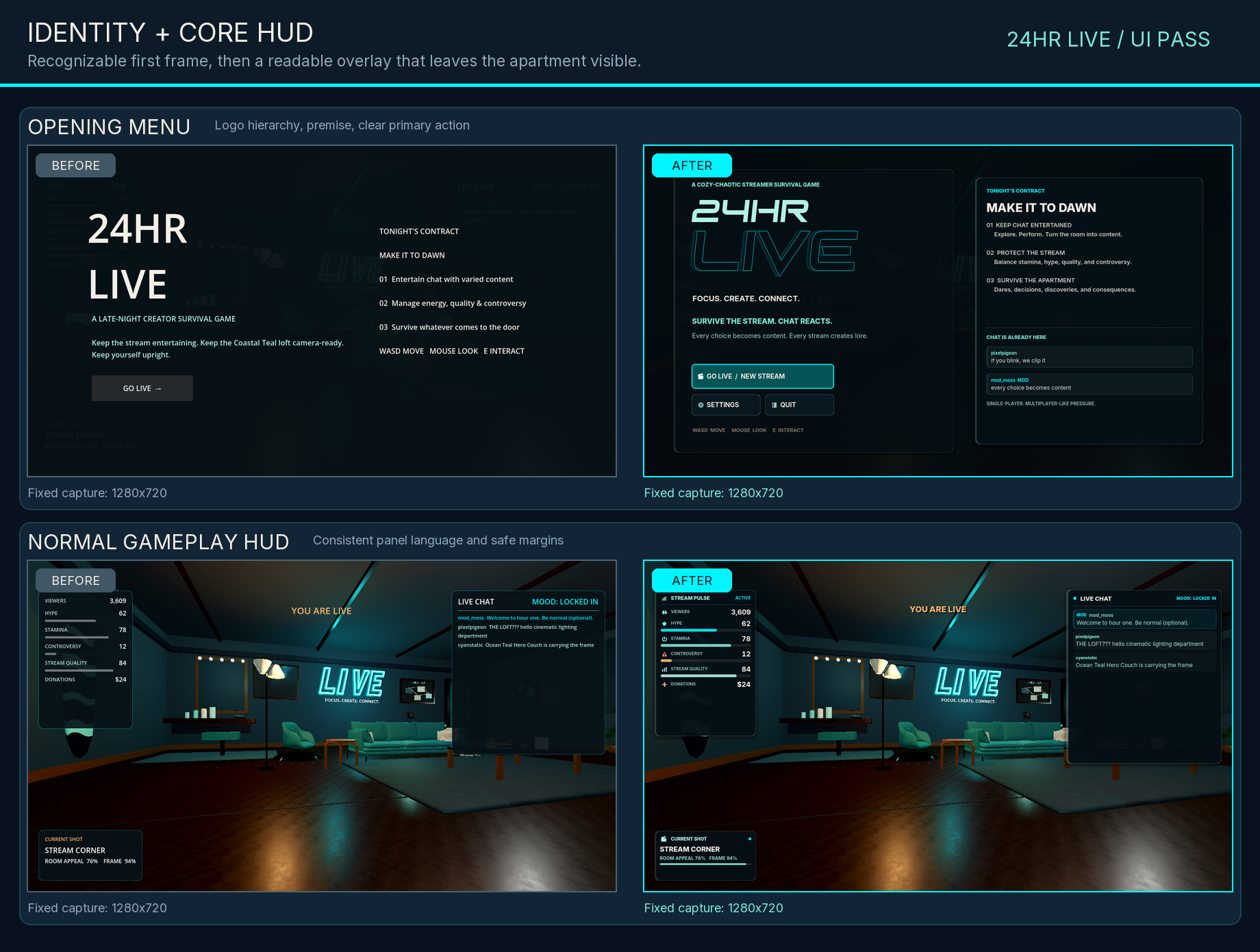
Codex UI Iteration
About the project
24HR LIVE started as an experiment: what if a single-player game could recreate the pressure, humor, unpredictability, and weird intimacy of being live in front of an audience?
I was interested in the idea of a streamer simulation, but not in the usual shallow version where chat is just random decoration. What inspired me was the social psychology of being watched, reacting in real time, and turning ordinary decisions into content. I wanted to build a game where the apartment, the player, and the audience all influence each other. Over time, the concept evolved into something more specific: a cozy-chaotic survival game where the audience is part of the game mechanic.
The player explores a stylized apartment, manages stream-related stats like viewers, hype, stamina, controversy, and stream quality, and responds to audience reactions, prompts, and consequences. I also explored different room identities and modes, including visual styles like Cherry Luxe and Coastal Teal, because I wanted the apartment to feel like part of the gameplay rather than just a background.
How I built it
I built 24HR LIVE in Godot with heavy help from Codex across the full project workflow. Instead of using Codex for just isolated code snippets, I used it as a collaborative implementation partner across:
- first-person movement and interaction systems
- apartment scene building and layout iteration
- UI and HUD systems
- stream stats and gameplay logic
- event and choice systems
- furniture and environment asset conversion
- material and style passes
- cinematic and demo tooling
- documentation and submission prep
The project also involved a lot of asset pipeline work. I had to sort through multiple asset sources, identify what could actually be reused in Godot, extract portable meshes and textures, rebuild materials, normalize props, and curate a cohesive visual language instead of just dropping random furniture into a room.
A major part of the build was not only coding mechanics, but also art direction through iteration: deciding which couch, desk, lighting system, UI layout, and in-world signage actually served the game best. That process taught me how much of game development is about structure, hierarchy, and decision-making, not just raw implementation.
What I learned
The biggest thing I learned is that using Codex well is not the same as pressing a button and getting a finished game. I still had to direct the vision, evaluate tradeoffs, reject weak outputs, test alternatives, and keep the whole project coherent.
I also learned:
- how much game feel depends on iteration
- how environment design and gameplay design affect each other
- how important constraints are when working with AI tools
- how quickly a prototype becomes more real once systems begin interacting
- that UI, lighting, furniture scale, and scene composition matter just as much as code
- that AI is most useful to me when it helps with implementation, structuring, and exploration rather than replacing judgment
On a bigger level, I learned that this project is really about social simulation. Even though it has the wrapper of a streamer game, the deeper idea is about attention, pressure, audience behavior, and how a watched space can become its own kind of game system.
Challenges I faced
The biggest challenge was scope. The idea kept growing as the systems became more interesting. It was easy for the project to expand from “streamer simulation” into room design, audience identity, branching modes, seasonal variants, environmental storytelling, and AI-assisted features.
Another major challenge was the asset pipeline. It took real effort to figure out:
- which assets were portable
- which ones were Unity-only
- how to repurpose them in Godot
- how to rebuild materials and scenes cleanly
- how to keep the apartment from looking like a random blockout or asset dump
I also faced the challenge of balancing ambition versus submission deadline. There were many ideas I wanted to push further, especially around audience memory, dynamic reactions, and environmental polish, but hackathon time forced me to prioritize a working, understandable slice of the experience.
Finally, one of the hardest parts was knowing when to stop iterating. Because the project is visual, interactive, and system-driven, every improvement revealed another thing that could be improved. That made the process exciting, but also demanding. Even so, I’m proud that the result captures the core of the idea: a playable prototype where the room, the player, and the audience all start to feel connected.
Why this project matters to me
What excites me most about 24HR LIVE is that it feels like the beginning of a larger system. It is not just a room, or just a UI, or just a chat box. It is a prototype for a game where every stream can become its own story, and where social pressure, atmosphere, and interaction all share the same space.


Log in or sign up for Devpost to join the conversation.